
Imagine hiring a sales rep who works 24/7, never misses a follow-up, and perfectly nurtures every single lead without ever taking a day off. That’s the reality of HVAC email automations. It’s not just about sending emails; it’s about building a system that transforms your marketing from a manual chore into a powerful, automated sales engine that consistently turns website visitors into booked jobs.
Why HVAC Email Automations Are Your Best Sales Rep
For most HVAC contractors, managing leads feels like a constant battle against forgotten follow-ups and missed opportunities. You’re busy running the business, and manually chasing every quote or inquiry is completely unsustainable. This old way of operating leaves a ton of money on the table, especially during slower seasons when every single job counts.
But what if your business could automatically engage with potential customers at precisely the right moments? That’s where HVAC email automations step in. Instead of just blasting out generic emails, you create intelligent workflows that respond to specific customer actions. This builds a personalized experience that builds real trust and drives them to take the next step.
The Shift From Manual Effort To Automated Revenue
The real value here is the ability to handle repetitive, high-impact tasks without anyone on your team lifting a finger. This shift lets you focus on running the business while your marketing system works in the background, making sure no lead ever falls through the cracks. This isn’t just a time-saver; it’s a direct path to a more stable and predictable revenue stream.
Here’s how this automated approach completely changes your sales process:
- Instant Engagement: A potential customer fills out an online estimate form and immediately gets a confirmation email, followed by a series of helpful messages that build their confidence in your company.
- Consistent Nurturing: A homeowner who got a quote but hasn’t booked receives gentle reminders, customer testimonials, and answers to common questions. This keeps your company top-of-mind so when they’re ready, you’re the one they call.
- Proactive Customer Retention: Past clients automatically get service reminders right before the busy season hits, converting them into profitable repeat business without a single phone call from your team.
The most powerful part of automation is its consistency. It ensures every customer and every lead receives the same high level of attention, creating a seamless experience that builds brand loyalty and fills your calendar.
The numbers don’t lie. Email automation has revolutionized HVAC marketing by delivering an incredible $42 return for every dollar spent, blowing other channels like paid ads out of the water.
This whole process acts like a digital sales rep that guides customers from their first click all the way to a booked appointment. To see how these systems fit into the bigger picture, check out this ultimate guide to customer service automation. At the end of the day, it’s about creating a system that sells for you, ensuring your business thrives all year long.
Core HVAC Automation Workflows at a Glance
To get started, it’s helpful to see the key workflows that form the foundation of any solid HVAC email strategy. These are the automations that will handle the heaviest lifting for your business, from capturing new leads to bringing back old customers.
| Workflow Type | Primary Goal | When to Trigger |
|---|---|---|
| Lead Capture Follow-Up | Engage new leads instantly and build trust | Immediately after a form submission (e.g., contact, quote request) |
| Estimate Nurturing | Keep your brand top-of-mind and overcome objections | After an estimate is sent but not yet approved |
| Maintenance Plan Sales | Upsell existing customers and create recurring revenue | After a service call or during seasonal tune-up campaigns |
| Service Reminders | Drive repeat business and fill the calendar | 6 or 12 months after the last service, or seasonally |
| Win-Back Campaign | Re-engage inactive customers who haven’t booked in a while | 18-24 months after the last customer interaction |
Think of these five sequences as your core sales team. They work around the clock to make sure no opportunity is missed, allowing you and your actual team to focus on what you do best: providing excellent HVAC service.
Crafting Your Lead Nurturing Sequence
The moment a potential customer fills out your contact form or uses your online estimate tool, the clock starts ticking. That first inquiry is pure gold, and how you respond right then and there determines if you earn their business or just get buried in their inbox. This is where a killer lead nurturing sequence—a cornerstone of smart HVAC email automations—goes to work for you.
Forget about sending some generic, one-size-fits-all follow-up. A properly designed email sequence takes that initial spark of interest and turns it into a booked appointment by building value and showcasing your professionalism from the get-go. The goal isn’t just to sell; it’s to make the homeowner feel confident that calling you is the right move.
This infographic breaks down exactly how ditching old-school manual follow-ups for a modern, automated system hits your bottom line.
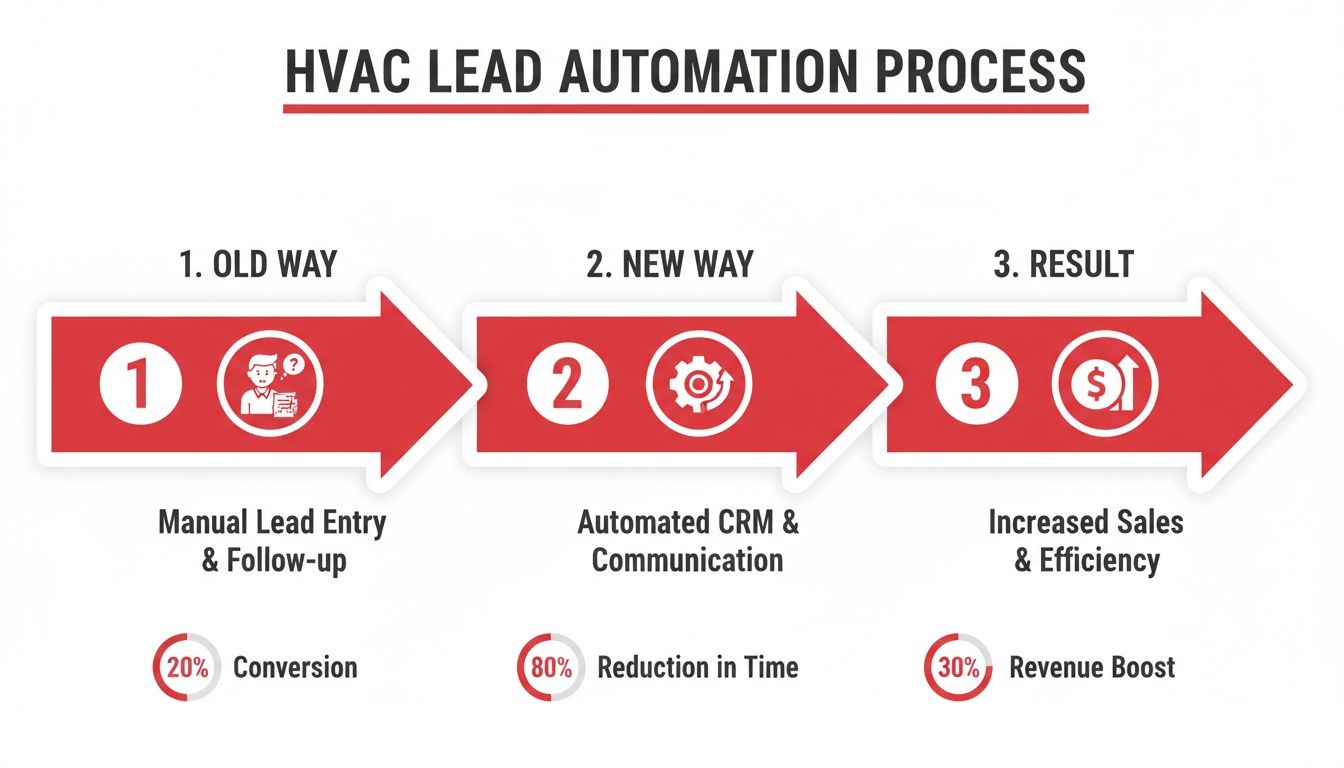
As you can see, the financial upside of an automated system is huge. It turns what used to be a point of friction into a smooth, profitable process.
Building Your Core 5-Email Workflow
A proven game plan for new leads is a 5-part email sequence that rolls out over one to two weeks. Each message has a specific job to do, all designed to nudge that prospect closer to scheduling a call. This approach keeps you top-of-mind without being annoying.
Here’s how we break down a workflow that just plain works:
- The Instant Confirmation (Sent Immediately): This needs to hit their inbox within seconds. Its only job is to confirm you got their request and to set expectations. Tell them when you’ll be in touch. This instant reply shows you’re on the ball.
- The “Meet the Team” Email (Sent Day 2): It’s time to humanize your business. Share a picture of your techs in uniform or your friendly office staff. This email isn’t about selling a furnace; it’s about selling trust by showing them the real people who will be coming to their home.
- The Social Proof Email (Sent Day 4): Let your happy customers do the talking. Pack this message with your best 5-star reviews from Google. Seeing direct quotes from satisfied neighbors is way more powerful than anything you can say about yourself.
Pro Tip: When you share testimonials, always use the customer’s first name and city (e.g., “Sarah P. from Arlington”). That small detail makes the review feel way more authentic and relatable to other local homeowners.
Addressing Objections and Closing the Loop
The last two emails in your sequence are all about getting ahead of common worries and making it ridiculously easy for them to say “yes.” This is where you answer their unspoken questions and give them one last friendly nudge. For a deeper dive, check out these lead nurturing best practices to really dial in your strategy.
- The FAQ and Value Email (Sent Day 7): Tackle the big questions head-on. Are they worried about scheduling? Financing? What makes you different? Answer those common objections here. Frame everything around the customer’s benefit, like your “transparent pricing” or “on-time arrival guarantee.”
- The Final Call-to-Action (Sent Day 10): Keep this one simple and direct. It’s a low-pressure reminder. Acknowledge they’re busy and give them a big, obvious button to book an appointment. Use clear text like “Book Your Consultation Now” or “Schedule Your Free Estimate.”
By automating this whole process, you’re creating a consistent and professional experience for every single lead. You’re not just blasting out emails; you’re building a relationship, answering questions, and proving your worth long before your tech ever rings their doorbell. This system is what effective HVAC email automations are all about.
Automating Maintenance Plan Sales and Renewals
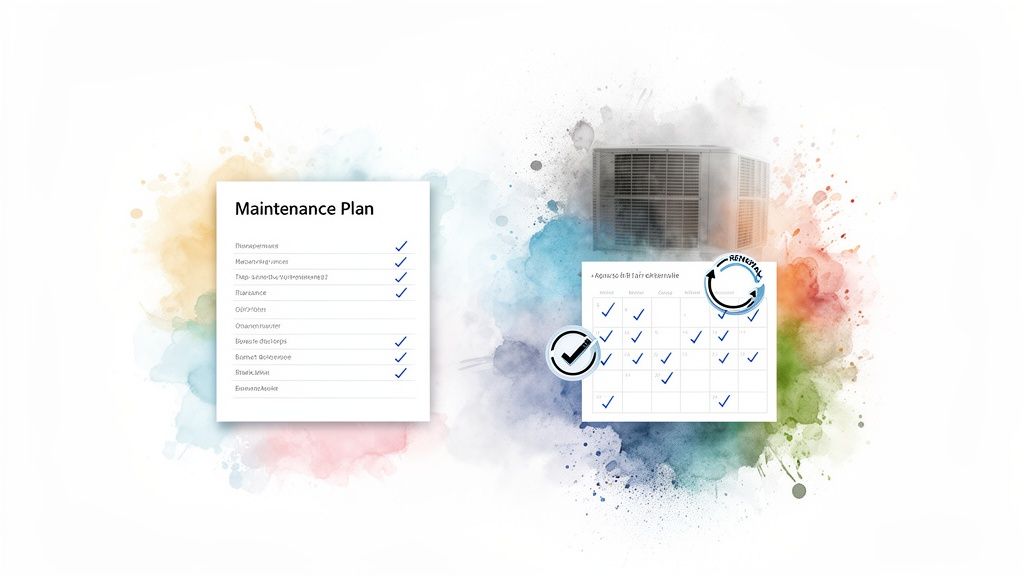
One-time repair jobs are great for cash flow, but predictable, recurring revenue is what really builds a stable HVAC business. This is where your maintenance plans come in, and HVAC email automations are the best tool you have to sell them on autopilot.
Instead of letting high-margin service agreements slip through the cracks, you can build an automated system that turns a one-time customer into a long-term, profitable relationship. The trick is to frame preventative care as a smart investment that protects their home—not just another upsell. That simple shift in positioning makes all the difference.
Selling New Plans to Recent Customers
The absolute best time to pitch a maintenance plan is right after you’ve solved a customer’s problem. Their trust in you is at an all-time high. A simple automated email sequence, triggered just a few days after a successful repair or install, can capitalize on that goodwill perfectly.
Here’s a simple but effective workflow that just works:
- Email 1: The “Protect Your Investment” Nudge (3 days post-service). This email should be all about the benefits of preventative care for the system you just worked on. Talk about avoiding future breakdowns, boosting energy efficiency, and making their unit last longer.
- Email 2: The “Exclusive Offer” (7 days post-service). Now you introduce a clear, time-sensitive offer. Something like, “As a new customer, you get priority scheduling” or “Enroll this week and save 15%” creates a little urgency.
- Email 3: The “Last Chance” Reminder (14 days post-service). This is a final, friendly nudge before the offer goes away. Keep it short and sweet with a clear call-to-action button like “Activate My Plan.”
This sequence is so effective because it’s timely and relevant. Every new customer gets the offer without anyone on your team having to lift a finger. If you need help structuring your offers, this HVAC maintenance plan template is a great place to start.
Automating the Renewal Process to Reduce Churn
Losing a maintenance plan member isn’t just losing one customer; it’s losing a guaranteed stream of future revenue. A proactive renewal workflow is your best defense against that kind of churn. This sequence should be automatically triggered based on the plan’s expiration date, making it a no-brainer for the customer to stick with you.
The real power here is consistency. An automated system ensures no one gets forgotten, turning what could be a painful manual task into a simple, revenue-generating process that just runs.
Try this proven timeline for your renewal automation:
- 60 Days Out: A friendly heads-up email. Remind them of the value they got over the past year—maybe even summarize the services you performed.
- 30 Days Out: Get a bit more direct. Emphasize the benefits of renewing, like locking in their current pricing or keeping their priority status. Include a simple link to renew online.
- 7 Days Out: The final reminder. Use a clear subject line like “Your Maintenance Plan Expires in One Week!” to prompt them to act.
This multi-touch approach dramatically increases renewal rates. In fact, companies that use HVAC email automations for retention often see up to 30 times more revenue per recipient than with one-off campaigns. We’ve seen HVAC shops boost their maintenance plan renewals from the industry average of 20-30% to over 50% just by sending timely, automated reminders.
By setting up these simple sequences, you’re not just sending emails—you’re building a predictable, profitable foundation for your entire business.
Winning with Seasonal and Reactivation Campaigns
Beyond nurturing new leads and renewing maintenance plans, two of the most profitable HVAC email automations are the ones most of your competitors completely ignore: seasonal and reactivation campaigns. These workflows are absolute goldmines for filling your calendar during predictable lulls and reclaiming lost revenue from the customer list you already have.
When you get ahead of the seasons, you stop competing on last-minute emergency calls and start booking profitable tune-up jobs weeks in advance. In the same way, a simple, automated check-in with a past customer can bring them back into the fold before they even think about calling someone else.

Launching Proactive Seasonal Campaigns
Timing is everything in the HVAC world. Don’t wait for the first sweltering day of summer to start talking about ACs. A smart automation gets your AC tune-up offers into inboxes in March and April, framing your service not as a reactive fix but as a savvy, preventative measure.
Your seasonal emails need to hit on the tangible benefits that homeowners actually care about:
- Preventing Breakdowns: Nobody wants their AC to die during a heatwave. You have to highlight how a pre-season checkup prevents inconvenient and expensive emergency repairs.
- Saving on Energy Bills: Position your tune-up as an investment that pays for itself by lowering their utility bills all summer long. A subject line like, “Is Your AC Ready for Summer Energy Bills?” can work wonders.
- Improving Air Quality: Mentioning how a clean system reduces allergens is a powerful angle, especially for families with kids or pets.
The same logic applies in the fall. Start deploying an automated furnace check-up sequence in September, long before the first frost hits. This not only books jobs during a typically slower period but also cements your company’s reputation as a trusted, forward-thinking partner.
Building a Win-Back Automation for Inactive Customers
Every single HVAC company has a list of customers who haven’t booked a service in a year or more. A “win-back” or reactivation campaign is a simple, low-cost way to re-engage this segment and remind them why they chose you in the first place. This is easily one of the lowest-hanging fruit when it comes to HVAC email automations.
The trigger for this sequence couldn’t be simpler: set it to activate when a customer has had no service appointments in the last 18 months.
A customer who has already done business with you is far easier to convert than a cold lead. A simple, automated “we miss you” campaign can recapture a surprising amount of revenue that would otherwise be lost.
Here’s a proven 3-email sequence I’ve seen work time and time again for winning back past clients:
- The Gentle Check-In (18 months of inactivity): The first email should be friendly and low-pressure. A subject line like “Just Checking In, [Customer Name]” is perfect. Simply ask if their system is running well and gently remind them you’re here if they need anything.
- The Compelling Offer (1 week later): If the first email didn’t get a response, it’s time to add an incentive. Offer something exclusive, like a discount on a tune-up or a waived diagnostic fee. Frame it as a “welcome back” gift for a valued past customer.
- The Final Nudge (1 week after offer): A last-chance reminder that their special offer is expiring creates a bit of urgency. Keep this one short, sweet, and make the call-to-action crystal clear.
These automations are so powerful because they run on real customer data and behavior. They deliver the right message at exactly the right time, turning your email list from a simple contact database into an active, revenue-generating asset for your business.
Optimizing Your System for Peak Performance
Setting up your email sequences is just step one. The real magic—the part that turns your email list into a predictable engine for booking jobs—happens when you start digging into the numbers and refining your approach.
A powerful automation system runs on good data. You can’t send hyper-relevant messages if your email platform has no idea who your customers are or what services they’ve had. That’s why connecting your email marketing tool directly to your customer database isn’t just a good idea; it’s non-negotiable.
The Power of CRM and ESP Integration
All the gold is sitting right there in your Customer Relationship Management (CRM) or field service software. I’m talking about service history, equipment age, and even neighborhood data. When you get that system talking to your Email Service Provider (ESP), you unlock a whole new level of personalization for your HVAC email automations.
This connection lets you build incredibly targeted campaigns that feel like they were written just for that specific homeowner. Suddenly, you can segment your audience based on real-world factors.
- By Equipment Age: Automatically trigger a replacement sequence for every customer with a system that’s over 12 years old.
- By Service History: Got a list of customers who had a capacitor replaced last summer? Perfect. Send them a targeted tune-up reminder this spring.
- By Neighborhood: Just finished a big install in the Oak Ridge subdivision? Send a quick “we’re in your area” email to their neighbors on your list.
To really get a handle on all this, you need a central hub for your customer data. Seriously consider implementing a CRM system if you haven’t already. The right combination of tools is essential, and you can explore different types of HVAC service business software that make this integration seamless.
Key KPIs That Actually Matter
Once your systems are talking, it’s time to track the Key Performance Indicators (KPIs) that actually move the needle. Forget about vanity metrics. For an HVAC shop, only a few numbers truly matter.
The ultimate goal isn’t just to get high open rates. It’s to book profitable jobs. Your tracking should always connect your email marketing efforts directly back to real-world revenue.
When you’re focused on the right stuff, the impact is huge. We’ve seen landing page conversions from HVAC email automations hit 10% or higher. That generates leads at a cost per lead (CPL) of just $25-$75—way below the industry average. That kind of efficiency doesn’t happen by accident; it comes from automated sequences that nurture people from their first click all the way to a booked install.
HVAC Email Benchmarks and A/B Testing
So, how do you know if your numbers are any good? You’ve got to measure them against industry benchmarks. Below is a quick rundown of the essential metrics and what you should be aiming for.
Key HVAC Email Automation KPIs and Industry Benchmarks
This table breaks down the metrics you should be watching and the benchmarks that tell you you’re on the right track.
| Metric (KPI) | What It Measures | Good HVAC Benchmark |
|---|---|---|
| Open Rate | The percentage of people who actually opened your email. | 20-25% |
| Click-Through Rate (CTR) | The percentage of openers who clicked a link in your email. | 2-3% |
| Conversion Rate | The percentage of clicks that turned into a booked job or lead. | 5-10% |
| Unsubscribe Rate | The percentage of people who opted out of your email list. | Under 0.5% |
Tracking these numbers gives you a scoreboard. Now you can start actively working to improve them.
The best way to do that is with A/B testing. It’s simple: create two versions of an email (an “A” and a “B”), send each one to a small slice of your audience, and see which one gets better results.
You can test almost anything to see what resonates with your customers:
- Subject Lines: Try a straightforward approach (“Your AC Tune-Up Reminder”) against something that sparks curiosity (“Is Your AC Ready for the Summer Heat?”).
- Offers: Does a percentage discount (“15% Off Your Tune-Up”) work better than a flat dollar amount (“$50 Off Your Tune-Up”)? Test it and find out.
- Calls-to-Action (CTAs): Even the button text matters. Pit something simple like “Book Now” against “Schedule My Service.”
By constantly testing and measuring, you can dial in every single aspect of your HVAC email automations. This is how you ensure they deliver the best possible return and keep your schedule full.
Your Top Questions About HVAC Automations, Answered
Jumping into HVAC email automations can feel like a huge project, but honestly, it’s one of the highest-impact moves you can make for your business. It’s totally normal to have questions about where to start, what tools to use, and how to know if any of this stuff is actually working.
We’ll break down the most common questions we hear from HVAC owners. Think of this as the final check-in before you launch a system that nurtures leads, sells maintenance plans, and books jobs for you 24/7. Getting this right is how you turn a simple email list into a real, revenue-generating machine.
What’s The Best Email Marketing Software For An HVAC Company?
There’s no single “best” tool for everyone. The right answer really hinges on your current business setup and what you’re trying to accomplish. You can narrow it down fast by looking at the software you already use every day.
If your whole business runs on an all-in-one platform like ServiceTitan, its built-in marketing features are often the perfect place to start. The biggest win here is that all your data—customer info, service history, and email tools—are already connected. That makes creating targeted campaigns way simpler.
But, if you’re looking for more firepower with advanced segmentation, A/B testing, or complex automation workflows, a dedicated Email Service Provider (ESP) is the way to go.
- Top Choices: Platforms like Mailchimp, ActiveCampaign, or Constant Contact are fantastic for HVAC contractors. They’re built for this stuff and are surprisingly easy to use.
- The Non-Negotiable Feature: Whatever you choose, it absolutely must integrate with your CRM or customer database. This connection is the magic key. It’s what lets you trigger emails based on real customer actions—like a job you just finished, an expiring service agreement, or even the age of their equipment. Without that link, your automations will never be more than generic email blasts.
At the end of the day, the best platform is the one that lets you use your customer data to send the right message at the right time.
How Many Emails Should I Send In A New Lead Follow-Up Sequence?
For a fresh lead that just came through your website—whether from a contact form or an online quote tool—the sweet spot is a sequence of 4 to 6 emails spread over two to three weeks. This keeps you top-of-mind while they’re making a decision, but it isn’t so aggressive that you come across as spammy.
The goal isn’t just to sell. It’s to offer value and build trust with every single email you send.
Remember, a new lead is evaluating more than just your price. They’re sizing up your professionalism and trustworthiness. A well-built email sequence can prove you’re the right choice long before a tech ever steps foot in their home.
Here’s a proven flow that we’ve seen convert time and time again:
- Instant Confirmation: Let them know you got their request immediately.
- “Meet Our Team” Email: A couple of days later, send a short email to humanize your brand.
- Social Proof Email: Showcase your best 5-star reviews to build confidence.
- FAQ-Style Message: Proactively answer common questions about financing, scheduling, or warranties.
- Final Call-to-Action: A last, friendly nudge to book an appointment.
If they don’t convert after this sequence, you can just slide them into your general monthly newsletter. That way, you keep the relationship going at a slower pace.
How Do I Measure The ROI Of My HVAC Email Automations?
You absolutely have to track your return on investment (ROI). If you’re not measuring, you’re just guessing. The basic formula is simple: (Revenue from Email – Cost of Software) / Cost of Software. The tricky part is connecting actual revenue back to specific email campaigns.
The most reliable way to do this is by using unique tracking assets inside your emails. This creates a clean, digital breadcrumb trail from an email click directly to a booked job.
You can pull this off in a couple of ways:
- Unique Tracking Phone Numbers: Use a call tracking service to assign a specific phone number just for your email campaigns. When someone calls that number, the system automatically credits your email marketing.
- Special Booking Links: Create dedicated landing pages or use UTM parameters on the booking links in your emails. When a lead fills out the form on that page, your analytics will show that the conversion came from a specific email sequence.
When you put this kind of tracking in place, you can see exactly which HVAC email automations are your money-makers. You’ll know, for a fact, whether your tune-up reminders or your estimate follow-ups are driving more profit, letting you double down on what works.
Can Email Automation Work For Commercial HVAC Clients?
Absolutely, but you have to throw the residential playbook out the window. Commercial clients operate on completely different timelines and care about a different set of problems. Your automations need to reflect that.
The decision-making process for a facility manager can take months, not days, and it often involves multiple people. They couldn’t care less about a “10% off” coupon; they want to know about ROI, energy efficiency, operational uptime, and staying compliant.
So, instead of a quick, 5-email series, you need to build a longer, more consultative sequence. Think about a 3-month workflow that positions your company as an expert partner, not just a contractor.
This sequence could include things like:
- Case studies of similar businesses you’ve helped save money.
- Whitepapers on the long-term energy savings of preventative maintenance.
- Guides on optimizing their specific type of commercial HVAC system.
The goal here isn’t a quick sale. It’s to educate and build massive credibility. That way, when they finally have a need or their budget gets approved, your company is the only one they think to call.
Ready to stop chasing leads and start building a system that books profitable jobs for you? The HVAC Growth Machine is a done-for-you website and lead generation system designed to do just that. We build you a high-converting website, implement an instant online estimate tool, and set up the powerful email automations discussed in this guide. Learn more and secure your exclusive service area today.




Founder of HVAC Growth Machine