
Ever feel like you’re trying to conduct an orchestra where every musician has a different sheet of music? That’s what running an HVAC business can feel like. The dispatcher has one set of notes, your techs in the field have another, and the office is working from a third. The result is pure chaos.
This is where HVAC service business software comes in. Think of it as your digital command center—the single source of truth that finally gets everyone on the same page. It’s not just a fancy calendar; it’s the system that pulls scheduling, dispatch, customer history, and invoicing into one place, kicking messy spreadsheets and paper invoices to the curb for good.
Your Digital Command Center for HVAC Operations

This kind of software gives you a complete, 360-degree view of your entire operation from a single screen. It eliminates the dangerous data silos that lead to double-bookings, techs showing up unprepared, missed appointments, and frustrating billing errors.
This software is more than a tool; it’s a shift in how you run your business. It turns reactive, daily firefighting into proactive, strategic management.
Unifying Your Operations
By connecting every function, this software links parts of your business that would otherwise never talk to each other. A customer’s call is no longer just a service request. It’s an entry that instantly updates their history, helps you schedule the best tech for the job, and tees up the invoice—all at once.
This level of integration brings some serious benefits:
- Fewer Manual Errors: Automating data entry and communication kills the human errors that cost you time and money.
- Real-Time Visibility: You can see where your techs are, the status of every job, and incoming payments as they happen. No more guessing.
- Focus on Growth: With the daily grind automated, you can finally focus on the bigger picture, like marketing and expansion.
The industry is catching on fast. The global HVAC service software market was valued at USD 1.07 billion in 2024 and is projected to smash USD 4.52 billion by 2033, all driven by the need for greater efficiency. You can read the full market growth analysis on businessresearchinsights.com. A high-performance website acts as the front door to this command center, feeding it a steady stream of qualified leads to keep the whole machine running.
Core Features That Power a Modern HVAC Business
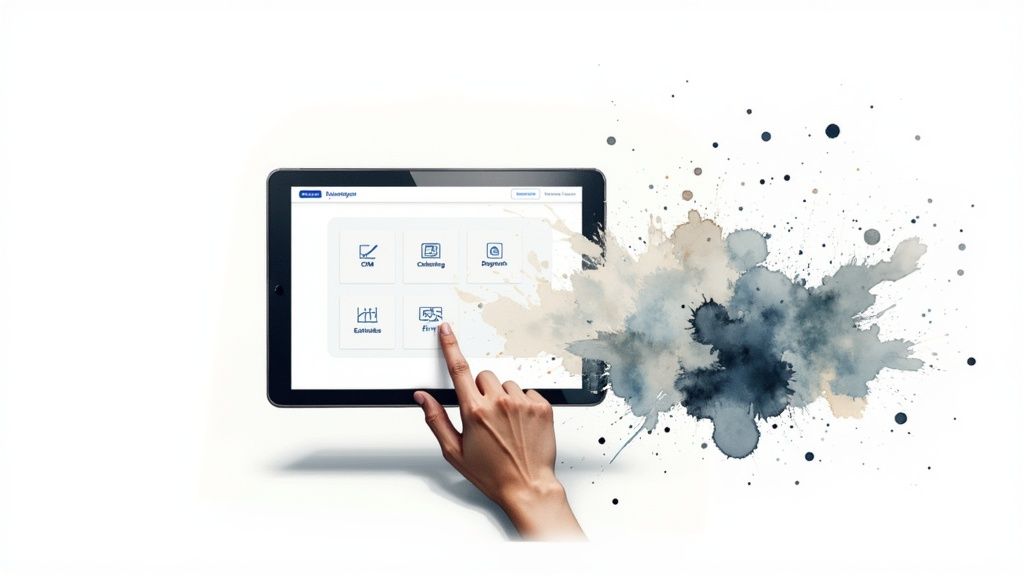
Think of the right hvac service business software as a digital Swiss Army knife for your company. Each tool is built to solve a specific, nagging problem you face every day. These aren’t just flashy add-ons; they’re the core components that replace messy whiteboards and overflowing filing cabinets with smooth, automated workflows.
At the very center of it all is the Customer Relationship Management (CRM) tool. This is your business’s brain. It remembers every single customer interaction—from the first phone call to past service notes, what equipment they have, and their warranty details.
This gives your team the power to provide truly personal service. Instead of asking a long-time customer the same questions over and over, your CSR can pull up their history instantly and see, for example, that their AC unit is 15 years old and has needed three repairs in the last two years. That’s a perfect, data-backed opportunity to start a conversation about a replacement.
Smart Scheduling And Dispatching
Trying to manage your technicians’ schedules manually is like playing a nightmare version of Tetris. You’re constantly shuffling jobs, trying to fit everything in, and inevitably leaving gaps or sending the wrong tech across town.
Smart scheduling and dispatching features completely automate this headache. The software looks at everything—which tech has the right skills, where they are right now, and how urgent the job is—to assign the perfect person every time. It even optimizes their routes to slash drive time and save a small fortune on fuel. The end result? More jobs booked and completed, every single day.
This is exactly why so many shops are moving to modern Field Service Management (FSM) platforms. They’re using these tools to perfect their operations and keep customers happy with real-time updates. You can dig deeper into this industry-wide shift over at mobilityforesights.com.
An optimized schedule isn’t just about squeezing in one more call. It’s about consistently delivering a better customer experience. Faster response times and techs who show up fully prepared are what set you apart from the competition.
Empowering Techs With Mobile Field Apps
Your technicians are the face of your company when they’re in a customer’s home. A mobile app on their tablet or phone is single-handedly the most important tool you can give them.
No more fumbling with crumpled paper work orders or calling the office to ask about a customer’s history. With a good mobile app, they have every job detail, the full customer service record, and even parts inventory right at their fingertips.
This immediate access to information transforms their effectiveness. The best apps include features like:
- On-the-Spot Invoicing: Techs can create and email a professional invoice before they even leave the driveway, often taking payment right there.
- Multi-Option Quoting: They can build good-better-best proposals for repairs or full system replacements in minutes, which is proven to increase the average ticket size.
- Parts Inventory Access: Need a specific capacitor? They can check truck stock or warehouse levels without a single phone call, preventing wasted trips.
A closer look at these core features reveals how they directly translate into a healthier bottom line.
Essential HVAC Software Features and Their Business Impact
Here’s a straightforward breakdown of what these key software tools do and the tangible benefits they bring to your HVAC company’s operations and finances.
| Core Feature | What It Does | Primary Business Benefit |
|---|---|---|
| Customer Relationship Management (CRM) | Centralizes all customer data: contact info, service history, equipment, and notes. | Improves customer service, identifies upsell opportunities, and prevents lost information. |
| Smart Scheduling & Dispatching | Automates job assignments based on tech location, skills, and job priority with route optimization. | Increases jobs per day, reduces fuel costs, and improves response times. |
| Mobile Field App | Gives technicians job details, history, invoicing, quoting, and inventory on their tablets/phones. | Boosts technician efficiency, increases average ticket size, and improves cash flow. |
| eCommerce for Maintenance Plans | Allows customers to sign up and pay for recurring maintenance plans directly on your website. | Creates stable, predictable recurring revenue and improves customer retention. |
| Integrated Call Tracking | Assigns unique phone numbers to different marketing channels (Google, Facebook, mailers). | Shows exactly which marketing efforts are generating calls and revenue, optimizing ad spend. |
Ultimately, each of these features works together to replace manual guesswork with data-driven efficiency, leading to higher profits and happier customers.
Generating Predictable And Recurring Revenue
The best HVAC software doesn’t just manage your day-to-day operations; it actively helps you grow the business. Two of the most powerful tools for this are eCommerce for maintenance agreements and integrated call tracking.
Adding eCommerce functionality to your website lets customers buy your preventative maintenance plans online, 24/7. This creates a stream of predictable, recurring revenue that acts as a financial cushion, especially during the slow shoulder seasons. It automates the entire sign-up and billing process, making it incredibly easy for customers to join and for you to manage.
Call tracking, on the other hand, gives you priceless marketing intelligence. It works by assigning a unique phone number to each of your marketing campaigns—one for your Google Ads, another for your website, and another for your direct mail flyers. Now, you can see with 100% certainty which channels are actually making your phone ring.
This data is gold. It allows you to calculate your true return on investment and stop wasting money on ads that don’t work, putting every single dollar toward what grows your business.
Transforming Operations from Chaos to Control

If you’ve been in the HVAC game for any length of time, you know the feeling of organized chaos. The dispatcher is glued to the phone, sending frantic texts and trying to shuffle job tickets like a high-stakes game of Tetris. It’s a manual process that almost always leads to double-bookings, techs wasting fuel on inefficient routes, and angry customers wondering where their technician is.
Now, imagine the same office powered by HVAC service business software. That dispatcher isn’t juggling calls anymore. Instead, they’re overseeing a smart system that automatically assigns jobs based on a tech’s skills and their real-time location. The result? A massive jump in efficiency. It often means each tech can squeeze in one or two extra jobs per day, without the extra stress.
The switch from manual to automated operations isn’t just about saving time. It’s about building a more resilient, profitable, and customer-focused business from the ground up.
Driving Profitability Through Efficiency
This operational shift hits your bottom line in a few powerful ways. First, by optimizing routes and schedules, you immediately slash fuel costs and cut down on that unpaid drive time between jobs. That newfound efficiency means your team can handle more paying work in the same number of hours, boosting your capacity without having to hire more people right away.
The software also helps you get paid faster, which is a huge deal for cash flow. Two key features make this happen:
- On-Site Payment Processing: Your techs can swipe a credit card and close out the invoice the moment the job is done. No more waiting for checks in the mail.
- Automated Invoice Reminders: The system can automatically chase down unpaid invoices, saving your office staff hours of administrative headaches and speeding up collections.
For a lot of companies, this is also the key to finally getting their maintenance agreements organized. In fact, tools for HVAC maintenance are a huge reason owners adopt this software—they’re that critical for managing recurring revenue and tracking equipment health. It’s a major trend you can learn more about over on univdatos.com.
Gaining Clarity With Data-Driven Decisions
Beyond the day-to-day grind, the real power of this software is in the data it collects. Instead of running your business on gut feelings, you can finally make strategic decisions backed by hard numbers. Your system can spit out reports that show you what’s really going on.
For example, you can instantly see your most profitable services, identify which techs might need a bit more training, or analyze customer trends in a specific zip code. That kind of clarity is what fuels sustainable growth. It tells you where to invest your marketing dollars and how to structure your team for maximum impact. A clear view of your operations is also the first step in building a more effective lead management system. You can explore our complete guide on how to implement an effective HVAC lead management system to take the next step.
How to Choose the Right HVAC Software for Your Company
Picking the right HVAC service business software is one of those make-or-break decisions for your company. This isn’t just about buying a tool; it’s about choosing a partner that will either supercharge your growth or bog you down in expensive headaches. Jumping into flashy sales demos without a game plan is a recipe for disaster. The first and most critical step is to look inward.
Before you even think about booking a demo, grab a notepad and trace the life of a job from the initial phone call all the way to the final payment. Where are the hang-ups? Is it scheduling chaos? Are invoices taking forever to get out the door? Are your techs constantly calling the office for basic customer info they should have on their phones? Pinpointing these specific pain points gives you a checklist of real-world problems your new software must solve.
Define Your Core Selection Criteria
Once you know exactly what’s broken, you can evaluate software based on what actually matters to your business—not just the bells and whistles a salesperson is pushing. This keeps you focused on the fundamentals that will make a real difference day in and day out.
Here are the non-negotiables to consider:
- Scalability: Will this software work for you today with three trucks and in five years when you have thirty? A system that can’t grow with you is just a temporary patch, not a long-term solution.
- Ease of Use: If your team finds the software clunky or confusing, they just won’t use it. It has to be intuitive for your office staff and dead simple for your techs in the field who need to get things done fast between jobs.
- Mobile Functionality: Your techs live on the road, and your software needs to live there with them. Does the mobile app have full functionality, or is it just a watered-down version of the desktop software? Even more important: can it work offline in a basement with no service and sync up later?
Choosing software is like hiring a key employee. You need to make sure they fit your company’s culture, can handle future growth, and won’t need constant hand-holding to do their job. A bad fit creates more problems than it solves.
Evaluate Integrations and Support Systems
Even the best software on the planet is useless if it operates in a silo. Its ability to talk to the other tools you depend on—like your accounting software—is what separates the good platforms from the great ones.
The single most important integration for almost every HVAC company is with its accounting software, usually QuickBooks. You need to know if the platform offers a deep, two-way sync. If you’re stuck manually entering data from your field service software into QuickBooks, you’re defeating the whole purpose of automation and opening the door for costly human error.
Finally, look past the software and at the company behind it. What does their customer support really look like? When you’re slammed in the middle of July and something breaks, you need a support team that understands the urgency of our industry. A great product backed by lousy support is a liability waiting to happen.
To help you sort through the options, we’ve put together a simple checklist. Think of this as your guide for comparing different platforms head-to-head, making sure you’re looking at both the basics you need today and the advanced features you’ll want tomorrow.
HVAC Software Selection Criteria Checklist
| Evaluation Criteria | What to Look For (Basic) | What to Look For (Advanced) |
|---|---|---|
| CRM Functionality | Stores customer history, contact info, and equipment records. | Tracks lead sources, sales pipeline stages, and multi-location customers. |
| Scheduling & Dispatch | Drag-and-drop calendar, job assignments, basic tech tracking. | AI-powered or route-optimized dispatching, multi-day job scheduling, skill-based assignments. |
| Mobile App | Access job info, create invoices, process payments. | Offline functionality, custom forms/checklists, access to technical manuals, pricebook integration. |
| Estimating & Quoting | Ability to create simple flat-rate or T&M quotes in the field. | Multi-option “good-better-best” proposals, integrated financing options, visual pricebooks. |
| Accounting Integration | One-way data push to QuickBooks or other accounting software. | Deep, two-way sync for invoices, payments, and customer data to eliminate double-entry. |
| Customer Support | Email and phone support during standard business hours. | 24/7 emergency support, dedicated account manager, robust online training resources, active user community. |
| Reporting | Basic reports on revenue, jobs completed, and technician performance. | Customizable dashboards, job costing reports, marketing attribution, inventory tracking. |
By vetting these core areas thoroughly, you’re not just buying a piece of software—you’re choosing a true business partner that will help you scale efficiently for years to come.
Connecting Your Software to a Powerful Lead Engine
So, you’ve invested in a powerful HVAC service business software. Think of it like building a brand-new, state-of-the-art factory. It has all the best tools and the most efficient workflows imaginable, all ready to go.
But there’s a catch. Without a constant supply of raw materials, that shiny new factory just sits there, silent and empty. It can’t produce a thing.
For your HVAC business, those raw materials are high-quality leads. The most advanced software on the planet is useless if your phones aren’t ringing and your schedule is wide open. This is precisely why your website and marketing system must function as the lead engine that constantly feeds your operational software. It’s what ensures you always have profitable work to manage.
A specialized, high-performance website is so much more than an online brochure. It becomes an automated sales machine that captures and qualifies customers before they even land in your CRM.
Turning Website Visitors into Booked Jobs
Modern HVAC websites are built for one thing: conversion. They’re designed to turn casual browsers into booked appointments, 24/7, taking a massive load off your office staff.
This doesn’t happen by accident. It’s the result of a few key components working together:
- Targeted SEO: Getting in front of local homeowners who are actively searching for things like “AC repair near me.”
- High-Converting Landing Pages: Using clear calls-to-action that guide visitors straight toward booking a job.
- Online Booking Portals: Giving customers the power to schedule their own appointments based on your real-time availability.
A perfect example of this in action is an instant online quoting tool. You can see just how well these tools work to engage serious buyers by exploring the power of instant quote tools for HVAC websites. This kind of integrated feature feeds confirmed, motivated leads directly onto your dispatching board.
Think of your website as your best salesperson, working 24/7 to fill your schedule. It handles the crucial first step of customer acquisition, freeing your team and software to focus on execution and service delivery.
When choosing a platform, you’ll face key decisions around scalability, integrations, and its ability to support your growth. This is where everything needs to connect seamlessly.
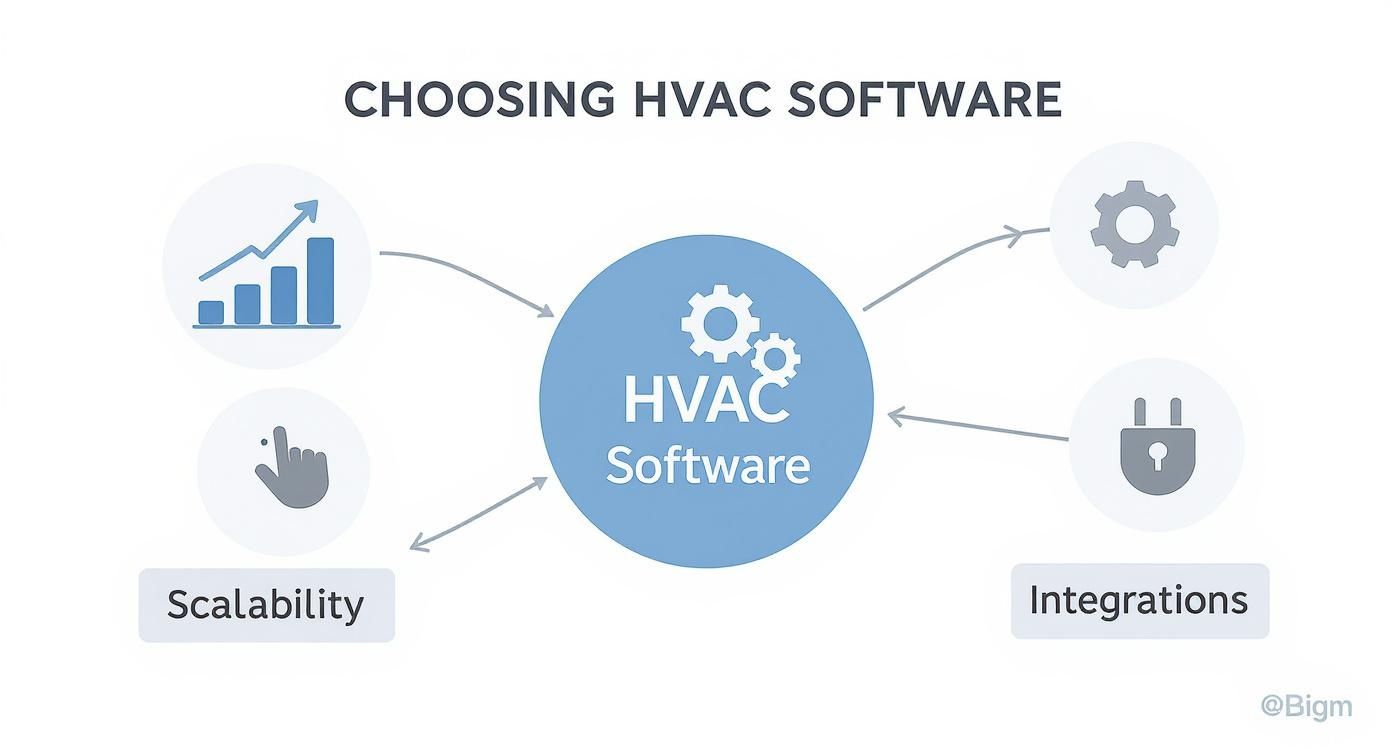
The diagram above really drives the point home: a software’s true value comes from its ability to connect with your other systems and grow right alongside your business.
When you pair your operational software with a lead generation engine, you create a complete, closed-loop system. Marketing automatically fills the pipeline, and your software efficiently manages the jobs that come in. This synergy maximizes the return on your software investment from day one, ensuring that expensive platform you just paid for is constantly fueled with profitable work.
Because without a steady flow of leads, your software is just an empty expense.
Your Plan for Getting This Rolled Out
Switching to a new HVAC service business software is a big deal. Let’s be honest, it can be a headache if you don’t have a solid plan to get your team up and running without tripping over everything.
First thing’s first: get your data ready. This is your chance to clean up those messy customer lists and finally standardize your parts inventory before you import a single thing. Trust me, it’s worth the effort. Then, map out a training schedule that gives your office staff and your techs in the field some real, hands-on time with the system before you flip the switch.
But First, You Need Leads, Not Software
Here’s a hard truth most software companies won’t tell you: before you sink a dime into a complex platform, you need a steady stream of profitable work to justify it. An empty dispatch board makes even the fanciest software a very expensive paperweight. Your real first priority is getting your marketing engine humming.
This means building a powerful digital presence is step one. It’s the fuel for the whole operation. Once you have the job volume, the software becomes an incredible tool to manage it all. A great starting point is our complete digital marketing guide for HVAC businesses, which shows you exactly how to build this critical foundation.
Investing in software before you invest in leads is like buying a high-performance engine for a car with no gas. Fuel your business with a steady stream of jobs first, then implement the system to manage the growth.
Your HVAC Software Questions, Answered
Jumping into the world of HVAC service business software always brings up some practical questions. Let’s tackle the most common ones HVAC owners ask when they’re thinking about making the switch.
What’s The Real Cost Of HVAC Software?
The price tag can be all over the map, but most platforms run on a subscription model, usually charging per user, per month. For a small to mid-sized shop, you should probably budget somewhere in the range of $150 to $400+ a month.
That monthly fee usually gets you the core software, mobile app access for your techs, and some level of customer support. Just make sure to ask about any one-time setup fees or extra charges for premium features like advanced reporting or marketing tools.
Does This Software Play Nice With QuickBooks?
Yes, and honestly, it has to. This is one of the most important features you should be looking for. Pretty much every major HVAC software out there is built to sync up with accounting tools like QuickBooks Online and QuickBooks Desktop.
A solid, two-way integration isn’t just a “nice-to-have”—it’s a must. It automatically pushes invoices, payments, and customer details back and forth, saving you from the soul-crushing chore of entering everything twice and catching costly accounting mistakes before they happen.
This link between your operations and your books ensures your financials are always accurate without your team wasting hours on admin work.
How Long Does It Take To Get Up And Running?
The timeline really depends on the software you pick and the size of your crew, but a good ballpark estimate is anywhere from three to eight weeks. That window covers getting your customer list moved over, building out your pricebook, and getting your daily workflows configured.
Most software companies will walk you through a structured onboarding and training process. The quality of that support is huge—a great partner will work hand-in-hand with your office staff and techs to make the transition as smooth as possible. They know that minimizing headaches and getting you a return on your investment fast is the name of the game.
Before you invest in software to manage all your jobs, you need a steady stream of jobs to begin with. The HVAC Growth Machine gives you a complete, done-for-you website and lead generation system that fills your schedule with profitable installs. First, build your lead engine and secure your exclusive service area by visiting https://hvacgrowthmachine.com.





Founder of HVAC Growth Machine