

In the cutthroat HVAC market, your website is either your #1 salesperson or your biggest liability. Let's be clear: the best websites for HVAC contractors aren't just online brochures; they are powerful, automated systems designed to book high-value installation jobs, not just collect random clicks. They should be turning visitors into qualified leads and paying customers while you sleep.
Why Your Website Is Costing You Jobs, Not Just Clicks
For too many HVAC contractors, their website is a sunk cost. It’s a digital placeholder that does little more than list a phone number. They pour good money after bad into paid ads and SEO, driving traffic to a site that completely fails to convert. This isn't just a missed opportunity—it's a financial leak that sends ready-to-buy customers directly to your competitors.
Think about it like this: Imagine you hire a new salesperson. They show up looking sharp and have a great pitch, but they never answer their phone, can't give a quote on the spot, and forget to follow up with interested homeowners. You’d fire them in a heartbeat. Yet, thousands of contractors tolerate this exact same terrible performance from their most visible asset: their website.
The Financial Drain of a Broken Digital Storefront
A generic, slow, or poorly designed website is the digital version of that useless salesperson. When a homeowner with a dead AC unit lands on your site, they are in a hurry and ready to spend money. If they can't immediately find what they need, see a clear next step, or feel confident you're the right choice, they are gone in seconds.
This digital leak has real-world consequences:
- Wasted Ad Spend: Every single dollar you spend on Google Ads or email marketing is thrown away if the landing page can't close the deal.
- Lost Installation Jobs: Those big-ticket installation jobs almost always start with online research. A weak website doesn't build the trust required to even get the first phone call for a major project.
- Damaged Brand Perception: A dated or clunky site sends a clear message to potential customers: this business is probably just as disorganized and behind the times.
Your website isn't just a piece of marketing; it's your primary digital storefront. If it fails to engage, qualify, and convert visitors, you are effectively closing your doors to the most motivated customers in your service area.
Ultimately, your website has to be more than a placeholder. It needs to be the core of your sales and marketing engine. To see just how common these mistakes are, check out our guide on why most HVAC websites fail and how to fix yours. Without a site built specifically to book appointments and generate revenue, you're not just losing clicks—you're losing profitable jobs every single day.
The Anatomy Of A High-Converting HVAC Website
Alright, let's stop talking about the problems and focus on what actually works. I want to break down the essential parts of an HVAC website that doesn't just sit there, but actively books jobs for you. Think of a great website as your best salesperson—one that works 24/7 turning curious homeowners into paying customers.
It’s not about flashy animations or complicated graphics. It’s about having the right tools in the right places, all designed to guide a visitor from a frantic Google search to a scheduled appointment.
Understanding this anatomy is the key. Once you see how the pieces fit together, you realize you're not just building a website; you're building a job-booking machine.
This isn't just a minor issue, either. A bad website actively bleeds money from your business. It's the digital equivalent of a leaky duct, losing you leads and booked jobs every single day.
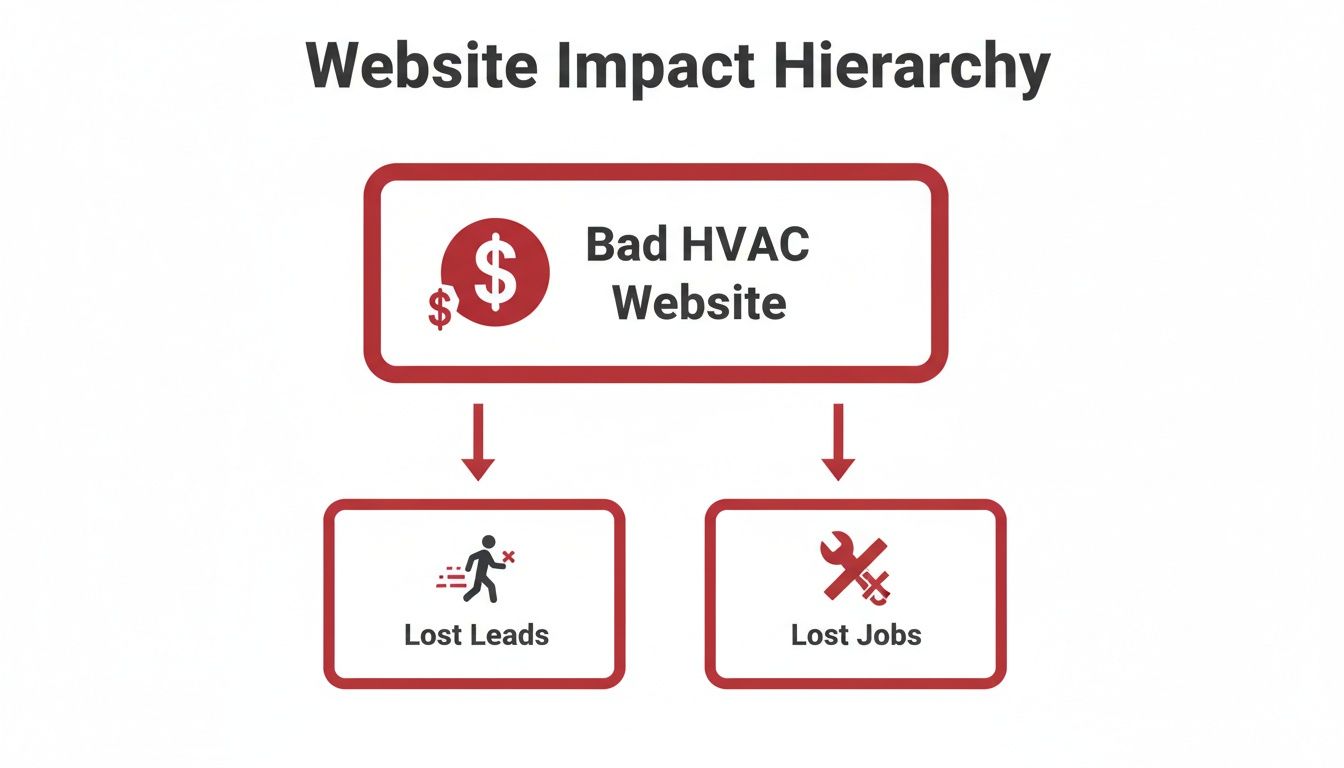
As you can see, this isn't a passive problem. It's an active drain on your growth and your bottom line.
Mobile-First Design Is Non-Negotiable
First things first: if your website doesn't work flawlessly on a phone, you're already losing. A mobile-first design is the absolute foundation. The days of people browsing for contractors on a desktop computer are over.
Today, your customers are searching for you on their phones, often in a panic when their AC dies on a 95-degree afternoon. Your website has to be built for that moment.
Mobile-first means the site was designed for the small screen from the very beginning, not just shrunk down as an afterthought. This impacts everything:
- Thumb-Friendly Navigation: Big, easy-to-tap buttons are a must. No one wants to pinch and zoom just to find your phone number.
- Click-to-Call Buttons: Your number needs to be front and center, ready to be tapped. A homeowner in distress wants to call you now, not fumble around copying and pasting numbers.
- Simple Forms: Keep your forms short and sweet. Ask only for what you absolutely need to get the conversation started.
A clunky mobile site is a gift to your competitors. If you want to dive deeper into this, check out our guide on effective HVAC website design.
Capture High-Intent Leads With An Instant Quoting Tool
Here's one of the most powerful tools you can have: an instant online quoting tool. Think about your most profitable jobs—new system installations. Homeowners looking for a replacement are in research mode. They want an idea of the cost before they commit to a sales visit.
Your typical "Contact Us for a Quote" form just creates a roadblock. It makes the customer wait, giving them plenty of time to click over to the next contractor on Google.
An instant estimator acts as a powerful lead magnet. It provides immediate value to the visitor in exchange for their contact information, converting a passive browser into a highly qualified, high-intent lead for a system replacement.
This tool does the initial qualification for you. It weeds out the tire-kickers and hands your sales team a list of homeowners who are serious about buying a new system. To make sure your site is a true lead-gen machine, it pays to learn how to increase your website's conversion rate.
Build Recurring Revenue with Integrated eCommerce
Finally, a truly modern HVAC website should make you money directly. By adding integrated eCommerce, you can sell maintenance plans, club memberships, or even tune-up specials right from your site.
This transforms your website from a simple brochure into a platform for building predictable, recurring revenue. It's a game-changer.
The difference between a standard site and one built for growth is night and day. Take a look at this comparison.
Essential Features Of A Job-Booking HVAC Website
| Feature | Standard HVAC Website | High-Converting HVAC Website |
|---|---|---|
| Mobile Experience | Shrunk-down desktop version; hard to use. | Mobile-first design with click-to-call buttons. |
| Lead Capture | Basic "Contact Us" form with slow response. | Instant online quote tool captures high-intent leads 24/7. |
| Revenue Generation | Acts as an online brochure; generates no direct revenue. | Integrated eCommerce for selling maintenance plans online. |
| Tracking | Basic traffic data (e.g., Google Analytics). | Full call, lead, and revenue tracking to prove ROI. |
| Local SEO | Basic on-page keywords. | Deeply integrated with an optimized Google Business Profile. |
Seeing the features side-by-side makes it clear. One is a passive online business card; the other is an active, revenue-generating system designed to grow your company.
The reality is your website is on the front lines. Research shows that while top HVAC brands get over 99% of their traffic from organic search, the average conversion rate is a dismal 3.10%. Even worse, the average cost-per-click can hit a staggering $29.03.
High-converting platforms with these tools act as your 24/7 sales reps, turning those expensive clicks into profitable, long-term customers.
Dominating Local Search To Own Your Service Area
Having a slick website is great, but it’s only half the battle. If local homeowners can’t find you when their furnace quits in the middle of a cold snap, your beautiful site might as well be invisible. For an HVAC contractor, getting found online means owning your specific, local service area.
Frankly, all SEO is local SEO when you run a home service business. Your goal isn't to rank nationally; it's to show up at the very top when a customer just a few miles away searches for "AC repair near me." This is where a sharp local strategy turns your website from a passive brochure into an active lead-generation machine.
Your Google Business Profile Is Your New Front Door
Long before a customer ever clicks through to your website, their first real interaction with your company is probably going to be your Google Business Profile (GBP). This is that all-important info box that pops up in Google Maps and the "Map Pack" results at the top of the search page. An unoptimized or neglected profile is a massive red flag to both Google and your potential customers.
Optimizing your GBP is completely non-negotiable. It means getting the fundamentals right:
- Complete and Accurate Information: Your company name, address, phone number, and hours need to be perfectly consistent everywhere online. No exceptions.
- Service & Product Listings: You have to clearly list every single service you offer, from furnace tune-ups to full system installations. This is how Google matches you to what customers are actually searching for.
- Regular Photo Uploads: Get high-quality photos of your team, your branded vans, and your completed jobs up there. It builds instant trust and shows you’re a real, professional operation.
Think of your optimized Google Business Profile as a mini-website that lives directly on the search results page. It's often the single most important factor in whether a local customer decides to call you or your competitor.
A crucial piece of this puzzle is earning the Google Guarantee badge. That little green checkmark signals to homeowners that Google has vetted your business and backs your work. It provides an immediate layer of trust that makes customers far more likely to click on your profile over others.
The Power of Hyper-Local Content and Five-Star Reviews
Once your GBP is dialed in, the next move is to prove your local authority through your website's content and your reputation. This is where dedicated service area pages become your secret weapon. Instead of one generic page listing dozens of towns, you need to create a unique, detailed page for each key city or neighborhood you serve.
These pages send a powerful signal to Google that you are the go-to expert for that specific location. To really make this work, you have to master localised keyword research to figure out exactly what customers in those specific neighborhoods are searching for.
At the same time, a steady stream of five-star reviews is the most powerful social proof you can get. You absolutely need a system for consistently requesting reviews after every completed job. These reviews don’t just sway customers—they also give you a major boost in the Google Map Pack, creating a powerful, self-feeding cycle of new leads.
To take a deeper dive into these strategies, you can learn more about how to win with local SEO for HVAC contractors. By combining a perfectly optimized GBP with hyper-local content and a rock-solid reputation, you'll own your digital territory and make sure local customers find you first, every time.
Turning Leads Into Loyal Customers With Automation
So, what happens after a potential customer fills out a form on your website? For most contractors, it kicks off a messy, manual process. Someone tries to remember to send an email, a follow-up call about a quote happens a few days late, and upselling a maintenance plan is usually just an afterthought.
This old-school approach leaves a staggering amount of money on the table. In contrast, the best websites for hvac contractors have a secret weapon working behind the scenes: a tireless digital sales assistant that never sleeps, forgets, or takes a day off. This is the raw power of email and SMS automation.
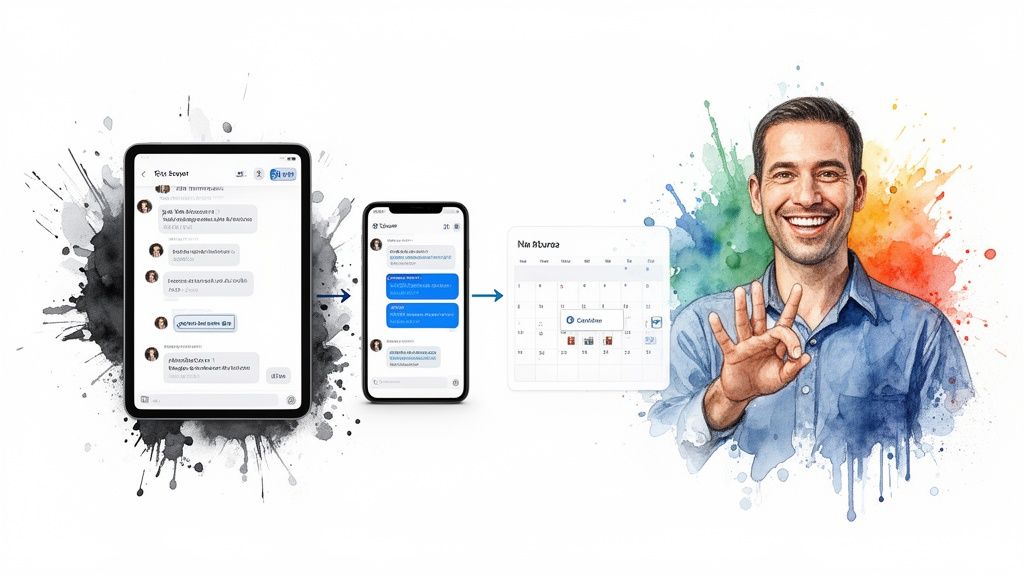
Automation lets you nurture leads who aren’t quite ready to buy, follow up on every single quote with perfect timing, and turn existing customers into recurring revenue with maintenance plans—all without you lifting a finger. It's a system that educates prospects, builds trust, and keeps your company top-of-mind.
Nurturing Leads Who Aren't Ready To Buy
Let's be real: not everyone who requests info is ready to book a service call right then and there. Many are just starting their research, especially for a big-ticket item like a full system replacement. This is exactly where a Welcome Sequence becomes your best friend.
When a new lead comes in, you can automatically trigger a series of emails designed to warm them up:
- Introduce Your Company: The first email should thank them for their interest and share a bit about your company’s story and commitment to doing the job right.
- Build Credibility: A day or two later, a second email can show off some five-star reviews or link to a case study of a recent install you did in their neighborhood.
- Educate and Inform: The third email could offer a genuinely helpful guide, like "5 Things to Look for in a New HVAC System," which positions you as a trusted advisor, not just another salesperson.
This sequence keeps your business in front of the homeowner while they're weighing their options. When they are ready to pull the trigger, you'll be the first contractor they think of. This is a cornerstone of effective HVAC digital marketing.
Following Up On Quotes To Increase Close Rates
Sending out a quote and just waiting for the phone to ring is a recipe for lost jobs. Homeowners get busy, they have questions, or sometimes they just get sticker shock and freeze up. An automated Quote Follow-Up series tackles these problems head-on.
This isn't about spamming people. It's about providing timely, helpful information that overcomes their objections and gently guides them toward making a decision. It’s a systematic way to turn more of those quotes into booked installations.
Think about a simple automated workflow like this:
- 24 Hours After Quote: An email goes out asking if they had any questions and briefly highlights the key benefits of the system you proposed.
- 3 Days After Quote: A second email follows up, specifically addressing common worries like financing options or warranty details.
- 7 Days After Quote: A final, friendly check-in reminds them of the quote's expiration and reinforces why you're the best choice for the job.
A system like this ensures no lead ever falls through the cracks and can dramatically boost your close rate on proposals.
Turning One-Time Repairs Into Recurring Revenue
The relationship shouldn't end once the job is done. Your HVAC email marketing can transform a one-time repair customer into a long-term, profitable asset. The key is an automated Upsell Sequence that kicks in right after a service call is completed.
This sequence can automatically offer a discount on a maintenance plan, clearly explain the benefits of regular tune-ups (like lower energy bills and fewer breakdowns), and make it incredibly easy for them to sign up online, directly through your website. This simple automation builds a solid base of recurring revenue, which stabilizes your cash flow and massively increases the lifetime value of every customer you bring in.
Tracking What Matters Most: Revenue And ROI
Are your marketing dollars actually turning into profitable jobs, or are they just generating clicks and empty leads? This is the million-dollar question for any contractor. So many owners track website visits and form submissions, but they can't connect those numbers back to actual, invoiced revenue. This massive gap in your data makes it impossible to know what's truly working.
Modern websites for hvac contractors finally solve this problem by baking in advanced call tracking and revenue attribution. Think of it as a financial GPS for your marketing. This technology lets you see exactly which channel—a specific Google Ad, an organic search result, or a social media post—generated the phone call that led to a $10,000 system installation.

This level of clarity gets rid of all the guesswork. Instead of wondering if your HVAC paid ads are effective, you can see precisely which campaigns are booking high-margin jobs. That empowers you to double down on what works and cut the wasteful spending—immediately.
From Vanity Metrics To Business-Critical Data
For far too long, contractors have been sold on "vanity metrics." These are the numbers that look good on a report but don't actually tell you if you're making money. They're the digital equivalent of a full parking lot but an empty store.
Here’s how to spot the difference:
- Clicks & Impressions: These are classic vanity metrics. They show that people are seeing your ads, but they tell you absolutely nothing about their quality or intent.
- Form Submissions: A step in the right direction, but a form submission is still just a lead, not a booked job. Too many of them never turn into real business.
- Cost Per Lead (CPL): This is getting warmer, but a cheap lead from a bad source that never converts is still a complete waste of money.
In contrast, business-critical metrics connect your marketing activity directly to your bottom line. These are the numbers that actually matter for growing your HVAC company.
The crucial shift is from asking, "How many clicks did I get?" to "Which marketing channel produced the highest return on investment last month?" One question measures activity; the other measures profitability.
Pinpointing Your True Cost Per Acquisition
The single most important number you can track is your true Cost Per Acquisition (CPA). This isn't just the cost of a lead; it's the total cost of acquiring a paying customer for a specific job type. With real revenue attribution, you can finally see this with precision.
For example, you might discover that while Facebook ads generate cheaper leads, the leads from Google Local Services Ads convert into profitable installation jobs at a much higher rate. This kind of insight allows you to strategically shift your budget to the channels that actually fill your calendar with the right kind of work.
The U.S. HVAC industry is a massive $32 billion market, yet the average cost per click for HVAC keywords can hit a staggering $29.03, with a dismal conversion rate of just 3.10%. When you consider that net profit margins hover around 8%, underperforming websites that can't track revenue are bleeding money on every single click. You can find more HVAC industry statistics on ConsumerAffairs.com to see the full picture.
Optimized websites that pinpoint what drives installs—not just leads—are absolutely essential to win in this market. This is how data-driven decisions directly boost your company's growth and profitability.
Choosing Your Path: DIY Website vs. A Done-For-You Platform
Alright, you know what a killer HVAC website needs to do. Now comes the big question: how do you actually get one built?
This really boils down to two paths, and the one you pick will have a massive impact on your time, your sanity, and your bank account. It's a choice between buying a box of parts and leasing a race car.
One path is the Do-It-Yourself (DIY) route. This usually means hiring a freelance web guy or trying to piece something together on a generic builder like Wix or Squarespace. On the surface, it looks cheaper, and you feel like you're in control.
But that initial "savings" is almost always a mirage. The DIY approach is notorious for hidden costs and long-term headaches that actually stop you from growing.
The Pitfalls of the DIY Approach
Going it alone often means you accidentally become a full-time project manager, trying to force-fit a bunch of different tools together that were never meant to speak the same language. It's a recipe for frustration.
Here's what that usually looks like:
- Integration Nightmares: You're trying to connect a generic contact form to a third-party quoting tool, which then has to somehow talk to your email software. Things break constantly. Data gets lost. You spend more time on tech support than you do booking jobs.
- Missing the Right Tools: Those generic platforms don't come with an instant estimator or an eCommerce checkout for your maintenance plans. Adding those critical conversion tools means paying for expensive custom coding or wrestling with clunky, unreliable plugins.
- The Maintenance Burden is All on You: Who updates the site when something breaks? Who makes sure it's secure and running fast? With the DIY method, that's your problem. Or, you're stuck paying a developer by the hour for every tiny fix.
The DIY path gets you a website, but it rarely gives you a system. You end up with a pile of parts that you are responsible for maintaining, not a cohesive machine built to make you money.
The Power of a Done-For-You Platform
The other path is a specialized, done-for-you platform built from the ground up specifically for HVAC contractors. This is less like buying parts and more like getting a high-performance vehicle that comes with a pit crew and a full-service maintenance plan.
This approach rolls all the essential, money-making features into a single, managed system. Everything is already integrated and fine-tuned for the HVAC industry from day one.
With a done-for-you system, you get:
- An All-in-One Solution: The quoting tool, the booking engine, the email follow-ups, and the revenue tracking all work together seamlessly because they were built to.
- Built-In Industry Smarts: The platform is designed by people who actually understand what makes a homeowner pull out their credit card. Best practices for HVAC SEO and lead generation are baked right in.
- Worry-Free Management: All the hosting, security updates, and tech support are handled for you. You get to stop being a web developer and go back to running your business.
Yes, this usually involves a monthly fee, but it’s a predictable cost for a complete system designed to deliver a measurable return. The choice is pretty clear: do you want to own a complicated, time-sucking project, or do you want to invest in a reliable outcome?
Common Questions We Hear About HVAC Websites
Thinking about a new website for your business brings up a ton of questions. We get it. Below are some straight answers to the most common concerns we hear from contractors, designed to help you make a smart investment in a platform that actually grows your business, not just sits there looking pretty.
How Much Should a Good HVAC Website Cost?
You'll see prices all over the map, from a few thousand bucks for a basic template to $20,000+ for a totally custom build. But honestly, that's the wrong way to look at it. This isn't an expense; it's an investment.
A cheap site that doesn't generate a single phone call is the most expensive mistake you can make. On the other hand, a high-performing website that consistently books profitable jobs delivers a return you can see and measure.
This is why done-for-you platforms with a predictable monthly fee make so much sense. That model usually wraps in hosting, support, and all the critical lead-gen tools, tying your cost directly to the site's ability to make you money. It gets you out of huge upfront costs and ensures the platform is always pulling its weight.
How Long Does It Take To Launch a New Website?
Building a custom website from the ground up can easily drag on for three to six months. That’s a huge amount of time where your business is missing out on leads you could be capturing. The delays almost always come from the endless back-and-forth on design tweaks, custom coding, and trying to bolt on third-party tools.
This is where specialized platforms built just for the HVAC industry have a massive advantage.
Because the core framework, essential features like quoting tools, and industry best practices are already built-in, a fully customized, high-converting website can be up and running in just a few weeks. That speed is a game-changer, letting you start seeing a return and booking more jobs almost immediately.
Can a New Website Really Get Me More Installation Jobs?
Absolutely. But only if it's built with that exact goal in mind. A website that’s just a digital brochure won’t move the needle one bit. A strategic website, however, is engineered from day one to turn visitors into booked appointments for your most valuable work.
By putting a tool like an instant online estimator on your site, you immediately engage high-intent visitors who are already shopping for a system replacement. By optimizing for local SEO, you show up right when a homeowner searches for "furnace installation near me." Your website is a tool, and when it’s the right tool, it becomes your best and most reliable system for booking profitable install jobs.
Is SEO or Paid Advertising More Important For My Website?
This is a false choice. The most successful contractors we see use both, working together. Think of them as two different engines powering your growth.
- SEO: This is your long game. It's how you build authority and generate a steady stream of organic traffic from places like the Google Map Pack. It’s the foundation.
- Paid Ads: This is your accelerator. It's how you generate immediate lead flow and fill your calendar when you need to, right now.
A high-performing website is the central hub that makes both of these strategies more profitable. Your SEO work drives valuable traffic to a site built to convert them, and your paid ad campaigns send hot leads to a landing page designed to capture their info efficiently. You need both to win.
Ready to stop losing jobs to a website that isn't pulling its weight? The HVAC Growth Machine is a complete, done-for-you system that combines a high-converting website with all the tools you need to dominate your local market and book more profitable installs. Stop guessing and start growing.
Discover how HVAC Growth Machine can transform your lead flow.




Founder of HVAC Growth Machine