

When a homeowner’s AC dies in the middle of July, they don’t reach for the phone book. They go straight to Google, searching for “AC repair near me” or “emergency HVAC in [Your City].” The HVAC companies that appear first are the ones that get the calls. This is the power of local search engine optimization (SEO)—a digital marketing strategy designed to make your business the first one they find.
Local SEO is the process of optimizing your entire online presence—from your website to local business directories—to ensure that when a potential customer in your service area needs heating or cooling help, your company is impossible to miss. It’s the foundation of a successful HVAC digital marketing plan.
Your Foundation for Local HVAC Dominance: Google Business Profile
Before diving into complex HVAC SEO strategies, focus on one thing: your Google Business Profile (GBP). This is the single most powerful tool in your local SEO arsenal. It’s not just a listing; it’s your digital storefront on Google Search and Maps and often the first impression a potential customer has of your company.
A fully optimized GBP doesn’t just increase visibility; it builds instant trust and drives high-intent customers—those with an urgent problem that needs solving now—directly to your phone. Get this right, and you’ve won half the battle. For a deeper dive, there’s excellent information on managing your Google Business Profile effectively.

Nail Your Categories and Services
This might seem basic, but it’s where many HVAC marketing efforts falter. Your primary category selection is critical. Choose “HVAC contractor” or “Air conditioning repair service“—whichever best reflects your core business. This single choice tells Google exactly what you do and which searches you should appear in.
Don’t stop there. This is where you broaden your digital net. Add secondary categories for every major service you offer. If you provide furnace repair, duct cleaning, or commercial HVAC services, add those categories. It’s a simple step that helps you rank for a much wider range of keywords.
Next, meticulously build out your services list within GBP. It’s not enough to just say “AC Repair.” Get specific and think like your customer. They aren’t just searching for broad terms; they’re looking for solutions to specific problems.
Your service list should look something like this:
- Emergency AC Repair
- Central Air Conditioner Installation
- Ductless Mini-Split Repair
- Annual AC Tune-Up & Maintenance
- Smart Thermostat Installation
This level of detail perfectly matches the “long-tail” keywords that ready-to-buy customers use. You’re essentially handing Google a menu of your services, making it easy for the algorithm to connect you with the most profitable jobs.
To help you get this right, here’s a quick checklist to run through for your own GBP.
GBP Optimization Checklist for HVAC Contractors
This table breaks down the essential elements to focus on when optimizing your Google Business Profile. Getting these details right is what separates the businesses that get calls from those that don’t.
| GBP Element | Optimization Action | Impact on Local SEO |
|---|---|---|
| Business Name | Ensure it matches your legal business name exactly. No keyword stuffing. | Builds trust and avoids suspension. Critical for NAP consistency. |
| Primary Category | Select the most accurate primary category (e.g., HVAC Contractor). | The #1 factor for ranking in relevant local searches. |
| Secondary Categories | Add all relevant secondary categories (e.g., Furnace repair service). | Broadens the range of keywords you can rank for in the Map Pack. |
| Service Areas | List all cities, zip codes, and neighborhoods you serve. Be specific. | Defines your geographical reach for “near me” searches. |
| Services List | Add every single service you offer with keyword-rich descriptions. | Matches your profile to specific, high-intent customer queries. |
| Photos & Videos | Upload high-quality, geo-tagged photos of your team, vans, and work. | Increases engagement and provides powerful local ranking signals. |
| Google Posts | Publish weekly posts about specials, tips, or company updates. | Keeps your profile active and signals relevance to Google. |
| Q&A Section | Proactively ask and answer common questions about your services. | Addresses customer concerns upfront and allows for keyword usage. |
Completing this checklist isn’t a one-time task. Think of it as ongoing maintenance for your digital marketing. Regularly updating these fields keeps your profile fresh and tells Google you’re an active, relevant local business.
Show, Don’t Just Tell, with Photos
According to Google, profiles with photos receive significantly more clicks and requests for directions. For an HVAC business, photos are your visual proof. They show you’re a real, professional operation.
Upload crisp, high-quality images of your branded vans, your technicians in uniform (with their permission, of course), and your team. Show off your professional operation and happy employees.
Here’s the pro tip: geo-tag your photos. Most smartphones do this automatically if you have location services enabled. When you take a picture at a job site in a specific suburb, that location data gets embedded in the image file. Uploading these photos to your GBP sends a powerful signal to Google, physically verifying that you’re active in the areas you claim to serve.
Key Takeaway: Your GBP is not a “set it and forget it” profile. It’s a living, breathing part of your HVAC marketing strategy. It demands consistent attention—weekly Google Posts for seasonal deals, quick responses in the Q&A section, and a steady stream of new, geo-tagged photos.
Think local SEO doesn’t matter? A staggering 97% of people learn about local companies online. For HVAC contractors, that number represents a goldmine of jobs waiting to be claimed. Ignoring local search is like having a fleet of vans with no phone number on them. Our complete guide to SEO for HVAC digs even deeper into how to capitalize on this.
Building Trust with Reviews and Local Authority
In the HVAC business, trust is everything. It’s the currency that turns a casual Google search into an actual service call. Once you’ve dialed in your Google Business Profile, the real work begins: building rock-solid social proof and local credibility. This really boils down to two things: a stellar online reputation driven by customer reviews and cementing your local authority with digital partnerships.

Think of it this way: your GBP gets you in front of potential customers, but it’s your reviews that convince them to pick up the phone and call you. For some timely ideas, check out these tips on how heating companies boost reviews in winter, which offers specific digital marketing strategies for your busiest seasons. Having the right system for gathering feedback isn’t just a nice-to-have; it’s essential.
Crafting an Effective Review Generation System
Waiting around for reviews to just happen is a slow, painful, and unreliable strategy. You need a proactive system—one that’s persistent but not pushy—to encourage your happy customers to share their experience. The secret is making it dead simple for them and asking at the perfect moment: right after a successful service call when they’re feeling the most relief and gratitude.
Here’s a simple, two-touch approach using SMS and email marketing automation that we’ve seen work wonders for HVAC contractors:
1. The Immediate SMS Request
Within an hour of finishing a job, have your office or an automated system send a quick text. It’s personal, immediate, and has a crazy-high open rate.
- Example SMS: “Hi [Customer Name], this is [Tech Name] from [Your Company]. Thanks again for your business today! If you have a second, we’d really appreciate your feedback on Google: [short link to Google review page]”
2. The Follow-Up Email
If the text doesn’t get a response, a friendly automated email a day later often does the trick. It catches people when they might have a bit more time to sit down and write something thoughtful.
- Example Email Subject: Your Feedback on Your Recent Service with [Your Company]
- Example Email Body: “Hi [Customer Name], We hope your new [AC/furnace] is keeping you comfortable. Our team works hard to provide 5-star service, and your feedback helps us and other local homeowners. Would you mind sharing your experience on Google? It only takes a minute: [link to Google review page]. Thanks, The [Your Company] Team”
Key Insight: Consistency beats complexity every time. The goal is to build a simple, repeatable HVAC email automation process that asks for feedback after every single job. This creates a steady stream of fresh, positive reviews that Google and new customers love to see.
Beyond Reviews: Local Link Building
While reviews build trust with your customers, local backlinks build trust with Google. Think of a backlink as a “vote of confidence” from another website. When that vote comes from a respected local business, organization, or news outlet, it sends a powerful signal to Google that you’re a legitimate, important part of the community. This is a hugely overlooked part of local SEO for HVAC.
Forget about generic directories. The best links come from real-world relationships.
- Chamber of Commerce: Joining your local chamber almost always gets you a listing in their directory—and a high-authority backlink.
- Community Sponsorships: Sponsoring the local little league team, a charity 5k, or a town festival? This often comes with a link from the event’s website, which is pure gold for SEO.
- Supplier and Partner Websites: Check with the brands of equipment you install. Many have a “certified installer” or “local dealer” locator on their site where they can link to you.
- Realtors and Property Managers: These folks are always looking for reliable HVAC contractors. Offer to write a guest post for their blog on a topic like “HVAC marketing tips for real estate agents” in exchange for a link back to your site.
These digital handshakes do more than just improve your SEO. They anchor your business as a trusted, integral part of the local community. Don’t forget that both reviews and local authority efforts are directly tied to your most important online asset. You can learn more about how to optimize Google Business Profile in our dedicated guide to make sure all these efforts are having the biggest possible impact.
Turning Your Website into a Local Lead Machine
Alright, once your Google Business Profile is dialed in and you’ve got a steady stream of reviews coming in, it’s time to focus on your website. Think of your site as the central hub for your entire local SEO strategy. It needs to be a powerful magnet, pulling in both search engines and homeowners who are in a jam.
Your HVAC website has to answer two simple questions, instantly: what services do you offer, and where do you offer them? This is where on-page SEO—the practice of optimizing your actual web pages—stops being a techy chore and starts driving real calls and revenue.
A well-optimized site doesn’t just show up on Google; it screams authority and makes it incredibly easy for a customer with a dead furnace to find you, trust you, and pick up the phone. It’s all about speaking Google’s language and your customer’s language at the same time.
Go Hyper-Local with Service and Location Pages
Here’s one of the biggest mistakes I see HVAC companies make with their websites: they cram all their services onto one generic “Services” page. To really dominate your local market, you have to get much more specific. Creating dedicated pages for each service and for each city or town you work in is an absolute must for effective HVAC SEO.
This is how you start ranking for the exact, high-intent phrases people are typing into their phones.
- Service Pages: Don’t stop at an “HVAC Services” page. You need individual pages for “AC Repair,” “Furnace Installation,” “Ductless Mini-Split Systems,” and especially “Emergency HVAC Services.” This strategy lets you target each specific need directly.
- Location Pages: If you serve five different towns, you should have five different location pages. A page titled “HVAC Services in Franklin” sends a crystal-clear signal to Google. On that page, embed a Google Map of Franklin and sprinkle in a few testimonials from customers who actually live there.
This structure tells Google you are the expert for a specific service in a specific place. It dramatically boosts your odds of showing up for searches like “furnace installation in Brentwood.”
How to Structure Your Pages for Clicks and Calls
The way you organize the content on these pages is a huge deal. Search engines use headings (like H1, H2, H3) to figure out what your page is about and what’s most important.
Your page title and the main headline (H1 tag) are your two most powerful on-page tools. They need to be dead simple, stating the service and the location.
Pro Tip: Your page title is what people see in the Google search results. A formula that flat-out works is: [Primary Service] in [City, State] | Your Company Name. For example: Emergency AC Repair in Phoenix, AZ | CoolBreeze HVAC.
It’s a small change, but it makes a massive difference in getting people to click on your result instead of your competitor’s.
And the data doesn’t lie. With 90% of consumers using search engines to find HVAC services, this kind of specific optimization is non-negotiable. It’s how 76% of mobile searchers end up calling a business within a day. For the HVAC industry, over 80% of website clicks come from these targeted local searches. If you want to dive deeper, check out these HVAC marketing statistics to see just how critical these on-page efforts are.
The Secret Weapon: Schema Markup for HVAC
Finally, let’s talk about something a little more technical that gives you a serious leg up: Schema markup. Think of it as a special code you add to your website that acts like a set of labels for Google. You’re not just telling Google you’re a business; you’re explicitly telling it what kind of business you are.
For any HVAC company, the most important type is HVACBusiness schema. This code directly tells search engines that you are a heating, ventilation, and air conditioning contractor. It removes all the guesswork.
By adding this code, you can clearly define your business name, address, phone number (NAP), service area, hours, and even accepted payment types. This structured data helps Google show much richer, more helpful search results for your business—sometimes including your review ratings right in the listing. It makes you stand out and earns you the click.
Mastering Your Digital Footprint with Citations
When it comes to local SEO for HVAC, consistency is everything. Think of it like this: if you told one potential customer your address was “123 Main Street” and another it was “123 Main St.”, some folks would get confused. Google operates the same way, just on a massive scale.
Every single mention of your business’s Name, Address, and Phone number (NAP) online is called a citation. These citations are like digital breadcrumbs that prove to Google you’re a real, local business. When they all match perfectly, Google trusts you.
But when they’re all over the place—a wrong suite number here, an old phone number there—it creates a mess. This erodes Google’s confidence in your business information, which can absolutely tank your local search rankings.
Auditing and Cleaning Your Citation Profile
First things first, you need to see where you stand. A simple Google search for your company name can dig up old listings on directories you forgot you even signed up for years ago. You’re hunting for any variation in your core NAP information.
Keep an eye out for these common culprits:
- Name Variations: “Cool Breeze HVAC” vs. “Cool Breeze Heating & Cooling Inc.”
- Address Issues: “Street” vs. “St.”, “Suite 101” vs. “#101”, or even an old office location you moved from two years ago.
- Phone Number Errors: Old tracking numbers, personal cell numbers, or simple typos.
Key Takeaway: Even the smallest inconsistency can dilute your local authority. A thorough audit is the essential first step to building a rock-solid digital footprint that Google can trust without hesitation.
Once you’ve found the errors, the real work begins. This means manually contacting each directory, claiming your listing, and updating the information. Yes, it can be a grind, but it’s a critical foundation for any serious local SEO for HVAC strategy.
Prioritizing High-Value HVAC Directories
Look, not all directories are created equal. Having dozens of random citations is fine, but having a handful of rock-solid ones on high-authority, relevant sites is way more powerful. Focus your energy where it matters most to homeowners and Google.
Start with the heavy hitters for any HVAC contractor:
- Google Business Profile: This is the big one. Your most important citation. It has to be perfect.
- Bing Places & Apple Maps: These are the primary data sources for millions of users who aren’t on Google.
- Yelp: A massive decision-making platform for local services. Homeowners live on Yelp.
- Angi (formerly Angie’s List): A go-to resource for homeowners actively looking for contractors.
- Better Business Bureau (BBB): A huge trust signal for customers on the fence.
- HomeAdvisor: Another industry-specific powerhouse that can send you leads.
Building out these core profiles with perfectly consistent NAP information sends strong, authoritative signals that search engines love.
DIY vs. Citation Management Services
Once your main listings are squeaky clean, you’ve got a choice: manage the rest manually or pay for a service to do it for you. Both approaches have their pros and cons.
Manual Citation Building (The DIY Route):
- Pros: It’s cheap (just your time) and you have total control over every single listing.
- Cons: It is incredibly time-consuming, easy to make mistakes, and requires constant upkeep to keep everything synced.
Citation Management Services (like BrightLocal or Moz Local):
- Pros: These platforms are built for this. They automatically push your correct NAP data to dozens, sometimes hundreds, of directories at once. It saves a massive amount of time and ensures consistency.
- Cons: They come with a subscription fee.
Honestly, for most busy HVAC owners, a management service is a no-brainer. It lets you focus on running your business while your online presence stays accurate and authoritative, building a strong local SEO foundation without all the manual grunt work.
Tracking Performance and Converting Clicks to Calls
Running a local SEO campaign without tracking your results is like sending a tech to a job site with no tools. You’re putting in the work, but you have no real way to see what’s actually getting fixed. To make local SEO work for your HVAC business, you have to connect the dots between your online efforts and real-world results—phone calls, form fills, and booked jobs.
It’s time to stop guessing. If you aren’t measuring, you’re flying blind. You need to know which keywords are making the phone ring, how many people are calling your office from your Google Business Profile, and which pages on your website are actually turning visitors into customers.
Setting Up Your Measurement Toolkit
Before you can optimize anything, you need the right tools in place. Think of these as the diagnostic gauges for your marketing engine. They tell you what’s working, what’s broken, and where to focus your time and money.
Your essential toolkit should include:
- Google Search Console (GSC): This is your direct line to Google, and it’s completely free. It shows you exactly which search terms people are using to find you, how often you’re showing up in the results, and where you’re ranking. It’s the single best tool for tracking your local keyword performance.
- Google Analytics 4 (GA4): This tells you what happens after someone clicks through to your website. You can see your most popular pages, how long people stick around, and where they came from. Setting up conversion goals here is mission-critical.
- Call Tracking Software: This is the one tool every single HVAC business needs, no exceptions. Services like CallRail or WhatConverts give you unique phone numbers for each of your marketing channels—your website, your GBP, your paid ads, etc. When a customer calls, the software tells you exactly where they came from, proving how many calls your SEO is generating.
Key Insight: Without call tracking, you can never truly calculate the ROI of your SEO. It’s the only way to definitively prove that a specific keyword ranking or a service page led to a profitable furnace installation, not just a website visit.
Turning Website Visitors into Leads
Getting traffic is only half the battle. The real goal is to convert those visitors into paying customers. This is called Conversion Rate Optimization (CRO), and for an HVAC company, it’s all about making it dead simple for a potential customer to get in touch with you.
Your website has one job: to guide visitors toward calling your office or filling out a form. A pretty website that doesn’t generate leads is just a digital brochure. A high-performing site, on the other hand, is a 24/7 sales machine. Our guide on effective HVAC web design dives deep into what separates the two.
Here are a few critical things you need to get right on your site to turn more of that hard-earned traffic into actual leads.
Essential CRO Elements for Your HVAC Website
Small, strategic tweaks can make a massive difference in how many leads you get from your site. Your focus should be on removing friction and building trust the second someone lands on your page.
1. Strategic “Request an Estimate” Forms
Don’t make people hunt for a way to contact you. Put a simple, clean contact form “above the fold” (visible without scrolling) on your homepage and every single service page. Keep it short and sweet—name, phone, email, and a quick message is all you need to get the ball rolling.
2. Prominent “Click-to-Call” Buttons
Nearly 70% of HVAC service searches now happen on a smartphone. That means a big, obvious, clickable phone number in your website’s header and footer is non-negotiable. This lets a homeowner whose AC just died call you with a single tap, capturing their business right when they need you most.
3. Displaying Trust Signals
Trust is everything in the HVAC world. Homeowners are inviting your techs into their homes, so they need to feel confident you’re legitimate and professional. Sprinkle these trust signals everywhere:
- “Licensed & Insured” badges: Put these front and center.
- Financing options: Show logos for partners like GreenSky or Wells Fargo.
- Certifications: NATE-certified, BBB accredited, or brand-specific dealer badges all build confidence.
- Customer testimonials: Use real quotes, names, and even photos from local customers you’ve helped.
By meticulously tracking what works and optimizing your site to make it easy for customers to take action, you create a powerful feedback loop. The data tells you where to focus, and your website improvements make sure you capitalize on every single click.
Essential HVAC Local SEO Tracking Metrics
To make sense of all the data, you need to focus on the key performance indicators (KPIs) that actually matter for an HVAC business. This table breaks down the most important metrics to watch.
| Metric | What It Measures | Why It’s Important for HVAC |
|---|---|---|
| GBP Phone Calls | The number of calls initiated directly from your Google Business Profile listing. | This is a primary lead source. A high number shows your GBP is optimized and attracting ready-to-buy customers. |
| Organic Traffic | The number of visitors who find your website through non-paid search results. | Shows the overall health of your SEO. Growing organic traffic means you’re ranking for more relevant keywords. |
| Local Keyword Rankings | Your average position in search results for key terms like “AC repair in [city]”. | Directly impacts visibility. Higher rankings for service and location terms lead to more clicks and calls. |
| Website Form Submissions | The number of leads generated through “Request an Estimate” or contact forms. | Measures how well your website converts visitors who prefer not to call immediately. |
| Conversion Rate | The percentage of website visitors who complete a desired action (call or form fill). | This is the ultimate measure of your website’s effectiveness. A low rate indicates a problem with your site’s design or messaging. |
| Cost Per Lead (CPL) | The total marketing spend divided by the number of leads generated. | Helps you understand the efficiency of your investment and compare the performance of different channels. |
Monitoring these metrics consistently will give you a clear picture of what’s driving growth. It allows you to move beyond simply “doing SEO” and start making strategic, data-backed decisions that fill your schedule with profitable jobs.
Your 90-Day HVAC Local SEO Action Plan
Knowing what to do is one thing, but actually getting it done is what books jobs. Turning all this strategy into real-world results means you need a clear roadmap. This 90-day plan is designed to break down the entire process into focused, manageable chunks so you can build momentum without getting buried in the details.
Think of it like this: the first month is all about pouring the concrete foundation for your online presence. Month two is when we frame the house—building out your content and reputation. And in the final month, we’re expanding your reach and fine-tuning everything to drive calls.
Let’s get to work.
Days 1-30: Laying the Foundation
The first 30 days are critical. This is the grunt work—the stuff that isn’t glamorous but is absolutely non-negotiable for long-term success. The goal here is simple: establish a rock-solid, consistent online footprint that both Google and your future customers can trust.
- Week 1: Google Business Profile Overhaul. Go through your GBP with a fine-tooth comb. I mean every single section. Make sure it’s 100% complete and optimized, from your primary and secondary categories to a full list of your services with real descriptions. You’ll also want to geo-tag and upload at least 10 new photos of your team and your vans.
- Week 2: Citation Audit & Cleanup. Time to hunt down every mention of your business online. Use a tool or just good old-fashioned manual searching to find every instance of your Name, Address, and Phone number (NAP). Create a simple spreadsheet to track the good, the bad, and the ugly, and start the process of claiming and fixing any incorrect listings.
- Week 3: Core Citation Building. Now, focus on the big dogs. Lock down and perfect your profiles on the directories that really matter, like Yelp, Angi, HomeAdvisor, and the Better Business Bureau. Make absolutely sure your NAP on these sites is an exact match to your GBP.
- Week 4: On-Site Technical Tune-Up. Let’s pop the hood on your website. Check that your
HVACBusinessschema is implemented correctly and that your title tags and meta descriptions are optimized for your main service pages. And if for some reason they aren’t already running, install Google Analytics 4 and Google Search Console.
Days 31-60: The Content and Reputation Engine
With a solid foundation in place, month two is all about creating value and building social proof. This is where you start to really show off your expertise and get your happy customers to do the selling for you. You’re moving from being findable to being the obvious choice.
- Weeks 5-6: Build Out Your Core Pages. It’s time to create two new, high-quality service pages for your most profitable offerings. Think “Ductless Mini-Split Installation” or “Emergency Furnace Repair.” On top of that, build one new location-specific page for a key suburb you serve—make sure it has local testimonials and an embedded map.
- Weeks 7-8: Fire Up the Review Machine. This is the week you implement that automated SMS and email system for requesting reviews. The goal is to send a request after every single completed service call. Your target: generate a steady stream of at least 10 new Google reviews this month.
- Weeks 9-12: Consistent, Helpful Content. Write and publish one genuinely helpful, localized blog post each week. Focus on HVAC marketing topics like “How to Choose the Right AC Unit for a [Your City] Home?” or “Signs Your Furnace Needs a Tune-Up Before a [State] Winter.”
By the end of month two, you’re no longer just a name in a directory. You’re a visible, reputable authority with a growing library of helpful content and the social proof to back it up.
This infographic gives you a simple look at the process—moving from tracking and analyzing your efforts to actually converting those visitors into paying customers.
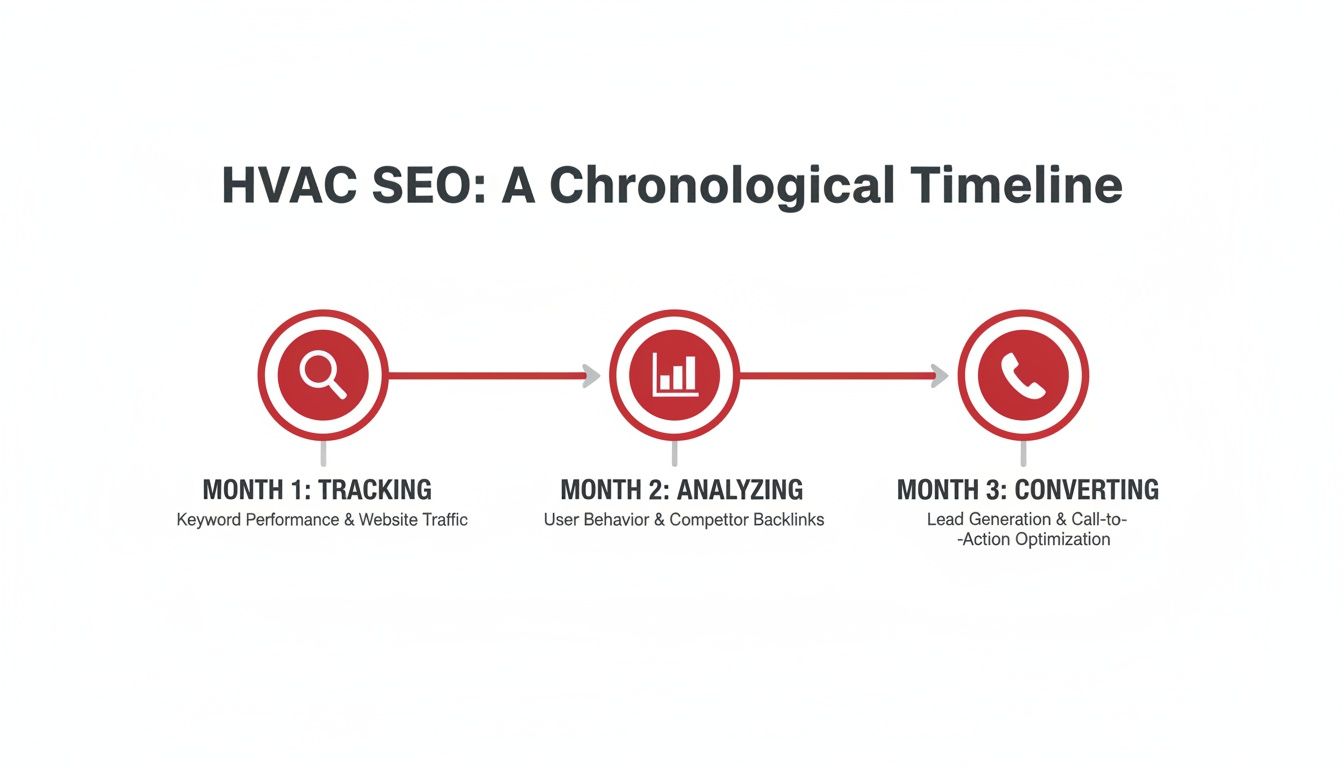
It’s a good reminder that SEO isn’t a one-and-done task. It’s a continuous cycle of monitoring what’s happening, understanding the data, and making smart moves to drive more calls.
Days 61-90: Proactive Outreach and Optimization
The final month is all about leverage. You’ll take the assets you’ve built and start using them to grow, while using data to get smarter about your strategy. We’re shifting from internal setup to proactive outreach, building valuable local connections and figuring out what’s working so you can do more of it.
- Weeks 13-14: Local Link Building. Time to make some friends. Identify five real local link-building opportunities. This could be anything from sponsoring a local kids’ sports team to joining the Chamber of Commerce or even co-authoring a blog post with a local realtor. The goal is to secure at least one new, high-quality local backlink.
- Weeks 15-16: Performance Analysis. Dive into Google Search Console and Analytics. Find out which pages are bringing in the most traffic and which keywords you’re starting to pop for. Now is also the time to set up call tracking so you can start attributing phone leads directly back to your SEO work.
- Weeks 17-18: Conversion Rate Optimization (CRO). Based on what you learned, make some small but powerful tweaks to your site. Add big, obvious “Click-to-Call” buttons. Make sure your “Request an Estimate” forms are simple and visible on every single service page. Sprinkle in some trust badges like “Licensed & Insured” to seal the deal.
This 90-day plan gives you structure and keeps you accountable. It transforms a big, complex marketing strategy into a series of achievable weekly goals that build on each other for powerful, lasting results.
Common Questions We Hear From HVAC Owners
Look, diving into SEO can feel like a whole other job on its own. When you’re busy running calls and managing techs, a lot of questions pop up. Here are the ones we get asked all the time, with straight-up, no-fluff answers.
How Long Until My Phone Actually Starts Ringing from SEO?
This is always the first question, and for good reason. You’re investing time and money, and you need to know when it’ll pay off.
You can often see your Google Business Profile start to climb the rankings in as little as 30 to 90 days, especially if you’re aggressive with optimization and reviews. But let’s be real—to consistently show up on page one for the big money keywords like “AC repair in [Your City],” you’re looking at a 6 to 12 month journey.
Think of it this way: SEO isn’t a light switch; it’s more like building a reputation. It takes time for Google to see your consistent effort and trust that you’re the best answer for local homeowners. The 90-day plan we laid out is all about building that initial momentum.
Should I Do SEO or Just Run Google Ads?
We get this one a lot. The answer isn’t “one or the other.” They’re two different tools for two different jobs, and the smartest HVAC companies use both as part of their digital marketing mix.
- Local SEO is your long-term asset. It’s like buying the land your business sits on. Once you earn those top rankings, you generate a steady stream of leads that you don’t have to pay for with every single click. It builds organic trust and authority.
- HVAC Paid Ads (especially Local Services Ads) are your gas pedal. They deliver immediate results. When it’s 95 degrees out and you need calls today, paid ads get your phone ringing. It’s like renting a billboard on the busiest highway in town.
Our Take: You need a balanced attack. Use HVAC paid ads to generate immediate cash flow and book jobs right now. At the same time, invest in HVAC SEO to build a sustainable, profitable pipeline of organic leads that will pay dividends for years to come.
Can I Just Do All This SEO Stuff Myself?
Absolutely. You can definitely tackle the foundational pieces yourself by following this playbook. Things like updating your Google Business Profile, asking customers for reviews, and writing a blog post about a new HVAC marketing campaign are totally within reach for a hands-on owner.
But the real question isn’t can you, it’s should you?
Once you get into the more technical side—deep on-page optimizations, building schema markup, and competitive link building—it becomes a major time suck. We’ve seen many owners start out strong, only to get pulled back into the day-to-day of running the business. They handle the basics, then bring in an HVAC marketing specialist to manage the heavy lifting so they can focus on what they do best: running a top-notch HVAC company.
Ready to stop guessing and start growing? HVAC Growth Machine provides a complete, done-for-you website and lead generation system that turns your online presence into a reliable source of profitable install jobs. See how it works at https://hvacgrowthmachine.com.





Founder of HVAC Growth Machine