

Think of a team member who works for you 24/7, never calls in sick, and consistently brings in your most profitable jobs. That’s what a modern HVAC website design should be doing for your business. It’s not just a digital business card; it’s your hardest-working sales tool.
Why Your Website Is Your Most Important Employee
In today’s market, your website is the digital front door to your company. It’s where most potential customers will size you up long before they ever think about picking up the phone.
Let’s be honest, an outdated, slow, or confusing site sends a terrible message—it suggests your business might be the same. On the flip side, a professional, easy-to-use website instantly builds credibility. It reassures a panicked homeowner with a broken AC that they’ve found a competent, trustworthy company ready to solve their problem, right now. That first impression is everything.
The Game Has Changed: From Phone Book to Search Engine
The way customers find HVAC services isn’t just different; it’s been completely flipped on its head. A massive 84% of customers now start their search for HVAC services online. This makes your website the frontline soldier in capturing a huge piece of the market.
The global HVAC systems market is booming, and the contractors who nail their online presence are the ones grabbing the biggest slice of the pie. Check out the latest HVAC statistics and trends to see the full picture.
This means your website can’t just exist—it has to perform. It needs to be a lead generation machine that works tirelessly in the background, day in and day out.
Think of your website as a virtual salesperson. Its job is to greet every visitor, answer their questions, prove your expertise, and steer them toward booking a profitable job—all without you lifting a finger.
A website built for HVAC digital marketing isn’t just about getting more clicks; it’s about hitting tangible business goals that actually grow your bottom line.
Tying Your Website Directly to Business Goals
A strategic HVAC website isn’t just another expense on the books; it’s an investment with a clear, measurable return. It should be built from the ground up to drive real results for your company.
- Generate Qualified Leads: Your site should be a magnet for homeowners actively looking for high-value services like system replacements, not just tire-kickers looking for a quick fix.
- Book High-Ticket Installs: Features like built-in financing options and detailed installation pages can be the difference-maker that convinces a visitor to book a large, profitable installation job.
- Dominate Your Local Area: By showcasing reviews, certifications, and specific local service area pages, your website proves you are the go-to expert in your community, building instant trust.
Ultimately, the gap between a website that just lists your phone number and one designed to convert is massive. The first is a passive brochure gathering digital dust. The second is an active, revenue-generating asset that fills your calendar and drives real, sustainable growth.
The Anatomy Of A High-Converting HVAC Website
Let’s get past the theory and actually build the blueprint for an HVAC website that turns clicks into customers. A high-performing HVAC website design isn’t just about looking good—it’s a system of features working together to put money in your pocket. Every button, every form, every piece of text has one job: get that visitor from “my AC is broken” to “your tech is on the way.”
This isn’t about adding fancy tech for the sake of it. It’s about getting inside a homeowner’s head and removing every single roadblock that stands between their emergency—like a furnace quitting in January—and your solution.
Make Contact Effortless
When a homeowner’s system dies, they’re stressed, uncomfortable, and in a hurry. Your website absolutely must make it dead simple to get in touch, especially from their phone.
- Mobile-First Design: Think about it: they’re probably standing in front of the broken unit, searching on their phone. Over 60% of website traffic now comes from mobile. Your site has to work flawlessly on a small screen, with big, fat buttons that are easy to tap.
- Click-to-Call Buttons: This is non-negotiable. A massive, can’t-miss “Click-to-Call” button lets a visitor connect with your office instantly. No fumbling to copy and paste a number. You turn that immediate need into a real conversation before they have a chance to even think about your competitors.
These features aren’t just nice to have; they recognize that the customer’s journey from panic to relief is happening on the go. Making that journey easy is the first step to winning the job.
Capture Leads with Immediate Value
Look, not every visitor is ready to book a service call right this second. Many are just kicking the tires, trying to figure out how much a new system might cost them down the road. This is your chance to grab their info by giving them something valuable right now.
An instant estimate calculator is a killer tool for this. A homeowner answers a few simple questions, and in exchange for their email and phone number, they get a ballpark price for a new install. Just like that, a curious browser becomes a qualified lead for your sales team to nurture. Throw in easy-to-find financing options right on your service pages, and you make that big installation ticket feel a lot more manageable.
A great website answers a visitor’s two biggest questions—”Can you fix this?” and “What’s it going to cost me?”—as fast as humanly possible. Features that give instant answers build immediate trust and generate the best kinds of leads.
Secure the Job Before They Leave
The whole point of all this is to get on the schedule. Modern HVAC websites make this happen by plugging online booking systems directly into the site, letting customers book an appointment 24/7.
This is a huge win for customer convenience, but more importantly, it locks in the job before they can click away to see what the other guys offer. When you connect your online booking to your CRM, you can even automate the scheduling and dispatching, which saves your office staff a ton of time. To really dial this in, you should explore proven strategies to increase your website’s conversion rate and see how they apply to your booking process.
By pulling these essential features together, you create an online experience that’s genuinely helpful for the customer and incredibly profitable for your business. For a deeper look at what a modern site can do, check out our complete guide on HVAC web design that converts visitors into leads.
Winning The Local Search Battle With SEO And GBP
Building a high-performance, conversion-focused website is a massive win, but it’s only half the battle. If a local homeowner can’t find you when their AC unit gives out in the middle of a heatwave, your shiny new website might as well be invisible. This is where local search becomes your secret weapon, turning your site into a magnet for customers who are actively looking for your help right now.
The two biggest engines driving your local visibility are on-page Search Engine Optimization (SEO) and your Google Business Profile (GBP). Think of on-page SEO as perfectly labeling your service trucks—it tells Google exactly what you do and where you do it. Your GBP, on the other hand, is your digital storefront in the single most important local directory on the planet.
This diagram breaks down the core anatomy of a website that actually works, showing the pillars that support both customer trust and search engine visibility.
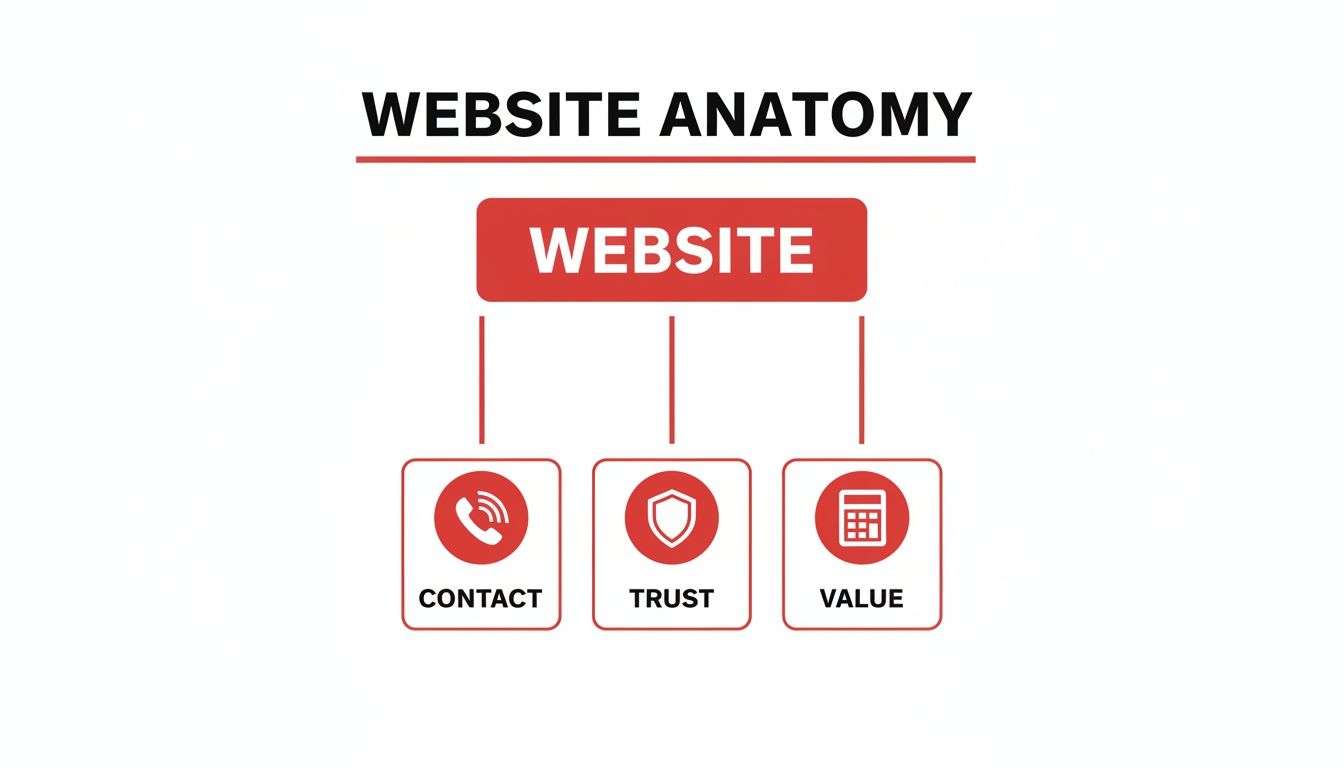
This shows that everything—from clear contact info to trust signals like reviews—has to work together to create a valuable experience for the user. And that’s exactly what Google wants to see.
Mastering On-Page SEO For Hyper-Local Targeting
For an HVAC company, on-page SEO is all about relevance and location, pure and simple. Your goal is to make it painfully obvious to search engines that you are the best and most relevant choice for a search like “furnace repair in [Your Town].”
The single most effective way to do this is by creating dedicated service and location pages. Instead of having one generic “Services” page, you need to build out individual pages for everything you offer in the specific areas you serve:
- AC Repair in [City Name]
- Furnace Installation in [Neighborhood Name]
- Ductless Mini-Split Services in [Nearby Suburb]
Each of these pages should be loaded with content that speaks directly to that service in that specific area. This strategy signals your expertise and geographic focus to Google, massively increasing your chances of showing up when a local customer needs a hand.
Dominating The Map Pack With Your Google Business Profile
Your Google Business Profile is, without a doubt, the most critical piece of your local marketing puzzle. It’s the engine that powers the “Map Pack”—that box with three local businesses you see at the top of the results for local searches. A well-oiled profile can generate a flood of phone calls before a user even has to click on your website.
An optimized GBP isn’t just a listing; it’s a dynamic profile that showcases your expertise, reputation, and real-time activity. It’s your chance to make an incredible first impression directly on the search results page.
To really win in the Map Pack, you need to be consistently active. Here’s what to focus on:
- Get More Reviews, All The Time: Actively ask every single happy customer for a review. Positive reviews are the most powerful trust signal for both potential customers and Google’s algorithm.
- Use Google Posts Weekly: Share special offers, show off recent jobs with photos, or link to a new blog post. This tells Google that your business is active, engaged, and relevant.
- Lock Down Your NAP Consistency: Your Name, Address, and Phone number (NAP) must be absolutely identical across your website, GBP, and any other online directories. Any inconsistencies create confusion and will hurt your rankings.
- Answer Questions in the Q&A Section: Get ahead of the game by proactively answering common customer questions. This lets you control the narrative and provide instant value to searchers.
By combining sharp, location-focused SEO on your website with a meticulously managed GBP, you make your business the obvious and most visible choice for local homeowners. For a step-by-step guide, check out our complete walkthrough on how to optimize your Google Business Profile.
How To Track Every Lead And Measure Your ROI
A great HVAC website design is built to do one thing: get you leads. But how can you be absolutely sure it’s making you money? Without proper tracking, you’re flying blind—spending marketing dollars without knowing what’s actually bringing in the jobs. The real goal is to connect every booked job back to its source, giving you a crystal-clear picture of your return on investment (ROI).
This process is called marketing attribution. Think of it like a detailed receipt for every dollar you spend on advertising. It finally answers the most important question in your business: “Where did this profitable installation job really come from?” Was it that Google Ad? A specific blog post? Your Google Business Profile? Knowing the answer is the key to scaling your business profitably.
Setting Up Your Tracking Foundation
To get clean data, you need to be able to see the two main ways customers will contact you through your website: phone calls and contact forms. If you ignore either one, you’re leaving a massive blind spot in your understanding of what drives revenue.
Call Tracking is non-negotiable. This technology assigns unique, trackable phone numbers to your different marketing channels (like your website, Google Ads, or GBP listing). When a homeowner calls one of these numbers, the system seamlessly forwards the call to your main office line while logging precisely where that lead came from. It tells you exactly which campaigns are making the phone ring.
Form Tracking works in a similar way. When someone fills out a “Request Service” or “Get an Estimate” form on your website, tracking software credits that lead to the marketing source that brought them there in the first place. This gives you undeniable proof of which pages and campaigns are turning visitors into real, actionable leads.
Connecting Actions to Real-World Jobs
Just gathering data on calls and form submissions is only the first step. The real magic happens when you connect this information to actual, paying jobs inside your CRM. This is what closes the loop and reveals the true financial impact of your marketing efforts.
Tracking isn’t just about counting leads; it’s about identifying which marketing sources produce the most profitable work. Data might show that one campaign generates dozens of low-cost repair calls, while another produces a handful of high-ticket system installation leads.
Armed with this kind of insight, you can finally make smart, data-driven decisions. You can confidently double down on the marketing channels that deliver profitable installations and pull back from the ones that only attract low-margin service calls. To truly measure your ROI, it’s vital to identify the key website metrics to track, which gives you a much deeper story than lead volume alone.
From Raw Data to Actionable Strategy
Once your tracking is dialed in, you can build a system that turns all that data into predictable growth. A well-organized approach ensures no opportunity gets missed and every marketing dollar is fully accounted for.
- Integrate with Your CRM: Make sure every single incoming lead—from both calls and forms—is automatically fed into your Customer Relationship Management software. No manual entry needed.
- Tag Every Lead: Automatically tag each lead with its source (e.g., “Google Organic,” “Paid Ad Campaign,” “GBP”). This makes reporting a breeze.
- Analyze the Results: Regularly review your reports to see which sources are generating the most revenue, not just the most leads.
This level of detail transforms your marketing from a frustrating expense into a predictable investment. By understanding exactly how each lead enters your pipeline, you can build a far more resilient system. For more on this, check out our guide on how to implement an effective HVAC lead management system.
Budgeting And Choosing The Right Website Partner
Now for the two questions every HVAC owner eventually asks: “How much is this going to cost?” and “Who can I actually trust to build it?”
Getting these answers right is the difference between investing in an asset that prints money and wasting thousands on a digital paperweight. The truth is, the cost of an HVAC website design can be all over the map, but the price is almost always tied directly to the results you can expect.
Making the right call means understanding your options, from do-it-yourself platforms to specialized marketing agencies. Your choice will come down to your budget, how comfortable you are with technology, and most importantly, where you want your business to be in a few years.
Understanding The True Cost Of A Website
A website isn’t a one-time purchase like a new service van; it’s an ongoing investment, and different tiers come with wildly different capabilities. Thinking you can get a high-performance, lead-generating site for a few hundred bucks is one of the most common—and costly—mistakes in this business. The initial build is just the starting line.
Here’s a realistic look at what you should expect:
- Template-Based DIY Builders (e.g., Wix, Squarespace): These platforms look incredibly cheap on the surface, often just a low monthly fee. The problem is, they are notoriously slow, poorly built for local SEO, and completely lack the specific lead-capture tools an HVAC company needs. The real cost isn’t the monthly fee; it’s the thousands in lost revenue from leads you never got and homeowners who couldn’t find you on Google.
- Generalist Web Design Agency: A local “do-it-all” agency might quote you anywhere from $5,000 to $15,000 for a custom site. The issue here is they don’t understand the HVAC industry. You’ll likely end up with a generic “brochure” website that looks decent but fails to include critical HVAC tools like online booking, financing integrations, or dedicated service area pages that actually rank.
- Specialized HVAC Marketing Agency: A partner who lives and breathes HVAC marketing doesn’t just build a website; they build a system. You can expect an initial investment ranging from $5,000 to $25,000+, plus an ongoing monthly retainer for hosting, support, and marketing. This price reflects a custom-built machine designed for one purpose: booking profitable HVAC jobs.
The most expensive website you can own is one that doesn’t generate leads. A cheaper initial price often leads to a far greater long-term cost in missed opportunities and lost market share.
HVAC Website Design Options: DIY vs Professional Agency
Deciding whether to build it yourself or hire a pro is a critical crossroads. While DIY builders seem to offer control and savings, they demand a massive time investment and almost never produce the kind of results a competitive HVAC business needs to grow. It’s a classic case of being penny-wise and pound-foolish.
To help you decide, here’s a straight-up comparison of the two paths.
| Factor | DIY (e.g., Wix, Squarespace) | Professional Agency |
|---|---|---|
| Initial Cost | Low monthly subscription fees. | Higher upfront investment and monthly retainer. |
| Time Investment | Extremely high. You are the designer, writer, and SEO. | Minimal. They handle everything from strategy to launch. |
| SEO Performance | Poor. Template code is often bloated, slow, and not built for local search. | Excellent. Built from the ground up for local SEO and Google’s rules. |
| Lead Generation | Basic contact forms only. Lacks industry-specific tools. | Advanced tools like estimate calculators and booking systems. |
| Ongoing Support | You are on your own to fix issues, update content, and stay secure. | Fully managed hosting, security, and updates are included. |
Ultimately, a professional agency that focuses on HVAC isn’t just selling you a website; they’re providing a growth partnership. They get that you don’t just need a pretty online brochure—you need a reliable system that consistently fills your calendar with high-margin installation and replacement jobs. Their expertise isn’t just in design; it’s in the specific strategies that make an HVAC business win online.
Your Essential Pre-Launch And Post-Launch Checklist
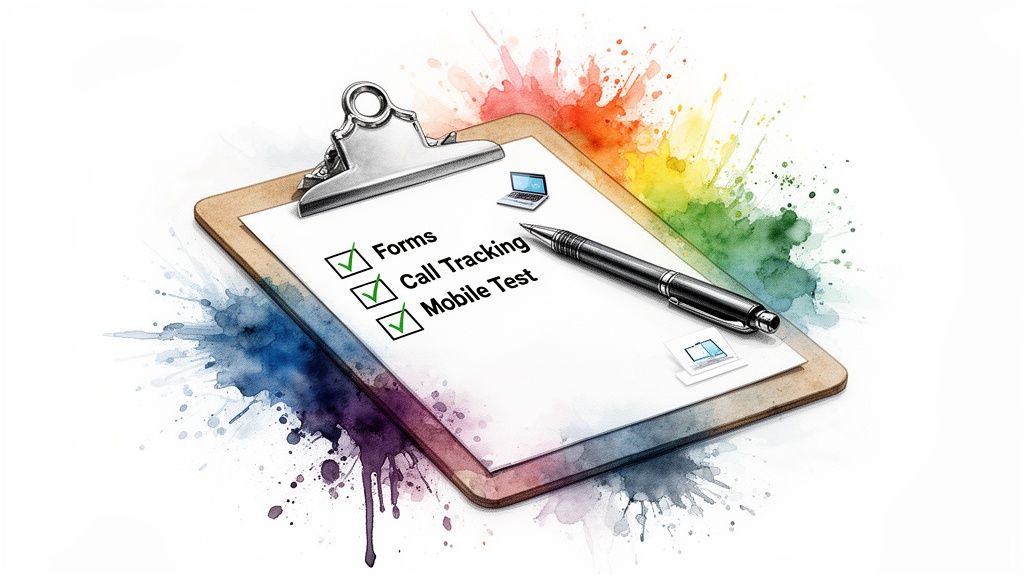
Getting your new HVAC website live isn’t the finish line—it’s the starting gun. A successful launch is just the beginning of a continuous process of growth and optimization. To make sure you get a return on your investment from day one, you need a clear checklist for the final moments before you go live and the crucial first steps right after.
Think of it like this: the pre-launch is the final system inspection before you flip the switch. The post-launch is the routine maintenance that keeps your new digital asset running at peak efficiency for years to come.
The Pre-Launch Technical Inspection
Before your new HVAC website design is visible to the public, a thorough technical sweep is non-negotiable. Finding a broken form or a dead link after launch can cost you real jobs. This checklist ensures every critical function works perfectly from the moment a customer lands on your page.
Your pre-launch inspection has to include:
- Form Functionality Test: Fill out every single contact, estimate, and service request form on the site. You need to confirm that the notifications hit the right email inbox instantly. No delays.
- Call Tracking Confirmation: Pick up the phone and dial every tracking number displayed on the site. Make sure the calls connect to your office and show up correctly in your tracking software.
- Cross-Device Responsiveness Check: Pull up the website on an iPhone, an Android phone, a tablet, and a desktop computer. Is all the text readable? Are the buttons easy to tap? Do the images look right on every screen?
- Page Speed Audit: Run your main pages through a tool like Google PageSpeed Insights. Your homepage and key service pages absolutely must load in under 3 seconds to keep visitors from bouncing.
Your Post-Launch Growth Plan
Once the site is live, your focus shifts from one-time technical checks to consistent, disciplined action. A great website needs fresh content, social proof, and ongoing monitoring to keep its momentum and climb the search rankings.
A new website is like a brand-new service van—it’s a powerful tool, but it only makes you money when you’re actively using it. The post-launch phase is about putting that tool to work every single week.
Here’s a simple, sustainable plan to get you started:
- Activate Your Review Generation System: Immediately start your process for requesting reviews from every happy customer. A steady stream of fresh, positive reviews on your Google Business Profile is pure gold for local SEO.
- Schedule Content Updates: Get it on the calendar. Commit to adding new project photos or a quick case study at least once a month. This tells Google your site is active, relevant, and worth showing to searchers.
- Monitor Key Performance Metrics: Once a week, open up your analytics. You need to keep a close eye on your website traffic, the number of leads coming from forms and calls, and your overall lead conversion rate.
This disciplined approach ensures your website doesn’t just launch successfully—it evolves into the hardest-working employee your company has.
Got Questions About HVAC Website Design? We’ve Got Answers.
Investing in a new website is a big move, and you should absolutely have questions about how much it costs, how long it takes to see a return, and where to focus your energy. Here are the straight-up answers to the questions we hear most from HVAC owners ready to build a site that actually books jobs.
How Much Should An HVAC Website Cost?
The cost of a new website varies wildly, but it’s almost always a direct reflection of the results you can expect. A cheap website is often the most expensive mistake an HVAC company can make when you factor in all the lost leads and missed opportunities.
Here’s a realistic breakdown of what you’re looking at:
- Basic Template Sites ($500 – $3,000): This is the DIY route. You’ll get something online cheap and fast, but these sites almost never have the speed, local SEO structure, or conversion tools needed to actually compete and win jobs.
- Professional Custom Sites ($5,000 – $15,000): In this range, you can get a good-looking, custom site from a generalist marketing agency. It’ll look professional, but it probably won’t have the HVAC-specific guts you need, like an instant estimate tool or a deep connection to your CRM.
- Performance-Focused Systems ($15,000+): At this level, you’re not just buying a website. You’re investing in a lead generation machine built by a team that lives and breathes the HVAC industry. This includes advanced tracking, dialed-in SEO, and specific tools designed to book high-ticket install jobs.
How Long Until A New Website Generates Leads?
A new website starts pulling in leads from two different engines, and they work on totally different timelines. It’s critical to know what to expect from both.
Paid ads, like Google Local Services Ads or pay-per-click campaigns, can start making the phone ring and filling up your inbox almost immediately after the site launches. It’s the fastest way to get your lead flow going while your long-term strategy gets its legs under it.
On the other hand, organic SEO is a marathon, not a sprint. It typically takes a solid 3 to 6 months of consistent work for Google to start trusting your new site and ranking it for valuable keywords in your service area.
This is exactly why a balanced approach wins. You use paid ads for immediate cash flow and then reinvest that into building an SEO foundation for sustainable, long-term growth.
Should I Focus On SEO Or Paid Ads?
The smartest HVAC contractors don’t pick one over the other—they use both. A great website is the hub that makes each channel stronger.
Think of it this way: Paid ads are like a faucet. You can turn them on for an instant flow of leads, perfect for filling the calendar this week. SEO is like digging a well. It takes time and effort upfront, but once it hits water, it provides a consistent, low-cost source of leads for years.
The winning strategy is to drive paid ad traffic to your new, high-converting service pages to get an immediate ROI. At the same time, you invest in an SEO campaign that builds the online authority you need to dominate your market down the road. This dual approach ensures your business grows now and for the future.
A high-performance website is the engine of predictable growth. HVAC Growth Machine builds done-for-you lead generation systems that include everything from an instant estimate tool to full revenue attribution, all designed to book more profitable install jobs. Learn more at https://hvacgrowthmachine.com.





Founder of HVAC Growth Machine