

Picture this: a salesperson who works for you 24/7, never calls in sick, and perfectly qualifies every single lead before they even hit your inbox. That's what a modern HVAC website should be doing for your business. It's not just a digital business card; it's the engine of your growth—and your single most valuable employee.
Why Your HVAC Website Is Your Most Valuable Employee
In a crowded market, a generic, cookie-cutter website just doesn't cut it anymore. It won't attract the high-value customers you're looking for. Homeowners today expect way more than a phone number and a list of services. They want instant answers, clear pricing, and a smooth experience from the second they land on your page. A high-performance HVAC website delivers on all of it, acting as your best digital marketer, lead generator, and sales closer all at once.
Think about it. Your website is your digital storefront, and it's always open. When a homeowner's AC dies at 10 PM on a Friday, your site is there to help. It doesn't just list your emergency number; it guides them, builds their trust, and grabs their info before they have a chance to click away to your competitor.
More Than Just an Online Brochure
A truly great HVAC website does more than just sit there looking pretty. It actively works to fill your schedule with profitable jobs. This is the critical shift—from a passive online brochure to an active lead-generation machine—that separates the HVAC businesses that are thriving from the ones just getting by.
A modern site pulls this off by wearing several hats at once:
- It Attracts Your Ideal Customers: Through smart HVAC SEO, it pulls in local homeowners who are searching Google right now for the exact services you offer, like "emergency AC repair in Phoenix."
- It Turns Clicks into Leads: With tools like an instant online estimator, it engages visitors and captures high-intent leads by giving them the pricing info they're looking for without making them pick up the phone.
- It Builds Instant Trust and Authority: By featuring real customer reviews, photos of your team, and professional certifications, it makes potential customers feel confident that they're making the right choice.
- It Creates Recurring Revenue: With built-in eCommerce for maintenance plans, you can sell service agreements directly on your site, building a stable, predictable income stream month after month.
Your website should be the hub of your entire marketing world. It’s where your paid ads send traffic, it’s the proof behind your Google Business Profile, and it’s the platform that nurtures leads with email automation.
At the end of the day, the goal is to have an online presence that works as hard as you do. It shouldn't be a line-item expense; it should be a dynamic asset that delivers a clear return on your investment. By tracking which marketing dollars lead to actual booked jobs, your website gives you the data you need to make smart business decisions and stop wasting money on tactics that don't work. That's the foundation of real, sustainable growth.
The Blueprint for a High-Converting HVAC Website
A great HVAC website isn't just a digital brochure; it's a machine built piece by piece to turn casual visitors into booked jobs. Forget the vague advice. You need a strategic blueprint of essential features—the kind that creates a lead-generating asset that consistently brings in high-value customers.
Think of your website as your best marketing employee, one that never sleeps. It plays three critical roles at once: salesperson, lead qualifier, and closer.
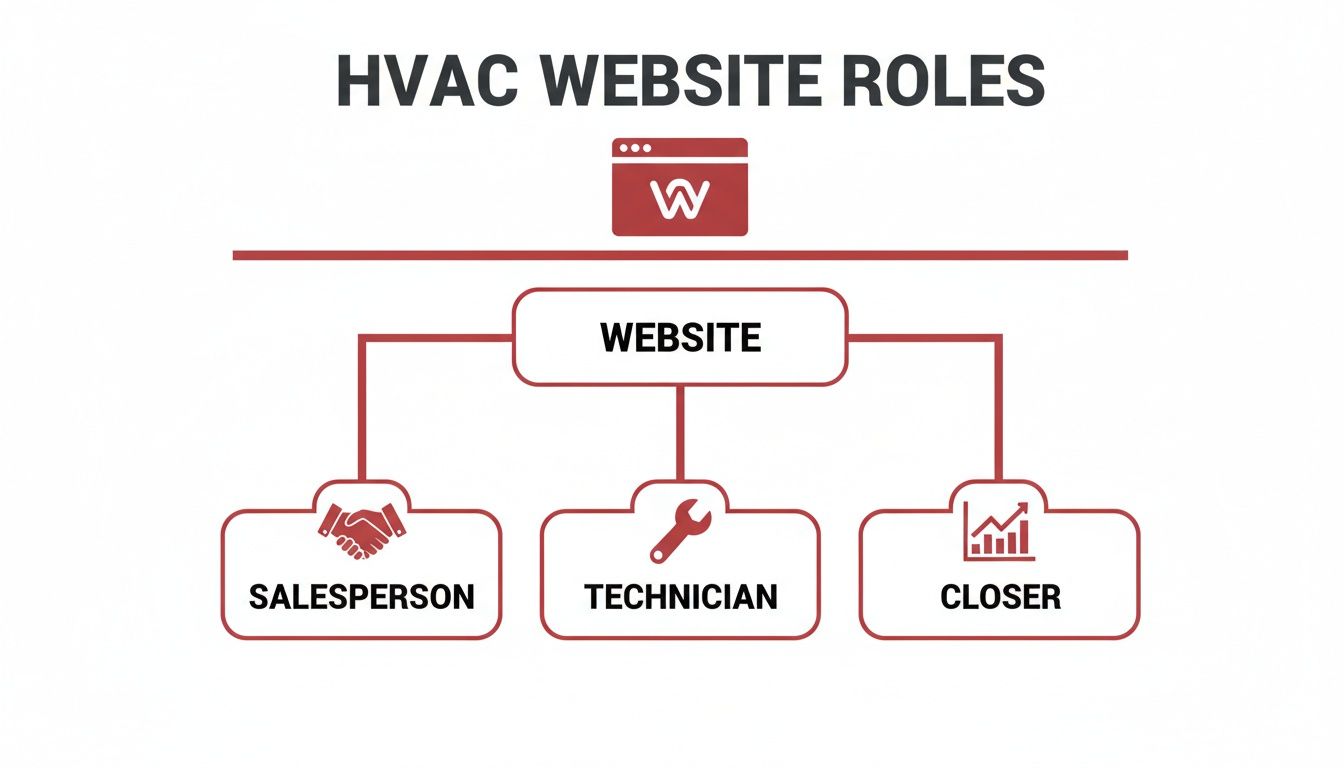
This structure shows how a single, well-built website can do the work of multiple team members, from grabbing a lead's attention all the way to securing the sale.
Dedicated Service Pages Are Non-Negotiable
This is the single biggest mistake HVAC contractors make: cramming all their services onto one generic page. If you want to show up on Google when a homeowner is desperately searching, you need a separate, SEO-optimized page for every single service you offer.
That means a dedicated page for "emergency AC repair," another for "furnace installation," and yet another for "ductless mini-split services." Each page needs to be a mini-authority on that one topic, answering every question a customer might have and targeting the exact phrases they’re typing into the search bar. This is how you tell Google you're the expert and climb the ranks for those profitable searches.
Capture Leads Instantly with Quote Tools
Let's face it, today's homeowners want answers now. Making them wait for a callback is a great way to send them straight to your competitor. An integrated instant quote tool is the fix, grabbing high-intent visitors the second they land on your site.
A potential customer answers a few simple questions, gets an estimated price range, and in return, you get their contact info. Just like that, your website goes from a passive flyer to an active lead-capture machine, securing opportunities before they can click away.
An instant estimator doesn't just generate leads; it pre-qualifies them. A visitor willing to go through the process is signaling a strong interest in making a purchase, giving your sales team a warm lead to follow up with.
The data doesn't lie. SEO leads for HVAC convert at a massive 14.6%, completely dwarfing old-school outbound methods at just 1.7%. This makes a properly optimized website your number one tool for sustainable growth.
Create Recurring Revenue with Simple eCommerce
One of the most overlooked—and powerful—features you can add is basic eCommerce for selling maintenance plans. Stop making customers call to sign up for your "Comfort Club." Let them buy it directly online with a credit card, just like they would any other subscription.
This one move accomplishes two huge goals:
- It creates a predictable, recurring revenue stream that smooths out your cash flow, especially during the slow seasons.
- It locks in customers for future repairs and replacements, massively increasing their lifetime value.
It's a core piece of smart HVAC website design that many owners miss, leaving reliable income on the table every single month.
Build Trust and Drive Action Immediately
Beyond the fancy tools, your entire site has to be built on a foundation of trust and usability. Every single element should make it easier for a customer to pick up the phone and call you.
Before diving into the features that make a difference, let's look at how each component of a high-converting website contributes to your bottom line.
Essential HVAC Website Features and Their Impact
| Feature | Primary Goal | Impact on Business |
|---|---|---|
| Dedicated Service Pages | Attract high-intent search traffic | Ranks higher in Google for profitable keywords, bringing in qualified local customers. |
| Instant Quote Tool | Capture leads instantly | Converts passive visitors into active, pre-qualified leads before they leave the site. |
| eCommerce for Plans | Generate recurring revenue | Creates predictable income, stabilizes cash flow, and increases customer lifetime value. |
| Mobile-First Design | Provide a seamless user experience | Retains visitors who search on their phones, preventing them from leaving out of frustration. |
| Click-to-Call Buttons | Drive immediate phone calls | Makes it effortless for mobile users to contact you, increasing inbound call volume. |
| Social Proof & Reviews | Build trust and credibility | Eases customer anxiety and shows that other homeowners trust your work, boosting conversion rates. |
These features aren't just "nice-to-haves"; they are the core components of a website that actively works to grow your business around the clock.
Key Foundational Features:
- Mobile-First Design: The majority of local searches happen on a phone. If your site is a pain to use on a small screen—forcing people to pinch and zoom—they're gone. It has to look and work perfectly on mobile.
- Prominent Click-to-Call Buttons: Don't make people hunt for your number. Put a clickable phone number right at the top of the page, where it's always visible and tappable. Make it dead simple for them to call you.
- Social Proof: Plaster your site with real customer reviews, testimonials, and trust badges like the Google Guarantee. This instantly builds credibility and tells new visitors that you're a safe, reliable choice.
Driving Targeted Traffic With HVAC SEO and Paid Ads
A perfect HVAC website is like a brand-new service van parked in a locked garage—it’s got all the right tools but it’s completely useless if customers can't find it. To turn your website into a real, lead-generating asset, you have to drive targeted local traffic straight to it. This is where the one-two punch of HVAC search engine optimization (SEO) and paid advertising comes in.
Think of SEO as your long-term investment. It's the slow and steady work of earning trust with search engines like Google, proving that your website is the most relevant, authoritative answer when a homeowner starts searching.
Paid ads, on the other hand, are your immediate response team. They get you to the top of the search results instantly for those urgent, high-value keywords.
When you use them together, they create a powerful system where each one makes the other stronger.
Dominating Local Search With HVAC SEO
The whole point of HVAC SEO is to make your business the obvious choice for customers right in your service area. This isn't about trying to trick Google; it's about systematically providing the best, most helpful answers to your customers' questions.
Since HVAC is a local game, putting your effort into strong local SEO is everything. For a deeper look at the fundamentals, check out this great guide on SEO for local businesses.
Your most powerful weapon here is your Google Business Profile (GBP). This free listing is what gets you into the coveted Google Map Pack—that block of three local businesses you see at the top of the results with a map. Owning that space is often the difference between a phone that rings off the hook and one that stays dead silent.
A meticulously optimized Google Business Profile is no longer optional. It's the digital storefront for local search, and it demands consistent attention, including fresh photos, new customer reviews, and accurate service information.
Beyond your GBP, creating genuinely helpful content on your website builds authority and trust. This means:
- Hyper-Local Service Pages: Don't just make one page for "AC Repair." Create specific pages for "AC Repair in [Your Town]" and "AC Repair in [Neighboring Town]." This tells Google exactly where you work.
- Blog Posts That Solve Problems: Write articles that answer the real questions your customers are asking, like "Why is my furnace making a weird noise?" or "How much does a new AC unit cost in [Your State]?" This brings in customers much earlier in their decision-making process.
For a full breakdown of the strategies that work, take a look at our guide on building a winning HVAC SEO strategy.
Capturing Immediate Demand With Paid Ads
While SEO builds momentum over time, paid advertising gets you results today. For an HVAC business, two platforms are non-negotiable: Google Ads and Local Services Ads (LSAs).
Google Ads (you might know them as pay-per-click or PPC) let you bid on keywords to show up at the very top of search results. This is perfect for grabbing those emergency repair calls and high-ticket installation leads from people who are ready to buy right now.
Local Services Ads are even more potent. They appear above the traditional Google Ads and come with the "Google Guaranteed" badge, which is a massive trust signal for homeowners. With LSAs, you stop paying for clicks and start paying for actual qualified leads—phone calls or messages from customers in your area.
But be warned: running paid campaigns without a clear strategy is a fast way to burn cash. The average cost per lead (CPL) for HVAC campaigns is around $153, but a truly high-performance HVAC website can slash that down to as low as $25-$75. The secret is focusing on high-converting landing pages and precise tracking to turn your ad spend into actual installs, not just wasted clicks. This efficiency is what separates the top performers from everyone else.
Turning Clicks Into Customers Through Automation
Getting traffic to your HVAC website is only half the battle. A click is a good start, but turning that click into a scheduled job is what actually grows your business. This is where we get into the science of conversion—blending a dead-simple user experience with smart automation to make sure no lead ever slips through the cracks.
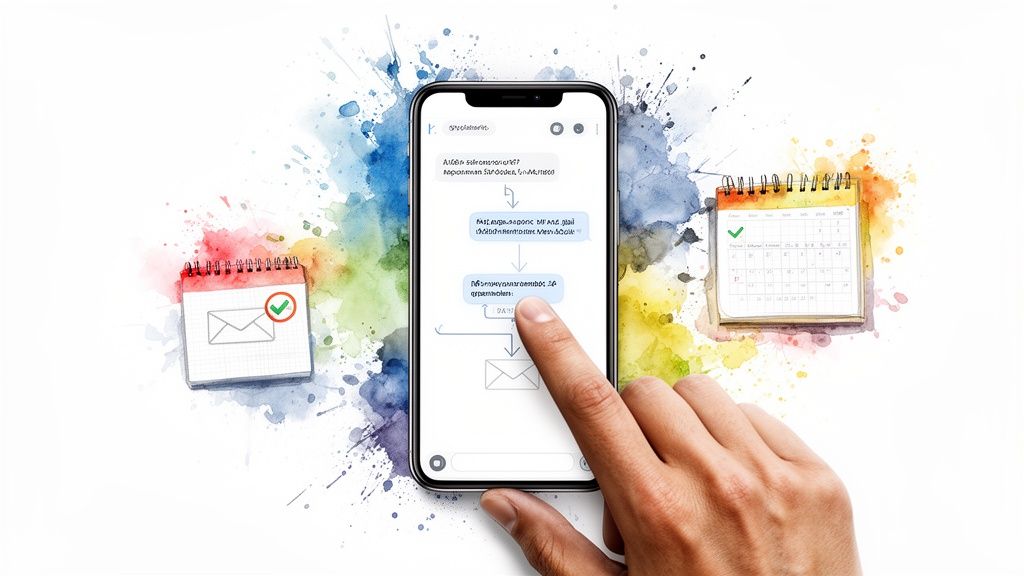
It all begins with making it incredibly easy for a potential customer to take that next step. Think about it: when a homeowner lands on your site with a broken AC in the middle of a heatwave, they're stressed out and in a hurry. A clunky, slow, or confusing website is a guaranteed way to send them straight to your competitor.
Creating an Effortless User Experience
User experience (UX) isn't just a buzzword; it's about tearing down every single obstacle between a frustrated visitor and a booked appointment. For an HVAC business, that means you have to prioritize simplicity and speed, especially on the mobile devices where almost all local searches happen.
Here are the key elements of a high-converting UX:
- Simple, Clear Navigation: Your menu needs to be intuitive. A visitor should be able to find your services, see your service areas, and get your contact info in seconds without having to think.
- Lightning-Fast Mobile Speed: More than half of all users will ditch a site if it takes longer than three seconds to load on their phone. Your website has to load almost instantly, even if they're on a shaky cell signal.
- Strategic Calls-to-Action: Don’t make people hunt for your phone number or a contact form. Big, clickable "Call Now" buttons and "Request Service" forms should be impossible to miss on every single page.
This friction-free approach means that when a customer is finally ready to pull the trigger, the path to contacting you is obvious and immediate.
A great HVAC website anticipates the customer's needs. It understands they are likely on a mobile device, in a hurry, and looking for a quick solution. Every design choice should serve that reality.
The Power of Automated Follow-Up
Now for the fun part. Once a visitor shows some interest—maybe they use your instant estimator or start to sign up for a maintenance plan—the real magic can begin. This is where automation acts like your 24/7 digital assistant, nurturing leads and making sure opportunities are never missed.
Imagine a homeowner gets an instant quote on your site for a new furnace but doesn't book the job right away. Instead of that lead going cold, an automated system can jump into action immediately. It can send a follow-up email a few hours later, maybe with a helpful guide on choosing the right furnace or a link to check out your financing options.
This is the heart of effective HVAC email marketing. You can set up automated sequences to handle all kinds of scenarios without anyone on your team lifting a finger. You can learn more about setting this up in our complete guide to HVAC email automations.
Building a Self-Sustaining Lead Machine
Automation isn't just for chasing down new leads; it's a powerful tool for the entire customer journey. By connecting your website forms directly to your job management software, you can build a system that drives repeat business and grows your online reputation on autopilot.
Consider these automated workflows:
- Abandoned Cart Reminders: If a visitor starts to sign up for a maintenance plan but gets distracted, an automated email or text can gently remind them of the benefits, often recovering a sale you would have otherwise lost.
- Post-Job Review Requests: A day after a job is marked complete, your system can automatically send the customer a message asking for a five-star review on Google. This systematically builds the social proof you need to win over the next customer.
- Service Reminders: Six months after a tune-up, your system can automatically email the customer to schedule their next maintenance visit, helping keep your techs' schedules full and your customers loyal.
By putting these automated systems in place, your HVAC website transforms from a static online brochure into an active, intelligent member of your sales and service team. It captures leads, nurtures them, and even helps generate glowing reviews, creating a powerful cycle of growth for your business.
Measuring What Matters for Your HVAC Website
Stop guessing and start knowing exactly where your revenue comes from. A powerful HVAC website isn't just a pretty online brochure; it's a machine built to produce measurable, profitable results. This means you have to move beyond fuzzy "vanity metrics" like website visitors and focus on the Key Performance Indicators (KPIs) that actually hit your bank account.
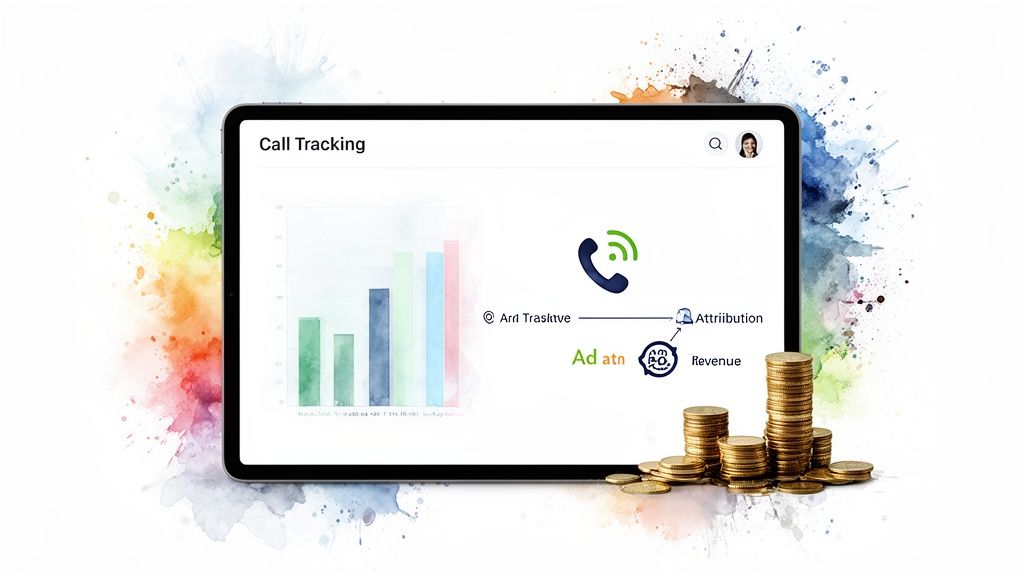
So many HVAC owners get caught up tracking social media likes or total website traffic. And while those numbers might feel good, they don't tell you if you're actually making money. A real data-driven approach means tracking the metrics that connect your marketing dollars directly to booked jobs.
This is how you turn your HVAC website from a marketing expense into a predictable, high-return investment. When you know which channels are delivering profitable customers, you can pour gas on what's working and cut what's not.
KPIs That Directly Impact Your Bottom Line
To get a crystal-clear picture of your website’s performance, you need to track the numbers that truly matter. These are the KPIs that bridge the gap between a click and a paid invoice, giving you a real-time health report on your marketing.
You need to be laser-focused on these core metrics:
- Cost Per Qualified Lead (CPQL): This is your ultimate efficiency score. It tells you exactly how much you're spending to get one real, serviceable lead from a customer in your area. No fluff.
- Lead-to-Customer Conversion Rate: This shows how well your team turns those qualified leads into paying customers. If this number is low, the problem might be in your sales process, not your marketing.
- Average Revenue Per Job: Tracking this helps you see the quality of the leads your site is pulling in. Are you attracting small repairs or high-ticket system installs?
- Customer Lifetime Value (CLV): This measures the total revenue a single customer brings you over the years, including maintenance plans and future replacements. A great website helps you grow this number significantly.
By keeping your eyes on these KPIs, you can stop hoping for leads and start engineering a system that produces them reliably and cost-effectively.
Tying Revenue Back to the Source
The single biggest challenge for most HVAC owners is revenue attribution. How can you be 100% sure that a $10,000 furnace installation came from that specific Google Ad campaign and not a postcard you sent last month? This is where modern tracking technology completely changes the game.
With the tools available today, there's no more guesswork. You can definitively link every single dollar of revenue back to its original marketing source, giving you an undeniable report card on your ROI.
This is done with two key pieces of tech working together on your HVAC website:
- Dynamic Call Tracking: This system assigns a unique phone number to each of your marketing channels. When a customer calls the number shown on your Google Ads landing page, the system knows exactly which ad they saw.
- Conversion-Tracking Forms: When a customer fills out a "Request Service" or "Get an Estimate" form on your site, hidden data is passed along that identifies where they came from—whether it was an organic search, a paid ad, or a link in an email.
In the cutthroat HVAC industry, a good website is a massive advantage. While the average B2B services site converts at a measly 3.1%, a specialized HVAC website optimized for mobile and local search can easily push its landing page conversions to 10% or higher. You can discover more insights about industry conversion rates and see how HVAC stacks up.
This level of tracking closes the loop. It allows you to see that a specific search on Google led to a website visit, which led to a phone call, and finally resulted in a booked job worth thousands. It’s the ultimate proof that your HVAC website isn't a cost—it's a true revenue-generating asset.
Your Action Plan for a Profitable HVAC Website
Alright, we've covered a ton of ground. But knowledge without action is just trivia. It’s time to take everything we've talked about and turn it into a straightforward, actionable roadmap.
Think of this as your step-by-step checklist for building an HVAC website that actually brings in high-value jobs. Whether you're starting from scratch or fixing a site that isn't pulling its weight, this is how you build an online presence that works as hard as you do. We'll break it down into three simple phases.
Phase 1: Foundation and Strategy
Before you even think about colors, fonts, or code, you need to get the strategy right. This first phase is all about figuring out the "who" and "why" behind your website, making sure every decision from here on out has a clear purpose.
- Define Your Ideal Customer: Who are you really trying to reach? Is it homeowners with 15-year-old systems who are prime for a full replacement? Or are you the go-to for emergency, middle-of-the-night repairs? Knowing this dictates your messaging, design, and the keywords you target.
- Set Clear Business Goals: You can't hit a target you can't see. What does "success" actually look like in numbers? Maybe it's 20 new installation leads every month, or a 50% jump in maintenance plan sign-ups. You have to have real, quantifiable goals to know if your investment is paying off.
- Analyze Your Top Competitors: Pull up the top-ranking HVAC websites in your service area. See what they're doing well, but more importantly, find where they're dropping the ball. Their weaknesses are your biggest opportunities.
Phase 2: Buildout and Implementation
With a solid plan in place, it's time to build the machine. This is where you assemble the key features that will attract visitors and, more importantly, turn them into paying customers.
- Develop SEO-Optimized Service Pages: Don't just list your services. Create a detailed, unique page for every single service you offer, targeting every major town in your area. This is non-negotiable for local SEO.
- Integrate a Lead-Capture Tool: Make it incredibly easy for people to take the next step. An instant online estimator or a big, bold "Request a Quote" form are perfect for grabbing a visitor's info while they're interested.
- Launch Your Google Business Profile: This is your digital storefront on Google. Optimize every single detail—correct info, high-quality photos, and a constant flow of new reviews. This is how you win the local map pack.
Phase 3: Optimization and Growth
Here's the thing: a great website is never really "done." This final phase is all about using real data to make continuous improvements. To make sure your site becomes your most valuable employee, you need to apply proven strategies on how to grow your online business and lock in that long-term profitability.
Frequently Asked Questions
When it comes to building a real, lead-generating HVAC website, a few questions always pop up. Owners want to know about the cost, the timeline, and what kind of results they can actually expect. Let's cut through the noise and get you some straight answers.
How Much Does a Professional HVAC Website Cost?
This is always the first question, and the honest answer is: it depends. You can get a basic site from a generic builder for a few thousand bucks, but it's usually just a digital brochure. It won't have the tools you need to actually book jobs, like dedicated service pages or an instant quote generator.
A custom, high-performance website built by a specialist agency, on the other hand, is a different animal. Expect to invest anywhere from $10,000 to $25,000 or more. These aren't just websites; they're lead-generation systems built from the ground up with HVAC SEO, conversion science, and call tracking baked in from day one. It’s an asset, not an expense.
Many modern agencies now offer a "website-as-a-service" model. This means a smaller setup fee and a monthly subscription that covers hosting, updates, and ongoing support, making it much more manageable.
How Long Does It Take to See Results?
Results come in two flavors: immediate and long-term.
If you pair your new site with a smart paid ads campaign, you can get the phone ringing within the first week. Google Local Services Ads, in particular, can drive qualified calls almost instantly.
But organic growth from HVAC SEO is a marathon, not a sprint. You're looking at 3-6 months before you start seeing real movement in Google rankings for competitive local keywords. The whole point of SEO is to build a long-term, sustainable source of free leads, and that takes patience. A great website just gives Google a rock-solid foundation to work with, speeding up the process.
Can I Just Build My Own HVAC Website?
Look, with DIY builders like Squarespace or Wix, anyone can get a website online. But for a service business like HVAC, they almost always fall short. The real challenge isn't the design; it's the implementation.
A DIY site doesn't come with integrated call tracking, revenue attribution, or automated email follow-ups. It’s just not built for it.
A professional HVAC website isn't about pretty pictures; it's about engineering a system that turns clicks into profitable jobs. The value is in the integrated marketing engine that converts traffic, not just the visual layout.
At the end of the day, you have to ask yourself: do you want to spend your time trying to be a web developer and digital marketer, or do you want to run your HVAC business? A done-for-you service handles all the technical headaches so you can focus on what you actually do best.
Ready to stop guessing and start getting real, measurable results from your website? The team at HVAC Growth Machine builds high-converting websites designed to generate profitable install jobs, not just clicks. We handle everything from the initial design to the ongoing optimization, so you can focus on running your business. Get your done-for-you website and lead generation system today.





Founder of HVAC Growth Machine