

An effective HVAC website is supposed to be your digital storefront, your very best salesperson working around the clock. Its one job? To turn curious visitors into booked service calls. It’s not just an online brochure; it's a strategic tool built to grab the attention of local customers actively searching for heating and cooling help.
A great site makes it dead simple for a homeowner with a busted AC on a 95-degree day to find you, trust you, and get you on the way in just a few clicks.
Why Your HVAC Website Isn’t Booking Jobs
Let's be honest. Your website should be your hardest-working employee, filling your schedule 24/7. But for too many HVAC contractors, it’s asleep on the job. An underperforming website isn't just a missed opportunity; it’s an active leak in your profit bucket, dripping away potential jobs every single day.
When your site is slow, a nightmare to use on a phone, or makes it impossible to find a contact number, it’s actively pushing away the very customers you need most.
This digital friction sends high-intent local homeowners—the ones frantically searching for emergency repairs or a new system quote—straight to your competitors. Their immediate problem isn't solved by your confusing website, so they just hit the "back" button and give their business to the next company on Google.
From Digital Brochure to Lead Machine
The root of the problem is usually a misunderstanding of the website’s purpose. Many HVAC sites are built like static online flyers—a list of services and a phone number. That approach just doesn’t cut it anymore. A modern, effective HVAC website is a dynamic lead generation machine.
Its primary goals are simple:
- Build Instant Trust: Real photos of your team, a flood of customer reviews, and professional affiliations tell visitors they’ve found a reputable company they can count on.
- Provide Clear Answers: Homeowners want to know if you service their town, what you specialize in, and how to get help right now. No digging required.
- Create Effortless Action: Big, obvious "Click to Call" buttons, simple "Book Online" forms, and easy-to-find contact info aren't optional—they're essential.
Without these core elements, your site becomes a barrier instead of a gateway to new business.
Diagnosing Your Website Performance: Profit Leak vs Lead Machine
Is your website actively helping or hurting your bottom line? A quick look at its key features and the results it produces will tell you everything you need to know. Most sites fall into one of two camps: the "Profit Leak" that quietly costs you money, or the "Lead Machine" that consistently drives growth.
See where your current site fits in.
| Feature Or Outcome | Underperforming Website (The 'Profit Leak') | High-Converting Website (The 'Lead Machine') |
|---|---|---|
| First Impression | Looks dated, slow to load, and is hard to read on a phone. | Modern, fast, and looks great on any device. |
| Primary Goal | Acts as a simple online business card or brochure. | Built to convert visitors into phone calls and form submissions. |
| Call to Action | Hidden contact info, confusing navigation, no clear "next step." | Obvious "Click to Call" & "Book Now" buttons on every page. |
| Trust Signals | Lacks reviews, uses generic stock photos, feels impersonal. | Showcases dozens of real customer reviews and team photos. |
| Lead Generation | A few calls trickle in, but you're not sure from where. | A steady, predictable flow of qualified leads every month. |
| Mobile Experience | Users have to pinch and zoom; buttons are tiny and hard to tap. | Perfectly optimized for mobile users who need help on the go. |
| Overall Result | High bounce rate. Visitors leave frustrated and call a competitor. | Low bounce rate. Visitors feel confident and take action. |
If your site has more in common with the "Profit Leak" column, you're not just missing out on leads—you're actively sending them to your competition. The good news is that turning that leak into a machine is entirely possible with the right strategy.
The High Cost of an Underperforming Site
The numbers don't lie. In the hyper-competitive HVAC world, a well-built website can be a massive growth engine. Industry benchmarks show the average HVAC website converts visitors at a rate of 3.1%. That means for every 100 people who visit, only about three actually become a real lead.
But here’s the kicker: companies that nail their local SEO and website strategy see their organic traffic jump by an average of 188%, driving a huge influx of new opportunities. You can explore more about these industry conversion rates to see the data for yourself.
An underperforming website doesn't just fail to bring in new business; it actively damages your brand's credibility. Every visitor who leaves your site in frustration is a potential customer who now has a negative impression of your company before you've even had a chance to speak with them.
Ultimately, the first step is to shift your mindset. Your website isn't just a passive online placeholder; it's a strategic asset. Every single element, from the headline on your homepage to the final button on your contact form, must be engineered to guide visitors toward one simple action: booking a job with your company.
The Blueprint For A High-Converting HVAC Website
Let's get one thing straight: your website isn't an online brochure. It should be your best salesperson—a lead-generating machine that works for you 24/7. A high-converting HVAC website isn't about flashy designs; it's a carefully engineered tool built to turn a casual Google search into a booked appointment with as little friction as possible.
Think of it as the central hub for all your marketing. Every ad, every social media post, and every referral points back here. To actually get a return on that traffic, you have to improve website conversion rates with an expert-led strategy. Every single click needs to have a clear path to becoming a paying job.
The reality is your website is either making you money or losing you money. There's no in-between.
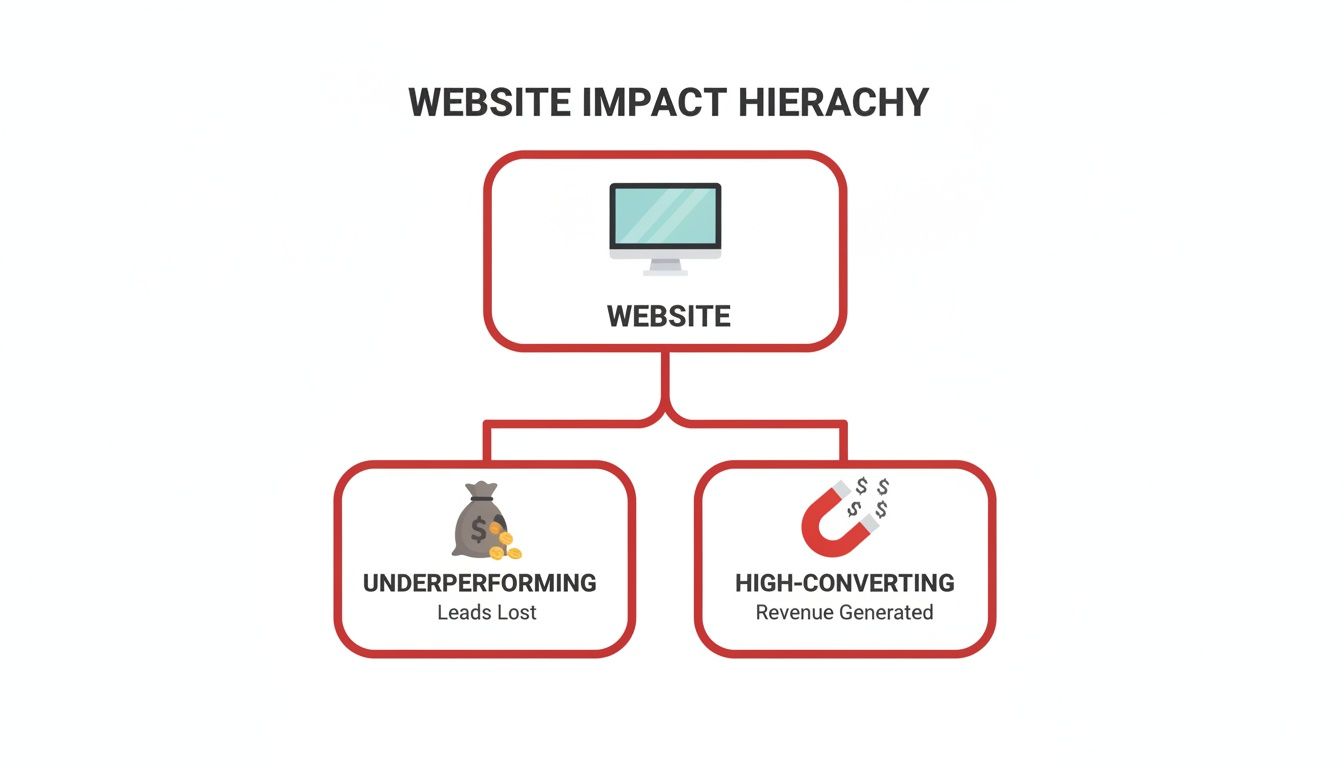
This diagram shows the two paths your site can take. It's the difference between leaking potential jobs every single day and actively generating new revenue for your company.
Essential Trust and Conversion Elements
Before a homeowner even thinks about calling you, they need to trust you. A high-converting site builds that trust in seconds with a few non-negotiable elements. These features immediately answer a visitor's biggest questions and crush their initial skepticism.
Your site absolutely must have:
- Prominent Click-to-Call Buttons: Over 60% of local searches are on mobile. When someone's AC is out in July, they aren't filling out a form. Make your phone number a giant, tappable button right at the top.
- Clear Service Area Maps: Nothing is more frustrating for a potential customer than not knowing if you even work in their town. Show them an interactive map or a clean list of cities and zip codes. Qualify them on the spot.
- A 'Meet the Team' Page: Stop being a faceless company. Real photos and short bios of your team humanize your business and make people feel comfortable letting your techs into their homes.
- Abundant Social Proof: Plaster your best reviews, testimonials, and industry badges all over the homepage. This is instant validation from other homeowners.
Without these foundational pieces, you're asking visitors to take a leap of faith, and most won't. You can learn more about how to structure these pages in our guide on HVAC website design.
The Instant Online Estimate Tool: A Lead Magnet
One of the most powerful conversion tools you can add is an instant online estimate tool. This isn't just another contact form. It’s a true lead magnet designed to capture homeowners who are still in the research phase.
Plenty of people are thinking about a new system but aren't ready for an in-home sales pitch. They want a ballpark price without the pressure. This tool meets them exactly where they are.
By giving them immediate value—a custom estimate—you capture the contact info of a high-intent prospect. From there, your automated HVAC email sequences can nurture that lead with helpful info until they're ready to pull the trigger.
This single feature bridges the gap between a casual browser and a qualified lead, filling your pipeline with prospects who've already bought into your brand and pricing.
Unlocking Recurring Revenue with eCommerce
Finally, a modern HVAC website can create a predictable, recurring revenue stream. By adding simple eCommerce functionality, you can sell maintenance plans directly on your site. This makes the entire process seamless for you and the customer.
Instead of hoping your techs remember to upsell memberships in the field, you can send customers to a dedicated page where they can:
- Compare your maintenance plan options.
- See the clear value and cost savings.
- Sign up and pay with a credit card in just a few minutes.
This approach doesn't just lock in customer loyalty and boost their lifetime value; it also stabilizes your cash flow, especially during the slow seasons. It turns your website from just a lead tool into a self-service sales platform that captures every possible dollar.
Dominate Local Search And The Google Map Pack
Let's be honest. You can have the best-looking, highest-converting HVAC website on the planet, but it's completely worthless if local customers can't find it.
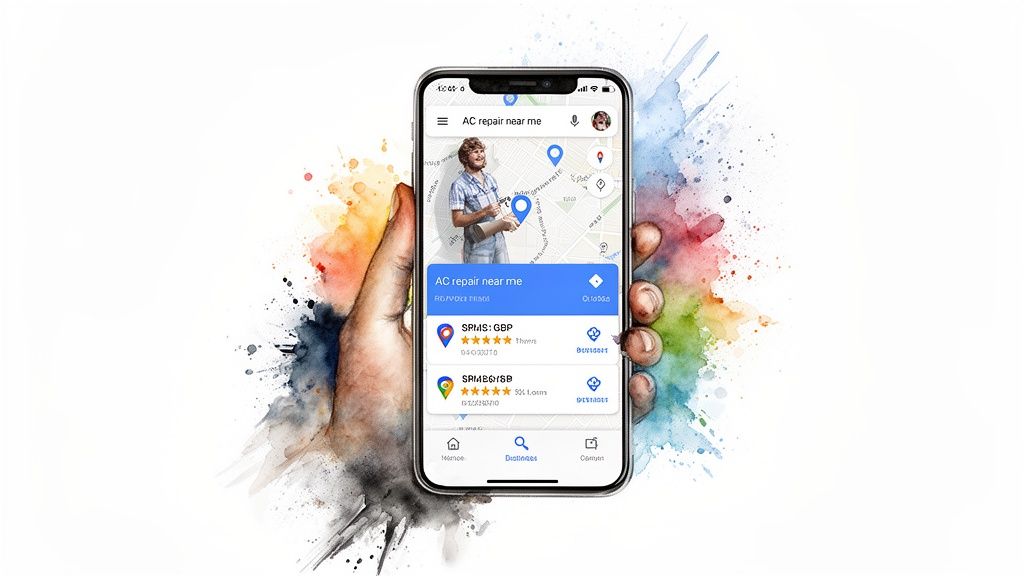
When a homeowner's AC unit dies on a blistering summer afternoon, they aren't admiring your logo. They're frantically typing "AC repair near me" into their phone. Being the first name they see in that exact moment of need is the entire point of local search engine optimization (SEO).
SEO isn’t some dark art—it’s just the process of proving to Google that you are the most relevant, trustworthy answer for a local searcher's problem. A well-built HVAC website is your foundation, confirming your expertise, services, and service area to the search engines.
The Power of Hyper-Local Service Pages
One of the most effective, non-negotiable SEO strategies is creating dedicated pages on your site for every single service and city you target. A generic "Services" page just doesn't cut it anymore. You have to get specific and match what your customers are actually searching for.
This means building out individual pages like:
- AC Repair in [City Name]
- Furnace Installation in [City Name]
- Emergency HVAC Service in [Neighborhood Name]
Each of these pages needs unique content about that specific service in that specific location. This strategy screams to Google that you're an authority in those towns, dramatically boosting your chances of ranking when a homeowner there needs help. If you want to really dig in and own your service area, a deep dive into Local SEO for Contractors is a must.
Your Website and Google Business Profile: A Symbiotic Relationship
Think of your website and your Google Business Profile (GBP) as two halves of the same local-ranking powerhouse. They are not separate marketing channels; they have to work together.
Your GBP is the digital sign above your shop's door in the Google Map Pack, and your website is the expert salesperson inside. Your GBP pulls information directly from your website to verify what you do and where you do it. In return, a well-optimized GBP with tons of great reviews sends powerful trust signals back to Google, boosting your entire website's authority. Neglecting one will always hurt the other.
Your Google Business Profile is often the very first impression a potential customer has of your company. It's your digital curb appeal, and it needs to be meticulously maintained to attract the best local leads.
Optimizing your GBP is critical. It directly impacts how often you show up in the coveted "Map Pack"—those top three local listings that get almost all the clicks. For a step-by-step walkthrough, check out our guide on how to optimize your Google Business Profile.
Earning the Google Guaranteed Badge
For HVAC contractors, Google offers an extra layer of trust you can't get anywhere else: the Google Guaranteed badge.
This little green checkmark appears right next to your business name in Local Services Ads. It tells homeowners that Google has personally vetted your company and even backs your work with a satisfaction guarantee. It's one of the fastest ways to build massive credibility.
While it's part of a paid ad program, getting the badge requires a background and license check. Earning it instantly sets you apart from the competition, showing customers that you are a low-risk, high-quality choice. It's a powerful signal that can dramatically increase your lead flow from local search.
Drive Traffic And Nurture Leads With Ads And Automation
A high-converting HVAC website is like a perfectly tuned engine—powerful, efficient, and ready to go. But every engine needs fuel to run.
Paid advertising and marketing automation are the high-octane fuel that powers your website, driving the right kind of traffic to your pages and making sure no lead ever goes cold.
While SEO is your long game for building a steady stream of organic traffic, paid ads are your secret weapon for immediate visibility. They put your business right in front of homeowners at the exact moment their AC dies or their furnace gives out. This is how you capture those urgent, high-intent customers who are ready to book a job right now.
Pouring Gasoline on the Fire with Paid Ads
For most HVAC contractors, paid advertising boils down to two incredibly powerful platforms: Google Ads (the classic paid search) and Google Local Services Ads (LSAs). Both are designed to get you to the top of the search results, but they work in different ways.
Paid Search Ads (PPC): These are the text ads you see at the top of Google. You bid on keywords like "emergency furnace repair" or "new ac unit cost," and you only pay when someone actually clicks your ad.
Local Services Ads (LSAs): These show up even above the PPC ads and come with the trust-building Google Guaranteed badge. The big difference? You pay per qualified lead (a phone call or message), not just a click, which often gives you a much clearer return on your investment.
Here's the single most important rule for any paid campaign: never send ad traffic to your homepage. Ever.
Instead, every ad should point to a dedicated landing page built specifically for the service they searched for. If someone clicks an ad for "AC repair," the page they land on should talk only about AC repair. It needs a clear headline, a list of benefits, and a big, obvious call-to-action to book service. This focused approach makes a world of difference and dramatically increases your conversion rates.
The Power of Smart Email Automation
So, what happens after a visitor fills out your "Instant Online Estimate" form but doesn't book a call? This is where your 24/7 digital sales assistant—email automation—takes over.
An automated email sequence can instantly follow up with that lead, sending them helpful information and building trust over the next few days or weeks. This system is designed to nurture prospects who aren't quite ready to buy today, keeping your company top-of-mind until they are.
Think of it as a friendly, automated salesperson that never sleeps. It follows up consistently, provides value, and gently guides leads toward making a decision, all without you lifting a finger. This ensures the money you spent to get that lead doesn't go to waste.
This kind of system is absolutely essential for getting the maximum value out of every single lead your HVAC website generates. You can learn more about setting these up in our detailed guide on HVAC email automations.
Tracking What Truly Matters: Cost Per Sale
The days of guessing which marketing channels are actually making you money are over. A modern HVAC website equipped with detailed call tracking and revenue attribution can show you the true cost per sale—a metric that's way more important than just cost per lead.
Real data from high-performing HVAC companies shows us that while PPC keywords like 'emergency AC repair' can cost $15-$40 per click, they convert into booked jobs at a rate of 8-15%. This results in a cost per sale between $300-$500+. But that initial sale can easily be upsold to a full system replacement worth $3,000-$8,000.
While the broader industry average cost per lead sits around $153, we see that highly efficient campaigns can bring that down to $25-$75 with landing page conversion rates hitting 10% or higher.
Building Your Website The Smart Way
When it’s time to get a new website or fix the one you have, you’ll find yourself at a fork in the road. This isn’t just about picking pretty colors; it’s about choosing the engine that’s going to drive your company’s growth. Do you try to build it yourself, hire a local jack-of-all-trades designer, or partner up with a specialist who lives and breathes HVAC marketing?
Each path comes with its own price tag, timeline, and, most importantly, potential for success. You’ve got to look past the initial invoice to make a smart investment.
Weighing Your Options: DIY vs. Hiring Out
The temptation to save a few bucks with a do-it-yourself website builder is real. These platforms look easy enough on the surface, but they hide a ton of complexity. Slapping together a website is one thing. Building an HVAC website that actually makes your phone ring is a completely different ballgame.
Going the DIY route means you have to become a part-time digital marketer, an SEO wizard, and a conversion expert—all while trying to run your real business. That massive learning curve usually leads to frustrating delays and a site that just sits there, never quite doing its job. The money you lose from a botched or delayed launch can easily swallow up any cash you thought you were saving.
Hiring a generic web designer feels like a step up, but it has its own set of traps. A local designer might build you something that looks nice, but do they know what makes an HVAC customer tick? Do they have any clue how to structure a service page for furnace repair that actually ranks on Google, or how to plug in an instant estimate tool that turns visitors into leads?
An HVAC website isn't a passive digital brochure. It’s an active, lead-generating machine. The right partner gets this and builds a site engineered for one purpose: to fill your schedule with profitable jobs.
The Strategic Advantage of a Specialized System
This brings us to the third, smarter path: partnering with an industry specialist or using a "done-for-you" system. This isn't about hiring someone to just build a website; it's about investing in a proven lead-generation asset from day one.
These systems are built on a foundation of what’s already working for other successful HVAC companies. They come packed with battle-tested conversion tools that a generic designer wouldn't even know exist.
- Launch in Days, Not Months: Instead of endless back-and-forth, a specialized system can get you live in a matter of days. That means you start getting leads almost immediately, not next quarter.
- Conversion Tools Are Baked In: Things like instant online quote generators, built-in e-commerce for selling maintenance plans, and perfectly optimized service pages come standard, not as expensive add-ons.
- Expert Support on Tap: You don’t just get handed the keys and wished good luck. You get ongoing support from a team that eats, sleeps, and breathes HVAC marketing, making sure your site keeps performing.
This approach flips the script. It turns a risky, time-sucking project into a predictable investment. The goal is to get a system that fills your calendar without adding to your workload, so you can focus on running the business.
And investing correctly is critical. HVAC company owners chasing profitable installs know the average customer lifetime value is a staggering $15,340. That potential dwarfs the typical $296-$350 it costs to acquire a customer, but only if your website is built to convert. The data doesn't lie: SEO leads from a properly optimized HVAC website convert at 14.6%, absolutely crushing the 1.7% you get from old-school outbound methods. You can discover more HVAC industry statistics and trends to see the full picture.
Your HVAC Website Success Checklist
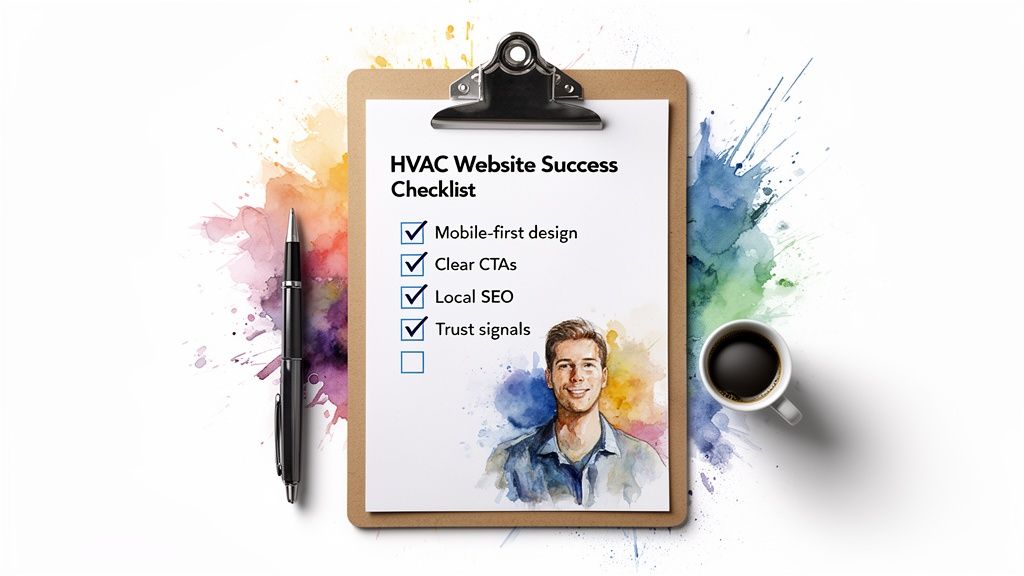
Theory is one thing, but putting it into action is what gets you paid. It's time to take all these ideas and turn them into a simple, scannable checklist.
Use this to audit your current HVAC website or to guide the build for your new one. Think of it as the pre-flight inspection for your digital lead machine. If you miss even one of these critical pieces, your site might never get off the ground and deliver the calls your business needs to grow.
Core Website and Design Audit
First up, the fundamentals. These are the absolute non-negotiables that shape every visitor's experience and your site's performance. Get this part wrong, and nothing else you do will matter.
- Is it Mobile-First? Seriously, pull up your site on your phone right now. Can you read everything without pinching to zoom? Are the buttons big enough for a thumb to tap easily? With over 60% of local searches happening on mobile, a clunky phone experience is a guaranteed lead killer.
- Does it Load Fast? Use a tool like Google's PageSpeed Insights. If your site takes more than three seconds to pop up, potential customers are gone before they even see your phone number.
- Is Your Branding Clear? Your logo, company colors, and slogan should be front and center. It needs to look professional and instantly tell visitors who you are and what you stand for.
Conversion and Lead Generation Audit
Next, let's look at the elements that turn a casual visitor into a paying customer. Your site’s #1 job is to make it ridiculously easy for a homeowner to take the next step, no matter what page they land on.
A great HVAC website doesn't just display information; it actively funnels the user toward a conversion. Every button, form, and phone number is a strategically placed tool designed to make booking a job effortless.
- Are Calls-to-Action (CTAs) Obvious? You need big, bold "Click to Call," "Book Online," or "Get a Free Estimate" buttons. They should be impossible to miss on every single page, especially right at the top.
- Is Your Contact Info Easy to Find? Your phone number should be in the header and footer of your site, and it absolutely must be tappable on a phone. Don't make people dig for it when their AC is out.
- Do You Offer Multiple Contact Options? Some people want to call, others want to fill out a form, and some prefer a live chat or online scheduler. Give them options to capture every possible lead.
SEO and Trust Signals Audit
Finally, let's make sure your site is built to get found on Google and to build instant trust with local homeowners. These signals are what convince both search engines and people that you're the right company for the job.
- Do You Have Dedicated Service Pages? Check for individual pages for each service you offer (like AC Repair, Furnace Installation) and for each major town in your service area. This is critical for local SEO.
- Is Social Proof Abundant? Your homepage should be plastered with customer testimonials, reviews from sites like Google, and any industry awards or certifications you’ve earned. Prove you're the real deal.
- Is Your Google Business Profile Linked and Optimized? Make sure your website is linked directly from your GBP. Double-check that your name, address, and phone number are perfectly consistent across both.
Common Questions from HVAC Contractors
When you're looking at building a website that actually makes the phone ring, a lot of questions come up. We hear them all the time from contractors. Here are some of the most common ones, with straight-up answers to help you move forward.
How Much Should an HVAC Website Cost?
This is a big one, and the prices you'll see are all over the map. The key is to stop thinking of it as a cost and start seeing it as an investment in a lead-generating asset.
A basic "brochure" website from a generic local designer might run you $1,000 to $5,000. The problem is, these sites look pretty but rarely have the specific tools and sales psychology needed to convince a homeowner to book a job. They're digital business cards, not lead machines.
On the other hand, a high-converting HVAC website system—the kind built by experts who live and breathe this industry—will typically range from $5,000 to $15,000+. That higher price tag gets you the good stuff: instant quote tools, built-in SEO for local search, landing pages that actually convert, and revenue tracking. It's the difference between a tool that costs you money and a tool that makes you money.
How Long Does It Take to See Results from a New Website?
This really depends on your game plan.
If you launch your new website and immediately fire up a paid ads campaign (like Google Local Services Ads or PPC), you can get the phone ringing within the first week. It's like flipping a switch for immediate lead flow.
Organic SEO, however, is a long game. Think of it like planting a tree. It usually takes a solid 3 to 6 months for Google to fully index, understand, and start trusting your new site enough to rank it for valuable keywords. This is how you build a sustainable source of "free" leads that pays off for years. The best approach? Use ads for now, and build SEO for forever.
What Is More Important: SEO or Paid Ads?
You hear this debate all the time, but it’s the wrong question. The real answer is: you need both. They work together, each playing a different but critical role in your marketing.
- SEO (Search Engine Optimization): This is your long-term asset, like owning your storefront instead of renting it. When you rank organically, you build incredible trust and authority, generating a steady stream of high-quality leads that you don't have to pay for with every click.
- Paid Ads (PPC & LSAs): This is your short-term firepower. It's the fastest way to get to the top of Google, period. Paid ads are perfect for filling gaps in your schedule, dominating during peak season, or getting leads flowing the day your new site goes live.
The winning strategy isn’t about choosing one over the other; it’s about integrating them. You use paid ads to get leads today while your SEO builds a powerful foundation for a steady stream of jobs tomorrow.
Can I Just Use My Facebook Page Instead of a Website?
Absolutely not. Let me be crystal clear on this one. Your Facebook page is a great place to connect with your community and show off your company’s personality, but it's a terrible substitute for a real website.
Why? Because you don't own your Facebook page—Meta does. They can change the algorithm, restrict your reach, or even shut your page down overnight with no explanation. Your website is an asset that you control completely.
Think of your website as the central hub for all your marketing. It’s where you send traffic from your ads, your emails, and even your social media. It's the one place online that is 100% designed to do one thing: turn visitors into paying customers.
Ready to stop guessing and start getting predictable, profitable jobs from your online presence? HVAC Growth Machine provides a complete, done-for-you system that turns your website into your best salesperson. Secure your exclusive service area today and see how it works.




Founder of HVAC Growth Machine