

Let’s be real—homeowners don’t think about their HVAC system until it’s a crisis. A dead AC in the middle of a July heatwave isn’t a casual browse; it’s a high-stakes, emergency search that sends people scrambling for their phones. This is where a rock-solid local SEO for HVAC companies becomes your single most powerful asset, making sure you’re the first name they see when their comfort is on the line.
Why Your HVAC Business Needs a Local SEO Game Plan
In the dog-eat-dog world of HVAC, your next customer is almost always just a few miles away, desperately searching for help. They’re not just kicking tires. They’re dealing with a furnace that conked out in January or an air conditioner blowing hot air during a brutal summer. These are high-intent moments where just being visible isn’t enough—you have to be unavoidable.
Showing up in Google’s Local Pack—that golden trio of businesses under the map—is today’s version of being the first company in the phone book. It’s the go-to spot for searches like “emergency furnace repair near me.” When a homeowner is in a panic, they’re calling one of those top three results, not scrolling through pages of other listings.
The Customer Journey Starts With a “Near Me” Search
To really get why this matters, you have to understand how people find you. It starts with a problem, moves to a quick local search on their phone, and, if you play your cards right, ends with your technician getting dispatched to a new job.
This flow chart breaks it down perfectly, showing how local SEO is the bridge between a customer’s problem and your solution.
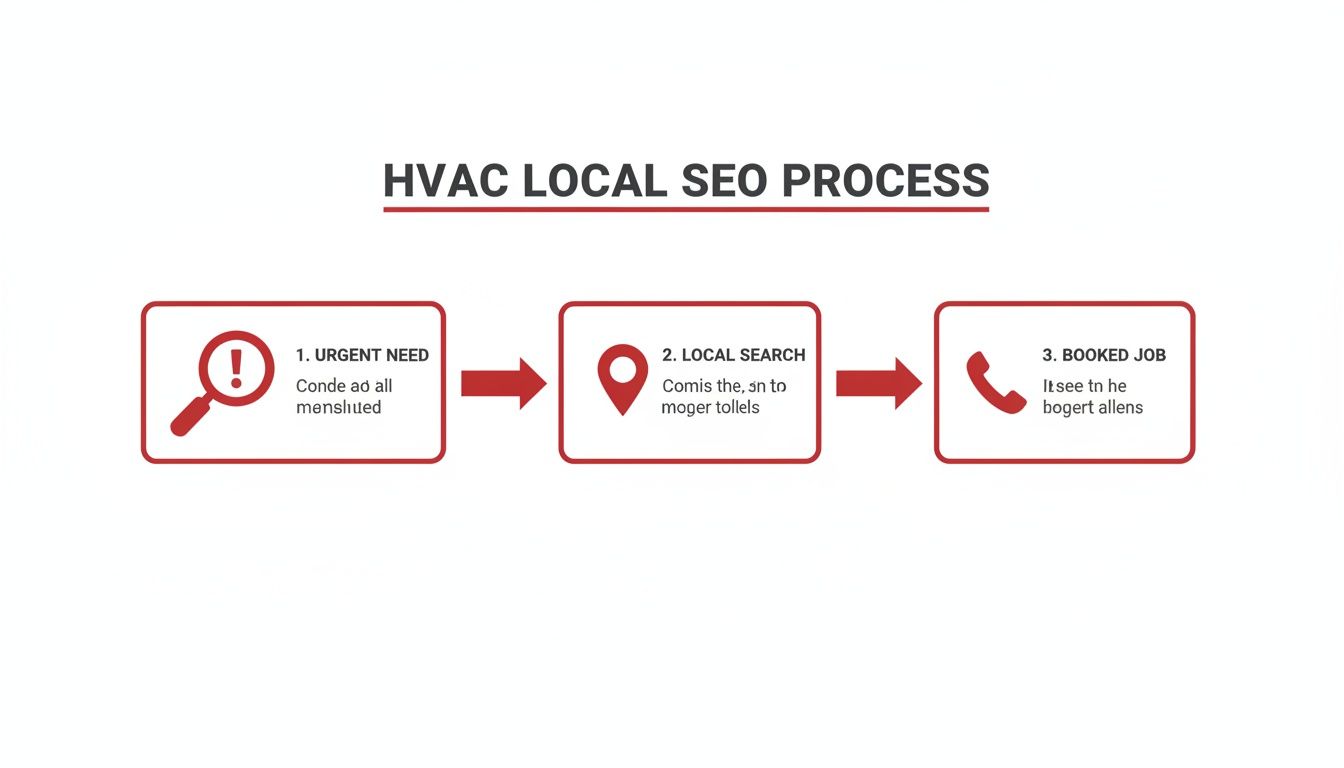
As you can see, being front and center during that “Local Search” phase is the critical link. It’s what turns a frantic homeowner into your next paying customer.
The numbers don’t lie. The HVAC industry is absolutely massive, hitting a $249 billion valuation in 2024 and projected to climb to an insane $383 billion by 2030. Since HVAC is a hyper-local game, over 80% of website clicks for contractors come from searches like ‘HVAC near me’ or ‘AC repair [city]’.
Here’s the kicker: 46% of all Google searches are for local information, and a staggering 76% of those people contact a business the very same day.
Turning Clicks Into Calls and Customers
A smart local SEO strategy does way more than just get your name out there; it drives real, measurable business. Every piece of the puzzle, from your Google Business Profile to the service area pages on your website, works together to build credibility right where you operate. This sharp focus ensures the people finding you aren’t just random visitors, but actual potential customers in your service area who are ready to book a job.
By focusing on local search, you’re not just chasing rankings. You are strategically planting your business directly in the path of homeowners with an immediate, pressing need for the exact services you provide.
To truly tap into this, it helps to have a solid grip on understanding local SEO fundamentals. This foundation makes it clear how every small optimization adds up, turning your online presence into a reliable, lead-generating machine that keeps your phones ringing.
Turn Your Google Business Profile into a Lead Magnet
Let’s be clear: your Google Business Profile (GBP) isn’t just a digital business card anymore. It’s the modern-day storefront for your HVAC company. For a homeowner whose AC just died in the middle of a heatwave, your GBP is often the very first—and last—place they look before mashing the call button. Nailing this is non-negotiable for any local SEO strategy.
A fully optimized profile does more than just tell Google where you are. It screams that you’re the most relevant, trustworthy, and active contractor in the neighborhood. It’s the difference between being buried on page two of the map results and owning a spot in the coveted Local 3-Pack, where the lion’s share of calls and clicks actually happen.
Mastering Your HVAC Categories and Services
The first place most people mess up is with categories. It seems simple, but this one choice carries a ton of weight with Google’s algorithm.
- Primary Category: Choose “HVAC contractor” or get more specific with “Air conditioning contractor” if that’s the bulk of your calls.
- Secondary Categories: Don’t just stop there. You need to add every relevant secondary category. Think “Heating contractor,” “Furnace repair service,” and “Air conditioning repair service.” This casts a much wider net to catch all the different ways customers search.
Once your categories are locked in, dive deep into the services section. This is your chance to spell out every single thing you do. Instead of a generic “AC Repair,” create separate, specific entries for things like “Ductless Mini-Split Installation,” “24/7 Emergency AC Repair,” and “Smart Thermostat Installation.” Every service you list is another keyword opportunity, another chance for Google to match you with a local homeowner in desperate need.
To make sure you’ve covered all your bases, here’s a quick checklist of the most critical optimization areas for your HVAC company’s profile.
Essential HVAC Google Business Profile Checklist
This table breaks down the must-do tasks to turn your GBP from a simple listing into a lead-generating machine. Follow these steps to ensure you’re sending all the right signals to both Google and potential customers.
| Optimization Area | Action Item | Why It Matters |
|---|---|---|
| Core Information | Verify NAP (Name, Address, Phone) is 100% consistent everywhere. | Inconsistent data confuses Google and hurts your local rankings. |
| Categories & Services | Select “HVAC contractor” as primary; add all relevant secondary categories. | This is the #1 factor for showing up in relevant searches like “furnace repair near me.” |
| Detail every single service you offer, from tune-ups to full installs. | Each service becomes a keyword Google can match to a user’s search query. | |
| Visuals & Media | Upload 10+ high-quality, geo-tagged photos and videos regularly. | Builds trust and signals to Google that you’re an active, legitimate local business. |
| Customer Engagement | Actively request and respond to every single customer review. | Social proof is massive. More positive reviews directly impact your ranking and click-through rate. |
| Content & Updates | Use Google Posts weekly to share offers, updates, and service highlights. | Shows Google you’re an active business and keeps your profile fresh. |
| Q&A Section | Proactively add and answer common customer questions. | Pre-empts customer questions and lets you control the narrative with keyword-rich answers. |
Getting these elements right is the foundation of a dominant local presence. It’s not a one-and-done task but an ongoing process that pays huge dividends in qualified, local leads.
Crafting a Description That Converts
Your business description is prime real estate. Don’t just list your services again—that’s what the services section is for. This is your chance to sell your company and weave in local keywords naturally. Talk about your commitment to the community, your years of experience, and what makes your crew the obvious choice for a homeowner in your town.
Mentioning specific neighborhoods or local landmarks adds a powerful layer of local relevance. For example, saying you’ve been “proudly serving the homeowners of Arlington for over 20 years” creates an instant connection that a generic description never could.
Your Google Business Profile is the bedrock of your local SEO efforts. Think of it less as a listing and more as a dynamic, 24/7 sales representative that works tirelessly to bring you qualified leads from your immediate service area.
For a deeper dive into making your profile a true lead-generating powerhouse, our comprehensive guide on how to optimize your Google Business Profile covers even more advanced tactics.
The Power of Visual Trust and Geo-Tagging
In the HVAC world, seeing is believing. A profile packed with high-quality photos and videos simply gets more action. Google’s own data shows that business listings with photos get 42% more requests for driving directions.
Your photo strategy needs to be deliberate. Include:
- Team Photos: Put a friendly, professional face to your brand.
- Branded Vans: Your fleet is a mobile billboard. Feature it.
- Examples of Your Work: Before-and-after shots of new installs are incredibly persuasive.
- Team Members in Action: Pictures of your team professionally performing service work builds instant credibility.
Now, here’s the pro move: geo-tag your photos. This means embedding location data directly into the image file before you upload it. When you upload a picture of that new HVAC unit you just installed in a specific suburb, you’re sending a direct, powerful signal to Google that you actively work in that area. This reinforces your local authority like nothing else.
Adding fresh, geo-tagged photos on a regular basis is one of the single most effective ways to prove to Google—and your future customers—that you are the dominant HVAC presence in your community.
Build Local Trust with Reviews and Citations
In the HVAC business, a flashy website doesn’t mean a thing if a homeowner doesn’t trust you. Trust is what turns a frantic Google search into a booked service call, and online, that trust is built on two things: customer reviews and business citations. These are the signals that tell Google you’re a real, respected player in your local market.
Think about it. When a furnace gives out in the middle of January, people aren’t just looking for any company; they’re looking for the one their neighbors would recommend. Your online reviews are today’s word-of-mouth referral, and they have a massive impact on your bottom line.
The numbers don’t lie. Local searches are gold for HVAC companies, with a staggering 80% converting into paying customers—a rate that blows most other marketing channels out of the water. What’s more, 84% of these searchers haven’t picked a company yet, making your online reputation the tie-breaker.
Businesses with four or more stars win 57% more choices, and 37% of potential customers are actively digging through Google for HVAC feedback before they even think about making a call.
Getting a Steady Stream of Positive Reviews
The absolute best time to ask for a review is right after a successful service call. The customer is happy, their problem is solved, and the value you provided is fresh in their mind. The trick is to make it a natural part of your process, not some awkward, pushy add-on.
Equip your team with a simple process. After they’ve wrapped up and walked the customer through the work, they can say something like, “We’re always trying to get better, and feedback from customers like you really helps. If you have a minute later, we’d appreciate you sharing your experience on Google.”
You can also put the process on autopilot:
- Text Message Follow-Up: An hour after a job is marked complete, send a text with a direct link to your Google review page.
- Email Automation: Drop a review request link into the final invoice or a thank-you email.
- Leave-Behind Cards: A small card with a QR code that goes straight to your Google Business Profile review section makes it dead simple for the customer.
How to Handle Every Review Like a Pro
Getting reviews is only half the battle. Responding to them shows you’re engaged and that you actually care about what your customers have to say.
For positive reviews, a simple, “Thanks so much for the kind words and for your business!” works great. If you can, personalize it by mentioning the job: “We’re glad we could get your new AC unit installed so quickly.”
Negative reviews are an opportunity, not a catastrophe. A calm, professional response can often win back an unhappy customer and shows potential clients that you take responsibility. The goal is to acknowledge the issue publicly, then take the conversation offline to find a solution. Our guide on how to respond to a negative Google review walks you through the exact process for turning a bad situation around.
The Power of Consistent Citations
While reviews build trust with homeowners, citations build trust with search engines. A citation is simply any online mention of your business’s Name, Address, and Phone number (NAP). Google spiders these mentions across the web to confirm that you are who you say you are and that your business is located where you claim.
NAP consistency is the foundation of local SEO. Even a tiny difference like using “St.” on one directory and “Street” on another can confuse Google and weaken your local authority. It has to be identical everywhere.
Start with a quick audit. Google your company name and see what pops up. Do you have old addresses or wrong phone numbers floating around on sites like Yelp, Angi, or HomeAdvisor? You need to hunt down and fix those inconsistencies immediately.
Once your core info is clean, focus on building new citations on the directories that matter most for HVAC contractors. Prioritize the platforms that homeowners actually use to find home service pros. A strong, consistent citation profile sends a powerful signal to Google, reinforcing your service area and cementing your spot in local search results. Understanding the importance of offsite SEO for Generative Engine Optimization (GEO) is key, as these external signals are becoming even more critical for proving your local authority.
Create Website Content That Wins Your Service Area
A generic “Services” page is a digital dead end. In today’s HVAC market, it’s not enough. To really own local search results, your website has to be a mirror of what homeowners in your area are actually searching for. This means getting specific—building out dedicated pages that target the exact services and locations you cover with total focus.
This strategy isn’t just about adding more pages; it’s about sending powerful relevance signals to Google. When someone in Arlington searches for “heater maintenance,” a page built specifically for that service in that town will crush a generic “Our Services” page every single time. You’re not just telling Google what you do; you’re proving you are the local authority for that specific need.
Blueprint for Hyper-Local Service and City Pages
Think of your website as a series of specialized landing zones. Every single service you offer and every city you operate in deserves its own unique page. This structure lets you speak directly to the problems and needs of different customer groups in different areas.
Here are the essential pages you need to build out:
- Service-Specific Pages: Instead of one page, create individual pages for “Air Conditioning Installation,” “Emergency AC Repair,” “Furnace Maintenance,” and “Ductless Mini-Split Systems.” Go deep on each one.
- Location-Specific Pages: If you serve multiple towns, each one gets a page. Think “HVAC Services in Arlington” or “Heating and Cooling in Springfield.”
Each of these pages needs to be packed with geo-specific content. I’m talking about testimonials from customers in that exact city, photos of jobs you’ve completed in local neighborhoods, and weaving in keywords naturally like “best AC replacement company in Arlington.” This kind of localized proof builds instant trust and credibility. For tips on laying these pages out for maximum impact, the principles of solid HVAC web design are a great starting point.
Using Schema Markup to Speak Google’s Language
Beyond what your customers see, you have to communicate clearly with the search engines themselves. That’s where schema markup (also called structured data) comes in. It’s a layer of code you add to your website that helps Google understand your content without any guesswork.
For an HVAC company, this is a game-changer. You can use HVACBusiness schema to explicitly tell Google your business type, service area, opening hours, and what payments you accept. This helps you stand out in search results and can even help you land those valuable rich snippets.

Implementing this code is like having a direct line to the search engine, making sure it perfectly categorizes your services and location. This is a non-negotiable part of a strong local SEO for HVAC companies strategy.
Think of schema markup as spoon-feeding Google the exact information it needs to rank you correctly. You’re removing all ambiguity and making it incredibly easy for the algorithm to see you as the most relevant local result.
Attracting Customers with Problem-Solving Blog Content
Your service pages are for customers who are ready to buy now. But what about all the homeowners who are still in the research phase? Creating blog content that answers common, local questions is a brilliant way to pull in valuable traffic and stamp your name as the local authority.
Homeowners aren’t just searching for “AC repair.” They’re searching for answers to their problems. By creating content that hits on their specific concerns, you grab their attention long before they’re ready to pick up the phone.
High-value local blog topics look like this:
- How much does a new AC unit cost in [Your City]?
- Signs your furnace won’t survive a [Your State] winter.
- Is a ductless system a good choice for older homes in [Your Neighborhood]?
- Local energy rebates for high-efficiency HVAC systems in [Your County].
Each one of these posts should be genuinely helpful, informative, and subtly guide the reader toward your services. When you provide real value upfront, you build trust. So when it’s finally time to make that call, your company is the only one they’re thinking about.
Track the Metrics That Actually Matter for Your Business
An SEO strategy without measurement is just guesswork. Pouring time and money into optimizing your website and Google Business Profile without tracking what’s working is like driving your service van blindfolded—you might be moving, but you have no idea if you’re actually getting closer to a paying job.
To make your local SEO for HVAC companies profitable, you have to get laser-focused on the data that directly impacts your bottom line. We’re talking about moving past vanity metrics like website traffic. The real goal is to connect every click, call, and search ranking to a scheduled appointment. You need to know with total certainty which marketing efforts are filling your calendar and which are just noise.

The stakes are high. The HVAC industry is valued at a massive $249 billion in 2024, and the competition is fierce. Local search data shows that a whopping 46% of all Google searches have local intent, and over 80% of those local searches convert into actual customers. You can’t afford to guess. For more on this, check out some recent industry analysis on the importance of HVAC local SEO.
Setting Up Call Tracking to Measure True ROI
For most HVAC businesses, the single most important conversion is a phone call. That’s why setting up call tracking is a non-negotiable step to measure the true return on your SEO investment.
Services like CallRail or WhatConverts let you assign unique, trackable phone numbers to all your different marketing channels. This means you can finally see exactly how many calls came directly from:
- Your Google Business Profile’s “click-to-call” button.
- A specific service page, like your “Emergency AC Repair in Phoenix” page.
- Your general organic search traffic.
Without this data, you’re flying blind. You won’t know if that spike in calls last week came from the GBP work you did or that new ad campaign, making it impossible to double down on what’s actually working.
Essential Free Tools for Monitoring Performance
The good news? You don’t need a huge budget to start tracking the metrics that matter. Google gives you some incredibly powerful and completely free tools to get a clear picture of your local search performance.
Google Search Console (GSC) is your direct line to understanding how Google sees your website. It’s a goldmine of information, showing you which search terms are bringing people to your site, your average ranking for those terms, and how many people are actually clicking through. Best of all, you can filter this data by page to see how your “Furnace Installation in Denver” page is performing compared to your “AC Maintenance” page.
Google Business Profile Insights gives you a quick snapshot of how customers are interacting with your listing in the map pack. It tracks key actions you care about:
- Phone Calls: The number of people who clicked your call button.
- Website Clicks: How many visitors went to your site from your GBP.
- Direction Requests: A strong signal from a customer ready to do business.
By checking GSC and GBP Insights regularly, you can spot trends, identify underperforming pages, and see which of your services are drumming up the most interest. This data-driven approach lets you stop guessing and start making strategic decisions that lead to more jobs.
Key HVAC Local SEO Performance Indicators
To make tracking simple, focus on a handful of key performance indicators (KPIs). These are the numbers that give you a clear, at-a-glance view of whether your efforts are paying off. Here are the most important ones to watch.
| Metric | What It Measures | Tool for Tracking |
|---|---|---|
| Local Organic Rankings | Your website’s position in Google for target keywords (e.g., “ac repair houston”) across different ZIP codes. | BrightLocal, Whitespark, SEMrush |
| Google Maps/Local Pack Rankings | Your business’s visibility in the “map pack” for critical local searches. | BrightLocal, Whitespark |
| Google Business Profile Actions | The number of calls, website clicks, and direction requests originating from your GBP listing. | Google Business Profile Insights |
| Organic Search Traffic | The number of visitors coming to your website from unpaid search results. | Google Search Console, Google Analytics |
| Phone Calls from Organic Search | The volume of inbound calls generated specifically from your website’s organic traffic. | CallRail, WhatConverts |
| Conversion Rate | The percentage of website visitors who take a desired action (call, fill out a form). | Google Analytics, Call Tracking Software |
| Cost Per Lead (CPL) | The total marketing spend divided by the number of leads generated, telling you the real cost of a new opportunity. | CRM, Call Tracking Software |
Tracking these metrics consistently will give you the clarity needed to make smarter marketing investments and ensure your SEO strategy is directly contributing to your bottom line.
Using Local Rank Trackers for Hyper-Local Visibility
Here’s a major challenge for HVAC companies: your search rankings can change dramatically from one neighborhood to the next. You might rank #1 in the Local Pack when searching from your own office, but be completely invisible just five miles down the road in a neighborhood you serve every day.
This is where specialized local rank tracking tools become absolutely essential. Tools like BrightLocal or Whitespark let you monitor your keyword rankings across multiple, specific locations—simulating searches from different ZIP codes and towns.
This gives you a true map of your visibility. You can see exactly where you’re strong and, more importantly, where you need to focus your SEO efforts next. This granular data ensures your marketing dollars are actually making an impact in all the communities you serve.
Frequently Asked Questions
Even with a solid game plan, I find most HVAC owners have the same practical questions when it comes to local SEO. Let’s tackle the big ones so you can feel confident moving forward and start investing in your company’s growth.
How Long Does Local SEO Take to Work for an HVAC Company?
This is always the first question, and it’s an important one. Think of local SEO as a long-term investment, not a quick fix. You’re building a sustainable asset that brings in leads for years, not just trying to get a temporary spike in calls.
While some of the initial tweaks—like fully optimizing your Google Business Profile—can show small signs of life within a few weeks, getting to the top of the search results for valuable keywords like ‘AC repair [your city]’ usually takes about 3 to 6 months of consistent work. It’s a lot like building a great local reputation in real life; you have to put in the time to earn Google’s trust and prove you’re the authority in your service area.
A few things can speed this up or slow it down:
- Market Competition: Trying to rank in a major metro area packed with dozens of established HVAC companies is a different ballgame than ranking in a smaller town. More competition means you’ll need a more aggressive, sustained effort.
- Your Starting Point: If you’re starting with a brand-new website and zero online presence, the runway is longer. A business that already has some local history and a handful of good reviews has a head start.
- Consistency of Effort: SEO is all about momentum. Showing up and doing the work month after month will always beat sporadic, start-and-stop efforts.
What Is a Realistic Monthly Budget for HVAC Local SEO?
There’s no magic number here—a realistic budget really depends on how competitive your market is and what your growth goals are. The most important thing is to stop thinking of it as a “cost” and start seeing it as an investment that should generate a serious return through high-ticket installation and repair jobs.
For a smaller HVAC business in a less crowded town, a good starting point might be around $500 to $1,500 per month. This usually covers the foundational work like managing your GBP, building out citations, and handling on-page optimizations.
For companies in major cities with tons of aggressive competitors, you’re looking at a more significant investment, typically in the $2,000 to $5,000+ per month range. A budget like that allows for a much more comprehensive strategy, including building out targeted service and city pages, consistent content creation, and proactive local link-building campaigns.
Your budget should directly mirror your revenue goals. A bigger investment isn’t just about ranking higher; it’s about capturing a larger piece of the market and driving a higher volume of profitable installation jobs, not just small service calls.
Can I Do Local SEO Myself or Should I Hire an Agency?
This is a critical question every business owner faces. The honest answer? You can absolutely handle some of the basics yourself, especially if you’re just getting started or have a tight budget. These are great tasks to manage in-house.
Tasks you can manage yourself:
- Filling out and verifying your Google Business Profile.
- Regularly uploading new photos of your team, trucks, and examples of your work.
- Creating a simple, repeatable process to ask every single customer for a review.
- Responding to all new reviews—the good and the bad.
But local SEO gets complicated, fast. When you get into advanced strategies like technical website optimization, building hundreds of citations correctly, earning local backlinks, and writing perfectly optimized content, you’re talking about a specialized skill set and a huge time commitment.
Hiring an agency that lives and breathes HVAC digital marketing can seriously accelerate your results. It frees you up to do what you do best: run your business. A good agency brings proven playbooks, expensive tools, and deep industry knowledge that’s tough to replicate on your own, especially when every spot in the search results counts.
Ready to stop guessing and start getting a predictable flow of profitable install jobs? The team at HVAC Growth Machine builds done-for-you websites and lead generation systems designed to dominate local search, fill your calendar, and grow your business reliably. Learn more and secure your service area today.





Founder of HVAC Growth Machine