

When a negative Google review pops up, your gut reaction might be to ignore it, delete it, or get defensive. But the right move is to lean in. Acknowledge the customer’s frustration, apologize for their bad experience, and offer to take the conversation offline to fix it.
This single act can turn a public complaint into a powerful demonstration of your company’s integrity and customer service.
Why Every Negative Review Demands a Thoughtful Response
Think of a negative review less as a blemish on your Google Business Profile and more as a public conversation. Every single homeowner scrolling through your reviews is watching to see how you handle the heat.
Ignoring a complaint is loud. It tells potential customers you either don’t care about their satisfaction or don’t know how to solve problems when they crop up.
This is your chance to grab the microphone and control the narrative. A smart, empathetic response flips a one-sided complaint into a live showcase of your company’s values. It proves you listen, you own your mistakes, and you’re committed to making things right. Honestly, that can be more convincing than a dozen glowing five-star ratings.
Building Trust with the Silent Majority
For every person who takes the time to write a review, there are dozens, maybe hundreds, of others just reading them. They’re the silent onlookers, the ones trying to decide who to call for their A/C replacement.
When they see you engaging with negative feedback like a pro, you’re not just talking to that one unhappy customer. You’re earning the trust of every future prospect watching from the sidelines. They see a business that’s accountable and confident enough to face criticism head-on.
That interaction shapes their entire perception of your HVAC company. They start to see you as a reliable partner—someone who will be there for them if something goes wrong with their new furnace install.
Your public response isn’t really about winning back one unhappy customer. It’s about winning over the next hundred who are watching to see how you react.
The data backs this up. A solid 56% of customers say they’re more likely to choose a business that actively responds to Google reviews. And when you consider that 88% of consumers trust online reviews as much as a recommendation from a neighbor, you realize your review section is prime real estate. Failing to respond is like hanging up on a customer in the middle of a crowded showroom.
The Hidden SEO Benefit of Responding
Here’s something most HVAC owners miss: responding to reviews isn’t just reputation management, it’s also good for your search rankings.
Google sees every interaction on your Google Business Profile. When you consistently reply to reviews, it signals that your business is active, engaged, and values its customers. This can actually give your local search rankings a nice little bump.
It also gives you a natural way to use important keywords. For example, a simple reply like, “We’re very sorry you had a frustrating experience with our AC repair in Dallas,” subtly reinforces both your service and your location. These small signals add up, strengthening your local SEO and making it easier for new customers to find you. If you want to dive deeper, you can learn more about how to generate more SEO leads for your business. It’s a simple habit that helps build a much stronger online presence.
The First 15 Minutes: Your Triage Checklist
When that notification for a one-star review hits your inbox, the gut reaction is to jump online and start defending your company. Fight that urge. The single most powerful thing you can do in that moment is to take a strategic pause.
Before your fingers even touch the keyboard, take a deep breath and give yourself just 15 minutes to run a quick internal investigation. This brief triage period stops a knee-jerk reaction from turning a bad situation into a total dumpster fire. You’ll be gathering facts, not reacting with emotion. This is the foundation for a response that’s measured, professional, and actually helpful—the kind of reply that impresses both the upset customer and the dozens of prospects reading along.
Verify the Customer and the Claim
First things first: is this person even a real customer? Cross-reference the reviewer’s name and the details of their complaint with your CRM or service records. You’d be surprised how often a negative review comes from someone who isn’t in your system at all, which is a huge red flag for a fake review.
Assuming they are a real customer, it’s time to dig into the job file. Your goal here is to get the full picture of the service call before you form an opinion.
- Check Technician Notes: What did your tech write down? Did they mention any complications, parts on backorder, or specific concerns the customer had during the visit? The notes are your first source of on-the-ground truth.
- Review Internal Communications: Look at any emails or internal chat logs related to the job. Was there a scheduling mix-up that someone mentioned? A question about pricing that got passed around?
- Listen to Call Recordings: If you use call tracking, this is pure gold. Listen to the initial booking call and any follow-ups. The tone and specific words used in these calls provide context you just can’t get from a text summary.
This process transforms a vague complaint into a specific, documented event. You’re no longer guessing; you’re operating from a clear understanding of what happened from your team’s perspective.
Pinpoint the Core Issue
With the facts in hand, you can now diagnose what really went wrong. Negative reviews are rarely random; they’re symptoms of a breakdown in one of a few key areas.
This visual shows how your response to a single review can directly influence the trust of future customers.
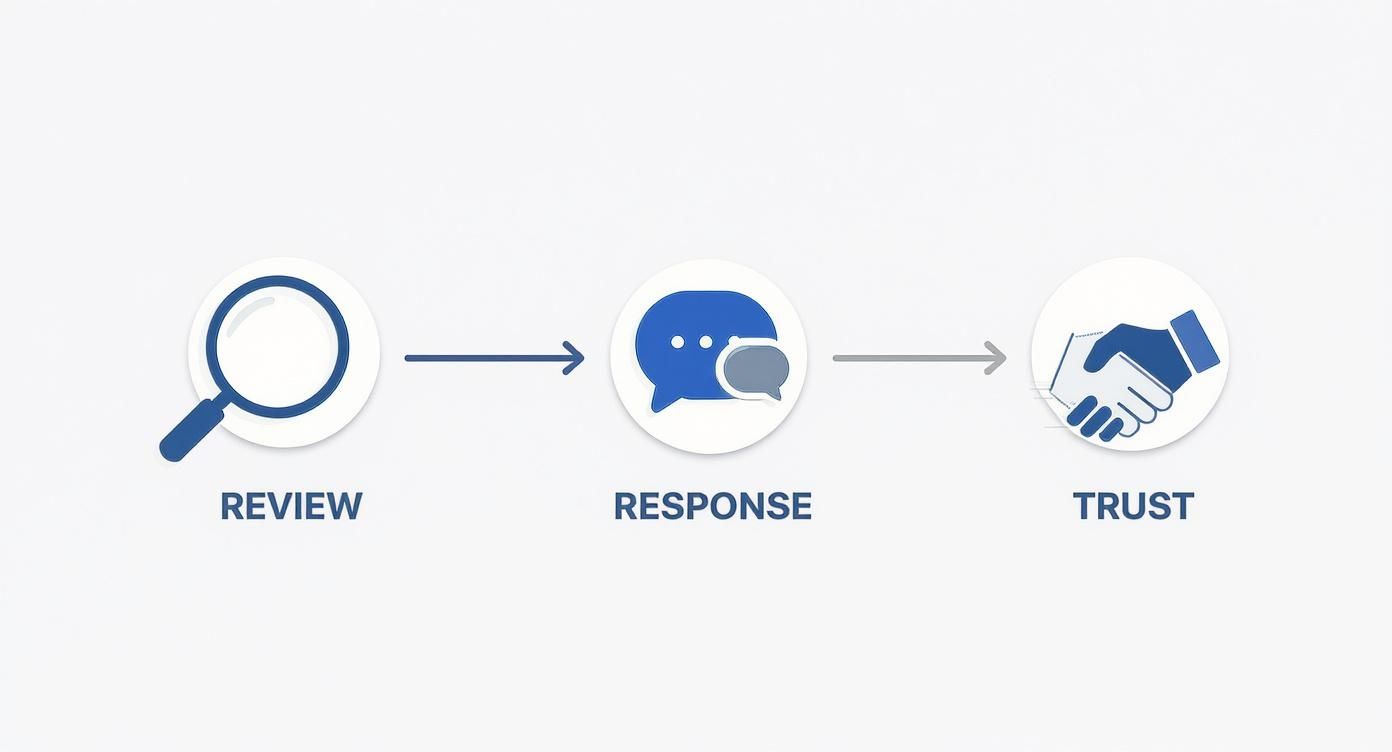
This simple flow proves that a thoughtful, public response is a critical step in turning a negative experience into a positive brand impression.
Was the problem a simple communication gap where the final bill wasn’t explained clearly? Or was it an operational failure, like a part that failed prematurely? Pinpointing the exact source allows you to address the actual problem, not just the customer’s anger.
Key Takeaway: You can’t solve a problem you don’t fully understand. Investigating first ensures your public response addresses the real issue, showing onlookers you’re thorough and fair.
Assess the Reviewer’s Tone
Okay, last step. Reread the review one more time, but this time, ignore the details and focus only on the tone. Is the customer genuinely frustrated and looking for a real solution, or are they just trying to burn the house down?
Knowing the difference between a constructive complaint and an inflammatory attack is crucial. A constructive review, even if it’s angry, usually has specific details and expresses disappointment. An inflammatory one is all about personal insults, over-the-top language, or completely unreasonable demands.
Understanding their mindset helps you decide your next move. Do you lead with a direct offer to fix the problem, or do you start with a more careful, de-escalating approach? This final analysis is how to respond to a negative google review in a way that actually matches the reviewer’s emotional state, dramatically increasing your chances of turning things around.
How to Craft the Perfect Public Response
Alright, you’ve done your initial 15-minute investigation and you have the facts. Now comes the part that everyone sees: the public reply. Think of this less as damage control and more as a marketing opportunity. Your response is a permanent billboard showcasing how you handle problems, and every potential customer is watching.
Forget those stiff, copy-paste templates. They sound robotic and everyone can spot them a mile away. What you need is a flexible framework, not a rigid script. I’ve found that the best responses are built on four key pillars that let you stay professional while tailoring your message to the actual complaint.

Acknowledge and Personalize
First things first, show the reviewer you actually read what they wrote. Use their name and mention the specific problem they brought up. This one small step immediately takes the heat out of the situation.
A generic “We’re sorry for your experience” is basically the corporate version of “I’m not listening.” Get specific. If they complained about a tech leaving a mess, your reply needs to reflect that.
- Weak Response: “Hi John, we’re sorry you were unhappy with our service.”
- Strong Response: “Hi John, thank you for bringing this to our attention. We were very concerned to read your feedback about the condition your home was left in after our recent furnace installation.”
See the difference? The second one proves a real person read and understood their specific frustration. That’s half the battle.
Express Genuine Empathy
Once you’ve acknowledged the issue, you need to validate their feelings. You don’t have to agree with every point they made to understand why they’re upset. Empathy isn’t admitting fault; it’s just showing you get it.
Use phrases that connect on a human level. Show them you can see things from their side of the fence.
Key Takeaway: Most of the time, people just want to feel heard. A little empathy can completely defuse a tense situation and open the door to a real solution.
Let’s say a customer is angry about a surprise charge on their bill. You could say something like, “I can absolutely understand how frustrating it would be to receive a bill that was higher than you expected. Nobody likes financial surprises, and we sincerely apologize for the stress this has caused.”
Apologize and Take Ownership
This is where a lot of business owners get nervous. They worry that saying “sorry” is like admitting guilt in a court of law. It’s not. A well-phrased apology is about taking ownership of the customer’s bad experience, not necessarily admitting legal liability.
You can apologize for their frustration, a miscommunication, or the simple fact that your service fell short of their expectations. Good data backs this up: 89% of consumers say a thoughtful response to a negative review actually improves their opinion of a business. A real apology is the core of that response.
Here’s how you could handle a common complaint about a technician’s attitude:
“We are truly sorry that our technician’s conduct did not meet the professional standards you expected from our team. We pride ourselves on courtesy and respect, and we apologize that your experience felt short of that mark.”
This owns the customer’s perception without throwing your tech under the bus before you have the full story. It’s a balanced approach that validates the customer while you figure things out internally.
Move the Conversation Offline
This is the final—and most important—step. Your goal is to solve the problem, not get into a public back-and-forth for the entire internet to see. Get the conversation into a private channel, fast.
Give the customer a clear, direct way to reach a specific person who can actually fix things. This shows you’re serious and puts you back in control.
- Don’t say: “Please call our office.”
- Instead, say: “I want to personally look into this and find a solution. Please call me, Jane Doe, the Service Manager, directly at (555) 123-4567 or email me at [email protected].”
That direct invitation is a power move. It shows real accountability and makes the customer feel like their issue is being taken seriously by someone with authority. Mastering this is fundamental to learning how to respond to a negative google review effectively. It contains the problem while publicly proving you’re committed to making it right.
This framework is your blueprint for handling any negative review. Here’s a quick breakdown of how the pieces fit together.
Negative Review Response Framework
This table outlines the essential building blocks for a professional and effective public response. Use it to guide your structure every time.
| Component | Objective | Example Phrasing |
|---|---|---|
| Personalized Greeting | Show you see them as an individual, not a ticket number. | “Hi [Customer Name], thank you for your feedback.” |
| Specific Acknowledgment | Prove you read and understood their specific complaint. | “We were concerned to read about the issue with…” |
| Sincere Empathy | Validate their feelings and de-escalate the situation. | “I can certainly understand how frustrating that must have been.” |
| Ownership & Apology | Take responsibility for their negative experience. | “We sincerely apologize that our service did not meet your expectations.” |
| Move It Offline | Provide a direct contact to resolve the issue privately. | “I’d like to personally make this right. Please call me, [Your Name], at [Direct Number].” |
By consistently following this Acknowledge, Empathize, Apologize, and Move Offline structure, you can de-escalate public conflicts, demonstrate your professionalism, and take control of the resolution process every single time.
Transforming Bad Reviews Into Business Gold
Let’s shift your perspective for a minute. That one-star review isn’t just a fire you need to put out. It’s raw material you can use to build a stronger business and a more dominant online presence. Handled the right way, a complaint can become one of your most powerful marketing assets.
Every single potential customer scrolling through your reviews is looking for proof. Think about it—a perfect string of 5-star ratings can almost feel fake. Seeing a few bumps in the road, and more importantly, how you handled them with grace, shows you’re a real, accountable business. This is your chance to shine in front of an audience of silent onlookers.
Turn Your Response Into an SEO Asset
Your public reply is so much more than customer service; it’s a golden opportunity to reinforce your local search signals. Google is watching. It pays attention to every single piece of content on your Google Business Profile, and that includes how you respond to reviews.
This is the perfect, natural place to remind Google what you do and where you do it.
Instead of a generic, “We’re sorry,” you can strategically weave in keywords. This doesn’t mean stuffing your response with awkward phrases. It has to feel completely natural.
- Instead of: “We’re sorry for the issue with your service.”
- Try this: “We’re very sorry that our HVAC repair team in Austin didn’t meet your expectations during the recent service call.”
That simple tweak reinforces both your service and your location. It’s a small but meaningful boost to your local SEO. Every reply becomes a micro-optimization that strengthens your digital footprint. Consistently doing this is one of the core benefits of local SEO that most HVAC companies completely miss.
Mine for Business Intelligence
Beyond the public relations win, negative feedback is some of the most honest and valuable business intelligence you will ever get. It’s unfiltered, direct insight into your customer experience, shining a spotlight on cracks in your operation you can’t see from the inside.
Treat these complaints like a consultant’s report. Don’t just react to the one incident; start looking for patterns.
A single complaint is a story. A pattern of similar complaints is a data point demanding action. It’s the market telling you exactly where your business needs to improve.
Start tracking the themes that pop up in your bad reviews. Are you seeing the same issues come up month after month? Grouping them can reveal systemic problems that, once you fix them, will elevate your entire business.
Identify and Fix Operational Gaps
By analyzing complaint themes, you can pinpoint specific weaknesses in your business model. This feedback loop is absolutely essential for long-term growth and can prevent countless future negative reviews.
Try organizing the feedback into these common buckets:
- Communication Breakdowns: Are customers constantly surprised by the final invoice? This might signal a need to improve how your techs explain pricing and get approval before starting additional work.
- Technical Skill Gaps: If you see multiple complaints about a specific type of repair (e.g., “the furnace stopped working again two days later”), it could point to a training gap for certain equipment.
- Scheduling and Dispatch Issues: Are people complaining about late arrivals or, even worse, no-shows? This points directly to a problem in your dispatching software or the communication protocol between the office and the field.
- Professionalism and Conduct: Feedback about a technician’s attitude or cleanliness is a loud, clear signal that it’s time to revisit customer service training and reinforce your company standards.
Each of these data points is a gift. A customer took the time to tell you exactly how to become a better company. By listening and acting on these patterns, you do more than just figure out how to respond to a negative google review—you learn how to stop them from happening in the first place. You turn today’s complaint into tomorrow’s competitive advantage.
Dealing With Fake Reviews and When to Flag Them
Let’s be real—not every one-star review comes from an actual customer. Sometimes, a bad review is just spam, a local competitor trying to drag you down, or someone who confused your company with another. You have to know the difference between a review you just don’t like and one that flat-out violates Google’s rules.
Responding to a real complaint is just good business. But letting a fake review sit there unanswered can be just as bad for your reputation.
Your first move is to spot the fakes. The biggest red flag? You can’t find any record of the reviewer in your customer database. Reviews with super vague complaints (“terrible service”), personal attacks on your techs, or weird links to other websites are also prime candidates for removal.
Knowing What Breaks the Rules
Google has a very specific set of policies for reviews. Your opinion on whether the review is “fair” doesn’t matter one bit. What matters is whether it breaks one of their rules. Getting familiar with these policies is the secret to getting bogus reviews taken down.
Here are the most common violations we see HVAC businesses run into:
- Spam and Fake Content: This is the obvious stuff—reviews from bots, fake accounts, or anything clearly designed to manipulate your star rating.
- Off-Topic Reviews: A review ranting about politics or complaining about the wrong company has no business being on your profile. The review has to be about a customer’s experience with you.
- Conflicts of Interest: This is a big one. Reviews from current or former employees, or even your direct competitors, are a huge no-no.
- Harassment or Hate Speech: Any review that personally attacks an employee, uses offensive language, or incites hatred is a clear violation and should be flagged immediately.
It’s important to see the line here. A customer complaining that your bill was too high is their opinion, and it will stay. A “customer” you’ve never served leaving a one-star review is potentially fraudulent and worth fighting.
How to Flag a Review for Removal
Once you’ve found a review that you’re confident violates Google’s policies, it’s time to report it. You can do this right from your Google Business Profile. The process is simple, but success isn’t always a sure thing.
Google gives you a clear list of what’s prohibited to guide you.
This screenshot shows the exact categories Google looks at. Having proof that a review fits into one of these buckets is everything when you make your request.
Here’s how you do it:
- Log in to your Google Business Profile manager.
- Find the review you need to report.
- Click the three little dots next to the review and hit “Report review.”
- Pick the violation type that best describes the problem.
Key Takeaway: Now, you wait. Google has a real person look at every flagged review, and it can take several days—sometimes longer. Just flagging it doesn’t mean it’s coming down.
Don’t give up if your first request gets denied. You can appeal the decision and provide more context. This is where having documentation, like a screenshot from your CRM showing the person was never a customer, can make all the difference.
While you’re waiting, it’s a smart move to post a calm, professional reply. Something like, “We don’t have a record of you in our system, but we’d be happy to discuss this if you could contact our office directly.” This shows potential customers that you’re on top of things, even when you’re dealing with a review that might not be legit.
Building a Proactive Reputation Management System
Let’s be real. The best defense against a negative review isn’t some perfectly crafted reply. It’s having so many glowing five-star reviews that the bad one gets buried. Responding to criticism is something you have to do, but building a system to proactively get good reviews is where the real power lies. This is how you shift from playing defense to actively shaping what people think about your business every single day.
A strong online reputation is built by making it ridiculously easy for your happy customers to sing your praises. You don’t need some complex marketing plan for this. It’s all about simple, repeatable steps baked right into your daily workflow. The goal is to create a constant flow of authentic, positive feedback that makes any single negative review look like a minor blip.
Simple Tactics for Generating Positive Reviews
To make this happen, you need to catch customers when they’re happiest. That golden moment right after a successful install or a tricky repair is your best shot at getting a great review.
- Train Your Techs: Your technicians are on the front lines. Get them in the habit of politely asking for a review after a job well done, especially when the customer is clearly thrilled with the work. A simple, “We’d love to hear your feedback on Google if you have a minute,” can work wonders.
- Automate Your Follow-Up: Use your scheduling or invoicing software to send an automated text or email the day after service. Make it painless—include a direct link to your Google review page so they don’t have to go searching.
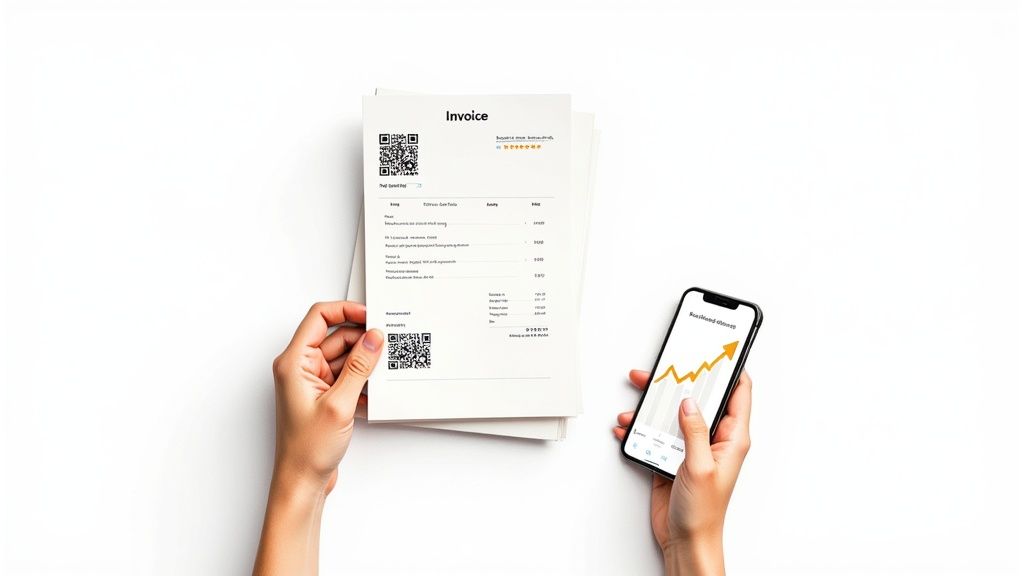
- Put It On the Invoice: Add a QR code that links straight to your Google Business Profile on every invoice. It’s a simple, physical reminder for the customer to take action while they have your company top-of-mind.
The Critical Role of Response Time
A proactive system isn’t just about getting new reviews; it’s also about jumping on all feedback—good or bad—as quickly as possible. Don’t let reviews sit there. Timeliness is huge, as 53% of customers expect a business to reply to their negative review within a single week.
Ignoring them can spike your customer churn by as much as 15%. And since 97% of people who read reviews also read the business’s responses, your engagement (or lack thereof) is on full display.
Creating a simple, repeatable process for requesting, monitoring, and responding to all reviews puts you in the driver’s seat of your online reputation.
When you manage it right, your Google Business Profile becomes one of your most valuable sales tools. It’s a living, breathing testament to your quality of work and a magnet for new customers. For a deeper dive, check out our guide on how to optimize your Google Business Profile. This is the final piece of the puzzle that helps you build the five-star reputation you deserve.
Got Questions? We’ve Got Answers
Dealing with negative Google reviews can feel like walking on eggshells. Let’s tackle some of the most common questions HVAC owners have when they’re in the hot seat.
How Fast Should I Really Respond?
You need to be on it within 24 hours. Seriously. A fast reply shows the person who left the review—and everyone else reading it—that you’re paying attention and you actually care.
If you let a bad review sit there for a week, it looks like you’re ignoring the problem. Plus, more than half of customers expect a business to get back to them within that 24-hour window anyway. A quick, professional response can put out the fire before it spreads.
Should I Offer a Refund or a Discount in My Public Reply?
Absolutely not. Never, ever offer money or freebies in a public response.
Once you do that, you’ve set a precedent. You’re basically inviting anyone who wants a discount to leave a one-star review. Instead, keep your public reply focused on acknowledging their frustration and moving the conversation offline.
Key Takeaway: Your public reply should signal, “We hear you, and we want to fix this.” The actual fix—whether it’s a refund, a follow-up visit, or just a clear explanation—needs to happen in a private phone call or email.
This keeps you looking professional and stops your Google reviews from turning into a public bargaining table.
What If the Review Is Just Plain Wrong?
It happens. Someone leaves a review that’s completely untrue. If it doesn’t violate Google’s policies for removal, you still have to respond.
The last thing you want to do is get into a public shouting match. Calmly and professionally state your side of the story without getting emotional. Then, invite them to talk privately to sort it out.
Something like, “We don’t have a record of this service call under your name, but we take this seriously and would like to investigate. Could you please call our manager at…” works perfectly.
This strategy shows other potential customers that you’re reasonable and thorough, and it lets them see the potential discrepancy for themselves. You’re addressing the lie head-on while staying in control of the situation.
Ready to turn your website into a lead-generating powerhouse? HVAC Growth Machine builds high-converting websites with built-in estimate tools and automated follow-ups designed to fill your calendar with profitable install jobs. Learn more and secure your exclusive service area at https://hvacgrowthmachine.com.





Founder of HVAC Growth Machine