

When we talk about SEO lead generation, we’re talking about a system that attracts potential customers to your HVAC business through search engines like Google. The goal is to capture high-intent homeowners the moment they’re actively looking for a solution you provide.
This isn’t about chasing down leads with disruptive ads. It’s about turning your website into a consistent, reliable source of qualified customers who are ready to make a call.
Why SEO Is Your Best Source for HVAC Leads
Let’s cut right to it. SEO isn’t just another marketing channel for your HVAC business—it’s the most sustainable engine for real growth.
Think about it. Traditional advertising interrupts people. SEO connects with them at the exact moment they need you most. When a homeowner’s air conditioner dies in the middle of a July heatwave, they aren’t flipping through mailers. They’re grabbing their phone and searching for “AC repair near me.” Being the first result they see is the modern-day equivalent of being the most trusted name in town.
This process transforms your website from a simple online brochure into your best salesperson—one that works 24/7 to get you seen, attract clicks, and turn those clicks into booked jobs.
This simple flow shows exactly how SEO turns search engine visibility into real leads for your business.
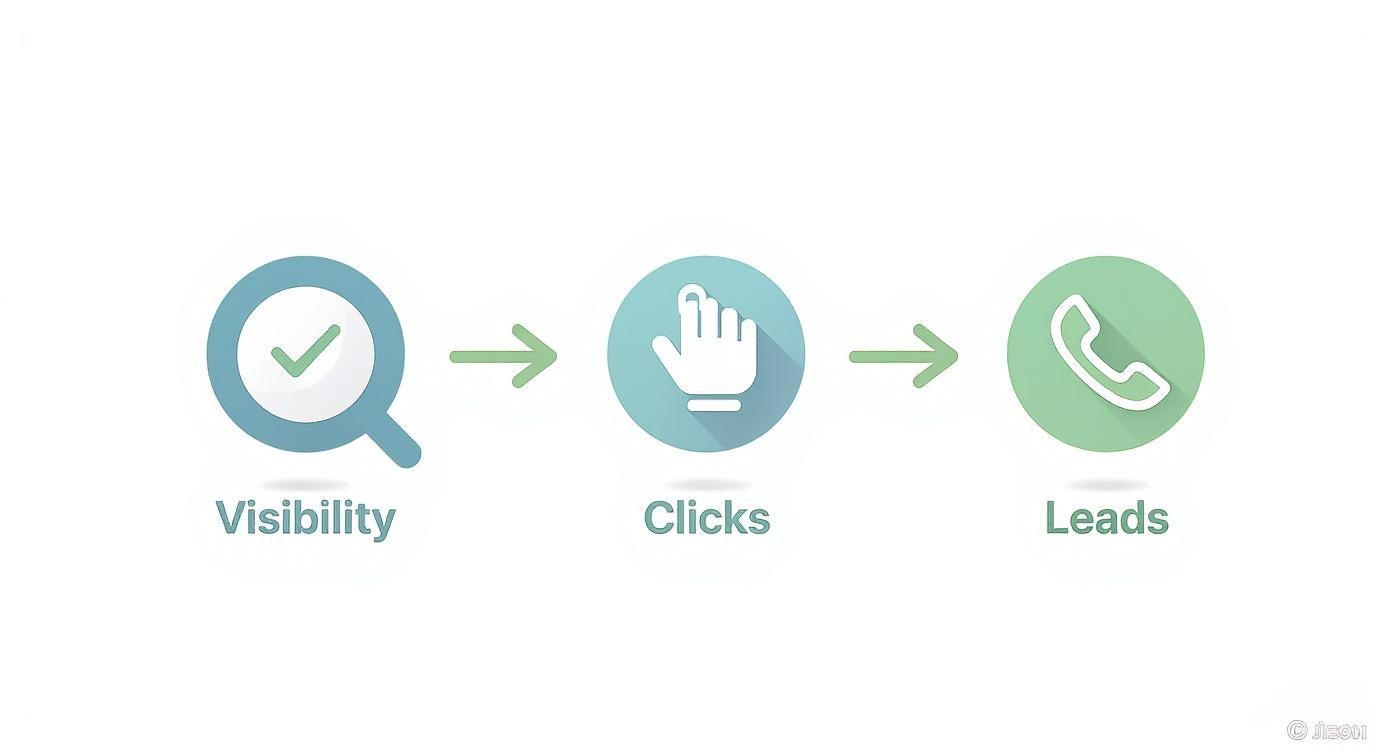
As you can see, getting high rankings is just the first step. The real goal is to drive meaningful actions—phone calls and quote requests—that actually grow your bottom line.
The Power of Inbound Interest
The real magic of SEO is the quality of the lead. These aren’t cold calls; they’re inbound inquiries from people with an urgent problem they need solved now.
This “hand-raiser” dynamic is precisely why SEO leads close at a much higher rate than leads from other marketing methods.
SEO leads have an impressive 14.6% close rate, which absolutely crushes outbound marketing’s measly 1.7% conversion rate. That’s a nearly nine-fold difference, and it’s why smart companies keep investing in organic search.
This is especially true for local services like HVAC. A solid strategy gets you to the top of the local search results and, more importantly, into the Google Map Pack. That’s where the emergency repair calls and high-ticket installation inquiries happen. If you want to dive deeper, you can learn more about why local SEO is a game-changer for HVAC contractors and how it builds trust with both customers and Google.
To break it down, a successful HVAC SEO strategy for generating leads rests on a few core pillars.
HVAC SEO Pillars for Lead Generation
| SEO Pillar | Primary Goal | Key Action |
|---|---|---|
| Local SEO & GBP | Dominate the Map Pack | Fully optimize your Google Business Profile with services, photos, and reviews. |
| On-Page SEO | Match Homeowner Intent | Create service and city pages targeting keywords like “furnace repair [City]”. |
| Technical SEO | Ensure a Great User Experience | Optimize site speed, mobile-friendliness, and secure a clean site structure. |
| Content Marketing | Build Authority & Trust | Publish helpful blog posts answering common HVAC questions to attract traffic. |
| Link Building | Increase Domain Authority | Earn backlinks from reputable local and industry-specific websites. |
Each of these pillars works together to build a powerful, lead-generating asset for your business.
Ultimately, investing in SEO is about building something that lasts. Unlike paid ads that vanish the second you stop paying, a strong organic presence delivers a predictable and profitable stream of customers. It builds your authority, earns trust, and most importantly, keeps your calendar full.
Winning the Local Search Game with Google
For any HVAC company, local search is where the money is. This isn’t just about having a website; it’s about owning the top spots in your service area when a homeowner’s AC dies on a scorching afternoon. The absolute center of this fight is your Google Business Profile (GBP)—it’s the digital storefront that determines whether you get the call.
A well-managed GBP is the single most powerful tool for immediate seo leads generation. It’s what gets you into the coveted Google Map Pack—that block of three businesses that appears at the top for searches like “AC repair near me.” Showing up here is non-negotiable if you want a consistent flow of leads.
Optimizing Your Google Business Profile
Think of your GBP not as a static listing but as an active, living marketing channel. Getting it right involves a lot more than just plugging in your business name and address.
First, nail your categories. Your primary category should be “HVAC contractor.” From there, add every secondary category that applies to your services, like “Air conditioning repair service,” “Furnace repair service,” and “Air duct cleaning service.” This tells Google exactly what you do, helping you show up for a much wider range of searches.
Next, write a business description that actually sells. This is your chance to tell potential customers why you’re the right choice. Mention your years in business, your commitment to quality, any special financing you offer, and the specific neighborhoods you serve. Naturally sprinkle in keywords like “emergency HVAC service” or “new furnace installation” to reinforce what you do. For a deeper dive, check out our complete guide on how to optimize your Google Business Profile for more HVAC leads.
Building Trust with Reviews and Visuals
In a service business, social proof is everything. Customer reviews are a huge ranking factor and a massive trust-builder. You need to be actively and consistently asking happy customers for reviews. And just as important, respond to every single one—both the good and the bad. It shows you’re engaged and that you actually care about customer feedback.
Visuals are just as critical. Upload high-quality, real photos of your team on the job, your branded vans, and recent installations. Here’s a powerful but often overlooked tip: geotag your photos before you upload them. This embeds location data right into the image file, sending another strong signal to Google about exactly where you operate.
Pro Tip: Use GBP Posts for seasonal offers. In the spring, create a post about an “AC tune-up special.” Come fall, promote a “furnace safety inspection.” These posts are like mini-ads that show up directly on your profile, grabbing immediate attention and driving calls.
The Importance of Consistent Citations
Beyond your GBP, Google scours the web for consistent information to verify that your business is legitimate and located where you say it is. This is where NAP (Name, Address, Phone number) consistency is a make-or-break factor.
Your NAP info must be identical across all online directories and citation sites. This includes the big players like Yelp, Angi, and the Better Business Bureau, but also smaller local directories. Even a tiny variation, like using “St.” instead of “Street,” can confuse search engines and water down your local authority.
- Audit Your Listings: Use a tool to find every mention of your business online and clean up any inconsistencies.
- Build New Citations: Systematically submit your business information to reputable local and industry-specific directories.
- Focus on Quality over Quantity: A handful of high-quality, accurate listings is far more valuable than hundreds of spammy, inconsistent ones.
This painstaking process of building citations signals to Google that you are a well-established, trustworthy provider in your service area, which is foundational for ranking high. The game has shifted to mobile, where urgent needs are researched on the go. Today, mobile users account for roughly 50% of B2B search queries.
The data is clear: 46% of all Google searches have local intent, and a staggering 88% of mobile users visit a business within 24 hours after a local search.
Ultimately, winning in local search comes down to proving your relevance and trustworthiness to both Google and your future customers. By mastering your Google Business Profile and ensuring your digital footprint is consistent and authoritative, you position your HVAC company to capture the most valuable leads—the ones right in your own backyard.
Designing Service Pages That Convert Clicks to Calls
Getting a homeowner to click on your website from a Google search is a great start. But that click is totally worthless if it doesn’t turn into a phone call or a form submission.
Your service and location pages are where this magic happens. They are the single most critical component of your entire seo leads generation strategy. Think of them as your digital sales floor—it’s where a visitor decides if you’re the right HVAC company for the job.
The structure of these pages has to be deliberate. Picture a homeowner frantically searching for “AC repair in Denver” on a scorching hot day. They need quick answers, reassurance you’re legit, and a dead-simple way to contact you. Your page has to deliver on all three fronts, instantly.
This means every single element, from the main headline down to the customer testimonials, must be engineered to build trust and push the user toward taking action.
Crafting High-Impact Page Elements
To turn casual visitors into paying customers, your service pages have to speak directly to their problem right now. This starts with the very first things they see: the page title and headlines. These have to perfectly match what they just typed into Google.
For instance, if you’re targeting “furnace installation in Atlanta,” your page’s title tag should say exactly that, like “Furnace Installation Atlanta GA | Expert Replacement Service.” The main headline (your H1 tag) on the page should then echo it: “Reliable Furnace Installation for Atlanta Homeowners.” This gives the visitor immediate confirmation that they’ve landed in the right spot.
Next up is your meta description—that little snippet of text under the title in the search results. This is your 155-character sales pitch. It has to be compelling.
- Weak Meta Description: We offer furnace installation services in Atlanta. Contact us for a quote.
- Strong Meta Description: Need expert furnace installation in Atlanta? We offer upfront pricing, next-day installs & top brands. Get your free, no-obligation estimate today!
The second version is packed with benefits (upfront pricing, next-day installs) and has a clear call-to-action. It’s far more likely to get the click from someone who’s ready to buy.
Building Unshakeable Trust and Credibility
Once a potential customer lands on your page, you have just a few seconds to convince them you’re the real deal. This is where trust signals come in. People do business with companies they trust, and your service page is the perfect place to build that confidence from the ground up.
Sprinkle genuine customer testimonials throughout the page. A quote from “Sarah P. in Brookhaven” talking about your tech’s professionalism is infinitely more powerful than you just promising you’re professional.
A study found that 72% of consumers say positive reviews make them trust a local business more. This is exactly why plastering real, local testimonials directly on your service pages is one of the most effective conversion tactics you can use.
Showing off photos of your actual team and branded vans works wonders, too. It humanizes your business and shows there are real, professional people behind the logo. Generic stock photos do the opposite—they scream “fly-by-night operation.”
Here are other essential trust-building elements you need:
- Affiliations and Certifications: Prominently display logos for the BBB, NATE, and any major brands you’re certified to install, like Trane or Carrier.
- “Why Choose Us” Section: Use a simple bulleted list to quickly hit your key differentiators: “24/7 Emergency Service,” “Licensed & Insured Technicians,” or a “100% Satisfaction Guarantee.”
- Clear Pricing Information: You don’t have to give an exact price, but mentioning “Upfront Pricing” or “Flexible Financing Options” addresses a major customer anxiety and shows you’re transparent.
The Strategic Role of Internal Linking
Finally, you need to show Google how all your services and locations are connected. This is done through internal linking.
It’s simple. On your “AC Repair in Denver” page, you should have a link pointing back to your main “AC Repair” service page. In the same way, your main AC repair page should link out to all the specific city pages you serve.
This creates a logical site structure that helps search engines understand your expertise and your exact service area. It effectively tells Google, “We are experts in AC repair, and we specifically offer that service in Denver, Aurora, and Lakewood.” This siloed structure is a powerful, old-school SEO tactic that still works incredibly well for boosting your rankings for those valuable, location-specific keywords that drive the best leads.
Turn Your Website Into a 24/7 Sales Tool
Your website needs to be your hardest-working employee. It’s the one that should be actively capturing leads while you’re on a job site, with your family, or even asleep. This isn’t about flashy designs; it’s about smart, strategic user experience that removes every single barrier between a potential customer and a booked job. This process is the core of effective SEO lead generation.
Put yourself in the shoes of a homeowner in a panic. Their AC just died, it’s 90 degrees out, and they’ve landed on your site from a quick Google search. They don’t have time for a scavenger hunt. Your website has one job: guide them to a solution, fast. This is why prominent, impossible-to-miss calls-to-action (CTAs) are so critical.
Buttons and links like “Schedule Service Now” or “Get a Free Estimate” can’t be buried. They need to be right there, above the fold—the first thing a visitor sees without scrolling—and repeated throughout the page.
Most of those emergency searches are happening on a phone. Your site absolutely must work flawlessly on a small screen, putting conversion opportunities right at their fingertips.
Make It Fast and Effortless
In today’s world, speed is everything. A slow-loading website is a lead killer. Period. If your page takes more than a couple of seconds to pop up, that frustrated homeowner is gone, clicking right over to your competitor’s faster site. Site speed isn’t just a “nice-to-have” for user experience; it’s a massive ranking factor for Google.
This mobile-friendly experience is non-negotiable. Pinched-in text, tiny buttons, and clunky menus will send potential customers running for the hills. Your website must be responsive, meaning it automatically adjusts to look great and function perfectly on any device, from a huge monitor to the smallest smartphone.
To make sure your website is a true lead-generating machine, drill down on these critical elements:
- Click-to-Call Phone Numbers: Your phone number should be a clickable link on mobile. Let them call you with a single tap.
- Simple Navigation: Keep your menu clean. A user should be able to find your services, service area, and contact info in seconds.
- High-Contrast CTAs: Make your call-to-action buttons pop. Use bright, contrasting colors that draw the eye and scream “click me!”
Slow-loading pages are a massive conversion killer. In fact, conversion rates can drop by an average of 4.42% with each additional second of load time. For an HVAC business, that delay could mean losing several high-value installation leads every single month.
Remove Friction with Modern Tools
Getting a visitor to your site is only half the battle. The real work is making it incredibly easy for them to choose you. This is where modern conversion tools come in, stripping away all the friction that causes a potential customer to hesitate.
Look, a simple “contact us” form is a start, but it’s not enough to capture someone who wants an answer right now. Today’s customers are used to instant gratification and self-service options.
Here are a few tools we’ve seen dramatically increase a site’s conversion rate:
- Online Booking Forms: Let customers see your availability and schedule their own service appointments directly on your site. This is perfect for non-emergency tune-ups and consultations.
- Instant Quote Calculators: This is one of the most powerful tools you can add. Instead of forcing someone to call for a price, an instant estimator gives them a ballpark figure right away in exchange for their contact info. That simple trade turns a passive browser into a qualified lead. If you want to dive deeper, you can explore the power of instant quote tools for HVAC websites and see how they can seriously boost conversions.
- Financing Options: A new HVAC system is a huge investment. By displaying clear, easy-to-apply-for financing options right on your service pages, you address a major customer pain point upfront and make those high-ticket sales much more attainable.
When you put these pieces in place, your website transforms from a static online brochure into an active, 24/7 sales tool that consistently fills your calendar with profitable jobs.
Create Helpful Content That Attracts New Customers
Effective content marketing is about way more than just having a blog. It’s a strategic approach to SEO leads generation that positions your HVAC company as the go-to local authority, building trust long before a customer’s AC unit ever breaks down.
The goal isn’t to write random posts. It’s to create genuinely helpful, problem-solving content that directly answers the real questions your customers are typing into Google every day.
This works because you’re attracting homeowners who aren’t ready to buy right now, but you know they will be in the future. When you provide the answer to “Why is my AC running but not cooling?” you become a trusted resource in their mind. So, when their unit finally gives out, you’re the first company they’ll remember and call.
This isn’t just a theory; the numbers back it up. Content marketing through blogs and SEO can generate three times more leads than old-school outbound marketing, and it costs 62% less to do it. There’s a reason over 70% of marketers believe blogging is more effective than ever—it pulls in people who are already looking for what you offer. You can see more of these lead generation statistics and how they’re reshaping marketing budgets.
Adopting the Topic Cluster Model
The smartest way to organize all this content is with the topic cluster model. You create a main “pillar” page for a big, important topic and then surround it with shorter, more specific “cluster” articles that all link back to it. This structure is a massive signal to Google that you have deep expertise on that subject.
For an HVAC company, your core services are perfect pillar topics. Think big.
- Pillar Topic Idea: Home Energy Efficiency
- Pillar Topic Idea: HVAC Maintenance Plans
- Pillar Topic Idea: Indoor Air Quality Solutions
Each of these pillar pages would be a comprehensive guide, covering the topic from top to bottom. Once you have that foundation, you start building out your cluster content.
Creating Content That Solves Problems
Your cluster articles are where you answer the super-specific, long-tail questions that homeowners are searching for every single day. This is your bread and butter for attracting traffic from people who are just starting their research.
Let’s stick with the “Home Energy Efficiency” pillar as an example. Your supporting cluster articles could be things like:
- “How to Choose the Right MERV Rating for Your Air Filter”
- “Are Smart Thermostats Worth It for [Your City] Homes?”
- “5 Signs Your Home’s Ductwork Is Leaking Air”
- “What’s the Best Temperature to Set Your Thermostat to in Summer?”
Each article solves one specific problem or answers one direct question. They’re straightforward, easy for a homeowner to understand, and provide real value without a hard sales pitch.
The key is to write for the homeowner, not for another HVAC tech. Ditch the jargon and focus on clear, practical advice. Your goal is to be helpful and build trust, cementing your company as the knowledgeable expert in your area.
This problem-solving content builds a foundation of credibility. When someone learns something useful from your article on air filters, they’re far more likely to trust you when they eventually need a major repair or a full system replacement.
Mapping Content to the Customer Journey
A truly effective content strategy meets customers at every stage of their buying process, from the first inkling of a problem to the final decision to buy. By creating different types of content, you can attract and convert homeowners no matter where they are in that journey.
The table below shows how you can create content that targets customers at each stage of the funnel, using a “high humidity” problem as a real-world example.
HVAC Content Ideas for the Full Customer Funnel
| Funnel Stage | Customer Question | Content Type Example |
|---|---|---|
| Top of Funnel (Awareness) | “Why does my house feel so humid?” | Blog Post: “7 Common Causes of High Humidity in [Your City] Homes” |
| Middle of Funnel (Consideration) | “Best dehumidifiers for a whole house” | Comparison Guide: “Whole-Home Dehumidifiers vs. Portable Units” |
| Bottom of Funnel (Decision) | “Dehumidifier installation cost in [Your City]” | Service Page: “Whole-Home Dehumidifier Installation” with a “Get a Free Estimate” button |
This full-funnel approach makes sure you’re capturing potential customers at every opportunity. The initial blog post brings in traffic from people just trying to figure out their problem. The comparison guide helps them weigh their options, and the service page is right there to convert them once they’re ready to pull the trigger.
When you integrate these pieces, your website stops being a simple brochure and starts becoming a powerful, consistent source of qualified HVAC leads.
Your HVAC SEO Questions Answered
Jumping into a full-blown SEO strategy always brings up a ton of questions. I get it. This is a real investment of your time and money, so you need a clear picture of what you’re getting into. Let’s tackle the most common questions I hear from HVAC owners about using search to generate real leads.
How Long Does HVAC SEO Take to Generate Leads?
This is always the first question, and the honest answer is: it’s not an overnight fix. While you can get some quick wins, building a reliable lead generation machine takes time.
Think of it like building a house. You can’t just throw up the walls on day one; you have to pour a solid foundation first. Early moves, like optimizing your Google Business Profile and fixing major website errors, can sometimes produce a small bump in calls within the first 30 to 60 days.
But for the really competitive, high-value keywords like “[city] AC installation,” you’re playing a longer game. It usually takes a good 4 to 6 months for a serious SEO strategy to start getting traction and climbing the rankings. You should expect to see a consistent, predictable flow of quality leads building between the 6 and 12-month mark. Of course, things like how cutthroat the competition is in your city and the current state of your website will move that timeline around.
The key is to see SEO as a long-term asset, not a short-term expense. The work you do upfront is critical, but the real, profitable payoff comes from staying focused and consistent over time.
Should I Do My Own SEO or Hire an Agency?
A lot of HVAC owners wonder if they can just handle SEO themselves. The truth is, you absolutely can—and should—handle some of the basics. Nobody knows your customers or your business better than you do.
Managing your Google Business Profile, for instance, is a perfect task for you or your office manager. Uploading new photos from job sites, responding to every review, and creating weekly posts keeps your most important local profile fresh and active. You’re on the front lines and can do that better than anyone.
But let’s be real: the HVAC market is incredibly competitive online. While you’re out on a job, your competitors have experts digging into technical SEO, doing deep keyword research, mapping out content, and analyzing what’s working for other companies across the country. That deeper strategy is almost impossible to manage while you’re also running the day-to-day of your business.
A hybrid approach is usually the sweet spot:
- You Handle: Daily customer-facing stuff like asking for reviews and uploading job photos.
- An Agency Handles: The technical backend, strategic content creation, and competitive analysis.
This kind of partnership lets you keep control over your brand’s voice while a pro manages the complex parts needed to get you results faster and more effectively.
What Are the Most Important SEO Metrics to Track?
It’s way too easy to get lost in a sea of data. I see so many business owners fall into the trap of tracking “vanity metrics”—numbers that look good in a report but don’t actually move the needle on your revenue. Seeing your ranking for some random keyword go up is nice, but it doesn’t pay the bills.
You need to focus only on the metrics that directly translate to cash in the bank. For an HVAC business, that means tracking a few key performance indicators (KPIs) that prove your seo leads generation efforts are actually working.
Forget everything else. These are the only numbers that truly matter:
- Organic Traffic to Service Pages: Are more people landing on your “AC Repair” and “Furnace Installation” pages from Google? This is a direct sign of more interest in your core services.
- Calls from Google Business Profile: Your GBP listing tracks how many people click the “Call” button straight from the search results. This is often your hottest source for emergency repair leads.
- Form Submissions for Quotes and Service: How many people are filling out your “Get an Estimate” or “Schedule Service” forms? This is a clear measure of conversions.
- Keyword Rankings for “Money” Terms: Where do you stand for high-intent, location-based keywords like “[your city] AC repair” and “furnace installation near me”? These are the searches that turn into high-ticket jobs.
Ultimately, the single most important metric is the number of qualified leads and booked jobs that you can point to and say, “That came from our website.” Everything else is just noise.
At HVAC Growth Machine, we build done-for-you websites and lead generation systems that focus on these exact metrics. Our goal is to fill your calendar with profitable install jobs, not just give you reports. If you’re ready to turn your online presence into a reliable growth engine, learn more at https://hvacgrowthmachine.com.





Founder of HVAC Growth Machine