

If you want to rank higher in Google Maps, you have to get serious about your Google Business Profile (GBP). It’s not just another listing—it's your digital storefront and the single most important factor for getting found by local homeowners searching for HVAC services.
Mastering Your Google Business Profile
Think of your Google Business Profile as the command center for your entire local search strategy. It’s the foundation. A neglected or incomplete profile is like having a broken sign outside your shop; it tells potential customers you might not be open for business, and it tells Google you're not a serious player.
For HVAC contractors, getting this right is non-negotiable. It all starts with choosing 'HVAC contractor' as your primary business category. This one choice tells Google exactly what you do and immediately qualifies you for the searches that matter. Picking something generic like 'Home Services' is a rookie mistake that will kill your visibility.
Fine-Tuning Your Services and Categories
Once your primary category is locked in, it’s time to detail every single service you offer. Don't just list 'repairs' or 'installations.' That's lazy. You need to get specific because every service you add is another keyword Google can use to match you with a homeowner in need.
- Air Conditioning Repair Service: This targets people with an urgent, often panicked, need.
- Furnace Installation: This goes after high-value leads looking for a full system replacement.
- Ductless Mini-Split System Supplier: This attracts customers looking for modern, efficient solutions.
- Thermostat Repair Service: This captures smaller jobs that can easily turn into bigger opportunities down the road.
When you build out a complete service list, you’re basically handing Google a detailed map of your expertise. It makes it dead simple for the algorithm to recommend your business for all kinds of different searches.
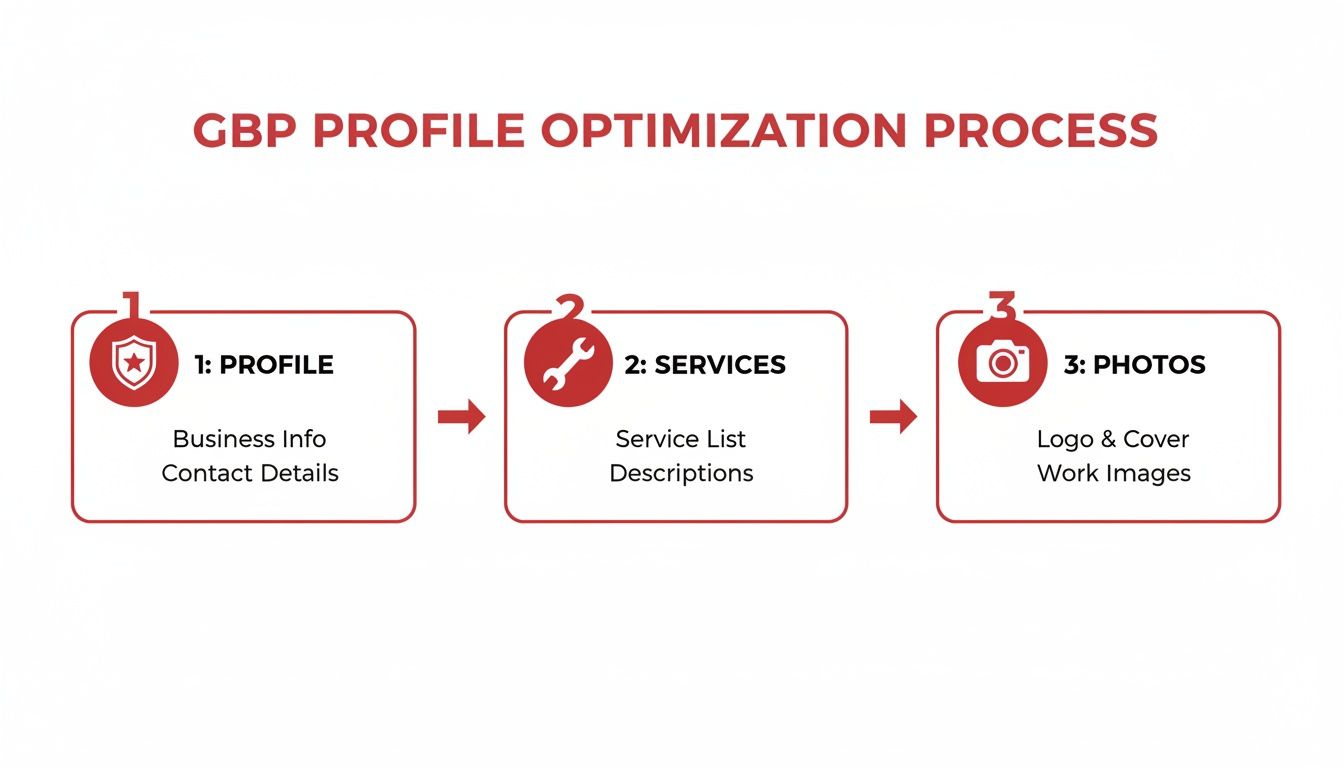
The formula is straightforward: a complete profile, detailed services, and real-world photos are the three pillars of a GBP that actually gets you calls.
Leveraging Advanced GBP Features for HVAC
Going beyond the basics is what separates the top-ranking HVAC companies from everyone else. Your GBP dashboard has some powerful tools that can seriously boost your rankings and get customers to actually engage with your listing.
Google Posts for Seasonal Promotions
Use Google Posts to run timely offers that homeowners in your area will actually care about. A post about a "Spring AC Tune-Up Special" in March or an "Emergency Furnace Repair" offer during the first cold snap can grab immediate attention and drive calls. Think of them as free mini-ads right on your profile.
The Power of Geotagged Photos
High-quality photos are critical, but I'm not talking about stock images. You need pictures of your team on-site, your branded vans parked in specific neighborhoods, and recently completed installations. Here's the pro tip: when you upload photos taken from a phone with location services on, they're often geotagged. This embeds location data into the image file, sending a powerful local signal to Google that proves you actually work in the areas you say you do.
A fully optimized Google Business Profile is not just a digital asset; it’s a lead generation machine. When every section is complete and accurate, you provide the trust signals Google needs to rank you prominently in the local map pack.
The data backs this up. Google Business Profile signals now account for a staggering 32% of all Local Pack and Maps ranking factors. This means details like your hours, service area zip codes, and attributes like 'free estimates' are non-negotiable. In fact, businesses with complete GBPs see 7 times more clicks than ones with half-finished profiles. For an even deeper dive into profile setup, check out our guide on how to optimize your Google Business Profile.
Proactively Engaging with the Q&A Section
Don't just sit back and wait for customers to ask questions. Get ahead of it. Use the Q&A feature to proactively answer the common questions you get from HVAC customers every single day. Add questions like, "Do you offer financing for new AC installations?" or "What are your emergency service hours?" and then provide detailed, helpful answers. This helps potential customers and lets you naturally work in important keywords.
To make sure you've covered all your bases, use this checklist. It breaks down the most critical elements and why they matter for getting ranked.
GBP Optimization Checklist for HVAC Contractors
| GBP Element | HVAC-Specific Action | Ranking Impact |
|---|---|---|
| Primary Category | Select 'HVAC contractor'. Do not use generic categories like 'Home Service' or 'Contractor'. | Very High |
| Services List | Add every specific service you offer, like 'Furnace Repair', 'Duct Cleaning', and 'AC Installation'. | High |
| Service Areas | List all specific cities, towns, and zip codes you serve. Don't just list a single county. | Very High |
| Business Description | Write a keyword-rich description mentioning your core services, service areas, and unique selling points. | Medium |
| Geotagged Photos | Regularly upload photos of your team, vans, and job sites with location data enabled on your phone. | High |
| Google Posts | Publish weekly posts with seasonal offers, maintenance tips, or company updates. | Medium |
| Reviews | Actively request reviews from every customer and respond to every single one (good and bad). | Very High |
| Q&A Section | Pre-populate this section with common customer questions and your own detailed answers. | Medium |
| Business Hours | Ensure hours are 100% accurate, including holiday hours and any 24/7 emergency service availability. | High |
| Attributes | Select all relevant attributes like 'Free estimates', '24-hour service', and 'Family-owned'. | Low |
Following this checklist isn't just about ticking boxes. It's about systematically building trust with Google and showing that you are the most relevant, active, and authoritative HVAC contractor in your service area.
Building Unshakable Trust with Reviews and Citations
Once you’ve dialed in the core of your Google Business Profile, the next battleground for Google Maps rankings is all about trust. You have to think about it from Google's perspective. It's playing matchmaker, trying to connect a homeowner with a broken AC to the most reliable HVAC contractor in town.
Two of the biggest signals Google looks at are customer reviews and consistent online directory listings, which we call citations.
These pieces prove to Google that your business is a real, active, and valued part of the local community. A profile with dozens of recent, glowing reviews and a squeaky-clean online footprint will almost always smoke a competitor with a flimsy digital reputation.
The Power of a Five-Star Reputation
Customer reviews are the social proof that fuels modern HVAC businesses. It's not just about convincing potential customers; a steady flow of positive feedback is a direct ranking signal for Google Maps. The algorithm wants to see businesses that real customers love and trust.
And getting these reviews doesn't have to be some complicated song and dance. The absolute best time to ask is right after a successful service call, when the customer is happy and relieved their AC is back on. Give your techs a simple, repeatable process they can use every time.
Simple SMS Template for Review Generation
A simple text message can make all the difference. Try this:
"Hi [Customer Name], this is [Tech Name] from [Your Company]. Thanks for letting us handle your AC repair today! If you have a moment, we'd appreciate you sharing your experience here: [Your Google Review Link]. Thanks again!"
This direct, low-friction approach makes it dead simple for happy clients to leave a review. The key is making this part of your standard operating procedure for every single job. For a deeper dive, you might want to check out our full guide on how to get more HVAC Google reviews to build out a more powerful system.
Responding to Every Review—The Right Way
Just getting reviews isn't the whole game. You need to respond to every single one. This shows Google you’re an active, engaged business owner. But more importantly, it's a golden opportunity to juice your local SEO.
- For Positive Reviews: Thank the customer by name, and be sure to mention the service and the city. For example, "Thanks, John! We're so glad we could help with your AC repair in Scottsdale." This reinforces your local keywords right inside your GBP.
- For Negative Reviews: Respond quickly and professionally. Acknowledge their problem, apologize for their experience, and offer to take the conversation offline to fix it. This shows potential customers that you stand behind your work and care about satisfaction.
Demystifying Citations and NAP Consistency
Beyond reviews, Google is constantly cross-referencing your business info across the web to make sure you are who you say you are. These listings on other sites and directories are called citations. The most critical part of any citation is your Name, Address, and Phone number (NAP).
For Google Maps, your NAP has to be 100% identical everywhere it shows up online. Period.
Even a tiny inconsistency—like using "123 Main St." on your GBP but "123 Main Street" on Yelp—can confuse search engines. That confusion erodes Google's trust in your business and can absolutely hurt your rankings.
Start by auditing your company's presence on the big data aggregators and directories for home services. To get a handle on building local trust, this guide on Marketing for Moving Company: A Growth Guide for Local Movers has some great insights that apply to any local service business.
A Clear Process for Citation Cleanup
Your first move is to decide on one, official version of your NAP and use it religiously. From there, it's time to hunt down and fix any inconsistencies.
- Audit Major Directories: Check your listings on sites like Yelp, Angi, Houzz, and the Better Business Bureau (BBB).
- Look for Inconsistencies: Search for old addresses, different phone numbers, or slight variations of your business name ("HVAC Inc" vs. "HVAC, Inc.").
- Claim and Correct: Take control of any unclaimed listings and update them with your official NAP.
This cleanup work can be a grind, but it’s a non-negotiable part of local SEO. By making sure every mention of your HVAC company is accurate and consistent, you build an unshakable foundation of trust that Google will reward with better visibility in the map pack.
Aligning Your Website for Local Search Dominance
Your Google Business Profile doesn't exist on an island. If you really want to own the map pack, your website and GBP have to work together, sending Google a consistent and powerful message about where you operate. Think of your GBP as the billboard on the highway and your website as the showroom that closes the deal.
So many HVAC contractors treat their website like a totally separate project, and that’s a huge mistake. Google is constantly cross-referencing the info on your GBP with what’s on your website to make sure you're legit. When those two things are perfectly in sync, it creates a powerful connection that tells Google you're an authority in your service area.
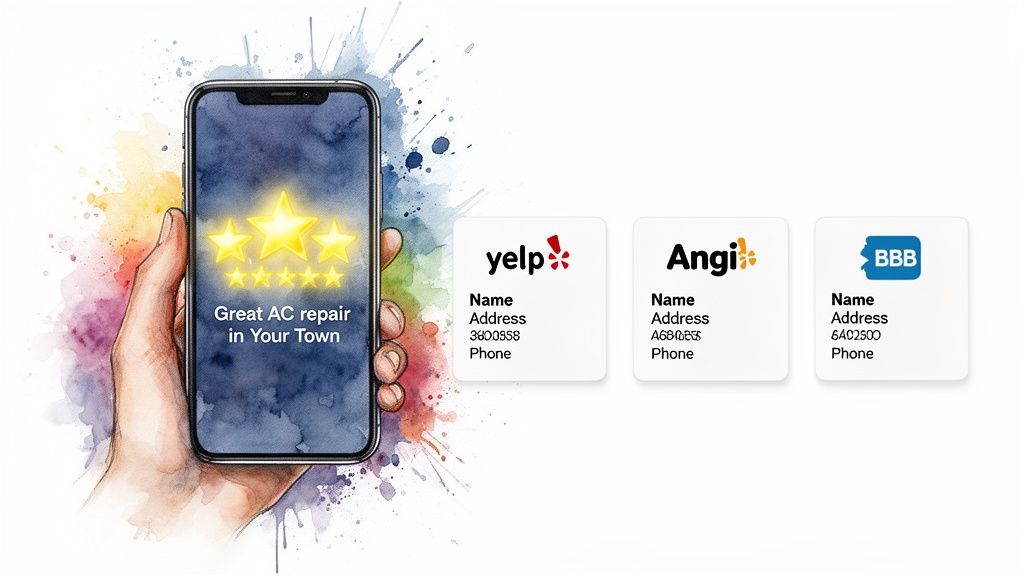
This alignment is your secret weapon for proving you’re the most relevant contractor for a homeowner searching in a specific neighborhood.
Building Hyper-Local Service Area Pages
One of the best moves you can make is to ditch the generic "Service Area" page that just lists a bunch of towns. Instead, create dedicated pages on your website for each specific city or even neighborhood you want to win. And I don't mean just copying your homepage and swapping out the city name—these need to be unique, content-rich pages built to prove your local expertise.
Think about it. A page titled "Emergency Furnace Repair in Naperville" is way more powerful than a generic services page. This targeted approach tells Google you're not just near the area—you are the authority there.
These pages need to be packed with localized content that actually speaks to homeowners in that community.
- Drop in local landmarks or well-known neighborhoods to show you know the area.
- Talk about common HVAC problems specific to the homes in that town (e.g., "servicing older furnaces in historic Oak Park homes").
- Feature testimonials from customers in that exact city. This is powerful social proof.
By creating this hyper-local content, you’re giving Google specific landing spots for geographically-focused searches, which directly fuels your Google Maps ranking goals.
The Power of On-Page Local Signals
To make the connection between your service area pages and your GBP even stronger, you need to embed key local signals right on the page. This is all about showing Google you belong, not just telling them.
First, embed a Google Map on each service area page. But don't just drop in a map of your office. Create a custom map that outlines the specific service area that page is targeting. This gives Google a crystal-clear visual signal about the page's geographic focus.
Next, pepper the page with testimonials from customers within that specific city. A glowing review from a homeowner in "Wheaton" featured on your "AC Repair Wheaton" page sends an incredibly strong relevance signal. It tells both Google and potential customers that you've got a proven track record of serving their neighbors.
When your website content directly mirrors and expands on the service areas listed in your GBP, you create a feedback loop of authority. Each asset reinforces the other, making your business the obvious choice for Google to show in local map results.
Implementing Local Business Schema
While content and visuals are critical, there's a powerful tool working behind the scenes called schema markup. Think of schema as a secret language you use to speak directly to search engines. For our purposes, Local Business schema lets you spoon-feed Google the exact details about your HVAC company.
This little snippet of code, added to your website's header or footer, explicitly defines things like:
- Your exact business name
- Your verified address
- Your local phone number
- Your hours of operation
- The type of business you are ("HVACBusiness")
This structured data removes all the guesswork for Google's bots. It confirms that the NAP (Name, Address, Phone number) on your website is identical to what's on your GBP, creating an unbreakable link of trust. If you're serious about your online presence, our guide on high-performing HVAC company websites shows you how all these technical pieces fit together.
Honestly, implementing schema is a non-negotiable step for any contractor who wants to consistently outrank the local competition on Google Maps.
Becoming a Local Authority with Content and Links
To really move the needle in Google Maps, Google needs to see you as a genuine local authority. Think of it this way: your Google Business Profile is your business card, but your local content and community links are your reputation. They prove you're not just a company in a city; you're an active, trusted part of it.
This comes down to two things working together. First, creating website content that answers the specific questions local homeowners are actually typing into Google. Second, getting backlinks from other local businesses, which act like digital votes of confidence.
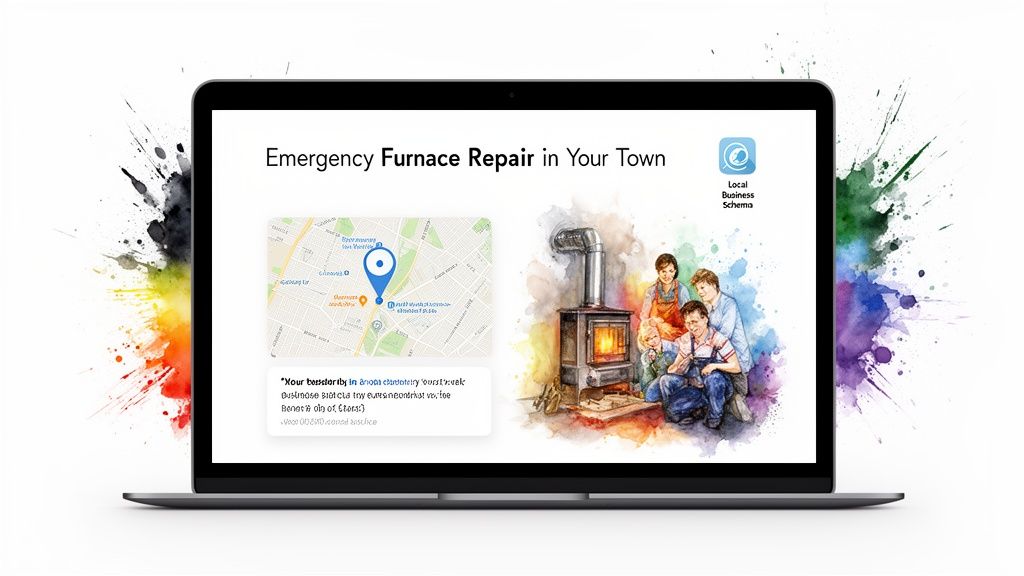
Crafting Content for Your Community
Generic blog posts about "the benefits of AC maintenance" are a waste of time. Your content needs to be intensely local to build the authority Google rewards. Homeowners are looking for solutions to problems unique to their area, and your blog is the perfect place to give them answers.
Instead of vague topics, get specific and answer hyper-local questions. This immediately positions you as the go-to expert for their home and creates content that naturally ranks for local searches.
Local Content Ideas That Actually Work:
- "How to Choose the Right AC Size for a Chicago Brick Bungalow"
- "Tips for Slashing Heating Bills During a Harsh Minnesota Winter"
- "Getting Your HVAC System Ready for Arizona's Monsoon Season"
This kind of content shows you understand the local climate, the housing stock, and the common headaches people face. It's something a national chain or a contractor from two states over just can't write with any real credibility.
Every piece of local content you publish is another signal to Google. It confirms your expertise in your service area, backs up the info in your GBP, and helps you own the map pack.
Earning Powerful Local Backlinks
Great content is the foundation, but backlinks from other reputable local websites are the rocket fuel. A backlink is just a link from their site to yours. When a respected local organization links to your website, it's a powerful endorsement that tells Google your business is a legitimate and important part of the community.
You don't need hundreds of these. A handful of high-quality, relevant local links can make a massive difference in your Google Maps visibility. It's all about translating your real-world community relationships into online ones.
Actionable Local Link Building Strategies
Forget about complicated SEO schemes. The best local links often come from simple, real-world community engagement. These are practical tactics that also build genuine goodwill right in your service area.
- Sponsor a Local Team: Sponsoring a little league team, a high school football team, or a local 5k run usually gets you a link from their website's sponsor page. This is an incredibly powerful and authentic local signal.
- Partner with Other Home Service Pros: Build relationships with non-competing businesses that serve the same homeowners—think roofers or electricians. You can feature each other on a "trusted partners" page on your websites, creating a relevant, local backlink for both of you.
- Get Featured in Community News: Did your company do some charity work, celebrate a big anniversary, or win an award? Pitch the story to a local community newsletter, a neighborhood blog, or even the local paper. A feature story almost always includes a link back to your site.
To truly become a local authority, you need to build up your website's domain authority the right way. You can learn more about effective organic link building strategies to expand on these ideas. Every local link you earn strengthens your website's authority, which lifts your entire online presence—including your rank in Google Maps.
Advanced Strategies for Long-Term Map Pack Success
Getting your HVAC company into the Google Maps pack is a huge win. But staying there? That's a different game entirely.
Your competitors are not sitting still. They're actively trying to knock you off that top spot every single day. The key to long-term domination isn't just about setting up your profile; it's about constantly monitoring, refining, and sweating the technical details that give you an unshakable edge.
This is where we move from the basics to building a real competitive moat around your business. It means tracking the right numbers, making sure your website is flawless, and always testing your approach to stay one step ahead.
Prioritizing Technical Performance and Mobile Experience
Think about the last time you saw a frantic homeowner. When their AC dies on a 95-degree day, they aren't booting up a desktop computer. They're grabbing their phone. In fact, research shows that 58% of people search for a local business on their smartphone every single day.
This is exactly why your website's technical performance, especially on mobile, is a make-or-break factor for your Google Maps ranking. If a potential customer clicks from your Google Business Profile to your site and it takes an eternity to load or they can't figure out how to call you, they're gone. They hit the back button, and that little action sends a powerful negative signal to Google, telling the algorithm your site offers a poor experience.
- Page Speed: Your site has to be fast. No excuses. A slow website doesn't just annoy people; it actively hurts your rankings. Use Google's PageSpeed Insights tool to see where you stand and get a checklist of what to fix.
- Mobile-Friendliness: Your website must be responsive, meaning it looks and works perfectly on any screen. Text should be readable and buttons should be easy to tap without needing to pinch and zoom like a detective.
A fast, mobile-friendly site creates a seamless path for a customer, turning a desperate search into a scheduled job.
Tracking the Metrics That Actually Drive Revenue
You can't improve what you don't measure. To make sure all this effort is actually turning into booked jobs, you have to track the metrics that connect your Maps presence to your bottom line. "Impressions" are nice, but they don't pay your technicians.
You need to zero in on a handful of key performance indicators (KPIs) that show real-world business impact. This means looking beyond the basic GBP Insights dashboard and using tools that paint a clear picture of your return on investment.
The goal isn't just to rank; it's to generate profitable leads. By tracking the right data, you can see exactly which keywords and tactics are filling your schedule with high-value installation and repair jobs.
Here's a look at the key metrics you should be watching and the tools to help you do it.
Local SEO Metrics That Matter for HVAC
Tracking the right data is the difference between guessing and knowing. This table breaks down the essential KPIs for any serious HVAC business owner, showing you what to measure and how to measure it.
| Metric | Why It Matters | Tool for Tracking |
|---|---|---|
| Local Keyword Rankings | Tracks your visibility for money-making terms like 'AC repair near me' or 'new furnace cost in [City]'. This shows if your optimization efforts are working. | Ahrefs, Semrush, BrightLocal |
| GBP-Sourced Phone Calls | Measures how many inbound calls originate directly from your GBP listing. This is a primary indicator of lead generation success. | CallRail, WhatConverts, Native GBP Tracking |
| Website Clicks from GBP | Shows how many users are clicking from your profile to your website, indicating strong interest in learning more about your services. | Google Analytics, GBP Insights |
| Direction Requests | While less common for HVAC, this can signal commercial clients or customers visiting a showroom. It’s a strong indicator of local interest and intent. | GBP Insights |
| Conversion Rate | Tracks the percentage of GBP visitors who become a lead (e.g., call, fill out a form). This measures the overall effectiveness of your profile. | Call Tracking Software + CRM Data |
By focusing on these metrics, you can ditch the vanity stats and make data-driven decisions that directly contribute to revenue growth.
Adopting a Continuous Improvement Mindset
Finally, staying at the top of Google Maps isn't a "set it and forget it" task. Google’s algorithm is always changing, new competitors pop up, and customer habits shift. You have to be willing to adapt.
Treat your Google Business Profile like a living, breathing asset that needs regular attention. Block out time each month to review your performance and test small, incremental changes.
- Experiment with Google Posts: Don't just post the same old thing. Try different calls to action, test new images, and see what kind of headlines get the most clicks and calls.
- Update Your Service Descriptions: Your services should reflect the season. Talk up furnace repair in the fall and push AC tune-ups hard in the spring.
- Refresh Your Photos: You should constantly be adding new, geotagged photos from recent jobs. This keeps your profile looking active and fresh, which Google loves to see.
When you adopt this mindset of constant testing and improvement, you don't just reach the top of Google Maps—you build a system that keeps you there, generating a steady pipeline of qualified leads all year round.
Common Questions About HVAC Google Maps SEO
When you're trying to figure out Google Maps, a handful of questions always seem to pop up for HVAC owners. Getting straight answers is the key to avoiding common mistakes and focusing your energy on the marketing strategies that actually make the phone ring. Let's tackle some of the most frequent ones we hear.
Can I Rank in a City Where I Don't Have an Office?
This is a big one. You're based in one town but you serve five others, so how do you show up? While it's definitely tougher without a physical address in that city, it's not impossible. Your best weapon here is building out those hyper-local service area pages on your website we talked about earlier.
Think about it from Google's perspective. A page titled "AC Repair in Spring Hill" that's loaded with video testimonials from Spring Hill customers, photos of your team on jobs in that specific zip code, and content that mentions local landmarks tells Google you're a serious player there. You're actively doing business in that community.
The bottom line is you have to prove your relevance and prominence in that target city. A physical address is Google's favorite signal, but a mountain of localized proof on your website is the next best thing.
How Long Does It Take to Rank Higher on Google Maps?
I wish I could say there's a magic switch, but ranking on Google Maps is a long game, not an overnight fix. If you're a brand-new business just getting started, you need to be patient. It can easily take 6-8 months of consistent work to see real, meaningful movement in the rankings.
Now, if you're an established company with some history, you can see results much faster. Just by cleaning up your business citations, fully optimizing your Google Business Profile, and kicking off a serious review generation campaign, you could see positive changes in as little as 2-3 months. The keyword here is consistency. Dipping your toes in the water for a few weeks won't get you anywhere.
Do I Need to Run Google Ads to Rank on Maps?
Nope. You absolutely do not need to run paid ads to earn a spot in the organic Google Maps "3-Pack." Your organic ranking is purely based on the SEO factors we've been covering—how relevant your business is to the search, your distance from the searcher, and your overall prominence in the market.
However, you've probably seen those ads at the very top with the "Google Guaranteed" badge. Those are Google Local Services Ads, and they're a separate, paid placement. The two systems are completely independent. Your ad budget has zero influence on your organic map ranking, but running both at the same time is a great way to absolutely dominate the search results and maximize your visibility.
Ready to stop guessing and start getting a predictable flow of profitable HVAC jobs? The HVAC Growth Machine is a complete, done-for-you system that combines a high-converting website with powerful tools to dominate your local market. Get your guaranteed leads at https://hvacgrowthmachine.com.




Founder of HVAC Growth Machine