

For any HVAC business trying to win in local search, HVAC Google reviews are your single most powerful weapon for landing profitable installation jobs. I’m not exaggerating. They're so much more than a simple report card—they are a direct pipeline to your bottom line, shaping customer trust, Google rankings, and, ultimately, your revenue.
The Financial Engine Behind Your Star Rating
Too many HVAC owners see Google reviews as a passive, "nice-to-have" marketing task. That’s a huge mistake. In reality, they are an active sales engine working for you 24/7.
Every single positive review is like a mini-testimonial, building the social proof that sways a homeowner’s decision. Picture this: a potential customer finds your Google Business Profile. What’s the first thing they see? Your star rating, the total number of reviews, and little snippets of customer feedback. This is your digital handshake.
A solid collection of real reviews answers a homeowner's biggest questions before they even think about calling you:
- Is this HVAC company reliable?
- Is their pricing transparent?
- What happens if something goes wrong with the marketing or booking process?
When your reviews answer these questions for you, they essentially pre-sell your services. The sales conversation becomes infinitely smoother, and your closing rate goes up.
Imperfection Sells Better Than Perfection
Here’s something that surprises a lot of owners: a perfect 5.0-star rating can actually feel less trustworthy than a 4.8 or 4.9. Think about it. A profile with hundreds of reviews and a near-perfect score that also includes a few thoughtfully handled negative reviews feels more authentic. It shows you're a real business that, like any other, sometimes hits a snag—but more importantly, it shows you’re a business that steps up to make things right.
A skillfully handled negative review can be more powerful than ten 5-star reviews. It showcases your company's commitment to customer service, accountability, and problem-solving—qualities every homeowner wants in an HVAC contractor.
The right review strategy does more than just build a good reputation; it directly translates into tangible business growth. The table below breaks down exactly how a strong review profile impacts the metrics that matter most.
The Real Business Impact of HVAC Google Reviews
| Benefit of Strong Reviews | Impact on Your HVAC Business | Key Metric Improved |
|---|---|---|
| Increased Trust & Credibility | Homeowners are more likely to call a company with a proven track record of happy customers, shortening the sales cycle. | Lead-to-Appointment Rate |
| Higher Local Search Rankings | Google's algorithm favors businesses with frequent, positive reviews, pushing your profile higher in local search results. | Google Business Profile Views |
| Improved Click-Through Rate | A high star rating stands out in search results, attracting more clicks to your profile and website over competitors. | Website Traffic from Search |
| Higher Lead Conversion Rates | Positive reviews act as powerful social proof, answering objections and pre-selling your services before the first call. | Lead Conversion Rate |
| Justifies Premium Pricing | A stellar reputation allows you to command higher prices, as customers are willing to pay more for proven quality and reliability. | Average Job Value & Profit Margin |
As you can see, the benefits go far beyond just looking good online. A proactive review strategy is a core driver of profitable growth, filling your calendar with the high-margin jobs you want.
Turning Clicks Into High-Value Customers
The link between reviews and your bank account is crystal clear. Research shows that a staggering 87% of consumers now use Google to find local HVAC services.
It gets better. A separate study found that 80% of those local searches convert into actual customers. But here’s the catch: only the businesses with a smart SEO strategy, including proactive review management, are the ones capturing these high-intent leads. To see the bigger picture, check out the benefits of local SEO for HVAC contractors.
This is why we're so focused on reviews. A strong review strategy isn't just about vanity metrics; it's a fundamental piece of a marketing system designed to bring in a steady stream of high-margin installation jobs.
How to Automate Your HVAC Review Generation
Relying on your team to remember to ask every single customer for a review is a losing battle. It's a recipe for missed opportunities. A truly effective system for generating HVAC Google reviews has to run on autopilot, capturing that crucial feedback without adding another task to your team's already packed day.
The goal isn't to nag customers. It's about building a frictionless process that makes leaving a review the natural, easy final step after a great service experience. We want to move from getting a review here and there to a steady, predictable flow of positive feedback that fuels your local SEO and builds an online reputation that sells for you.
The Art of the Frictionless Review Request
The biggest reason customers don't leave reviews? It's a pain. If they have to open their browser, search for your company, find your Google profile, and then hunt for the review button, you've already lost them.
Your entire strategy needs to revolve around creating a direct, one-click path to the review form itself.
It all starts with your unique Google review link. This special URL bypasses all the searching and clicking, taking customers straight to the "leave a review" pop-up on your Google Business Profile. Once you have this link, it becomes the engine of your entire automation strategy.
Don't underestimate how this simple process connects directly to your bottom line.
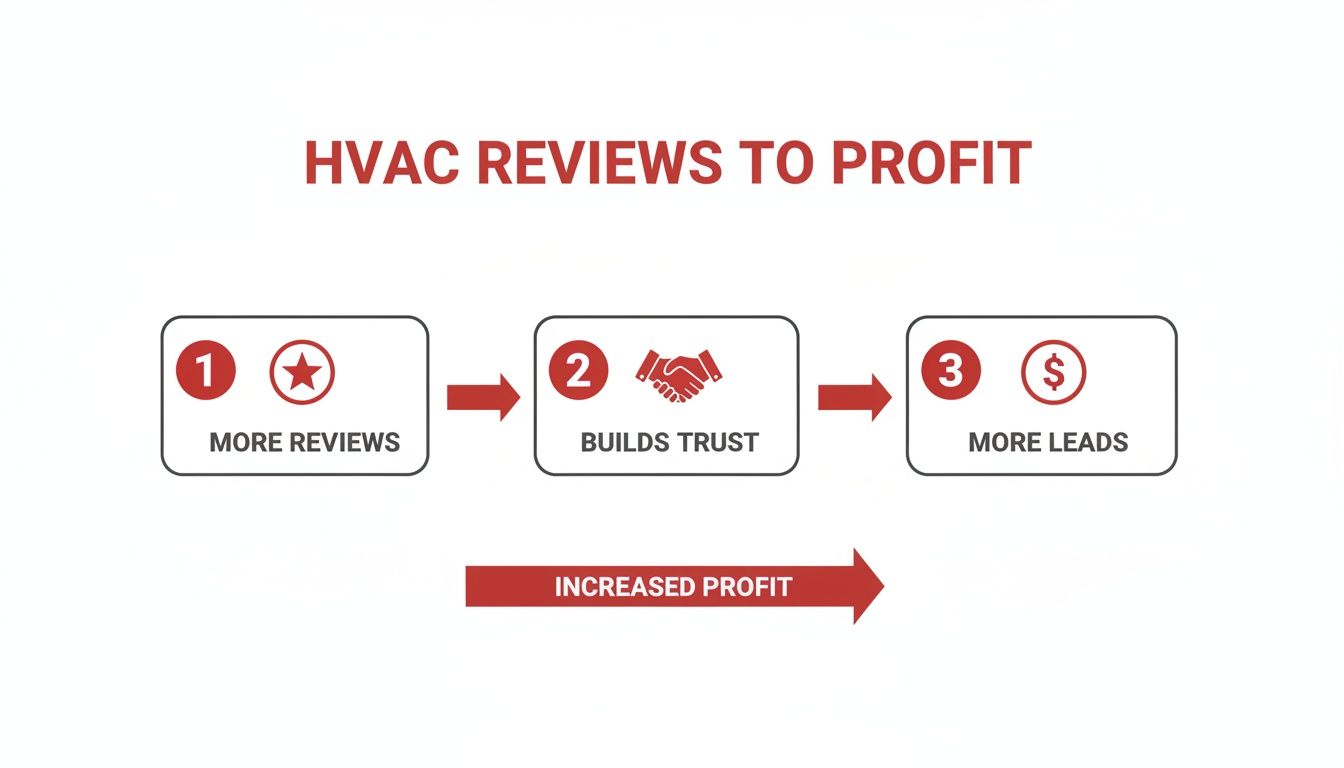
More positive reviews build trust with homeowners searching online. That trust translates directly into more qualified leads and, ultimately, more profitable jobs for your HVAC company.
Automating the Ask with Email and SMS
Timing is everything. The absolute best time to ask for that review is within a few hours of the job being completed, while the positive experience is still fresh in the customer's mind. Automated email and SMS sequences are the perfect tools for this job.
Instead of a generic "Please review us," your automated messages should feel personal and come from a place of gratitude. Here’s a simple but incredibly effective sequence you can set up in your CRM or marketing automation software:
- The Trigger: The moment a job is marked "Complete" in your system.
- Action 1 (1-2 Hours Post-Job): Fire off an automated SMS message. Text messages have a ridiculously high open rate—often over 90%—making them perfect for that first, immediate ask.
- Action 2 (24 Hours Post-Job): If they haven't left a review, a follow-up email goes out. This can be a bit more detailed, just reiterating how much you appreciate their business.
Pro Tip: Keep your request scripts short, friendly, and to the point. The goal is to say thanks and give them one clear, simple action to take. Ditch the long, corporate-sounding emails that get instantly deleted.
For example, an SMS triggered by a job being marked as complete could be as simple as:"Hi [Customer Name], this is [Your Company]. Thanks again for your business today! We'd be grateful if you could share your experience on Google. It only takes a minute: [Your Google Review Link]"
This feels personal and timely, which dramatically increases the odds of them actually clicking the link.
Embedding Your Review Link Everywhere
To get the most out of this, your Google review link should be everywhere. Think of it as a digital business card for your reputation.
Here are the key places to plant that link:
- Digital Invoices and Receipts: Add a clickable link right in the footer.
- Email Signatures: Every single person on your team who talks to customers should have the review link in their email signature. No exceptions.
- Service Summary Reports: If you send a digital summary after a tune-up, include a big, obvious "Review Us" button.
- QR Codes: Turn your link into a QR code and use it in your digital marketing materials or email footers. For a deep dive, check out this comprehensive guide on how to create a QR code for Google reviews.
Why Review Velocity Matters for HVAC SEO
Finally, you need to understand the concept of review velocity. This is just a fancy term for how often and consistently you get new reviews. Google's local algorithm loves a steady stream of feedback way more than a sudden burst of reviews followed by months of silence.
Think about it: ten reviews spread out over ten weeks is far more powerful for your local search ranking than getting those same ten reviews in a single day.
A consistent flow tells Google that your business is actively serving customers and keeping them happy right now. This ongoing activity is a massive trust signal that helps you climb the rankings in the local map pack. An automated system is the only way to ensure this happens. By creating a hands-off process that triggers a request after every job, you build a predictable and continuous stream of HVAC Google reviews that reinforces your credibility and boosts your visibility, month after month.
Mastering Your Responses to Every Review
Think of your public replies to HVAC Google reviews as more than just a quick "thank you" or a necessary apology. They're a marketing tool, plain and simple. Every single response is a public demonstration of your company's professionalism, seen by thousands of homeowners looking for a trustworthy HVAC contractor.
Getting a handle on how you respond to both glowing praise and sharp criticism can turn your review profile into one of your best lead-generation assets. The original review tells the customer's side of the story, but your response? That's your chance to tell your company's story and control the narrative.
Crafting Responses to Positive Reviews
A generic "Thanks for the review!" is a massive missed opportunity. A truly strategic response to a happy customer does so much more. It makes them feel genuinely heard, reinforces the specific value you delivered, and gives your local SEO a subtle but important boost.
The trick is to personalize the reply and sprinkle in relevant keywords without sounding like a robot. It’s a small effort that helps Google connect the dots about what you do and where you do it.
Here’s a simple framework I've seen work time and again:
- Use Their Name: Always kick things off by addressing the reviewer personally.
- Be Specific: Mention something they brought up in their review, like the specific service they received.
- Reinforce Your Brand: Briefly touch on a core value they highlighted, whether it’s your punctuality, professionalism, or great communication.
- Include Keywords: Naturally add the service and location. Think "AC installation in Dallas" or "furnace maintenance in Springfield."
Real-World Example:
Let's say a review reads, "They were great and fixed our AC fast!" A much more powerful response would be:
"Hi Sarah, thank you so much for the kind words! We're thrilled to hear you had a great experience with your AC repair in Springfield. We pride ourselves on quick and professional service, and we really appreciate you choosing us."
See the difference? It's personal, it reinforces your company's values (quick, professional), and it slips in a high-value local SEO keyword phrase.
A Framework for Handling Negative Reviews
Negative reviews are going to happen. It's just part of being in business. But they absolutely do not have to torpedo your reputation. I’ve actually seen companies build more trust with a thoughtful, non-defensive response than they do with a wall of perfect five-star reviews.
Why? It shows potential customers that if something does go wrong, you're an accountable company that will step up and make things right.
The goal is never, ever to get into an argument online. The real strategy is to de-escalate, show you’re committed to customer satisfaction, and get the conversation offline as fast as possible. A bad response makes a bad situation worse, but a professional one can win you future business.
Here’s a proven, three-part process for responding to criticism:
- Acknowledge and Validate: Start by acknowledging their frustration. A simple, "We're very sorry to hear your experience didn't meet your expectations," can go a surprisingly long way.
- Take It Offline: Immediately offer to resolve the issue through a private channel. Give them a direct contact name, a specific phone number, or an email address. This proves you're serious about fixing the problem, not just managing your online image.
- Keep It Brief and Professional: Do not get dragged into a point-by-point debate about the job. Remember, your public response is for all the future customers reading it, not just the unhappy one.
This approach stops an online shouting match before it starts and showcases your company's maturity. For a deeper dive, our guide on how to respond to a negative Google review offers a complete playbook for turning tough feedback into a marketing win.
Showcasing Reviews to Win More Business
Getting a steady flow of HVAC Google reviews is a huge win, but it’s only half the job. Letting all that social proof just sit on your Google Business Profile is like keeping a brand-new service van parked in the garage. To get a real return on your reputation, you have to put those reviews to work across all your marketing.
Think of it this way: every single positive review is a powerful piece of marketing content just waiting to be used. It's time to stop passively collecting stars and start actively using them to book more jobs.
Weave a Live Review Feed into Your Website
Your website is your digital showroom. Nothing builds trust faster for a homeowner on the fence than seeing real, unfiltered praise from their neighbors. That’s why embedding a live feed of your latest Google reviews directly on your homepage and service pages isn't just a nice-to-have—it's essential.
This is all about boosting conversions. Imagine a potential customer lands on your "AC Installation" page. Right there, they see a stream of recent 5-star reviews from other happy installation customers. It instantly answers their biggest questions about your quality and reliability without you having to say a word.
Putting social proof right at the point of decision shortens the sales cycle dramatically. The reviews do the heavy lifting of building trust, freeing up your website to focus on closing the deal.
Modern tools and plugins make this dead simple. You can even set them up to filter for only 4- and 5-star reviews, ensuring every visitor sees a constant stream of your best work.
Turn Customer Praise into Social Media Gold
Your best reviews are the perfect raw material for social media content that actually gets noticed. But don’t just post a boring screenshot. Transform that review into a clean, professional graphic that stands out on feeds like Facebook and Instagram.
Here’s a simple process we’ve seen work time and time again:
- Find the money quote: Pull out a short, powerful sentence from a great review. Something like, "The company was professional and their communication was excellent!" is perfect.
- Brand it up: Use a simple tool like Canva to drop that quote onto a background with your company's logo and colors. It takes five minutes.
- Tag and thank: In the post's caption, thank the customer (by first name only, of course) and briefly mention the value you provided. This public shout-out makes that customer feel great and encourages others to leave their own feedback.
This simple strategy turns one person's positive experience into a shareable marketing asset that reinforces your reputation for great service across a much wider audience.
Power Up Your Ads and Emails with Real Reviews
Social proof is also a secret weapon for your paid ads and email follow-up. When you’re trying to win over a new lead, a quote from a real customer is often far more believable than any sales copy you could ever write.
For instance, in a Facebook ad targeting homeowners who need a new AC, try adding a line like, "See why Sarah P. from [Your City] called our AC installation process 'the smoothest home service experience she's ever had!'" It adds a layer of authenticity that makes your ad pop.
You can also sprinkle these review snippets throughout your email campaigns to build trust at every step. This is especially effective for nurturing leads who got an estimate but haven't pulled the trigger yet. A well-timed email featuring a review about your transparent pricing or communication can be the final nudge they need to book the job.
Understanding Google's Rules and Measuring Success
Getting a steady stream of HVAC Google reviews is like adding a high-octane fuel to your business's growth engine. But with great power comes great responsibility—you have to play by Google's rules. Messing this up, even by accident, can get your hard-earned reviews deleted or even land your Google Business Profile in hot water.
So, what are the big no-nos?
First and foremost, you cannot offer incentives for reviews. No gift cards, no discounts on the next service, no entries into a prize drawing. Google wants real, unbiased feedback from homeowners, and dangling a carrot in front of them completely undermines that.
Another major violation is a shady practice called "review gating." This is when you secretly screen your customers, sending the happy ones a direct link to leave a Google review while quietly shuffling the unhappy ones to a private feedback form. Google wants all customers to have the same, fair chance to share their experience publicly. Don't do it.
Are Your Review Efforts Actually Working? Here's How to Tell
Once you've got your systems humming for generating and responding to reviews, you need to know if it's actually moving the needle. It's easy to get caught up in vanity metrics like the total number of reviews, but the real magic is in tracking the numbers that directly impact your bottom line.
Forget the fluff. You only need to focus on a handful of core metrics to get a clear picture of your online reputation and how it’s driving real business.
Here's what every HVAC owner should be watching:
- Average Star Rating Trend: Don't just obsess over your current rating. Is it climbing or dipping over the last 90 days? A steady upward trend tells you that your marketing and customer service efforts are paying off.
- Review Velocity: How many new reviews are you pulling in each week or month? A consistent, healthy flow of new reviews signals to Google that you're a relevant and active business.
- Response Rate: What percentage of reviews—good and bad—are you actually responding to? You should be aiming for 100%. This shows both Google and potential customers that you're engaged and you care.
- Negative Review Ratio: What's the percentage of new reviews that are negative? If you see a sudden spike here, it's often a red flag for an internal communication or process issue that needs your immediate attention.
KPIs for Tracking Your Google Review Performance
To truly understand the impact of your efforts, you need a clear way to measure success. This table breaks down the essential metrics that will tell you if your review strategy is just a feel-good exercise or a genuine profit-driver for your HVAC business.
| Metric (KPI) | What It Measures | Why It Matters for Your HVAC Business |
|---|---|---|
| Average Star Rating | Your overall customer satisfaction score on a 1-5 scale. | This is the first thing potential customers see. A high rating builds instant trust and directly influences their decision to call you over a competitor. |
| Review Velocity | The frequency of new reviews (e.g., reviews per month). | A steady stream of recent reviews shows Google your business is active and relevant, which is a major factor in local SEO rankings. |
| Total Review Count | The cumulative number of reviews your business has received. | A high volume of reviews acts as powerful social proof, signaling authority and experience to homeowners. |
| Response Rate | The percentage of reviews to which you've posted a public reply. | A high response rate (ideally 100%) shows you are engaged and value customer feedback, which can turn neutral or even negative experiences around. |
| Response Time | How quickly you reply to new reviews. | A fast response, especially to negative reviews, shows you're proactive and can mitigate damage before it spreads. |
By consistently monitoring these KPIs, you can move from guessing to knowing, making informed decisions that directly boost your reputation and, ultimately, your revenue.
Tying Your Reputation to Real-World Revenue
Tracking KPIs is a great start, but here's where the rubber meets the road. The whole point of getting more and better HVAC Google reviews is to make the phone ring and book more jobs. You need to connect the dots between your reputation management and your revenue.
The most critical connection to watch is the link between your review metrics and the performance of your Google Business Profile (GBP). For example, as your average star rating climbs from a 4.2 to a 4.7, are you also seeing more phone calls coming from your GBP? You can find all this data right inside your GBP Insights dashboard. Of course, this only works if your profile is properly set up in the first place. Make sure you're not missing any opportunities by checking out our guide on how to optimize your Google Business Profile.
This is how you prove your ROI. When you can draw a straight line from improving your review response time to a measurable increase in qualified leads, reputation management stops being a "cost" and becomes a documented profit center.
This data-first approach shows you exactly how your online reputation is feeding your sales pipeline. Digging into SEO tools like RankMath can give you even deeper insights into how reviews directly influence your visibility in local search.
The battle for local visibility is intense. To dominate the local "3-pack"—where the vast majority of clicks happen—requires a whole different level of commitment. The top-performing HVAC contractors in major cities have between 1,594 to 2,007 reviews. That creates a massive 64-fold gap between the average business and the market leaders. This isn't just a marketing tactic; it's a fundamental requirement to rank.
Questions We Hear All the Time About HVAC Reviews
When you're trying to master your company's online reputation, a lot of questions pop up. The world of Google reviews can feel like it has its own set of unwritten rules, but once you get the hang of it, it's a powerful tool for growth. Let's dig into some of the most common questions we hear from HVAC contractors and give you some straight, real-world answers.
What Should I Do About a Fake or Malicious Google Review?
It's infuriating to see a one-star review from someone who's not a real customer. It happens. The first thing you need to do is take a breath and then respond publicly and professionally.
A simple, calm reply does wonders. Something like this works perfectly: "Thank you for the feedback. We've checked our customer records and can't seem to find any service history under your name. If you believe this is an error, please call our office directly so we can make things right."
This kind of response immediately shows anyone else reading it that you're on top of your game. After you post that reply, go into your Google Business Profile dashboard and flag the review for removal. In your explanation to Google, be direct: "This person is not a customer and has never received service from our company." While Google doesn't always remove them, your public reply defuses the situation and protects your reputation.
Is It Better to Get 10 Reviews This Week or One a Week for 10 Weeks?
Consistency beats volume every single time. One review per week spread out over ten weeks is far more powerful for your local SEO than getting ten all at once. This steady pace is what's known as review velocity.
Think about it from Google's perspective. A consistent drip of new reviews shows that your business is actively serving and satisfying customers right now. A sudden flood of ten reviews, on the other hand, can look unnatural to the algorithm and might even get flagged. Your goal should be a steady, natural flow that reflects the great work you're doing every day.
The Bottom Line: A slow-and-steady approach to getting reviews builds more long-term trust and SEO authority with Google than a short, intense burst.
Does Responding to My Reviews Actually Help with Local SEO?
Yes, absolutely. Google has flat-out said that responding to customer reviews improves your local search ranking. Every time you write a reply, you're sending a signal to Google that you're an active, engaged business that actually cares about what its customers have to say.
But it goes deeper than that. Your responses are another chance to show Google what you're all about. When you naturally work in phrases like "glad we could handle your furnace replacement in Springfield" or mention specific services like "emergency AC repair," you're adding valuable context to your profile. This helps Google connect the dots, making it more likely you'll show up when local homeowners search for those exact services.
Can I Ask a Customer to Take Down a Bad Review After I Fix Their Problem?
Let's say a customer had a legitimate issue, left a bad review, but you went above and beyond to make it right. Once everything is fully resolved, it's perfectly acceptable to politely ask them if they might reconsider their original feedback.
The key here is how you ask. You can't pressure them, bribe them, or make it a condition of the fix. That's a huge no-no.
Instead, try a soft approach like this: "Hi [Customer Name], we're so glad we were able to get this sorted out for you. We really appreciate your patience. If you felt inclined to update your original feedback on Google to reflect how things turned out, our whole team would be incredibly grateful."
This is respectful, puts the ball in their court, and doesn't feel demanding. You'd be surprised how many reasonable people, once their problem is truly solved, are happy to update their review. It can turn a public negative into a powerful story about your company's commitment to customer service.
Ready to stop guessing and start growing? HVAC Growth Machine provides a complete, done-for-you system that turns your online presence into a reliable source of high-margin installation jobs. From a high-converting website to automated lead nurturing, we build the engine that fills your calendar. Secure your exclusive service area today.





Founder of HVAC Growth Machine