

Too many HVAC company websites are just digital brochures. They're glorified business cards that list services and maybe a phone number. They aren't doing the heavy lifting of capturing leads and booking high-value installation jobs.
A great website is a 24/7 sales machine. It combines clear, urgent messaging with a dead-simple user experience, turning a homeowner's emergency into a scheduled appointment in just a few clicks.
Transform Your Website From A Brochure Into A Sales Machine
Ask yourself honestly: does your website actually generate revenue, or does it just sit there? If it's just an online flyer, you're leaving a massive amount of money on the table.
This isn't a small opportunity, either. The U.S. HVAC market was valued at over $30 billion in 2023 and is projected to grow at 7.4% annually through 2030. According to ConsumerAffairs.com, this growth is driven by both new construction and homeowners replacing older systems. A website that actively works for you is the key to capturing your piece of that pie.
Building a Foundation of Trust and Urgency
To turn your passive brochure into a lead-generating asset, your site needs to accomplish two things the moment a visitor lands on it: build trust and address their urgency.
Think about it from the customer's perspective. When their AC dies on a 95-degree day, they aren't casually browsing. They are stressed, desperate, and looking for a fast, reliable solution right now.
Your website's headline and messaging need to speak directly to that pain. Forget generic fluff like "Quality HVAC Services." Instead, hit them with an action-oriented promise that solves their problem: "Fast, Reliable AC Repair to Cool Your Home Today."
A website's true value isn't measured in beautiful design, but in its ability to convert a panicked homeowner into a scheduled appointment. It should be your most effective salesperson, working tirelessly to fill your calendar.
From there, you have to make it incredibly easy for them to act. This means massive "Click to Call" buttons, simple "Request Service" forms, and online scheduling options are front and center—not buried three clicks deep on a contact page.
Key Features of a High-Converting HVAC Website
We've found that the best-performing sites are built on a strategic foundation. It’s never about flashy animations; it’s about making the customer’s journey from panicked visitor to booked job as frictionless as possible.
To give you a quick cheat sheet, here are the core components that work together to build credibility and drive action.
Key Features of a High-Converting HVAC Website
| Feature | Why It's Critical for Leads | Real-World Example |
|---|---|---|
| Urgent, Solution-Focused Messaging | Speaks directly to the customer's immediate pain point, showing you understand their problem. | "Need Emergency AC Repair? We're on Our Way!" |
| Prominent Calls-to-Action (CTAs) | Makes it impossible for a visitor to miss how to contact you, reducing friction and hesitation. | A bright red "Book Service Now" button that follows the user as they scroll. |
| Authentic Trust Signals | Proves you're a real, local business with happy customers, not some faceless national directory. | Displaying real photos of your team, recent customer reviews, and local awards. |
| Simple, Intuitive Navigation | Allows visitors to find exactly what they need (e.g., "Furnace Repair") in one or two clicks. | A clean top menu with clear service categories like "Heating," "Cooling," and "Maintenance." |
| Mobile-First Design | Ensures the site is easy to use on a phone, where most emergency searches happen. | Large, tappable buttons and forms that don't require pinching and zooming. |
| Upfront Financing & Rebate Info | Addresses the cost concern head-on, removing a major barrier for high-ticket installations. | A dedicated page or section explaining financing options and available energy rebates. |
By focusing on these foundational elements, you can start turning more of your website visitors into paying customers. It's not magic; it's just smart strategy. And once you have these pieces in place, you can start tracking your success by understanding what a good website conversion rate is and optimizing from there.
Build Service Pages That Actually Turn Clicks Into Calls
Generic service pages are where potential leads go to die. Just listing "AC Repair" or "Furnace Installation" with a couple of sentences doesn't cut it anymore. To even compete, every single core service page on your HVAC company website needs to work like a dedicated, high-octane landing page—built from the ground up to turn a curious visitor into a scheduled call.
Think about it. A homeowner frantically searching for "emergency furnace repair near me" is in a totally different headspace than someone researching "high-efficiency AC installation." They have different fears, different questions, and a completely different sense of urgency. Your service pages have to speak directly to each of them.
The Anatomy Of A High-Converting Service Page
Instead of a boring overview, a truly effective service page walks a potential customer through their specific problem and positions your company as the obvious solution. It’s a structured conversation that builds trust and pushes them to act.
Every successful service page needs these core elements:
- Problem-Focused Headlines: Ditch the generic stuff. Start with a headline that mirrors exactly what’s on their mind, like "Fast & Reliable AC Repair to Get Your Home Cool Again."
- Empathy-Driven Copy: Show them you get it. A simple line like, "We know how stressful a broken furnace is in the middle of winter," instantly connects with their frustration.
- A Clear, Simple Process: Break down what happens next. No one likes uncertainty. Lay it out: 1. You Call Us. 2. We Diagnose the Problem. 3. We Give You Upfront Pricing. 4. We Get Your System Running.
- Authentic Photos & Videos: Use real, high-quality photos of your actual technicians on the job—fixing that exact type of equipment. Stock photos feel cheap and erode trust in a heartbeat.
This structure does more than just state what you do; it shows how you solve their immediate crisis, making them feel understood and confident enough to pick up the phone.
Build Trust and Demolish Objections
Hiring an HVAC contractor is a big deal for a homeowner. It’s a decision loaded with anxiety about cost, trust, and the quality of work. Your service pages need to tackle these hesitations head-on before they even become objections.
One of the best ways to do this is by embedding social proof right on the page. Don't just link to a reviews page—that's lazy. Pull in specific, relevant testimonials. For your AC installation page, feature a quote from a thrilled customer raving about their new, quiet system and lower energy bills.
And you have to talk about money. So many customers won't call because they’re terrified of a high-pressure sales pitch or a surprise bill that will wreck their budget.
The most effective HVAC service pages answer the cost question before it's even asked. When you clearly display financing options, available rebates, and a rock-solid commitment to upfront pricing, you remove the single biggest barrier stopping a visitor from calling you.
Simply adding a "View Financing Options" button or a section on local energy rebates can dramatically boost conversions for big-ticket jobs like system replacements. It tells the customer, "We have ways to make this affordable for you."
Get Hyper-Local With Your SEO
To make sure local customers actually find these pages, you have to optimize them for the specific towns and neighborhoods you work in. A generic "Furnace Repair" page is going to get crushed by competitors who built targeted pages like "Furnace Repair in Naperville."
The solution is to create location-specific versions of your main service pages. You need to mention the town by name in the page title, in the headings, and naturally within the text. Something like, "For over 20 years, we've been the trusted choice for air conditioner repair for families all over the Arlington area."
This hyper-local focus sends powerful signals to Google that you are the authority for that service in that specific place, helping you completely dominate local search results. It's not just a nice-to-have; it's critical. An analysis of top-performing content found that local service pages account for 25% of the most effective content types for driving leads on HVAC company websites. You can see more data on these HVAC marketing benchmarks on WebFX.com. This is how you show up the moment a local customer needs you most.
Implement A Lead Capture System That Actually Works
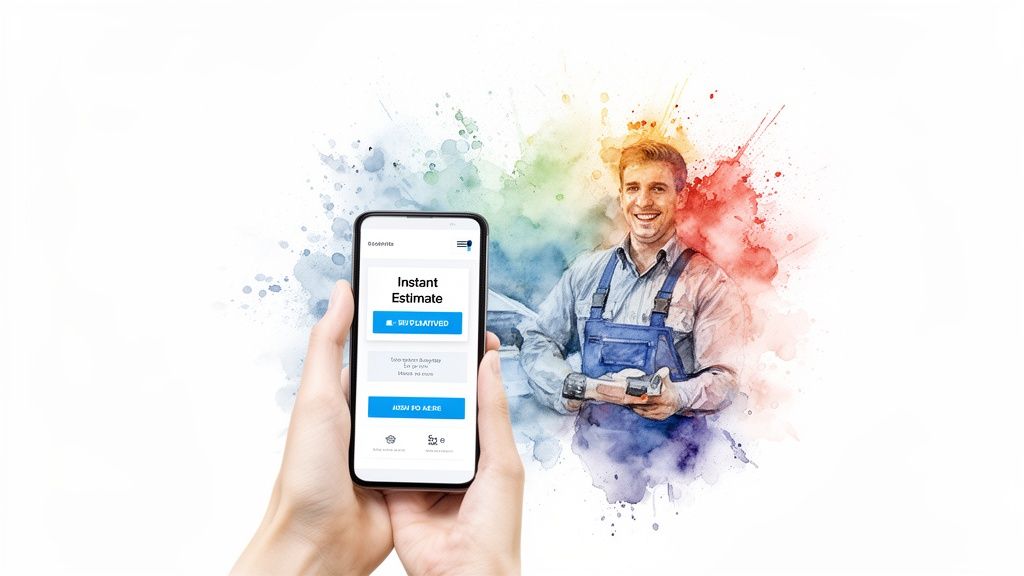
A beautiful website that doesn't generate qualified leads is just an expensive digital billboard. The real power of high-performing HVAC company websites comes from their ability to systematically turn anonymous traffic into actual appointments and sales. This means going way beyond a simple "Contact Us" page and building a multi-pronged system for capturing leads.
The goal here is simple: give every visitor a low-friction way to connect with your business on their own terms. Some people are ready to call you right now. Others are just starting their research and would never dream of picking up the phone yet. A smart lead capture system serves both.
Give Instant Value with an Online Estimate Tool
One of the single most effective ways to capture leads from visitors who aren't ready to schedule a call is an instant online estimate tool. This feature answers a homeowner's biggest question—"How much will this cost?"—without trapping them in a high-pressure sales call.
Here’s the breakdown:
- A visitor answers a few quick questions about their home and system needs, like square footage, current system type, or desired efficiency.
- In exchange for their name, email, and phone number, the tool provides an automated, ballpark estimate for a new system.
- Just like that, you've captured a warm lead from a homeowner who has shown clear intent to buy a high-ticket item.
This exchange is a total win-win. The customer gets the valuable info they're looking for immediately, and you get the contact details of a qualified prospect to nurture. Our guide on the power of instant quote tools for HVAC websites dives even deeper into this strategy.
By providing an instant estimate, you capture the details of serious buyers at the very beginning of their research process. This single feature can transform your website from a passive information source into an active lead generation engine for your most profitable jobs.
This approach gives you a massive leg up. While your competitors are sitting around waiting for the phone to ring, you're actively building a pipeline of future installation customers.
Create a Recurring Revenue Stream with Online Maintenance Plan Sales
Another powerful, yet criminally overlooked, lead capture machine is selling your maintenance plans directly through your website. Setting up a simple ecommerce function allows customers to buy a membership or "comfort club" plan with just a few clicks.
This does two massive things for your business. First, it creates a stable, recurring revenue stream that isn't dependent on emergency service calls. Second, it locks in customers for future repairs and eventual system replacements, massively increasing their lifetime value to your company.
Of course, a complicated or confusing checkout process will kill sales before they even happen. To make sure your system actually works, you need to understand how to improve form submission rates and convert more visitors into inquiries.
Make Contact Impossible to Miss
Finally, your entire website must be engineered to make getting in touch as easy as humanly possible. This means your contact points need to be prominent, persistent, and perfectly optimized for every device.
These are the non-negotiables:
- Sticky "Click to Call" Buttons: On mobile devices, which drive nearly 60% of global web traffic, a phone number that follows the user as they scroll is absolutely essential. It needs to be big, easily tappable, and always visible.
- Simple Scheduling Forms: Embed short, simple forms on every single service page. Ask for the bare minimum you need to book a call. Don't ask for ten fields when three will do the job.
- Web Chat & Texting Widgets: Give an option to visitors who hate talking on the phone. A chat-to-text widget can capture leads from people who are multitasking or sitting in a noisy office.
By rolling out these different tools, you build a complete lead capture system that meets customers wherever they are. You give them multiple ways to connect, making sure no potential job slips through the cracks. This is how you turn your website from a cost center into your company's most reliable source of profitable work.
Dominate The Google Map Pack In Your Service Area
For an HVAC contractor, the Google Map Pack isn't just a part of the search results—it's your digital storefront. It’s where the real action happens.
Think about it. When a homeowner's AC dies in the middle of a July heatwave, they're not casually browsing. They're grabbing their phone and searching "ac repair near me." Showing up in that top-three map listing is the difference between getting that emergency call or being totally invisible to a customer who's ready to buy. This is where local search is the entire game.
Winning here isn't an accident. It takes a focused strategy built around your Google Business Profile (GBP), which is the command center for your local presence. A neglected profile is like handing your best, highest-intent leads directly to the competition down the street.
Your Google Business Profile Is Your Local SEO Engine
Your GBP is the engine that drives your visibility in the map pack. A completely filled-out, constantly updated profile sends all the right signals to Google, telling them you're a legitimate, active, and relevant business for local searches.
This is more than just plugging in your name and address. You have to use every single feature Google gives you.
- Service Areas: Don't be vague. List every single city, town, and zip code you cover. This is a direct signal to Google about exactly where you operate.
- Services: Be specific. Instead of just "HVAC," add everything you do: "Ductless Mini-Split Installation," "Furnace Maintenance," "24/7 Emergency AC Repair," and so on.
- Photos & Videos: This is huge for building trust. Regularly upload real, high-quality photos of your team working, your branded vans, and happy customers with their new systems.
- Google Posts: Think of this as a mini-blog for your profile. Share special offers, company news, or quick tips. It shows Google you’re active and gives customers a reason to engage.
A dialed-in profile is the foundation you build everything else on. For a more detailed breakdown, check out our complete guide on how to optimize your Google Business Profile.
Build Unshakeable Trust with Reviews and the Google Guarantee
Once your profile is solid, the next step is to layer on overwhelming social proof. In the HVAC world, that boils down to two things: a constant stream of 5-star reviews and the coveted Google Guarantee badge.
Reviews are the lifeblood of any home service business. A steady flow of recent, positive reviews tells both Google and potential customers that you’re reliable and do great work. You absolutely need a system to ask every single happy customer for a review.
The Google Guarantee is an absolute game-changer. That little green checkmark tells searchers that Google itself backs your business. It builds instant credibility and can dramatically boost the number of calls you get from your profile.
How you handle reviews matters, too. Responding thoughtfully to both the good and the bad shows you’re engaged and genuinely care about your customers. To really get ahead, you need to be proactive. A great strategy is learning how heating companies heat up their reviews by turning customer feedback into a powerful marketing tool.
Ready to get a handle on your local SEO? Use this checklist to make sure all your bases are covered.
Local SEO Checklist for HVAC Contractors
| Checklist Item | Impact on Local Ranking | Action Step |
|---|---|---|
| Fully Optimize Google Business Profile | High | Complete every section: services, service areas, hours, photos, and business description. |
| Consistent Name, Address, Phone (NAP) | High | Ensure your NAP is identical across your website, GBP, and all other online directories. |
| Generate a Steady Stream of Reviews | High | Implement an automated system to request reviews from every customer after a job is completed. |
| Respond to All Reviews | Medium | Reply to both positive and negative reviews promptly to show you're engaged and value feedback. |
| Earn the Google Guarantee Badge | High | Complete Google's screening and verification process to add a massive layer of trust. |
| Create Hyper-Local Service Pages | Medium | Build individual pages on your website for each key service in each main city you serve. |
| Add Local Business Schema Markup | Medium | Implement schema on your website to help search engines understand your location and services. |
| Publish Weekly Google Posts | Low-Medium | Share offers, tips, or company updates on your GBP to keep your profile active and engaging. |
Tackling these items one by one will put you miles ahead of the competition and firmly in control of your local search presence.
Connecting Your Website to Your Local Footprint
Finally, your HVAC company website and your GBP can't operate in silos. They need to work together, sending consistent signals to Google that you are the authority in your service area.
This means creating hyper-local service pages (like "AC Repair in Springfield") that mirror the services you listed on your GBP. It also means using local schema markup on your site, which is basically code that helps search engines understand your address, phone number, and service areas more clearly.
The connection between local search and actual sales is undeniable. Industry data shows that a staggering 80% of HVAC local searches lead to conversions. When people in your area search, they are ready to act. When your website and GBP both tell the same hyper-local story, Google rewards you with the visibility you need to get the call.
Track Your Revenue And Nurture Leads On Autopilot
A slick website that brings in leads is great. But a website that tells you exactly where your best jobs came from? That’s how you build a real business.
For too many HVAC contractors, marketing feels like throwing money at a wall and hoping something sticks. You're running Google Ads, maybe sponsoring a local team, and doing some SEO. But can you honestly point to the one thing that brought in that $15,000 multi-zone system install last week?
If you can't, you're flying blind. Real growth comes from knowing your numbers—connecting your marketing spend to actual, bottom-line revenue. This is where your website stops being a simple brochure and starts acting like your smartest business development tool.
When you can draw a straight line from a specific ad campaign to a signed contract, you can finally stop wasting money on what's not working and pour gas on what is.
Pinpoint Your Most Profitable Channels With Call Tracking
The simplest way to figure out what's working is to track where your phone calls are coming from. Call tracking is a dead-simple system that gives you unique, trackable phone numbers for each of your marketing channels.
It's simple. You put one number on your Google Business Profile, a different one on your Google Ads, and another on your website's service pages. When a homeowner calls, the system automatically logs where they found you. No more asking, "So, how'd you hear about us?"
The goal isn't just getting more calls. It's about getting more of the right calls. Tracking lets you see which channels bring in the high-profit replacement jobs versus the low-margin service calls, so you can put your marketing dollars where they'll make you the most money.
This data is a game-changer. You might discover your SEO efforts are secretly bringing in all the big-ticket installs, while your expensive paid ads are just generating small repair jobs. With that insight, you know exactly where to shift your budget to actually grow the business.
How Call Tracking Works In Practice
Getting this set up is surprisingly easy and gives you clarity almost overnight.
- Assign Unique Numbers: A unique phone number gets assigned to every marketing source you want to track—Google Ads, Facebook, specific landing pages, even offline flyers.
- Calls Get Forwarded: When a customer dials one of those numbers, the call is instantly and seamlessly routed to your main business line. You and your customer won't notice a thing.
- Data Is Captured: The call tracking software does all the heavy lifting, recording the call source, caller info, time of day, and even the call recording itself for training and quality control.
- Analyze and Optimize: You get a simple dashboard that shows which campaigns are making the phone ring. When you connect it to your CRM, you can see which ones are actually driving revenue.
Nurture Hesitant Leads With Email Automation
Now, what about the leads who aren't quite ready to pull the trigger? A homeowner might use your instant quote tool, see the price, and then… crickets. Without a good follow-up plan, that lead is gone forever.
This is where HVAC email automation becomes your secret weapon. By setting up a simple, automated email sequence, you can stay top-of-mind and build trust with those prospects until they're ready to book the job.
Think about it: a potential customer gets an online estimate for a new AC unit. Seconds later, an automated email hits their inbox. It’s not a pushy sales pitch. It’s a helpful sequence designed to answer their questions, show off your 5-star reviews, and explain your financing options over a few days or weeks.
This hands-off approach keeps your business on their radar without anyone on your team lifting a finger. You're building a relationship on autopilot, making sure that when they're finally ready to buy, your company is the only one they'll call.
Your Launch Plan For Continuous Improvement
Going live with your new HVAC company website is the starting line, not the finish line. A lot of owners think the job is done once the site is up, but that couldn't be further from the truth. A successful launch isn't just a one-day event; it’s the beginning of a continuous cycle of improvement where you make data-driven decisions to grow your business.
The work you do right before and immediately after you flip the switch is what sets the stage for long-term, predictable growth.
The Pre-Launch Checklist
Before your site sees the light of day, you need a meticulous pre-launch check. This isn't just a quick once-over. It's about making absolutely sure every single lead capture point works flawlessly. One broken form or a wrong phone number can cost you thousands in lost jobs.
Here's what you or your team must test:
- Form Submission Tests: Personally fill out every contact form, every service request, and every instant estimate tool on the site. Did you get the notification? Did the "customer" get their automated confirmation email? Don't assume it works—prove it.
- Phone Number Verification: Grab your cell phone and click every single "click-to-call" button. Make sure it dials the correct, tracked phone number. A single wrong digit can send a high-value emergency call to a dead line.
- Mobile Usability Check: Test the site on different phones—both iPhones and Androids. The experience has to be seamless. If a customer has to pinch, zoom, or fight with your navigation, they'll just hit the back button and call your competitor.
Post-Launch Monitoring: The First 90 Days
Once the site is live, the first three months are critical. This is when you stop guessing what works and start listening to what the data is telling you. Your entire focus should be on a handful of key performance indicators (KPIs) that directly impact your bottom line.
Your website is a living asset, not a static brochure. The goal after launch is to listen to the data it provides. This feedback tells you precisely where to invest your time and money for the highest return.
Monitoring these numbers is what turns your website from an expense into a predictable source of profitable jobs.
Key Metrics You Need To Track
Forget about vanity metrics like "page views." Here are the essential numbers to watch in your analytics dashboard that actually tell you if your website is making you money:
- Conversion Rate: This is the big one. What percentage of your visitors are actually picking up the phone or filling out a form? This is the ultimate measure of your site's effectiveness.
- Cost Per Lead (CPL): If you're running ads, you need to know exactly how much you're spending to get one qualified lead. This tells you how efficient your campaigns are and if you're getting a positive ROI.
- Source/Medium Performance: Where is your best business coming from? Is it Google Organic search, your Google Ads campaigns, or your Google Business Profile? Knowing this tells you where to double down on your marketing efforts.
This relentless focus on performance ensures your website doesn't just look good—it consistently fills your calendar with the high-margin installs and service calls you want.
Common Questions About HVAC Websites
When you're looking to invest in a new website for your HVAC company, a few key questions always come up. It's more than just a design project; it's a major business decision that can make or break your lead flow for years. Getting clear on the costs, timelines, and what happens after the site goes live is essential.
One of the first things owners ask is, "So, what's a real, lead-generating HVAC website actually going to cost me?" You can always find a basic template site for a few thousand bucks, but that's not what we're talking about here. A custom-built system designed from the ground up to generate leads—complete with an instant estimate tool and optimized for every city you service—typically runs between $10,000 to $25,000+. That investment reflects the strategy, technology, and expertise required to turn website visitors into booked jobs, not just empty clicks.
How Long Does It Take to Launch a New HVAC Website?
A strategic website build isn't an overnight project. From start to finish, a proper launch usually takes between 4 to 8 weeks. That timeline gives us enough room for discovery and strategy, writing all the content, creating the designs, developing the site, and doing a final pre-launch review to make sure everything is perfect.
The process is typically broken down into three clear stages.
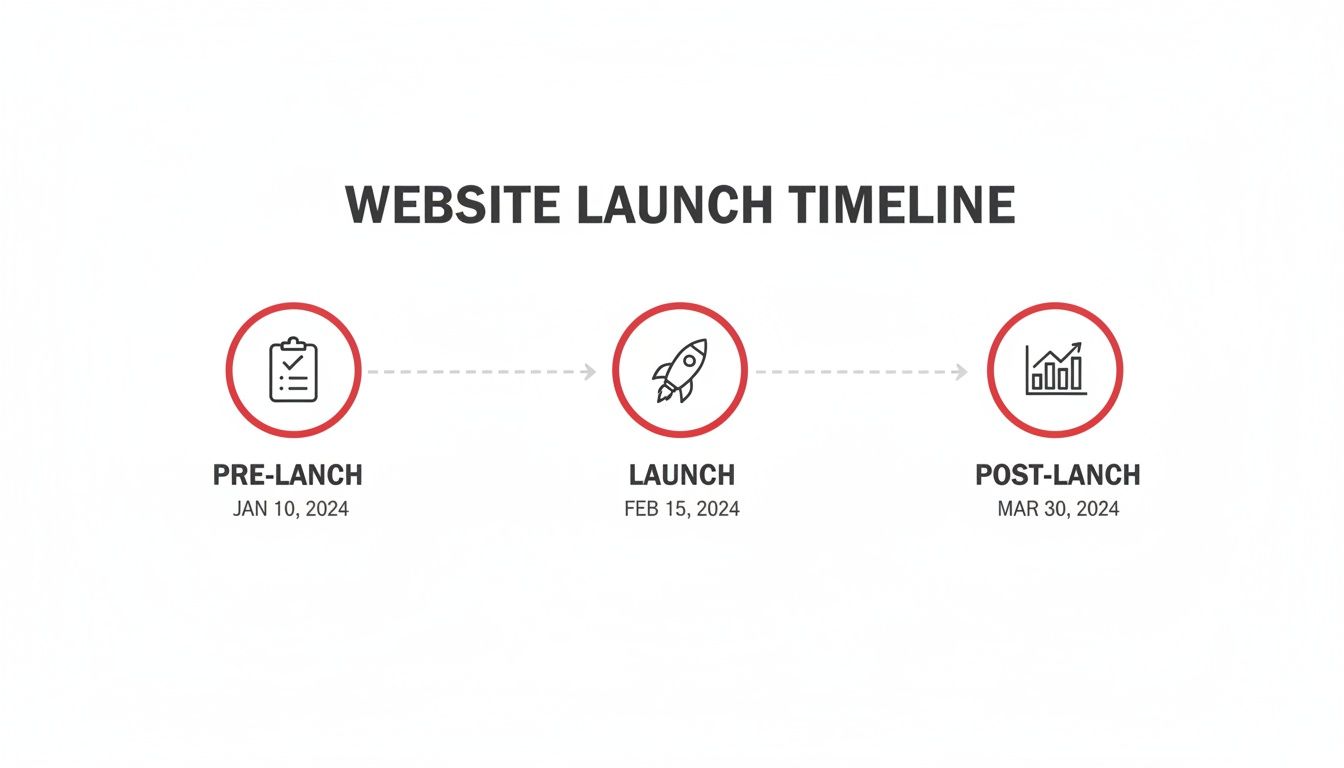
As you can see, the work doesn't stop once the site is live. That post-launch phase is where the real magic begins—tracking results and making data-driven improvements.
Is Ongoing Website Maintenance Really Necessary?
Absolutely. Thinking you can launch a website and just forget about it is like buying a brand new work van and never changing the oil. It's just not going to end well.
Ongoing maintenance is critical for a few key reasons:
- Security: Regular updates are your first line of defense against hackers and malware trying to take your site down.
- Performance: Keeping all the software and plugins current ensures your site loads fast. A slow site is a lead-killer and an SEO-killer.
- Functionality: It guarantees that your contact forms, online scheduler, and call-tracking numbers are actually working 24/7. A broken form is a lost lead.
A website is not a "set it and forget it" project. Think of it as a living asset that requires consistent attention to perform at its peak and continue delivering a positive return on your investment.
Neglecting your site leads to slow load times, broken features, and security holes that can tank your reputation and cost you thousands in lost revenue. It’s a small but non-negotiable investment to protect your most important digital asset.
HVAC Growth Machine offers a complete, done-for-you system that replaces your underperforming site with a lead-generation machine, complete with an instant estimate tool, Google Business Profile optimization, and revenue attribution so you can stop guessing and start growing. Secure your exclusive service area and see how it works at https://hvacgrowthmachine.com.




Founder of HVAC Growth Machine