

For most HVAC business owners, a good website conversion rate lands somewhere between 3% and 5%. That’s a decent starting point.
But let's be clear: the top-performing HVAC companies aren't settling for "decent." They're hitting rates of 15% or higher by turning their websites into lead-generating machines.
Defining Your HVAC Website Conversion Rate
When we talk about "what is a good website conversion rate," we're really asking a much simpler question: is your website actually making you money? Think of your website as your best salesperson—one that never sleeps. A good conversion rate means that salesperson is consistently turning curious visitors into paying jobs.
A "conversion" isn't just someone landing on your site. It's the moment a casual browser takes a real, measurable action that could lead to a booked job.
What Counts as an HVAC Conversion
Before you can improve anything, you have to know what you're measuring. For an HVAC business, conversions are the actions that directly fill your schedule and grow your bottom line. Forget vanity metrics; these are the ones that matter:
- A Phone Call: A homeowner with a broken AC clicks the "Call Now" button on their phone.
- A Submitted Form: Someone fills out your "Request a Quote" form for a new furnace installation.
- An Online Booking: A customer uses your website's scheduling tool to book their spring maintenance.
- An Estimate Request: A visitor uses an online calculator to get a ballpark figure for a system replacement.
Each of these actions is a signal of high intent. It's the transition from "just looking" to "I need help," and that's the magic of conversion.
The Financial Impact of Small Improvements
The average website conversion rate in the HVAC industry hovers around 3.10%. While that’s a respectable baseline, the most successful companies blow that number out of the water. We’ve seen top performers in home services push past 15% on targeted campaigns. You can dig into more HVAC marketing statistics and trends that highlight just how wide this performance gap can be.
A small lift in your conversion rate can have a massive impact on your lead volume without requiring you to spend a single extra dollar on ads or SEO.
Let’s run the numbers. Imagine your site gets 2,000 visitors a month. At a 3% conversion rate, that’s 60 leads. Not bad. But if you optimize your site and bump that rate to just 5%, you now have 100 leads from the exact same traffic. That's 40 additional opportunities to book high-ticket install jobs every single month.
This is why focusing on your conversion rate is one of the most powerful levers you can pull to grow your HVAC business.
To put this into perspective, here's a quick guide to see where your website stacks up.
HVAC Website Conversion Rate Performance Levels
This table will help you quickly gauge how your website is performing and what that means for your business's growth potential.
| Performance Level | Typical Conversion Rate | What This Means for Your Business |
|---|---|---|
| Needs Work | Below 2% | Your website is likely losing leads. Visitors are leaving without taking action. |
| Average | 2% – 5% | You're getting some leads, but there's significant room to improve and book more jobs. |
| Good | 5% – 10% | Your website is a solid lead generator. You're effectively turning traffic into opportunities. |
| Excellent | 10%+ | You're a market leader. Your website is a powerful, consistent source of high-quality leads. |
Look at your current rate. A small jump from "Average" to "Good" could mean dozens of extra jobs each month without increasing your marketing spend.
How to Accurately Calculate Your Conversion Rate
If you don't know your numbers, you can't improve them. It's that simple. Talking about a "good" conversion rate is pointless until you know your own.
Luckily, figuring this out isn't rocket science. It's just simple math that tells you how healthy your website really is.
The formula itself is straightforward, but don't let its simplicity fool you. It gives you a crystal-clear snapshot of how well your site turns casual browsers into actual leads.
(Total Conversions / Total Website Visitors) x 100 = Your Conversion Rate (%)
This little equation is your starting point for figuring out what's broken and where the biggest opportunities are hiding in your marketing. But be warned: the result is only as good as the numbers you plug into it.
Defining the Numbers in Your Formula
To get a number you can actually trust, you have to be brutally honest about what counts as a "conversion" and who counts as a "visitor." Getting this right is the difference between a vanity metric that makes you feel good and a real insight that makes you money.
1. Total Conversions
This is the total number of real, desirable actions taken on your website over a specific period, like a month. For an HVAC company, these aren't just clicks; they're direct hand-raises from potential customers.
- Form Submissions: Every single "Request a Quote" or "Schedule Service" form that hits your inbox.
- Phone Calls: Clicks on your phone number from a phone, or calls made from a tracked number you have listed on the site.
- Online Bookings: Any appointment scheduled right through a calendar tool on your website.
- Live Chat Leads: A chat that ends with you getting a name, phone number, and a clear service request.
You have to track everything. If you only count form fills but 70% of your real leads come from phone calls, your calculated conversion rate will be dangerously low. You'll think your website is a total failure when it might actually be your best salesperson.
2. Total Website Visitors (Sessions)
This number is the total visits (or sessions) to your website during that same timeframe. You can pull this straight from your Google Analytics account, usually in the "Audience" or "Acquisition" reports.
A "session" is just one visit by one person. If they show up in the morning and come back that afternoon, that counts as two separate sessions.
A Practical HVAC Example
Let's make this real. Imagine you're looking at your website's performance for last month.
- Total Website Visitors (Sessions): You pop into Google Analytics and see you had 3,500 sessions.
- Total Conversions: You tally up all your lead sources and find:
- Phone Calls from the Website: 65
- "Request an Estimate" Form Fills: 28
- Online Maintenance Bookings: 12
- Total Conversions: 65 + 28 + 12 = 105 leads
Now, you just plug those numbers into the formula:
(105 Conversions / 3,500 Visitors) x 100 = 3.0%
Boom. Your website conversion rate for the month is 3.0%.
This number is your baseline. It tells you that for every 100 people who land on your site, three of them turn into a tangible lead. Now you have a solid, data-backed metric you can use to set goals and track whether your changes are actually helping you book more profitable jobs.
Why All Traffic Is Not Created Equal
A single, sitewide conversion rate gives you a great starting point, but the real, actionable insights are found by digging deeper.
Relying on one average number is like trying to diagnose an engine issue by only looking at the gas gauge—it tells you something, but not the whole story. To truly understand what drives your business, you have to break down your performance by marketing channel.
The reality is, a visitor who clicks a high-intent Google Ad for "emergency AC repair near me" is in a completely different headspace than someone who stumbles upon your blog post about "how often to change an air filter." Their intent levels are miles apart, and lumping them together hides the truth about what’s really working in your marketing.
When you're looking at your website's performance, it's critical to start by understanding the distinction between a prospect and a lead, because not all traffic has the same potential to turn into a paying job. Breaking down your conversion rate by source shows you exactly which channels are your heavy hitters and which ones need a new game plan.
The Role of Visitor Intent
Visitor intent is simply the "why" behind a search. It’s the difference between a homeowner researching furnace brands for a future replacement and one whose heater just died. The first visitor is a prospect; the second is a red-hot lead ready to buy.
Your marketing channels naturally attract visitors with different levels of intent:
- High Intent Traffic: These visitors need a solution right now. They often come from Google Ads targeting emergency service keywords or from your Google Business Profile when searching for local HVAC companies. They convert at much higher rates because their need is immediate.
- Medium Intent Traffic: This group is in the consideration phase. They might be comparing companies, looking for quotes, or researching the cost of a new system. They often find you through organic search for non-emergency keywords like "best HVAC company in [Your City]."
- Low Intent Traffic: These visitors are usually looking for information, not a service. They might land on a blog post from a broad search. While they rarely convert on their first visit, they are crucial for building brand awareness and trust over time.
Understanding this is the first step toward optimizing your entire marketing strategy. It helps you see beyond just the raw numbers and understand the quality of traffic each channel delivers. After all, a conversion isn’t just a click. For a deeper look, you can learn more about what is a business lead and why that definition is so important.
HVAC Conversion Benchmarks by Channel
So, how does your marketing stack up? Here are the typical conversion rate ranges you can expect from the most common digital marketing channels for an HVAC business. Use this table to see where you’re strong and where you have room to improve.
Typical HVAC Conversion Rates by Marketing Source
| Marketing Channel | Average Conversion Rate Range | Key Visitor Intent |
|---|---|---|
| Google Ads (PPC) | 5% – 15%+ | Immediate Need: Seeking urgent repairs or ready to purchase a new system. |
| Google Business Profile | 8% – 20%+ | Local & High Trust: Looking for a reputable, nearby HVAC contractor now. |
| Organic Search (SEO) | 2% – 5% | Research & Consideration: Comparing options, learning, or planning a future project. |
| Email Marketing | 3% – 7% | Existing Relationship: Nurturing past customers for tune-ups or replacements. |
As you can see, where the traffic comes from dramatically changes the expected outcome. Your Google Business Profile often crushes it because it captures local searchers with sky-high intent. This is exactly why segmenting your data is non-negotiable if you want to make smart marketing decisions.
This simple infographic visualizes the basic formula: just take your conversions and divide them by your total visitors.
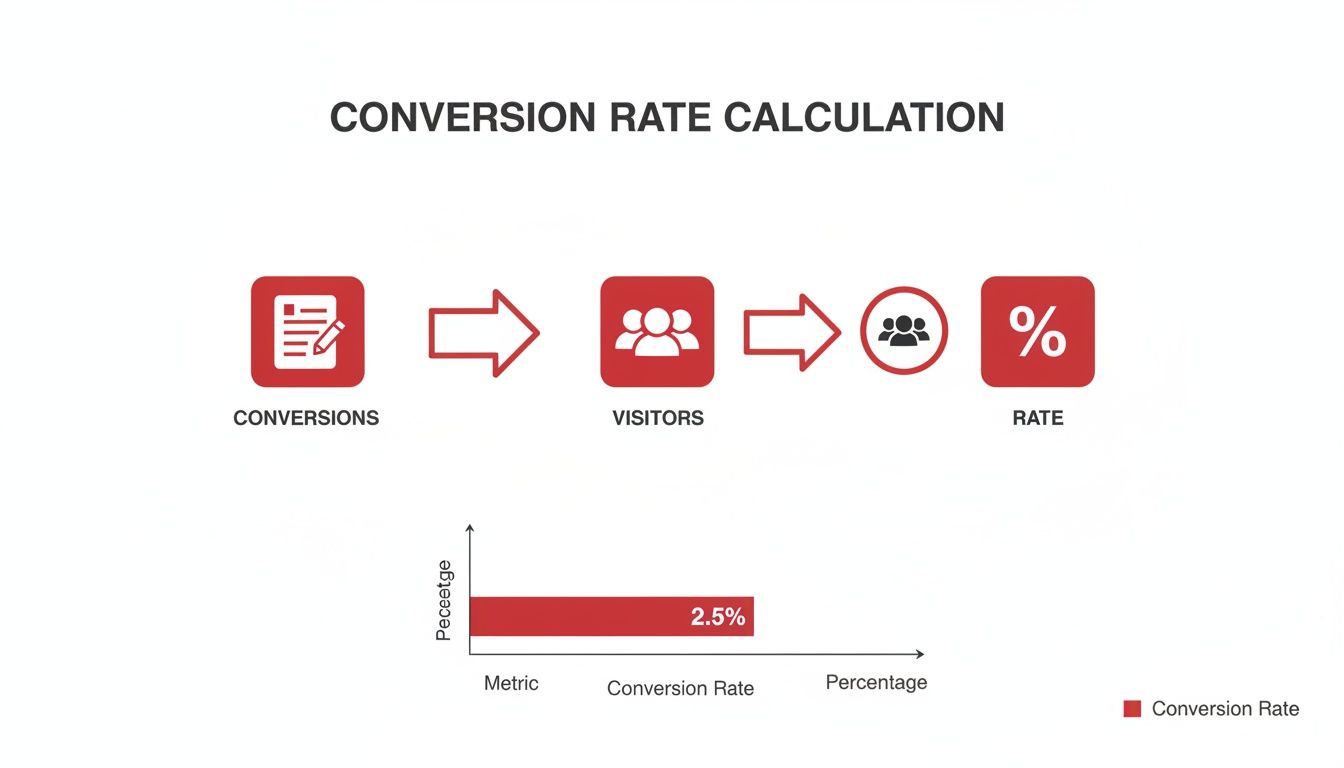
Apply that same formula to each marketing channel, and you'll quickly uncover which sources are truly driving your growth. This allows you to confidently invest more in what works and rethink the channels that are falling short.
Diagnosing Your Leaky Bucket Website
Before you can fix a low conversion rate, you have to figure out where the problem is. Pouring more cash into ads to get traffic to a broken website is like trying to fill a bucket full of holes—it’s a frustrating and expensive way to get nowhere fast.
Your website is that bucket. And right now, it could be leaking valuable leads every single day.
To even begin talking about what is a good website conversion rate, we first need to diagnose why yours might be struggling. The culprits are usually simple, overlooked issues that cause good customers to leave your site and call a competitor instead.
Think of your website as your digital showroom. If a customer walked in and the lights were flickering, the signs were confusing, and no one was around to help, they'd walk right back out. Your website is no different.
The Top Conversion Killers for HVAC Websites
Let's step into your customers' shoes for a minute and find the most common "leaks" that send them running. These are the issues that create friction, kill trust, and stop motivated homeowners from taking that next step.
1. A Terrible Mobile Experience
A huge number of homeowners search for HVAC services on their phones, usually in a panic when their AC or furnace gives out. If your website is slow, hard to read on a small screen, or has buttons that are impossible to tap with a thumb, you've already lost. They won't wait around—they’ll just hit the back button and click the next guy on the list.
2. Confusing Navigation and Layout
When a customer's AC dies on a 95-degree day, they don't have time for a scavenger hunt. They need your phone number or a "Book Now" button, and they need it immediately.
A visitor should land on any page of your site and know exactly how to contact you within three seconds. If they have to search for your contact info, your website has failed its most important job.
Cluttered pages, confusing menus, and no clear calls-to-action are like hiding the front door to your business. Make it painfully obvious how they can get in touch.
3. No Trust Signals
Homeowners are inviting your technicians into their homes. Trust is non-negotiable. A website that looks unprofessional or lacks clear signals of credibility just feels risky. Here are the absolute must-haves:
- Customer Reviews and Testimonials: Showing real feedback from local customers provides powerful social proof that you do good work.
- Certifications and Badges: Logos from the BBB, Google Guarantee, NATE, and trusted brands like Trane or Carrier build instant credibility.
- Real, Professional Photos: Ditch the generic stock photos. Using high-quality pictures of your actual team and trucks makes your business feel real and relatable.
Without these, your website looks less established than the competition, which is more than enough to scare off a potential customer.
From Diagnosis to Action
Pinpointing these leaks is the critical first step. Once you lose a lead, they’re gone for good. Fixing your site is half the battle; the other half is having a system to handle the leads you do get. That's why learning how to implement an effective HVAC lead management system is so important for turning those opportunities into scheduled jobs.
By finding and patching these common holes, you stop losing the valuable traffic you're already paying for. This is the foundation for turning your site from a leaky bucket into a true conversion machine.
Proven Strategies to Boost Your Conversion Rate
Alright, you know your numbers and you've spotted the problems. Now it's time to roll up your sleeves and get to work.
Boosting your conversion rate isn’t about throwing spaghetti at the wall to see what sticks. It's about systematically finding and removing every bit of friction a homeowner experiences on your site. The goal is to build so much trust that choosing your company becomes the easiest, most obvious decision they can make.
These are battle-tested strategies that work specifically for HVAC companies. We're not talking about fancy marketing fluff—these are high-impact changes that turn website visitors into scheduled jobs.
Meet Customers Where They Are
Let's be real: the way homeowners want to connect with service businesses has changed. Phone calls are still a big piece of the puzzle, but a huge chunk of your potential customers would rather text, chat, or fill out a form than pick up the phone.
If you ignore this shift, you're literally handing business over to your competitors who make it easier to get in touch.
We're seeing a massive trend away from phone-only conversions. In fact, recent data shows that a whopping 34% of revenue opportunity from paid ads now comes through digital channels like forms and chat, not phone calls. For an industry that's still so phone-centric, this is a wake-up call. You can dig into some great lead generation best practices for tripling conversions to get ahead of this. The scary part? Many HVAC companies build their entire tracking system around phone calls, meaning they could be completely blind to a third of their potential revenue.
To grab these leads before someone else does, you need to offer multiple, dead-simple ways for them to convert:
- Live Chat: Pop a chat widget on your site to catch those visitors who have a quick question or are on the fence. You can solve their problem in real-time before they have a chance to click away.
- Online Booking Tools: This is a game-changer. Let customers schedule their own tune-up or repair right on your website. It caters to people who want that instant confirmation without the back-and-forth of a phone call.
- Simple Contact Forms: Make your "Request a Quote" forms short and sweet, especially on mobile. Don't ask for their life story—just the essentials to get the conversation started.
Build Unshakeable Trust and Credibility
A homeowner's biggest fear is letting the wrong person into their home. Your website's first job is to scream, "We are professional, trustworthy, and we'll do the job right." You do this by plastering your site with social proof.
Think of these elements as your digital handshake. They do the selling for you before your dispatcher ever picks up the phone.
Your website's job is to answer one question above all others: "Can I trust this company?" Every single element on your page should contribute to a resounding "Yes."
Here are the non-negotiable trust signals you need front and center:
- Customer Testimonials: Feature glowing reviews from real, local customers. If you can get video testimonials, even better. They're pure gold.
- Google Guarantee Badge: If you're eligible, this badge is one of the most powerful trust signals in home services, period. It tells homeowners that Google has your back.
- Industry Certifications: Show off those logos! NATE, ACCA, and any major brand certifications like Carrier or Trane immediately tell visitors you know your stuff.
- An "About Us" Page with Real Photos: Ditch the cheesy stock photos. A professional photo of you, your actual team, and your wrapped trucks makes your business feel real, local, and authentic.
Capture Leads Who Aren't Ready to Call
Not every visitor is in a panic with a dead AC unit. A lot of them are in research mode, trying to figure out how much a new system will cost. These homeowners are incredibly valuable, but they're terrified of calling and getting cornered by a pushy salesperson.
So how do you capture their info? By offering them something genuinely useful in exchange for it.
An instant online estimate calculator is the perfect tool for this. It lets a homeowner get a ballpark price for a new furnace or AC without the pressure of a sales call. In return, you get the name, email, and phone number of a qualified prospect who is actively planning a major purchase.
This one tool can dramatically improve your conversion rate for high-ticket replacement jobs. It's a core principle of good user experience, which is something we dive into in our guide to effective HVAC web design. Start putting these strategies into practice, and you'll begin to plug the leaks in your sales funnel and see a real, measurable increase in leads.
Answering Your Top Conversion Rate Questions
Even after digging into all the numbers and strategies, it's normal to have a few questions rattling around. When it comes to something as vital as your website's ability to generate jobs, you need total clarity.
This section cuts right to the chase, tackling the most common questions we hear from HVAC owners. Think of it as your quick-reference guide to clear up any confusion so you can move forward with confidence.
How Quickly Can I Improve My Conversion Rate?
This is always the first question, and the honest answer is: it depends on what you change. Some fixes can give you a boost almost overnight, while others are more of a long game.
Simple tweaks—like making your phone number bigger and putting it everywhere, or rewriting a confusing call-to-action—can show a real lift in leads within just a few weeks. These are the quick wins that remove the most obvious roadblocks for your visitors.
Bigger projects, though, like a total website redesign or rolling out a new online booking system, will naturally take more time. For those major changes, you'll want to give it 30 to 90 days to collect enough clean data. You need enough consistent traffic coming through to know for sure that the change you made was responsible for the results.
Should I Get More Traffic or Improve My Conversion Rate First?
A classic marketing dilemma. But for an HVAC company? The answer is almost always the same: fix your conversion rate first.
Picture your website as a bucket you use to collect leads. If that bucket is riddled with holes (a low conversion rate), it’s insane to spend more money pouring water (traffic) into it. You’re just flushing your ad budget down the drain while good leads leak out to your competitors.
Patch the holes first. It makes every single dollar you spend on marketing later that much more powerful and profitable.
Let’s do some simple math. Say you get 2,000 visitors a month and have a 2% conversion rate. That gives you 40 leads. You could double your ad spend to get 4,000 visitors, which would get you to 80 leads. Or, you could focus on fixing your website to double your conversion rate to 4%. Now you're getting 80 leads from the same 2,000 visitors you started with—same result, for a tiny fraction of the cost.
Fixing that "leaky bucket" squeezes maximum value from the traffic you already have and sets the stage for profitable growth when you do decide to turn up the advertising.
Are Phone Calls More Important Than Form Fills?
This is a false choice. They are both absolutely critical. If you focus on one over the other, you're telling a huge chunk of your potential customers that you don't want their business.
The reality is, different customers have different needs. A homeowner whose air conditioner isn't working needs the instant relief of a phone call, right now. But the person planning a furnace replacement for next fall? They might prefer the convenience of filling out a form on your website at 10 PM after the kids are in bed.
Here’s the bottom line:
- Offer every option: Let people contact you however they feel most comfortable.
- Track everything: A qualified lead is a qualified lead. It doesn't matter if it came from a call, a form, or a carrier pigeon.
- Focus on revenue: The only thing that truly matters is connecting every lead—call or form—back to a scheduled job and a real dollar amount.
A modern HVAC business makes it easy for customers to buy on their own terms. Trying to force everyone down one path is a surefire way to lose jobs to competitors who are more flexible.
Does My Google Business Profile Have a Conversion Rate?
Yes, absolutely—and it might just be the most important one you’re not tracking. Your Google Business Profile (GBP) is your "mini-website" and, for many local customers, it's the very first time they'll ever interact with your brand.
A "conversion" on your GBP is any action a user takes that shows they're serious about hiring you, straight from your listing in Google Search or Maps.
These actions include:
- Clicks on the call button: This is a red-hot lead. Someone is ready to talk, right now.
- Clicks to your website: They want to learn more. Your listing did its job and moved them one step closer to becoming a customer.
- Requests for driving directions: This signals a powerful intent to visit you, which is huge for commercial clients or homeowners visiting a showroom.
An optimized GBP is a lead-generation machine for HVAC companies. Tracking its performance isn’t just a good idea; it’s essential to understanding how visible you are in your local market. Answering "what is a good website conversion rate" has to include these critical, top-of-funnel actions.
Ready to stop losing leads to a leaky website? The HVAC Growth Machine is a complete, done-for-you system designed to turn your website into a reliable source of profitable install jobs. We build you a high-converting site with an instant online estimate tool, automated follow-ups, and the tracking you need to see exactly where your revenue comes from. Secure your service area and start growing your business today.





Founder of HVAC Growth Machine