

Let’s be real—what is a business lead, anyway?
It’s any person or organization that shows even a tiny bit of interest in your HVAC services. This is the very first step in your entire sales process. It’s more than just a name and a phone number scribbled on a notepad; it’s a potential job just waiting to be booked, whether it’s a quick repair call or a high-dollar system install.
What a Lead Really Looks Like for an HVAC Pro
Forget the stuffy marketing definitions for a second. For an HVAC contractor, a lead isn’t some abstract concept—it’s a real opportunity hitting your desk.

Think of it like a fresh service request popping up on your dispatch board. Maybe it’s a homeowner whose AC just died in the middle of a July heatwave. Or it could be a property manager asking for a quote to replace the aging units across an entire apartment complex.
Every single one of those inquiries is an expression of interest that needs a closer look. That simple shift in perspective—from seeing a “contact” to seeing an “opportunity”—is everything. It sets the tone for your first response, your follow-up, and that final invoice.
Why Every Single Inquiry Matters
When you understand what a business lead truly represents, you start to see the value in every phone call, website form, and email that comes your way. The global lead generation market is expected to hit $21.43 billion in 2025, which just goes to show how vital these initial contacts are for any growing business.
But here’s the catch: not all leads are created equal. In fact, only about four out of every five are even considered “Marketing Qualified Leads” (MQLs) worth pursuing. You can dig into more lead generation statistics and trends to see how things are shaking out.
When you see every lead as an unsolved problem for a customer, your entire sales process changes. You stop selling equipment and start selling real solutions: comfort, reliability, and peace of mind.
At the end of the day, a steady flow of good leads is the lifeblood of your HVAC company. It’s what lets you:
- Build a predictable sales pipeline: Keep your techs busy and stop worrying about the slow seasons.
- Focus on high-value jobs: Spend your time on profitable system installations instead of just chasing small repairs.
- Actually measure your marketing ROI: Figure out which ads and channels are bringing in the jobs that make you money.
Throughout this guide, we’re going to break down exactly how to find, qualify, and turn these inquiries into profitable work for your team.
Understanding the Different Types of HVAC Leads
Not every phone call or form submission is created equal. To run a profitable HVAC company, you have to get smart about sorting through the noise and focusing your team’s precious time on the opportunities that are most likely to turn into high-dollar installs.
Think of it like running dispatch. Some calls are emergencies—”My AC just died and it’s 95 degrees!”—while others are just feelers—”I was wondering what a new furnace might cost… someday.” Telling the difference is the first step to building a sales process that actually works.
Inbound vs. Outbound Leads
The first and simplest way to slice it is by figuring out who made the first move. Did they come find you, or did you go find them?
- Inbound Leads: These are the folks who actively seek you out. They found your website on Google, saw a neighbor’s recommendation on Facebook, or got your number from a friend. Inbound leads are gold because the customer already knows they have a problem and is looking for a solution.
- Outbound Leads: This is when you do the hunting. Think direct mail flyers dropped in a target neighborhood, cold calls to property managers, or even door-to-door canvassing. It can absolutely work, but you have to put in more effort to figure out if they’re actually interested or just being polite.
The difference here is huge. An inbound lead from your “Request a Quote” form is someone raising their hand, ready to talk. A name on a mailing list is a total unknown. You have to treat them differently.
Marketing Qualified vs. Sales Qualified Leads
Beyond where they came from, you need to know how ready they are to buy. This is where the distinction between a Marketing Qualified Lead (MQL) and a Sales Qualified Lead (SQL) becomes critical for keeping your sales team from chasing dead ends.
An MQL is someone who has kicked the tires a bit. They’ve shown interest in your company, but they aren’t waving a credit card around. For B2B businesses, nurturing these contacts generates 67% more leads than companies that ignore them.
An MQL is like a homeowner who downloads your ‘Winter HVAC Prep Checklist.’ They know your brand and are interested in the topic, but they haven’t asked for a sales pitch.
An SQL, on the other hand, is practically begging to talk to a salesperson. They’ve taken a specific action that screams “I need to buy something now.” They’re past the research phase and are ready to make a decision.
This is the person who uses your website’s instant estimator tool to price a new heat pump or fills out a form titled “Schedule a Free Installation Consultation.” They have an immediate need. Throwing an MQL at a salesperson is a waste of their time, but ignoring an SQL is just leaving money on the table.
How to Qualify and Score Your HVAC Leads
Bringing in a lead is one thing. Figuring out if they’re a high-value installation job or just a casual price-shopper is another game entirely. Not every inquiry is created equal, and if you waste hours chasing dead ends, you’ll burn through your team’s energy and your marketing budget.
This is where lead qualification and scoring become your secret weapons. Think of it as a filter that separates the gold from the gravel.
Sorting the Hot Leads from the Lukewarm
A simple but powerful framework for this is BANT: Budget, Authority, Need, and Timeline. For any HVAC contractor, this boils down to a few gut-check questions you need to answer before you roll a truck or dedicate serious sales time.
- Budget: Can this person actually afford the work? Are they asking about financing options right off the bat?
- Authority: Are you talking to the person who makes the final decision, or do they need to run it by a spouse or landlord?
- Need: Is their furnace dead in the middle of a blizzard (high need)? Or are they just daydreaming about a new system for next year (low need)?
- Timeline: Do they need a tech out there today, or is this a project planned for six months from now?
Getting answers to these questions quickly tells you who’s ready to buy and who just needs to be put on a slow-drip nurture campaign for later.
The Basics of HVAC Lead Scoring
Once you know a lead is qualified, scoring helps you decide who to call back first. It’s a dead-simple system: you assign points to leads based on who they are and what they do on your site. This ensures your sales team is always focused on the leads most likely to turn into profitable jobs.
For instance, you could set up a point system that looks something like this:
- Lives in your primary service zip code: +5 points
- Downloaded your “Furnace Replacement Guide”: +10 points
- Visited your “Financing Options” page: +15 points
- Submitted an instant estimate request for a new heat pump: +25 points
This flowchart gives you a visual of how a lead moves from a general inquiry (Marketing Qualified Lead) to someone ready for a sales conversation (Sales Qualified Lead) based on the actions they take.
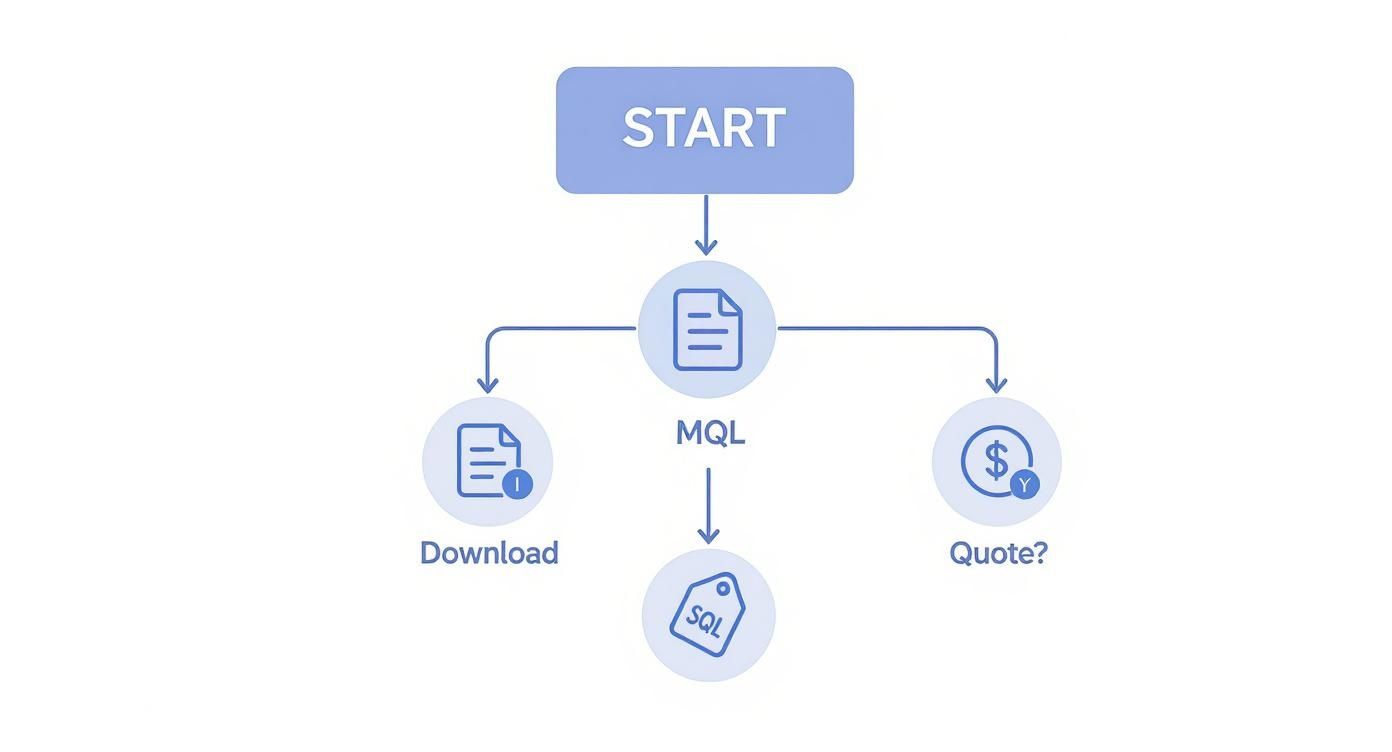
As you can see, a high-intent action like requesting a quote immediately flags a lead as sales-ready. Lower-intent actions, like downloading a guide, mean they’re interested but might need a little more warming up before they’re ready for a hard sell.
By scoring your leads, you create a clear pecking order. A lead with 50 points (an urgent quote request from a homeowner in your top neighborhood) gets an immediate callback. A lead with 10 points can be automatically added to an email sequence.
This methodical approach stops you from playing whack-a-mole with every incoming lead. Instead of treating every ping the same, you’re strategically pointing your team toward the biggest opportunities. To really get this process dialed in, check out our guide on how to implement an effective HVAC lead management system. A good system is what turns these scored leads into booked jobs and revenue in the bank.
Calculating the True Value of an HVAC Lead
Not every lead is created equal. So, how do you figure out what a business lead is actually worth to your bottom line? Knowing this number is everything when it comes to setting your marketing budget and understanding your real return on investment.
Without it, you’re just flying blind. You have no idea if your ad spend is actually making you money or just creating a bunch of noise.

Calculating a lead’s value isn’t just about the first job they book. It’s about zooming out and seeing the bigger picture—how one single opportunity can fuel your revenue for years to come. Let’s break down the three core metrics that pull back the curtain on the true financial impact of your leads.
Understanding Customer Lifetime Value
The single most important metric here is Customer Lifetime Value (LTV). This isn’t just about the profit you make from a one-and-done furnace installation. LTV is the total revenue you can realistically expect from that customer over their entire relationship with your company.
Think about it. A single installation lead can blossom into years of profitable work. For example, a $10,000 system replacement might easily lead to:
- A $300/year maintenance agreement.
- A few profitable repair calls over the next decade.
- Another full system replacement in 15 years.
This long-term view completely changes how you think about lead costs. Suddenly, paying a bit more upfront for a high-quality install lead makes perfect sense when it unlocks a decade or more of predictable income.
Tracking Your Lead Conversion Rate
Next up, you have to know your Lead Conversion Rate. This is simply the percentage of your leads that actually turn into paying customers. A high conversion rate is a sign that your sales process is dialed in and your leads are well-qualified from the start.
The formula is dead simple: (Total Number of New Customers / Total Number of Leads) x 100 = Conversion Rate.
Let’s say you got 100 leads last month and your team booked 15 jobs from them. Your conversion rate is 15%. Tracking this metric helps you pinpoint which marketing channels are bringing in the most motivated, ready-to-buy customers.
Measuring Your Cost Per Lead
Finally, Cost Per Lead (CPL) tells you exactly how much you’re spending to get each opportunity in the door. You calculate it by dividing your total marketing spend by the number of leads you generated.
If you spend $1,500 on Google Ads and get 30 leads, your CPL is $50. This number is the bedrock for making smart budget decisions.
Knowing your CPL is non-negotiable when you’re trying to compare different marketing channels. For contractors interested in a model where you only pay for legitimate opportunities, exploring HVAC pay-per-lead services can be a great way to manage acquisition costs predictably. This approach helps you control your budget while making sure you’re only investing in genuine prospects who are more likely to turn into jobs.
Top Channels for Generating High-Quality HVAC Leads
You know what a lead is and how to figure out its value. But where do the really good ones come from? The most profitable leads—especially for those big-ticket system installs—don’t just fall into your lap. They’re the direct result of a smart strategy, one that focuses on the channels where customers with real problems are actively looking for a pro.

Here’s a stat that should make you sit up: small businesses that actually invest in blogging and local SEO see 126% more lead growth than the ones that don’t. That tells you a solid digital presence isn’t just a “nice-to-have” anymore. It’s the engine that powers profitable growth.
So let’s break down the channels that consistently bring in the best work for HVAC contractors.
Dominate Local Search Results
For any HVAC business, your best customer is almost always right around the corner. That’s why dominating local search is the single most powerful thing you can do to connect with homeowners whose AC just died in the middle of a heatwave.
Google Business Profile (GBP) Optimization: Think of your GBP listing as your digital storefront. It needs constant attention. Keep it fresh with photos from recent jobs, make sure you respond to every single review (good and bad), and use the Q&A feature to proactively answer the questions you always get over the phone. A well-tended profile builds massive trust and rockets you up the local map pack rankings.
Google Local Services Ads (LSAs): These aren’t your typical ads. They sit right at the top of the search results, even above the paid ads and organic listings. By going through Google’s screening process to become “Google Guaranteed,” you gain instant credibility. This puts your business in front of the most motivated customers—the ones who need help right now.
Convert Website Visitors with High-Intent Tools
Getting someone to your website is only half the battle. Once they land there, you have to make it dead simple for them to take the next step. Your site needs to be a conversion machine, not just a pretty online brochure.
An on-site instant quote tool is a perfect example of this in action. It lets a homeowner who is actively shopping for a new system get a real ballpark estimate without the friction of a phone call. This simple tool does the heavy lifting, capturing the contact info of a highly qualified, bottom-of-the-funnel lead who is serious about buying.
A great website doesn’t just inform; it engages. By offering interactive tools like an instant estimator, you shift from passively providing information to actively capturing high-value sales opportunities 24/7.
Another powerhouse SEO tactic is creating dedicated service-area landing pages. A specific page for “AC Replacement in Springfield” is going to outrank a generic “Services” page every single time for that search. It sends a crystal-clear signal to both Google and your potential customers that you are the local expert for their town.
Now that we’ve covered some key channels, it’s worth taking a broader look at the options available. Not all lead sources are created equal—some offer high volume but low quality, while others deliver fewer but more valuable opportunities.
Comparing HVAC Lead Generation Channels
This table breaks down some of the most common channels, giving you a realistic idea of the cost, quality, and best use case for each.
| Channel | Typical Cost-Per-Lead (CPL) | Lead Quality (Intent) | Best For |
|---|---|---|---|
| Google Local Services Ads (LSAs) | $25 – $100+ | Very High | Capturing immediate, emergency repair and replacement jobs. |
| Organic SEO (GBP & Website) | $0 (Sweat Equity) – $50 | High | Building long-term, sustainable lead flow and local authority. |
| Google Ads (PPC) | $20 – $75 | Medium to High | Targeting specific keywords and generating predictable lead volume quickly. |
| Facebook Ads | $15 – $60 | Low to Medium | Building brand awareness and promoting maintenance plans or tune-up specials. |
| Angi / HomeAdvisor | $30 – $150+ | Low to Medium | Supplementing your schedule, but often shared with multiple competitors. |
| Referrals | $0 | Very High | Generating high-trust leads from your existing happy customer base. |
Ultimately, the best approach is a blended one. Relying on a single channel is risky; a smart mix ensures a steady stream of opportunities, protecting you from algorithm changes or shifts in the market.
To go deeper on building a system that keeps your schedule full, you can learn more about how to generate high-quality HVAC leads and stop worrying about where the next job will come from.
How to Turn More Leads into Booked Jobs
Getting a lead is just the start. The real work—and the real money—is in turning that initial flicker of interest into a booked job and a signed contract. The difference between a lead that fizzles out and one that becomes a profitable install often boils down to two things: speed and follow-up.
In the HVAC business, the first contractor to respond usually gets the job. This is called speed-to-lead, and it’s everything when a homeowner’s AC gives out in the middle of July. Think about it: they’re desperate. Studies have shown that responding within the first five minutes can massively increase your chances of closing the deal. If you wait even an hour, your odds drop off a cliff.
The second a homeowner hits “submit” on your website form, a timer starts. They aren’t just waiting for you; they’re probably reaching out to your top two competitors at the same time. It’s a race, plain and simple.
Nurture Leads That Aren’t Ready Today
But what about the leads who are just kicking the tires and getting quotes for a future project? You can’t let them go cold. The key is an automated nurture sequence—a series of pre-written emails or text messages that keep your company top-of-mind without you having to lift a finger.
A simple SMS follow-up sequence can work wonders. Here’s an example:
- Day 1 (30 mins after quote): “Hi [Name], just following up on the estimate we sent for your new system. Let me know if you have any questions! – [Your Name] from [Your Company]”
- Day 3: “Hi [Name], just checking in. Many of our customers ask about our financing options—we have some great plans that make it really affordable. Happy to chat if you’re interested.”
- Day 7: “Just a final check-in, [Name]. We’re booking installs for next week. If you’re ready to move forward, we can get you on the schedule.”
This simple system keeps you in the conversation without being pushy and answers common questions before they’re even asked.
Track What Actually Works
Finally, you can’t improve what you don’t measure. If you’re spending money on marketing, you need to know exactly what’s making the phone ring and what’s a waste of cash.
This is where call tracking comes in. By assigning a unique phone number to each marketing channel—one for your Google Business Profile, one for your website, one for your paid ads—you get crystal-clear attribution.
You’ll know, without a doubt, that your investment in Local Services Ads generated 15 high-value installation leads last month. That data gives you the confidence to double down on what’s working and cut the dead weight. Stop guessing and start knowing where your best jobs are coming from.
Common Questions About HVAC Leads
Getting your head around lead generation can feel like a chore. Let’s clear up a few of the most common questions HVAC owners ask about finding and managing new opportunities.
What’s the Real Difference Between a Lead and a Prospect?
Think of it like fishing. A lead is any fish that nibbles your bait—it’s someone who has shown a flicker of interest, like downloading a checklist from your site or clicking an ad. You don’t know if they’re the right size or even the right kind of fish yet. They still need to be qualified.
A prospect, however, is a fish you’ve already hooked and started reeling in. You’ve qualified them. You know they have a real problem (their AC is toast), they’re the homeowner who can make the call, and they have the budget for a replacement. A prospect is a legitimate potential customer your comfort advisors should be talking to right now.
How Much Should an HVAC Lead Actually Cost?
There’s no single answer here. The cost-per-lead (CPL) for HVAC services is all over the map, ranging from $25 for a basic repair lead to well over $300 for a competitive system install lead, especially from a channel like Google Ads. It really depends on your city and the service they’re looking for.
Forget about chasing the lowest cost-per-lead. What you really need to focus on is your cost-per-acquisition (CPA). I’d take one high-intent, $300 lead that turns into a $10,000 install over a hundred cheap, $10 leads that just waste my team’s time.
What’s the Best Way to Get Leads on a Shoestring Budget?
If you’re just starting out or cash is tight, skip the big ad spend for now. Instead, pour your energy into the low-cost, high-impact stuff that builds your local authority. These two strategies are the best place to start.
Obsess Over Your Google Business Profile (GBP): Your GBP listing is one of the most powerful free marketing tools you have, period. Fill out every single section. Upload high-quality photos from every job. Write detailed service descriptions. And most importantly, make it ridiculously easy for your happy customers to leave you reviews.
Launch a Simple Customer Referral Program: Your best customers are your best marketers, hands down. Set up a dead-simple referral program. Give them a gift card or a discount on their next tune-up whenever they send a new customer your way who books a job. It’s a win-win.
Ready to stop chasing tire-kickers and start filling your calendar with profitable install jobs? The HVAC Growth Machine is a complete website and lead generation system designed to do just that. We build you a high-converting website, bolt on an instant online estimator, and optimize your local presence to attract homeowners who are ready to buy. Learn more about how it works and secure your service area today.





Founder of HVAC Growth Machine