

Pay-per-lead (PPL) is exactly what it sounds like: a marketing model where you only pay for qualified customer inquiries, not for clicks or impressions that lead nowhere.
Think of it like a specialized parts delivery service for your HVAC business. You only pay for the specific components you need for a job, not for access to the entire warehouse. It’s a simple shift that focuses your marketing dollars on tangible opportunities instead of just hopeful advertising.
How HVAC Pay Per Lead Actually Works
Instead of pouring money into a billboard and just hoping the phone rings, the pay-per-lead model ties your marketing costs directly to potential jobs. It’s a clean, straightforward process that connects a homeowner’s urgent need with your team’s ability to solve it, filtering out all the noise of traditional marketing.
Let’s walk through a real-world scenario. Imagine a homeowner in your service area whose AC unit just dies on a sweltering July afternoon. What’s their first move? They grab their phone and search for something like “emergency AC repair near me.”
A PPL provider’s system is built to capture that exact moment of intent. It qualifies the homeowner as a genuine prospect and then delivers their contact info directly to you.
From a Desperate Google Search to Your Dispatch Team
The whole journey is designed for raw efficiency. You aren’t buying ads, you’re not managing complex campaigns, and you’re certainly not guessing which keywords work. You’re simply buying the end result: a qualified lead. This laser focus on real opportunities is why so many HVAC contractors are drawn to the model.
This simple diagram breaks down the basic flow of a pay-per-lead system.
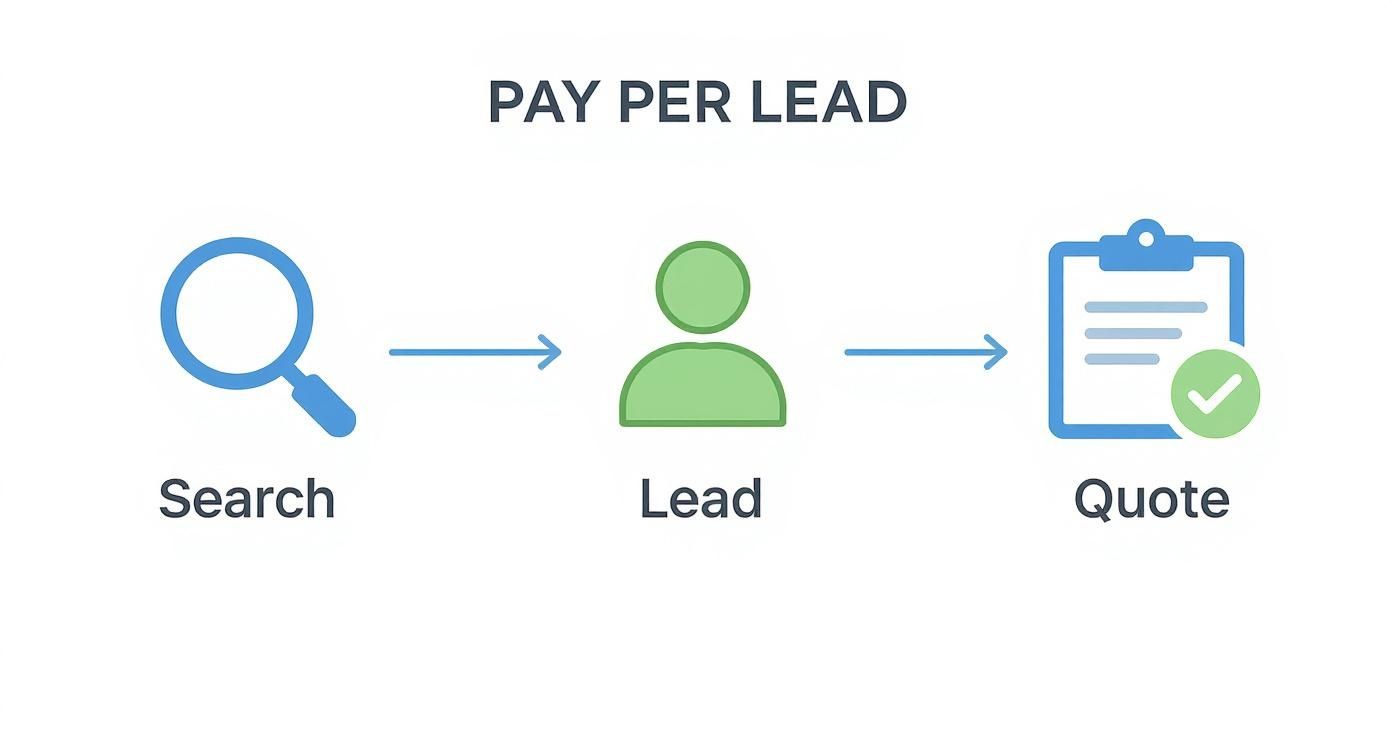
As you can see, PPL cuts through the typical digital marketing chaos, connecting a customer’s initial search directly to a quote request with your company.
Now, what defines a “lead” here is critical. This isn’t just a website visitor or a social media “like.” A legitimate lead is a real person, located within your designated service area, who has actively raised their hand and expressed a need for HVAC services by providing their contact details.
A true pay-per-lead model means you stop paying for abstract metrics like clicks and views. Instead, you invest in actual conversations with potential customers who have a problem you can solve.
The Financial Advantage of PPL
This model brings a massive dose of budget predictability to your marketing. You know exactly what each potential job costs to acquire, which makes financial planning a whole lot simpler.
Compare that to traditional advertising, which often involves a huge upfront investment with absolutely no guarantee of a return. Acquiring leads can be a serious expense; the average Cost Per Lead (CPL) across all industries hovers around $198.44, though this can swing wildly depending on the sector and the actual quality of the lead.
To help put this in perspective, here’s a quick comparison of the Pay Per Lead model against older advertising methods.
Pay Per Lead vs Traditional Advertising Models
| Model | Payment Trigger | Primary Focus | Budget Predictability |
|---|---|---|---|
| Pay Per Lead (PPL) | A qualified customer lead | Acquiring opportunities | High |
| Traditional (Print/Radio) | Ad placement/airtime | Brand awareness | Low |
| Pay Per Click (PPC) | A click on an ad | Website traffic | Medium |
| Pay Per Impression (CPM) | Ad views (per 1,000) | Visibility/Reach | Low |
This table highlights the core difference: with PPL, you’re paying for a potential customer, not just the chance to reach one.
This financial clarity is a game-changer for scaling your HVAC business. If you have the capacity to handle ten more jobs this month, you can confidently purchase ten more leads. This direct line between what you spend and the opportunities you get is the single biggest benefit of the PPL system. For a deeper dive into different methods, explore our comprehensive guide on how to get HVAC leads.
Decoding Lead Pricing and Quality
When you’re looking at a pay-per-lead service, two questions always pop up first: “How much?” and “Are they any good?” These aren’t just minor details; they’re the entire foundation of whether this model will work for your business.
The price of a lead is never just a random number. It’s a direct reflection of its potential value. That’s why a lead for a massive commercial boiler installation is always going to cost more than a simple residential AC tune-up. The potential payday from that commercial job is huge, and the cost to get that lead in the door reflects it. Getting this is the first step to setting the right expectations for your marketing budget.
Unpacking Lead Pricing Structures
Lead gen companies typically use a couple of different pricing models. Knowing how they work helps you pick the right partner for your HVAC shop.
The two most common you’ll run into are fixed-rate and tiered pricing.
Fixed-Rate Pricing: This is as simple as it gets. You pay one flat price for every single lead that meets the rules you agreed on, no matter the job type. It gives you a predictable, easy-to-manage budget.
Tiered Pricing: This approach is a bit more strategic. Leads are priced differently based on what the customer wants. A high-value furnace replacement lead would be in a top tier, while a low-value repair call would be in a bottom tier.
Just look across other industries, and you’ll see how much CPLs can vary. Legal services, for example, can see an average CPL skyrocket to $649-$784, while an e-commerce business might only pay $85-$98. This shows how things like the potential job value and how long it takes to close a deal directly impact what you pay for a lead—and HVAC is no different.
So, which one is right for you? If you’re laser-focused on high-ticket installs, a tiered model that lets you target those specific jobs just makes sense. But if you run a high-volume business that handles every kind of service call, the simplicity of a fixed-rate model might be a better fit.
Defining a High-Quality HVAC Lead
Price is only half the story. A cheap lead that goes nowhere is a total waste of money. On the other hand, an expensive lead that turns into a profitable installation is a brilliant investment. The quality of the lead is what really determines your ROI.
So, what does a “high-quality” HVAC lead actually look like? It has to check a few critical boxes before it ever lands in your hands.
A quality lead isn’t just a name and a phone number. It’s a verified, geographically relevant, and high-intent opportunity that matches the services your business actually provides.
This means every lead needs to be put through a tough qualification process. Any reputable provider will have a system to make sure every lead they send you meets the standards you both agreed on.
The Non-Negotiable Lead Qualification Checklist
Before you sign any contract, make sure your provider can guarantee leads that meet these four criteria. No exceptions.
- Correct Geographic Targeting: The lead has to be right inside your service area. A call from the next state over is an instant dud.
- Verified Service Intent: The customer must have a real, stated need for a service you actually offer. A call about plumbing when you only do HVAC is a waste of everyone’s time.
- Valid Contact Information: The phone number has to work and the email has to be deliverable. Bad contact info makes a lead completely useless.
- Exclusivity: A quality lead should be an exclusive lead. Nothing kills your closing rate faster than competing with three other contractors for the exact same job. Our analysis on the value of exclusive HVAC leads explores if they are worth the investment.
A transparent lead provider will have a clear and fair lead return policy. Think of it as your safety net. If you get a lead that doesn’t meet the criteria—it’s outside your territory or the number is disconnected—you should be able to return it for credit, no questions asked. This policy is a huge signal of a provider’s confidence in their own process, and it’s absolutely essential for protecting your investment.
Comparing PPL to Other Marketing Models

To really see why pay-per-lead is such a powerful model, you need to see how it stacks up against the other ways HVAC businesses try to fill their calendars. Every marketing approach has its own risks, costs, and potential payoffs.
Picking the right one isn’t just about finding leads. It’s about finding a strategy that fits your budget, your team’s capacity, and how much risk you’re willing to take on. Let’s break down how PPL compares to the two biggest alternatives: Pay-Per-Click (PPC) ads and building your own in-house marketing team.
Pay-Per-Lead vs. Pay-Per-Click (PPC)
Pay-Per-Click, usually run through platforms like Google Ads, is what most contractors think of first. The idea is simple: you create ads and pay Google every single time someone clicks on one. While PPC can get you to the top of the search results almost instantly, it works on a totally different principle than PPL.
With PPC, you’re paying for traffic. With PPL, you’re paying for an opportunity.
This is the most important difference to understand. A click is not a lead. A whole lot of those clicks come from competitors checking out your pricing, job seekers, or homeowners just doing research with zero intent to book a call.
In a PPC campaign, your budget gets eaten up by every click, whether or not that person ever actually contacts your business. In a PPL model, you only pay when a real prospect raises their hand and asks for a quote.
With PPC, you carry 100% of the risk of turning that website visitor into a lead. It’s on you to have a killer landing page, persuasive sales copy, and a lightning-fast, easy-to-use website. A slow or confusing website can burn through thousands in ad spend with absolutely nothing to show for it.
On the other hand, PPL flips the script and shifts that risk from you to the lead provider. They’re the ones on the hook for all the hard work—the SEO, the ad management, the website conversion—that it takes to generate that qualified phone call or form submission.
Pay-Per-Lead vs. In-House Marketing
The other route is to build your own marketing department. This means hiring a whole team—an SEO guy, a content writer, a social media person, a PPC manager. This approach gives you the absolute most control over your brand and strategy.
But it also comes with a massive price tag in salaries, software subscriptions, and constant training. Building a good in-house team isn’t a quick fix; it’s a long-term project that demands a ton of upfront cash and management headaches. You’re not just paying for leads anymore; you’re paying for the entire machine needed to create them.
For huge, established companies with deep pockets, this can be the ultimate solution. For most HVAC businesses, though, the cost and complexity are just too much.
The pay-per-lead model is a shortcut. It gives you access to the results of a high-powered marketing team without having to build and manage one yourself. It’s a way to tap into expert-level lead generation on a pay-as-you-go basis. If you want to see all the moving parts that go into a successful campaign, check out our complete digital marketing guide for HVAC businesses.
Lead Generation Model Comparison for HVAC Businesses
To make it even clearer, this table breaks down the core differences in risk, cost, and control between the three main approaches.
| Attribute | Pay Per Lead (PPL) | Pay Per Click (PPC) | In-House Lead Generation |
|---|---|---|---|
| Primary Cost | Qualified lead | Ad click | Salaries & overhead |
| Risk Profile | Low (Pay for results) | Medium (Pay for traffic) | High (Pay for effort) |
| Control Level | Low to Medium | High | Very High |
| Speed to Results | Fast | Fast | Slow |
| Scalability | High (Dial up/down) | High (Adjust budget) | Low (Hiring dependent) |
As you can see, the pay-per-lead model fills a crucial gap for most growing HVAC companies. It offers a scalable, predictable way to get more jobs on the books without the sky-high financial risk of PPC or the operational nightmare of building an in-house team from scratch.
How to Choose the Right PPL Partner
Picking a pay-per-lead partner is a lot like choosing a new parts supplier for your HVAC business. The right one sends you a steady stream of quality components that keep your operation humming. The wrong one sends you a box of junk and charges a premium for it.
Not all lead providers are created equal. To make the right call, you have to look past the sticker price and start digging into how they actually run their business.
Scrutinizing Their Process and Proof
Your vetting process should feel like an investigation. Kick it off with the single most important question you can ask: “How do you generate your leads?”
If they get cagey or give you a vague answer, that’s a massive red flag. You need a partner who uses legitimate, sustainable marketing tactics—like search engine optimization (SEO) and paid Google ads. You absolutely do not want someone who relies on shady email lists or clickbait gimmicks that will drag your brand’s reputation through the mud.
Once you’re clear on how they get leads, it’s time to dig into their quality control. A solid partner will have a transparent and rigorous process for verifying every single lead. They should be able to explain exactly how they filter out bad phone numbers, tire-kickers, and requests from outside your service area before that lead ever hits your inbox.
Ask them straight up: What happens when you send me a lead for a plumbing job or a disconnected number? A confident provider will have a clear, no-nonsense policy for crediting you back for invalid leads. It protects your investment and shows they believe in their own system.
Choosing a PPL partner isn’t just a marketing decision; it’s a business partnership. Their methods, ethics, and performance directly impact your bottom line and your company’s reputation in the local community.
Verifying Industry Expertise and Track Record
Does this company specialize in home services, or even better, just HVAC? A generalist marketing agency might not know the difference between a high-ticket furnace installation lead and a low-margin maintenance call. An industry specialist gets it. They understand the nuances of your business, the seasonality of your work, and what a genuinely qualified prospect actually looks like.
But don’t just take their word for it. Ask for case studies and testimonials from other HVAC or home service businesses your size. Research shows that 71% of B2B buyers check out content like this before making a decision. You want to see real-world proof that they can deliver the goods.
Finally, do your own homework. It’s non-negotiable.
- Check Online Reviews: See what people are saying on Google, Capterra, or in industry forums. Look for consistent themes in both the good and bad feedback.
- Ask for References: Get on the phone with a few of their current HVAC clients. Hearing directly from another business owner will give you invaluable, unfiltered insight into what it’s really like to work with them.
- Review Their Contract: Read the fine print. Look for total clarity on lead definitions, exclusivity, return policies, and the contract length. You don’t want to get locked into a long-term deal without a trial period or performance guarantees.
Following this simple checklist helps you cut through the sales pitch and see the real value a potential partner brings to the table. This is how you find a pay-per-lead provider who acts less like a vendor and more like a true partner invested in your growth.
Negotiating a PPL Contract That Protects You
A handshake deal is a recipe for disaster when your marketing budget is on the line. I’ve seen it happen too many times. A solid, well-defined contract is the only way to kick off a successful pay-per-lead partnership.
This isn’t about being difficult or starting off on the wrong foot. It’s about setting crystal-clear expectations from day one so both you and the lead provider are set up to win.
Think of it like the scope of work you provide for a new system install. You detail every part, every step, and every promise. Your PPL contract needs that same level of precision. It’s your single source of truth and your main line of defense against misunderstandings that drain your bank account.
Flying blind on assumptions is a terrible way to manage your marketing. A strong contract clears the air and gives you a roadmap for handling issues if—or when—they pop up.
Essential Clauses for Every PPL Contract
When a provider sends over their contract, you need to put on your technician’s hat and treat it like a diagnostic checklist. Certain parts are absolutely non-negotiable. If any of these are missing or sound fuzzy, it’s a massive red flag.
Your contract must spell out the following:
A Crystal-Clear Definition of a ‘Qualified Lead’: This is the single most important part of the entire agreement. It needs to detail the exact criteria a lead must meet to be billable—things like being in your geographic service area, having valid contact info, and showing real intent for a specific service (e.g., furnace repair, not just a DIY question).
Lead Exclusivity Terms: Is the lead yours and yours alone? The contract has to state this clearly. If the leads are shared, it needs to say exactly how many other contractors are getting that same name and number. Non-exclusive leads kill closing rates and should cost a whole lot less.
The Lead Dispute and Credit Process: Bad leads happen. What matters is how they’re handled. There must be a dead-simple process for disputing junk leads. The contract should outline how you submit a dispute, the timeframe for the provider to review it, and how you get credited for the duds.
A fair and transparent contract is a direct reflection of a provider’s confidence in their own lead quality. If a company is hesitant to define these terms clearly, they may not be confident in their ability to deliver on their promises.
Practical Negotiation Tactics for HVAC Owners
Negotiation isn’t just about getting a lower price; it’s about making the agreement work for your business in the real world. You have leverage, especially if you can offer a steady stream of business. Use it to build a partnership that matches your team’s capacity and your growth plans.
Here are a few practical points to bring to the table:
Request a Trial Period: Ask for a shorter initial term, like 30-60 days, with no long-term commitment. This lets you test-drive the lead quality and the provider’s service before you’re locked into a year-long deal.
Inquire About Volume Discounts: If you’re planning to ramp things up, it’s fair to ask if they offer tiered pricing. Buying more leads per month should come with a better rate.
Set Daily or Weekly Lead Caps: Nothing burns out a team faster than a firehose of leads they can’t handle. Negotiate the ability to cap the number of leads you get each day or week. This helps you maintain your “speed-to-lead” and ensures good opportunities don’t go cold.
By focusing on these key contract clauses and negotiation points, you go from being just another customer to an active partner. This proactive approach ensures your PPL investment is protected, predictable, and actually ready to drive real growth for your business.
Turning Leads Into Profitable HVAC Jobs
Getting a high-quality lead is a great first step, but it’s definitely not the finish line. The real money in any pay-per-lead investment is made in the minutes, hours, and days after that lead hits your inbox. The systems you have in place to handle these opportunities will make or break your profitability.
Think of it this way: a PPL provider delivers a brand-new, top-of-the-line compressor right to your shop door. If your team just lets it sit on the loading dock for a week, you can’t blame the part when it doesn’t get installed. It’s the same exact principle with leads—their value decays fast, and it’s your process that captures that value before it vanishes.
The Make-or-Break Importance of Speed-to-Lead
In the home services world, speed is king. When a homeowner’s AC gives out in the middle of August, they aren’t just casually browsing for quotes. They’re in full-blown emergency mode. They will hire the first qualified, responsive company that picks up the phone and offers a real solution. This is the entire game of speed-to-lead.
Your goal needs to be contacting every single new lead within five minutes or less. I know that sounds aggressive, but it’s the new standard for turning online leads into actual booked jobs. Every minute you wait, the odds of that prospect calling another contractor—or just giving up—skyrocket.
A lead is never really yours until you’ve made contact and scheduled the appointment. You’re in a race to be the first voice they hear, and it’s a race you absolutely cannot afford to lose.
Building Your Lead Management Machine
To win that race consistently, you need a rock-solid system, not just good intentions. Manually checking your email for new leads is a surefire way to let opportunities slip through the cracks. The real solution is to integrate your PPL service directly with your Customer Relationship Management (CRM) software.
This integration fires off an automated workflow that works for you 24/7:
- A new lead comes in from your PPL partner.
- It’s instantly and automatically dumped right into your CRM.
- Your dispatcher or sales team gets an immediate notification to follow up.
This automated process gets rid of human error and lag time, ensuring every lead gets the immediate attention it needs. Even better, it lets you track that opportunity all the way from the first phone call to the final paid invoice. That complete visibility is what you need to calculate your true cost-per-acquisition and ROI.
Creating a Powerful Feedback Loop
One of the most overlooked parts of a great PPL partnership is the feedback loop. Don’t just pay the bill and hope for the best; talk to your provider about how the leads are performing. When you close a big-ticket installation from one of their leads, tell them.
Share details like the job type, the neighborhood it was in, and the final invoice total. This data is pure gold for your provider. It helps them figure out what’s working so they can fine-tune their ad targeting to find more homeowners just like that one.
This turns a simple transaction into a true strategic partnership. You’re no longer just buying leads; you’re actively teaching your provider how to find the exact customers you want. Your PPL spend becomes a smart, data-driven growth engine for your entire HVAC business.
Common HVAC Pay Per Lead Questions
Jumping into the pay-per-lead world can feel a little confusing, especially if you’re used to old-school marketing. Getting straight answers is the only way to feel confident about whether it’s the right move for your HVAC business.
Let’s cut through the noise and tackle the real questions HVAC owners ask about PPL. My goal is to clear things up so you know exactly what you’re getting into.
Is Pay Per Lead the Same as Buying a Lead List?
Absolutely not, and this is a big one. Buying a lead list is like buying a phonebook—it’s just a static chunk of names and numbers. These people never asked to hear from you, and the data is often old, inaccurate, and sold to dozens of your competitors.
A pay-per-lead service, on the other hand, delivers real-time inquiries from actual homeowners. These are people who are actively looking for HVAC help right now and are waiting for someone to call them back. You’re paying for a real opportunity, not just a name on a spreadsheet.
Think of it this way: a lead list is a cold call. A pay-per-lead service is a warm inbound call from a customer who found you.
How Quickly Can I Expect to See Results?
This is where PPL really shines. Unlike SEO, which can take months to gain traction, a solid pay-per-lead campaign can have your phone ringing almost immediately.
Once you partner with a provider and lock in your service area and job types, they can often turn on the lead flow within a few days. It’s one of the fastest ways to fill your calendar, especially if you’re heading into a slow season or just hired a new tech you need to keep busy.
What if I Get a Bad Lead?
It happens. And any reputable PPL provider has a plan for it. A good partner will have a simple, no-hassle process for you to return a junk lead and get a credit for it.
This is a non-negotiable part of any agreement. So what counts as a “bad” lead?
- The phone number is disconnected or just plain wrong.
- The homeowner is way outside your service area.
- It’s a duplicate lead they’ve already sent you.
- The customer is looking for a service you don’t even offer.
A fair return policy is the signature of a partner you can trust. It’s your safety net, making sure you only ever pay for a legitimate shot at a new job.
Ready to stop paying for clicks and start paying for actual jobs? HVAC Growth Machine provides a complete, done-for-you system that generates exclusive, high-quality installation leads directly for your business, without the guesswork or long-term contracts. Learn more at https://hvacgrowthmachine.com.





Founder of HVAC Growth Machine