

If you want a steady stream of HVAC leads, you have to show up where customers are looking. That means building a powerful digital presence.
The most effective way to do this comes down to three things: optimizing your Google Business Profile for local searches, building a website that actually ranks for city-specific service keywords, and systematically collecting five-star reviews to build rock-solid trust. Get these three areas right, and you'll create a foundation that brings high-intent homeowners directly to you, instead of you having to chase them down.
Build Your Digital Foundation for Consistent Leads
Before you even think about running ads or building complex funnels, your business has to be findable. Simple as that. If a homeowner with a busted AC unit can't find you on Google, you might as well not exist.
Building a strong digital foundation is about more than just having a website. It’s about owning your local search results and becoming the obvious, go-to choice for customers in your service area. This is a strategic shift from chasing leads to attracting them.
The numbers don't lie. Over 55% of consumers now search online before they ever schedule a home service, which has completely changed the game. It’s why digital channels now make up around 45% of the total marketing spend in the HVAC industry. Your online reputation is your new word-of-mouth.
Dominate Local Search with Your Google Business Profile
Think of your Google Business Profile (GBP) as your digital storefront. It's often the very first impression a potential customer gets when they find you in Google Maps or the local search results. A neglected profile is like a shop with a dusty window and a "closed" sign—it tells people you're not on top of your game.
A fully optimized profile, on the other hand, is a lead-generation machine. It's way more than just your name and phone number.
To turn your GBP into a real asset, you need to give it some attention:
- Get Hyperlocal with Service Areas: Don't just list your main city. Add every single town, suburb, and specific neighborhood you cover. This is how you show up for those high-intent searches like "ac repair near me" or "furnace service in Southwood."
- List Every Single Service: Get specific. Instead of just "HVAC services," list out everything from "emergency furnace repair" to "ductless mini-split installation." Use the same language your customers are using when they search.
- Promote with Google Posts: Got a seasonal tune-up special? Offering a deal on new installs? Use Google Posts to put that offer right on your profile. They act like mini-ads that grab the attention of people who are ready to buy.
For a complete playbook on getting this right, check out our deep-dive guide on how to optimize your Google Business Profile for more leads.
This whole process really comes down to three core pieces working together.
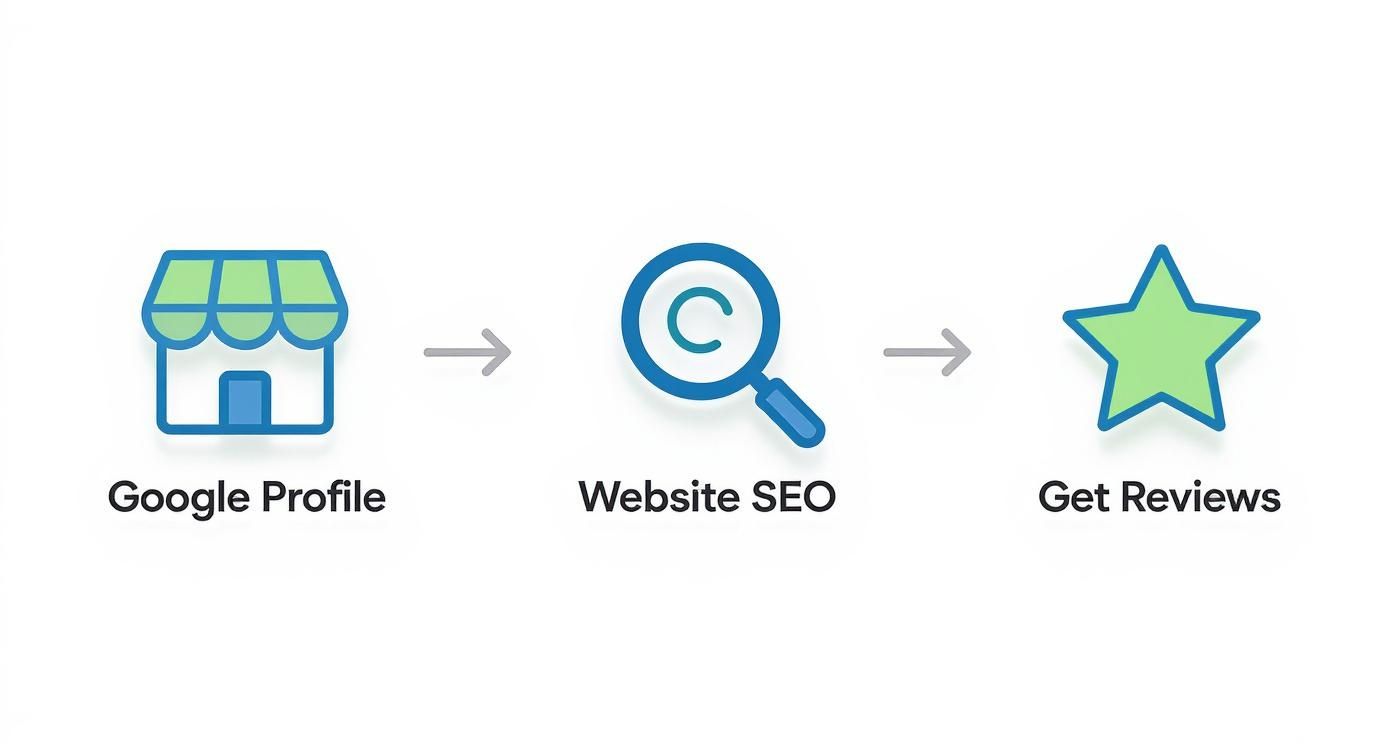
As you can see, a strong Google Profile, smart website SEO, and a steady flow of great reviews combine to create an unbeatable local presence that feeds your business.
Turn Your Website into a Local Authority
If your GBP is the storefront, your website is the sales floor. It's where you close the deal by convincing homeowners that you're the expert they need to call.
To do that, your site needs to be built for Local SEO. This just means creating specific pages that target the services customers are looking for in the exact locations you serve.
A generic "Our Services" page won't cut it. It doesn't rank. Instead, you need dedicated pages for things like:
- Air Conditioning Repair in [Your City, State]
- Furnace Installation in [Specific Neighborhood]
- Duct Cleaning Services in [Nearby Town]
Each of these pages should be loaded with unique, genuinely helpful content that answers common customer questions about that service. Talk about the types of systems you work on, the warning signs they might need a repair, and why your team is the best choice for the job right there in their town. This approach tells Google you're the local authority, pushing you higher up the rankings.
"Your website can't just be a digital business card. It needs to be a resource. When you create pages that answer the exact questions homeowners in your town are asking, you build trust and rank higher. That's how you get free HVAC leads from Google."
This targeted strategy transforms your website from a passive online brochure into an active lead-generation asset that works for you 24/7.
Turn Your Website Into a 24/7 Conversion Engine
Traffic is nice, but calls and booked jobs are what actually pay the bills. If your website isn't actively turning visitors into leads, it's nothing more than a digital brochure. The real goal is to transform it into a tireless conversion tool that works for you around the clock.
This all starts by making it ridiculously easy for a potential customer to take the next step. Think about it: a homeowner lands on your site with a broken AC in the middle of July. They’re stressed, impatient, and looking for a quick solution. You have seconds to convince them you're the right choice and show them exactly what to do next.
Build Immediate Trust and Prompt Action
The moment a visitor lands on your page, they need to feel confident they’ve found a professional, trustworthy company. It's the small visual cues that make a huge difference in building that instant credibility and guiding them straight to the "contact us" button.
Here are the non-negotiable elements your site absolutely must have:
- A Prominent Phone Number: It needs to be in the header of every single page. On mobile, it must be click-to-call so someone can just tap it without fumbling to copy and paste.
- Highly Visible 'Call to Action' (CTA) Buttons: Use bright, contrasting colors for buttons like "Get a Free Estimate" or "Schedule Service Now." Stick them in the top right corner of your header and sprinkle them throughout your page content.
- Trust Badges and Certifications: Display logos for your licenses, insurance, BBB rating, and any manufacturer certifications (like being a Trane or Carrier dealer). These are instant visual shortcuts for reliability.
These aren't just design choices; they're friction removers. They stop a potential lead from having to hunt for information and make contacting you the path of least resistance.
Your website’s only job is to get a visitor to do one of two things: call you or give you their contact information. Every single element, from your headline to your trust badges, should be strategically placed to achieve that outcome.
A great website doesn't just look professional; it's a carefully designed system for capturing leads. Building a website that effectively generates HVAC leads involves a specific set of strategies that go way beyond simple aesthetics.
Use Modern Tools to Capture High-Intent Leads
Today’s homeowners expect instant answers and convenient options. Just throwing up a "Contact Us" form isn't enough to capture every opportunity anymore. You need modern lead capture tools that meet customers where they are.
One of the most powerful additions you can make is an instant online quoting tool. A lot of homeowners are in the research phase and just aren't ready to talk to a person yet. An instant estimator lets them get a ballpark figure for a new system in exchange for their name, email, and phone number. Boom—you just captured a valuable lead your competitors, who only offer a phone number, completely missed.
And don't sleep on live chat. We've seen that implementing chat-based lead capture on HVAC websites can increase lead generation by up to 35%. Many visitors, especially younger homeowners, would much rather type a quick question than make a phone call. A well-managed chat service can answer basic questions and grab contact details for a follow-up call. When integrated correctly, these strategies are proven to deliver exceptional returns, which is why we break down how to build HVAC lead generation websites with these tools at their core.
Finally, give your standard web forms a tune-up.
- Keep them short. Only ask for the absolute essentials.
- Set up an auto-responder email to confirm you got their request.
- Use a clear, action-oriented submit button like "Get My Free Quote."
By offering multiple ways for a customer to engage, you create a safety net that catches leads at every stage of interest, turning your site into a powerful engine for getting more HVAC leads.
Master Paid Ads for Immediate High-Intent Leads
While SEO and a solid website are building your long-term pipeline, sometimes you just need the phone to ring right now. When a surprise heatwave hits or a cold snap freezes pipes, you can't afford to wait for organic rankings to kick in. You need to get in front of homeowners with urgent problems, and that’s where paid advertising becomes your best friend.
Paid ads instantly put your business at the top of the search results, right where customers who are actively looking for help will see you first. Unlike those longer-term strategies, you can flip a switch on a paid campaign and start getting calls within hours. It’s a direct lever you can pull to fill your schedule whenever you need it.
The key is to be smart about it. You want to focus on the channels that bring in qualified customers without burning through your budget.
Start with Google Local Service Ads
For almost every HVAC contractor I've worked with, Google Local Service Ads (LSAs) are the absolute best place to start. These aren't your typical ads. They show up at the very top of Google, even above the traditional pay-per-click (PPC) ads, and they come with the all-powerful “Google Guaranteed” badge.
That little green checkmark is a massive symbol of trust. It tells a stressed-out homeowner that Google has already vetted your business, giving them the confidence to click on your ad. This is a game-changer when someone's furnace dies in the middle of a January night.
But the real magic of LSAs is how you pay.
- You pay per lead, not per click. You only get charged when a real customer calls or messages you directly through the ad. This completely eliminates the risk of paying for clicks from tire-kickers or your competitors.
- You get direct phone calls. These aren't just browsers; these are local homeowners who need your help now.
Sure, setting up LSAs requires a background check and proof of insurance, but the payoff in high-quality, exclusive leads is more than worth the initial effort.
"LSAs have that green checkmark, and everyone loves a good green checkmark. People who are searching in their area, they’re more likely to click on those ads because they’re attractive, they’re guaranteed by Google."
That built-in trust factor is exactly why LSAs should be the first move in any paid advertising strategy for getting HVAC leads.
Run Targeted Google PPC Campaigns
Just below the LSAs, you’ll find the traditional Google Ads, better known as pay-per-click (PPC). While you do pay for every click here, PPC gives you an incredible amount of control and targeting power that LSAs just don't offer. This is where you can get surgically precise to attract your most profitable jobs.
The secret to winning at PPC is simple: relevance. Your ad has to speak directly to the searcher's urgent problem.
Forget generic ads for "HVAC Services." Instead, create highly specific campaigns around keywords that signal urgency, like:
- "emergency furnace repair [your city]"
- "same-day AC installation [your neighborhood]"
- "no heat call out service"
Your ad copy needs to match that urgency with headlines like "24/7 Emergency Furnace Repair" or "Get Your AC Fixed Today." This focused approach ensures you're attracting homeowners who have a real problem and are ready to book a job right away.
And here’s a critical piece most companies get wrong: these ads should never just point to your homepage. Each ad needs to send the user to a dedicated landing page that matches the ad's promise. If someone clicks an ad for "AC Repair," they better land on a page that is 100% about your AC repair services, complete with testimonials and a clear way to schedule an appointment.
Use Facebook Ads for Retargeting and Promotions
While Google is fantastic for capturing people who are already searching, Facebook Ads are your tool for creating demand and staying top-of-mind. For HVAC contractors, its real power lies in retargeting and seasonal promotions.
Ever looked at a product online, only to see ads for it pop up everywhere you go? That’s retargeting. By placing a small piece of code on your website (called a pixel), you can show ads on Facebook specifically to people who have already visited your site.
This is incredibly effective. Imagine running an ad for a "10% Off a New AC Install" promotion directly to someone who was just looking at your "AC Installation" page. It’s a gentle, effective nudge to bring them back and turn their interest into a booked job.
Facebook's detailed targeting is also perfect for seasonal maintenance campaigns. You can target homeowners in specific zip codes by age and income with ads promoting furnace tune-ups in the fall or AC checks in the spring. It’s a proactive way to fill your schedule during slower months and build a loyal base of maintenance customers.
Navigating the different paid channels can feel overwhelming, but each one has a distinct role to play in a well-rounded marketing plan.
Paid Advertising Channel Comparison for HVAC Contractors
This table breaks down the main paid channels to help you decide where to invest your marketing dollars for the best return.
| Channel | Best For | Cost Model | Key Benefit |
|---|---|---|---|
| Google Local Service Ads (LSAs) | Immediate, high-intent local service calls (repairs, emergencies). | Pay-Per-Lead | "Google Guaranteed" badge builds instant trust; only pay for qualified leads. |
| Google PPC Ads | Targeting specific, profitable keywords (e.g., "new AC install"). | Pay-Per-Click (PPC) | Granular control over keywords, ad copy, and landing pages for maximum relevance. |
| Facebook Ads | Retargeting past website visitors and seasonal maintenance promotions. | Pay-Per-Impression (CPM) | Excellent for building brand awareness and nurturing leads who aren't ready to buy yet. |
Ultimately, a smart paid strategy for an HVAC company often involves a mix of all three. You start with LSAs to capture the low-hanging fruit, use PPC to target high-value jobs with precision, and layer in Facebook to stay in front of potential customers and build your brand over time.
Don't Forget Offline and Referral Strategies for Real Growth
While a killer digital game is non-negotiable these days, some of the most profitable and loyal customers you'll ever get come from strategies that have worked for decades. If you're only focused online, you’re leaving money on the table. You're missing out on the powerful, trust-building impact that comes from being a visible part of your community.
These old-school methods are what separate a good local business from a great one. They build deep roots. Think about it: a clean, branded truck driving through a neighborhood or a yard sign on a happy customer's lawn is a constant, subtle advertisement that reinforces your local authority in a way a Facebook ad never could.
Turn Your Best Customers Into a Volunteer Sales Team
Your happiest customers are your single greatest marketing asset. Hands down. A formal customer referral program is the secret to turning their satisfaction into a steady stream of high-quality leads. People simply trust recommendations from friends and family far more than they'll ever trust an ad.
And look, this doesn't have to be complicated. The key is to make it dead simple and offer a reward that actually feels like a thank you.
- Offer a Real Reward: A discount on a future service, a gift card to a popular local restaurant, or a straight-up cash bonus gives customers a genuine reason to spread the word.
- Make It Easy: Give them a unique link or simple instructions they can text or email. The fewer steps they have to take, the more likely they are to actually do it.
- Don't Be Shy—Promote It: Mention your referral program in follow-up emails, on invoices, and have your techs bring it up after a job well done.
This approach creates a powerful, self-sustaining cycle of new business. One happy customer can easily lead to two or three more over time, dramatically lowering your cost to land a new job.
Build Strategic Local Partnerships
Who else serves the same homeowners you do but isn't a direct competitor? These businesses can become a massive, mutually beneficial source of leads. Building these relationships is a long-term play, but the dividends are huge.
Start reaching out to:
- Real Estate Agents: They are constantly working with new homeowners who need system inspections, last-minute repairs, or full replacements.
- Property Managers: These folks manage dozens, sometimes hundreds, of properties and are always desperate for reliable contractors for maintenance and emergency calls.
- Plumbers and Electricians: When they're on a job and spot an HVAC issue, they can pass your name along. You can—and should—do the same for them.
The single most important metric for sustainable growth isn't lead volume—it's lead quality. A warm referral from a trusted partner closes at a much higher rate and is almost always less price-sensitive than a cold lead from a random online search.
This focus on quality over quantity is everything. In fact, we've seen lead quality emerge as the critical metric separating successful HVAC contractors from the ones who are always struggling. Exclusive HVAC leads, which go to only one contractor, cost a lot more ($45-$300 per lead) but convert at insanely higher rates because you aren't fighting three other companies for the job.
Shared leads are cheap, but they pit you against everyone else in a race to the bottom on price. By building a real-world network, you're essentially generating your own high-value, exclusive leads. You can dig deeper into how lead quality impacts HVAC businesses on wearetg.com.
Install Systems to Nurture and Track Every Lead
Getting a potential customer to call or fill out a form is a huge win, but it's only the starting line. The real work begins the moment that lead enters your system. Without a rock-solid process to qualify, nurture, and track every single opportunity, you're essentially letting potential jobs evaporate into thin air.
Too many HVAC companies operate on a first-come, first-served basis, treating every ringing phone like a guaranteed job. This is a costly mistake. You need a system that helps your team quickly separate the high-value opportunities from the tire-kickers and price-shoppers, making sure your best people are focused on the most profitable work.
Immediately Qualify Every Incoming Lead
Let’s be honest: not all leads are created equal. A homeowner staring down a full system replacement is infinitely more valuable than someone trying to get the absolute lowest price on a basic tune-up. That's why simple lead qualification is the first step to maximizing your close rate and protecting your profit margins.
This isn't about giving them the third degree. Your CSRs can use just a few strategic questions to figure out a lead's intent and priority level:
- How old is your current system? Anything over 12-15 years old is a flashing neon sign for a potential replacement job.
- Have you gotten quotes from other companies? This tells you if you're walking into a bidding war or if you have a chance to be the first and best impression.
- When are you looking to get this work done? A sense of urgency almost always points to a higher-intent lead.
Just getting these answers helps you triage leads like a pro. A "no-heat" emergency call in the dead of winter? That gets immediate priority. A casual query about a tune-up for next month can be scheduled more flexibly. This simple process stops your team from wasting valuable time on dead-end leads.
Automate Your Follow-Up to Win More Bids
So, what happens after you send an estimate? For way too many contractors, the answer is "nothing." You wait for the phone to ring, and if it doesn’t, you just assume the homeowner went with someone else. This passive approach is a massive leak in your sales bucket.
We’ve seen it time and time again: consistent follow-up is what closes deals. Setting up simple, automated email and text message sequences can dramatically increase your conversion rate on quotes you've already sent.
A homeowner who receives an estimate is a warm, qualified lead. Failing to follow up is like doing all the work to diagnose a problem and then walking away without offering the solution. Automation ensures no opportunity is forgotten.
Think about a simple, automated sequence like this:
- 24 Hours After Estimate: An automated email checks in: "Hi [Name], just wanted to make sure you received the estimate we sent over for your AC replacement. Do you have any questions I can answer?"
- 3 Days After Estimate: A friendly text message follows up: "Hi [Name], it's [Your Name] from [Company]. Just following up on the quote for your furnace. Let me know if you'd like to move forward or have any questions. Thanks!"
- 7 Days After Estimate: A final email can create a little urgency by mentioning your financing options or a seasonal promotion that might be ending soon.
These automated touchpoints keep you top-of-mind and make it incredibly easy for the customer to re-engage when they're ready. This is how you convert leads that would have otherwise gone cold.
Track Your Leads to Understand What Actually Works
If you don't know where your best leads are coming from, you can't get more of them. It's that simple. This is where lead tracking and attribution become non-negotiable. Throwing money at different marketing channels without measuring the results is the fastest way to burn through your budget.
You really only need two core tools to make this happen: call tracking and a CRM (Customer Relationship Management) system.
Call tracking software assigns a unique phone number to each of your marketing campaigns—one for your Google Ads, one for your website, one for your trucks, you name it. When a call comes in, the system tells you exactly which channel generated it. This data is pure gold.
A CRM is your central hub for all customer information, tracking every interaction from the first phone call to the final invoice. When you combine your call tracking data with your CRM, you get a crystal-clear picture of your marketing ROI. You can finally answer the most important question in your business: which marketing efforts are actually making me money?
For an in-depth look at setting this up, our guide on how to implement an effective HVAC lead management system provides a complete roadmap. This data-driven approach is the key to cutting wasteful ad spend and systematically lowering your cost per job.
Common Questions About Getting HVAC Leads
Trying to figure out lead generation can feel like you're constantly chasing a moving target. You’re juggling budgets, looking at new marketing channels, and just trying to get a straight answer on what actually works.
Let's cut through the noise. Here are the real answers to the most common questions we hear from HVAC owners every single day.
How Many Leads Does an HVAC Company Need Per Month?
This is the big one, and the honest-to-God answer is: it depends entirely on your business. A two-truck shop has completely different needs than a company running twenty. There’s no magic number.
The only way to know your number is to work backward from your revenue goals. Look at your average ticket price and your closing rate. For a growing business trying to keep its techs busy, a solid target is somewhere between 50 and 100 quality leads per month.
But here's the thing: the raw number of leads is the wrong thing to focus on. Quality is everything.
It's far better to get 50 high-intent leads that you close at a 40% rate than it is to chase 200 price-shoppers that you only close at 5%. Quality always beats quantity if you want to build a profitable, sustainable business.
Stop obsessing over the number of calls and start tracking booked jobs and total revenue. That shift in mindset will change your entire business for the better.
What Is a Good Cost Per Lead for HVAC?
Cost per lead (CPL) is another one of those metrics that's all over the map, swinging from $25 to over $400. The "right" number depends on where the lead came from and what it’s worth. While the industry average might hover around $92, that number is almost useless without context.
For example, a lead from your SEO efforts might have a tiny CPL over the long run, but it took a big investment of time and money upfront. On the flip side, a Google Ads lead could cost you $90-$200 right now.
That’s why you need to be tracking a much more important metric: Cost Per Acquisition (CPA). This tells you what it actually costs to land a paying customer. Paying a high CPL is a brilliant move if that lead turns into a high-margin, full system replacement.
Should I Buy HVAC Leads From a Third-Party Service?
Buying leads can feel like an easy button, especially when the schedule is looking a little thin. It can be a decent way to supplement your own marketing, but you have to be extremely careful. The biggest problem is that most of these services sell "shared" leads.
This means you and three or four of your direct competitors get the exact same homeowner's info at the exact same time. It instantly becomes a race to the bottom on price, and that's a game you rarely win.
If you’re going to go down this road, follow these rules:
- Hunt for Exclusive Leads: Only work with services that offer exclusive leads, where you're the only company getting that customer's info. They’re more expensive, but your odds of closing the deal go up dramatically.
- Track Your ROI Like a Hawk: Use your CRM and call tracking to see exactly how many of these bought leads become booked jobs. Know your profit margin on them, down to the dollar.
- Compare It to Doing It Yourself: Most of the time, you'll find that putting that same money into your own assets—your website's SEO, your Google Business Profile, and your own targeted ads—delivers a much better, more sustainable return.
What Is the Single Best Way to Get HVAC Leads?
There isn't one. The most successful, bulletproof HVAC companies build a diversified marketing plan so they aren't relying on a single source. A healthy mix means that if one channel dries up, the others keep the phone ringing, creating a predictable flow of jobs.
But if we have to pick winners for specific goals, here’s how it breaks down:
- For Immediate, High-Quality Leads: Google Local Service Ads (LSAs) are the undisputed champ. You pay per lead, not per click, and the "Google Guaranteed" badge builds instant trust. It sends high-intent customers straight to your phone.
- For Long-Term, Profitable Growth: Investing in your own Local SEO and Google Business Profile delivers the best ROI over time, period. Owning that top spot in the organic search results is like owning prime digital real estate that pumps out profitable leads year after year.
Ready to stop guessing and start building a reliable system that generates profitable install jobs? The HVAC Growth Machine is a done-for-you website and lead generation system designed to fill your calendar. We build you a high-converting website with an instant online estimate tool, set up your Google Business Profile to dominate local search, and provide the tracking you need to see exactly what’s working. Secure your service area today and see how we can grow your business at https://hvacgrowthmachine.com.
Article created using Outrank





Founder of HVAC Growth Machine