

HVAC lead generation websites are the cornerstone of successful digital marketing for heating and cooling businesses. These sites can transform your online presence into a powerful lead-generating machine.
At HVAC Growth Machine, we’ve seen firsthand how well-designed websites can significantly boost conversion rates and attract high-quality leads.
In this post, we’ll share our top strategies for building HVAC websites that consistently bring in new customers.
What Makes an HVAC Website Generate Leads?
Creating a lead-generating HVAC website requires more than just an online presence. It demands a strategic approach to design a digital platform that transforms visitors into potential customers. Here’s what you need to focus on:
Compelling Calls-to-Action
Your website must guide visitors towards action. Optimize your site for mobile and include clear Calls to Action (CTAs). Consider implementing live chat or AI chatbots to engage visitors and capture leads effectively.
Similar to what we have on the bottom right hand corner of our site!
User-Friendly Contact Forms
Simplify the process when a potential customer decides to reach out. Keep your contact forms straightforward and request only essential information.
Poorly designed forms often result in reduced conversion rates, increased acquisition costs, and ultimately, low-quality leads that leave clients dissatisfied.
Mobile-First Design
Your HVAC website must look great and function perfectly on smartphones and tablets. Ensure that buttons are easily tappable, text is readable without zooming, and pages load quickly on mobile networks.
Social Proof
Display customer testimonials and reviews prominently on your website. Showcase these testimonials on your homepage and service pages to build trust with potential leads.
Include specific details about the services provided and the results achieved to make the testimonials more impactful.
Localized Content
Develop dedicated pages for each service area you cover. These pages should contain location-specific information, such as local climate challenges and how your HVAC services address them.
This approach not only helps with local SEO but also demonstrates to potential customers that you understand their specific needs.
Mention local landmarks or well-known buildings you’ve serviced to further establish your local expertise.

The implementation of these elements will equip your HVAC website to not just attract visitors, but to convert them into valuable leads.
The next section will explore how to optimize your website for search engines, ensuring that your well-designed site reaches its intended audience.
How to Optimize Your HVAC Website for Search Engines
Search engine optimization (SEO) plays a vital role in the success of any HVAC lead generation website. Effective SEO strategies can significantly increase organic traffic and lead generation for HVAC businesses.
Master Keyword Research
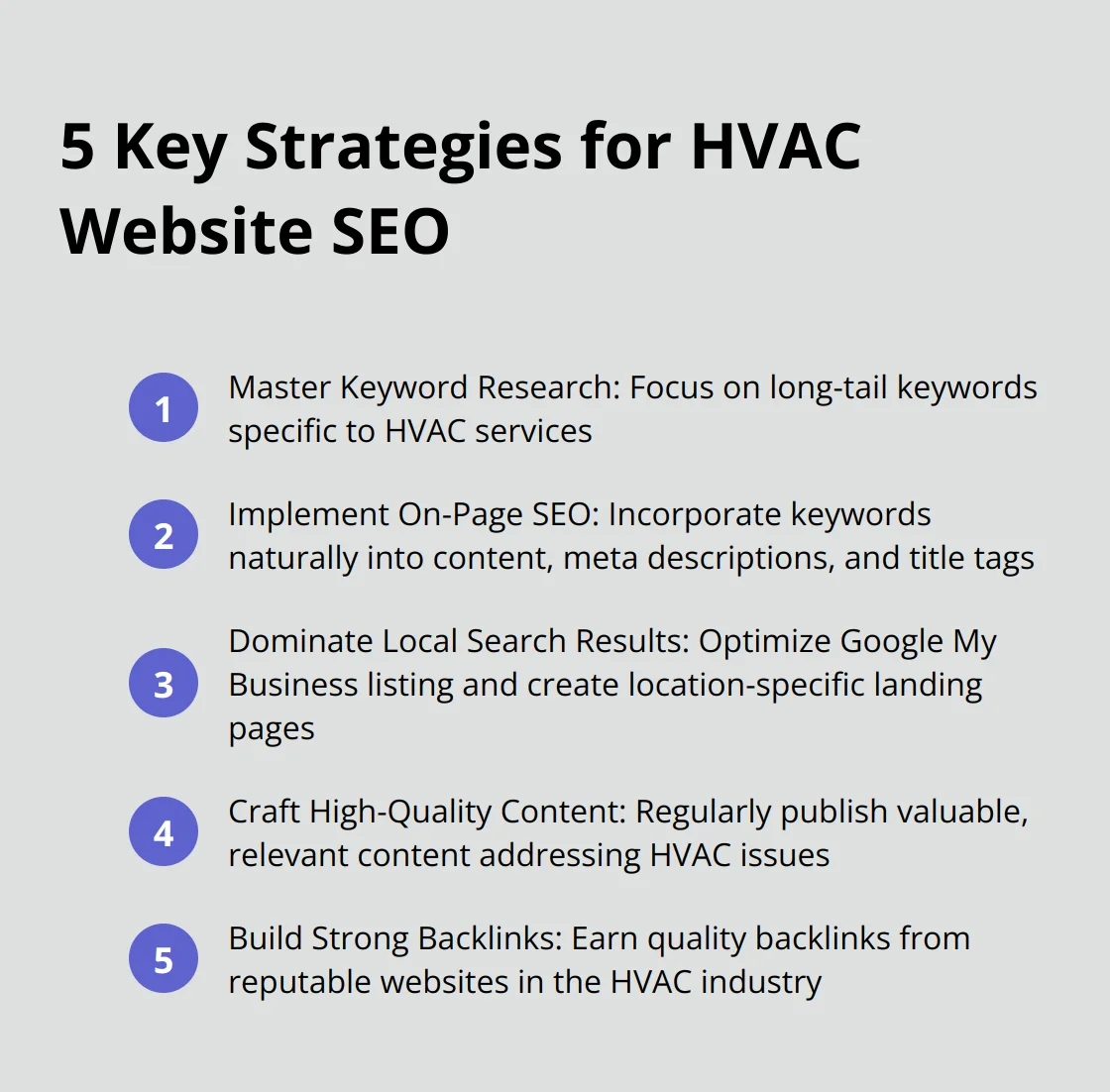
The foundation of effective SEO starts with thorough keyword research. Focus on long-tail keywords specific to HVAC services, such as “emergency AC repair in [your city]” or “furnace installation cost [your area].”
Tools like SEMrush or Ahrefs can help identify high-volume, low-competition keywords in your local market.
Implement On-Page SEO Techniques
After you identify your target keywords, incorporate them naturally into your website’s content, meta descriptions, and title tags.
Each page on your site should have a unique, descriptive title that includes your primary keyword. Use header tags (H1, H2, H3) to structure your content and make it easier for search engines to understand your page’s hierarchy.
Use ai to generate SEO optimized tags for each page of your site. Do this by visiting the page and then:
- Right click and view source (make sure you are not logged into WordPress when doing this)
- Copy all of the code you see
- Give ChatGPT this prompt: You are an on-page SEO expert and are going to help me optimize my HTML to improve my on-page SEO tags. Please update the HTML tags below to be optimized for modern SEO best practices.
- Update the tags on the page template and upload the template back to your server
Dominate Local Search Results
For HVAC businesses, local SEO is essential. Claim and optimize your Google My Business listing with accurate information (including your business name, address, phone number, and operating hours).
Encourage satisfied customers to leave reviews on your Google My Business profile, as positive reviews can significantly boost your local search rankings.
Create location-specific landing pages for each area you serve. These pages should include local keywords, information about your services in that area, and even mentions of local landmarks or events to demonstrate your community involvement.
Craft High-Quality, Relevant Content
Search engines favor websites that consistently publish valuable, relevant content. Create a blog section on your website and regularly post articles addressing common HVAC issues, maintenance tips, and industry news.
This not only helps with SEO but also positions your company as an authority in the HVAC field.
You could write a detailed guide on “How to Prepare Your HVAC System for Summer” or “10 Signs You Need to Replace Your Furnace.”
These types of articles can attract potential customers who search for HVAC-related information online.
Build a Strong Backlink Profile
Quality backlinks from reputable websites in the HVAC and home improvement industries can significantly boost your search engine rankings.
Reach out to local business directories, chambers of commerce, and industry associations to get your website listed.
Consider guest posting on relevant blogs or participating in industry forums to build your online presence and earn valuable backlinks.
SEO requires consistent effort and monitoring. Regularly analyze your website’s performance using tools like Google Analytics and Google Search Console to identify areas for improvement and track your progress over time.
Now that you’ve optimized your HVAC website for search engines, it’s time to focus on converting those website visitors into leads.
The next section will explore effective strategies to turn your website traffic into valuable business opportunities.
How To Convert HVAC Website Visitors into Leads
Offer Valuable Free Resources
Create and provide free, valuable resources to your website visitors. Develop a comprehensive HVAC maintenance checklist or an e-book on energy-saving tips.
Make these resources available in exchange for the visitor’s contact information.
This strategy provides immediate value to potential customers and allows you to nurture these leads with targeted follow-up communications.
Implement Live Chat for Instant Engagement
Add a live chat feature to your website to boost lead generation. 79% of businesses report that offering live chat has positively affected sales, revenue, and customer loyalty.
Live chat enables you to engage with visitors in real-time, answer their questions, and guide them towards making a service request or booking an appointment.

Create a Sense of Urgency
Use special offers with a time limit to convert hesitant visitors into leads. For example, offer a 15% discount on AC tune-ups if booked within the next 48 hours.
Display these offers prominently on your homepage and service pages.
Use Retargeting to Re-engage Previous Visitors
Implement retargeting strategies to re-engage potential leads who didn’t convert on their first visit. Use tools like Google Ads or Facebook Pixel to show targeted ads to people who have previously visited your website.
These ads can remind them of your services or highlight special offers, increasing the chances of conversion.
Continuously Improve with A/B Testing
Use A/B testing to optimize your website’s lead generation performance. Test different versions of your landing pages, call-to-action buttons, form designs, and even color schemes.
However, what works for one HVAC website may not work for another, so conduct your own tests to find the best solutions for your specific audience.
Final Thoughts
HVAC lead generation websites require a strategic approach that combines user-friendly design, compelling content, and smart optimization techniques.
Clear calls-to-action, user-friendly contact forms, mobile-responsive design, and localized content create a foundation for attracting and converting potential customers.
Search engine optimization through targeted keyword research, on-page SEO, and local search strategies ensures that your site reaches its intended audience.
Converting website visitors into leads involves offering valuable resources, implementing live chat features, and using retargeting strategies.
Continuous improvement through A/B testing allows you to refine your approach and maximize your website’s lead generation potential.
HVAC lead generation websites need ongoing optimization, testing, and adaptation to changing market conditions and customer needs.
HVAC Growth Machine specializes in creating and optimizing HVAC lead generation websites that drive results.
We can help you transform your website into a lead-generating powerhouse, ultimately boosting your HVAC company’s growth and success in the competitive market.




Founder of HVAC Growth Machine