

HVAC sales leads are the lifeblood of your business. I'm not talking about tire-kickers or price shoppers, but the high-ticket opportunities—full system installations and replacements—that really move the needle. These are the leads that come from a smart combination of a high-performance website, powerful local SEO, and a digital marketing strategy that actually works. The goal isn't just to get leads; it's to build a machine that consistently brings in the right kind of leads.
Build a Website That Sells for You
Think of your website as your #1 salesperson. It works 24/7, never calls in sick, and should be turning visitors into qualified leads while you sleep. Too many HVAC contractors have a site that's nothing more than a digital brochure, which is a huge mistake when over 70% of homeowners are finding local services online. A real high-performance website is an active asset, built from the ground up to capture attention, build trust, and drive action.
It all starts with a mobile-first design. Let's be real, when someone's AC dies in July, they're grabbing their phone to search "AC repair near me." If your site is slow, clunky, or hard to navigate on a smartphone, you've already lost them to a competitor. Your phone number needs to be front and center and clickable, and your contact forms have to be dead simple to fill out on any device.
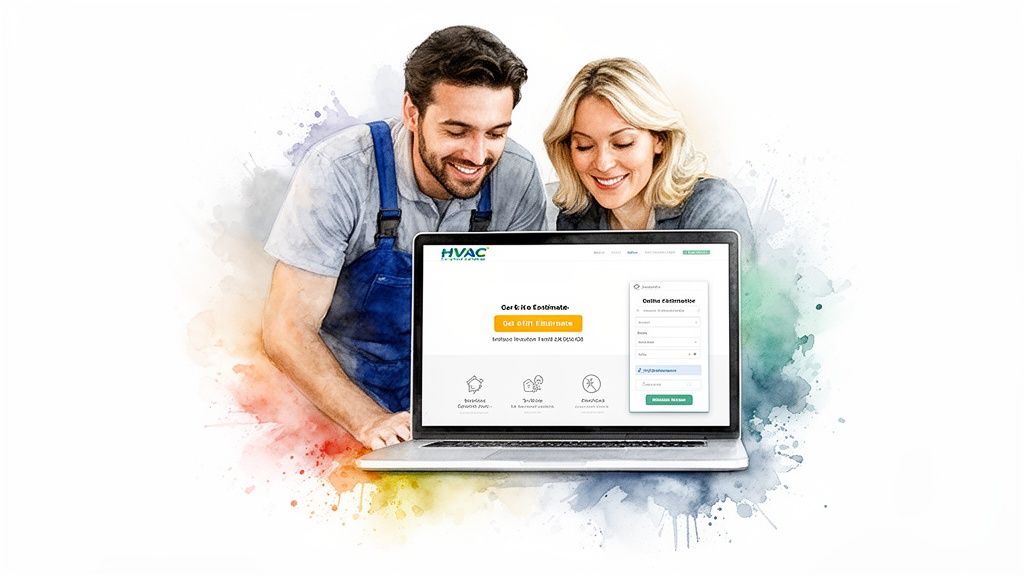
Transform Clicks into Customers with Smart Tools
One of the single most effective website tools for generating hvac sales leads is an instant online estimator. Most homeowners are hesitant to call right away because they're afraid of getting stuck in a high-pressure sales pitch. An online quoting tool meets them exactly where they are, offering instant value in exchange for their contact info.
This digital tool does the heavy lifting for you. It automatically filters for serious buyers who are researching a system replacement, while the "just curious" price shoppers tend to weed themselves out. By plugging this into your site, you’re creating an automated lead-gen machine that warms up prospects before your team even makes the first call.
Pro Tip: The best online estimators keep it simple for the user. Ask a few key questions—square footage, age of the current system, desired efficiency—to spit out a realistic ballpark number. That kind of transparency builds immediate trust and makes the follow-up conversation a thousand times easier.
Capture Recurring Revenue with eCommerce
Your website can do more than just generate one-off installation leads; it can build a predictable stream of recurring revenue. By adding simple eCommerce functionality, you can let customers purchase annual maintenance plans directly from your site. This is a brilliant digital marketing move for a few reasons:
- Locks in Future Business: A customer on your maintenance plan is calling you when their system finally gives out. You're their go-to.
- Improves Cash Flow: Selling plans online brings in predictable, upfront cash that helps smooth out the seasonal highs and lows of the business.
- Builds Real Customer Loyalty: Regular service visits keep your brand top-of-mind and strengthen the relationship, turning a one-time customer into a lifelong client.
It’s basically an automated retention strategy. Instead of just hoping customers remember to call for their annual tune-up, you make it a no-brainer for them to commit. This one small tweak can massively boost the lifetime value of every customer you bring in. If you want to go deeper, our guide on high-performing HVAC company websites breaks down even more strategies. At the end of the day, your website's success isn't measured by traffic—it's measured by how many profitable jobs it puts on your calendar.
Dominate Local Search to Win Your Service Area
When a homeowner's AC dies on a 95-degree day, they don't flip through a national directory. They pull out their phone and search "emergency AC repair near me."
Winning these high-intent, need-it-now moments is the entire game when it comes to generating profitable hvac sales leads. It all happens in local search. If you’re not showing up in the Google Map Pack and the top organic results for your service area, you're basically invisible to customers who are ready to buy right now.
Local SEO isn't just about having a website; it's about owning your digital territory. The battle for local customers is won or lost on Google. Consider this: a staggering 75% of people who run a local search on their phone visit a related business within 24 hours. This isn't just website traffic—it's immediate, actionable interest from people who need you, today.
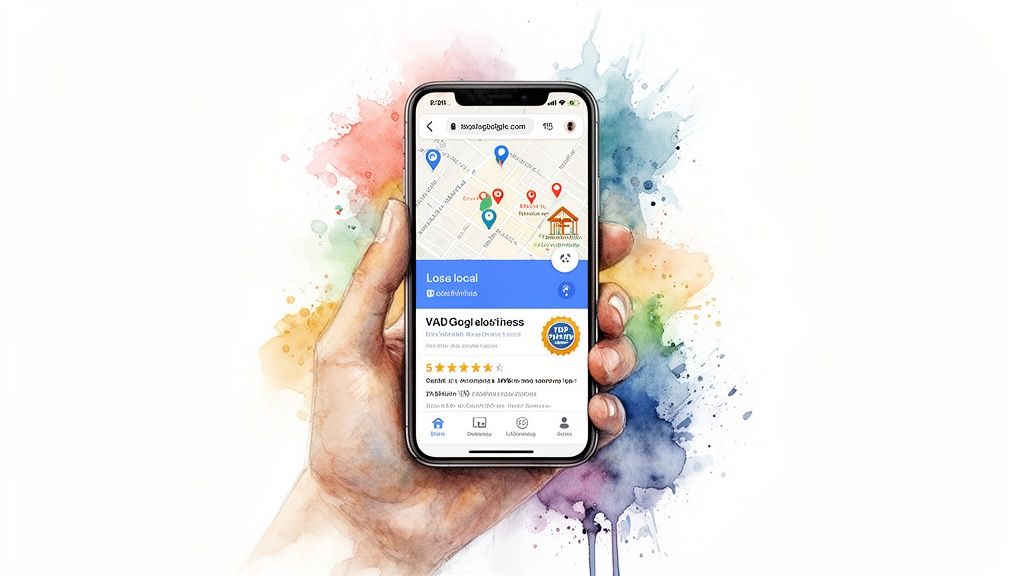
To win locally, you need to focus on three key channels that work together: your Google Business Profile, your website's local SEO, and your online reputation.
The table below breaks down these core digital marketing channels and what each one is meant to accomplish for your business.
Local SEO Channels and Their Primary Goals
| Channel | Primary Goal | Key Metric to Track |
|---|---|---|
| Google Business Profile (GBP) | Capture immediate, high-intent "near me" searches. | Phone Calls from GBP, Website Clicks, Direction Requests |
| Local On-Page SEO | Rank for specific, high-value service + location keywords. | Organic Rankings for Target Keywords, Website Form Submissions |
| Online Reviews | Build trust and social proof to increase conversion rates. | Number of New Reviews, Average Star Rating, Review Response Rate |
Each of these channels plays a distinct but connected role. A strong GBP gets you visibility, great reviews get you the click, and an optimized website turns that click into a paying customer.
Your Google Business Profile Is Your Digital Storefront
Your Google Business Profile (GBP) is, without a doubt, your single most important local marketing asset. It's that information-packed box that pops up in the map results, and it's often the very first impression a potential customer has of your company. Treating it like an afterthought is like locking the doors to your physical storefront during business hours.
A fully optimized profile is a lead-generation machine. This goes way beyond just listing your name and address. Every single section is a chance to prove your relevance to Google and build trust with homeowners.
- Define Precise Service Areas: Don't just list your city. Get granular. List the specific neighborhoods, surrounding towns, and zip codes you cover to show up in those hyper-local searches.
- List Every Single Service: Detail everything you do, from "ductless mini-split installation" to "furnace maintenance" and "smart thermostat setup." This helps you rank for the specific, long-tail searches that high-quality customers use.
- Use Google Posts Weekly: Think of these as mini-ads right on your profile. Share updates on recent installs, special offers, or helpful tips. Keeping it fresh tells Google you're active and engaged.
For a complete step-by-step breakdown, check out our detailed guide on how to optimize your Google Business Profile.
Build Trust Instantly with Reviews and Guarantees
In the digital marketing world, trust is the only currency that matters. Homeowners are looking for signals they can trust, and they need to feel completely confident in that decision. Your GBP is where you build that trust before they even visit your website.
Reviews are the most powerful form of social proof you have, period. We've seen it time and again: an HVAC company with over 50 positive reviews will consistently rank higher and get more calls than a competitor with only a handful. Actively asking for a review after every single job isn't optional—it's a core marketing process.
Beyond reviews, the Google Guarantee badge is a massive trust signal. This badge, which comes from running Google Local Services Ads, tells customers that Google has vetted your business and backs your work. It's a game-changer that can dramatically increase your click-through rates and the quality of your leads.
Having the Google Guarantee badge next to your name is like getting a direct endorsement from Google itself. It immediately separates you from the competition and answers the customer's biggest unasked question: "Can I trust this company?"
Align Your Website with Local Search Intent
While your GBP gets you on the map, it's your website's on-page SEO that secures your spot in the traditional organic search results just below it. The entire goal is to create pages that directly answer what local customers are searching for.
This means building out dedicated service pages for each of your core offerings and optimizing them for local keywords. A generic "Services" page won't cut it. You need specific, targeted pages like:
- "AC Installation in [Your City]"
- "Furnace Replacement in [Neighboring Town]"
- "Heat Pump Services in [Your County]"
Each of these pages needs to include the location name in the page title, in the headers, and naturally within the text. This makes it painfully obvious to Google where you work and what you do, helping you capture those high-value keywords that lead directly to big-ticket installation jobs.
Generate Predictable Leads with Paid Advertising
While a strong local SEO game builds your business for the long haul, sometimes you just need the phone to ring right now. That's where paid advertising comes in. It’s like opening a faucet for high-quality hvac sales leads whenever you need them—perfect for a sudden heatwave or right before that first winter cold snap.
Paid ads get you in front of homeowners who are actively looking for a solution. This isn't about casual browsing; it's about meeting urgent demand the second someone realizes their AC is blowing hot air. When a furnace dies in the middle of January, that homeowner is on a mission. They're grabbing the first trusted company that can solve their problem, and fast.
Google Ads vs. Local Services Ads
For HVAC contractors, the paid ad world really boils down to two main players: the classic Google Ads (PPC) and the newer Google Local Services Ads (LSAs). They might look similar at first glance, but they're built for very different jobs. Knowing how to use each one is the key to not burning through your marketing budget.
- Google Ads (PPC): This is the traditional pay-per-click system. You bid on keywords like "AC installation Dallas," write your own ads, and pay Google each time someone clicks through to your website. It gives you a massive amount of control over your messaging, your landing pages, and exactly which search terms you show up for.
- Local Services Ads (LSAs): You've seen these—they're the "Google Guaranteed" boxes at the very top of the search results, sitting above everything else. The big difference? You don't pay for clicks, you pay for leads. You only get charged when a customer actually calls or messages you directly through the ad.
Key Takeaway: Use Google Ads when you want total control and need to drive traffic to a specific landing page for a high-value service. Use LSAs to build instant trust and get your phone ringing with customers who are ready to book a job on the spot.
That "Google Guarantee" badge on LSAs is pure gold. It’s a huge trust signal for homeowners. It tells them Google has already vetted your business, which gives them the confidence to call you instead of scrolling down to a competitor who doesn't have it.
Structuring Campaigns for Profitability
The single biggest mistake I see HVAC contractors make with paid ads is running one big, generic campaign. You don't want to blow your budget on low-profit calls if your real money is made on full system replacements. The smart move is to build your campaigns around your most profitable services.
For example, you should have a dedicated campaign group just for "AC Installation." Inside that group, you'd target specific, high-intent keywords that homeowners are actually typing in:
- "new air conditioner cost"
- "central air installation near me"
- "best ac unit for 2000 sq ft home"
Your ad copy needs to speak directly to these searches. Talk about financing options, free estimates, and next-day installs. The idea is to perfectly match your ad's promise with the customer's problem. This sends them to a dedicated landing page on your site that seals the deal and makes booking a consultation a no-brainer. This laser-focused approach ensures every ad dollar is spent chasing your most valuable hvac sales leads.
For a much deeper look into this, our guide on HVAC paid ads breaks down more advanced strategies.
Smart Budgeting for Measurable ROI
Paid advertising isn't about who can spend the most money. It’s about who gets the best return. Start with a daily budget you're comfortable with, and obsess over the results. The only metric that truly matters is your Cost Per Acquired Customer.
Think about it. If you spend $1,000 on Google Ads in a month and it lands you five new installation jobs, and each of those jobs brings in $2,500 in profit, you just turned $1,000 into $12,500. That's a phenomenal return.
Once you know which keywords and ads are bringing in those profitable jobs, you can scale your budget with confidence. You're no longer guessing; you know that every extra dollar you put in is directly fueling real, measurable growth for your business.
Turn Website Clicks into Booked Jobs
Getting a click on your website or a name in your system is just the starting line. The real money in generating hvac sales leads comes from what you do immediately after.
In a market this competitive, speed is everything. A lead who waits even 30 minutes for a response is already looking at your competitors. This is where automation becomes your secret weapon, turning that initial flicker of interest into a booked job before they have time to shop around.
The goal isn’t to spam people. It’s about building a smart, automated system that qualifies and nurtures leads without burning out your office staff. Simple automated email and text sequences can engage homeowners the second they ask for an estimate, keeping you top-of-mind while they’re ready to make a decision.
This is how paid channels like Google Ads and Local Services Ads should feed directly into your pipeline—generating calls and bookings that your follow-up system can then close.
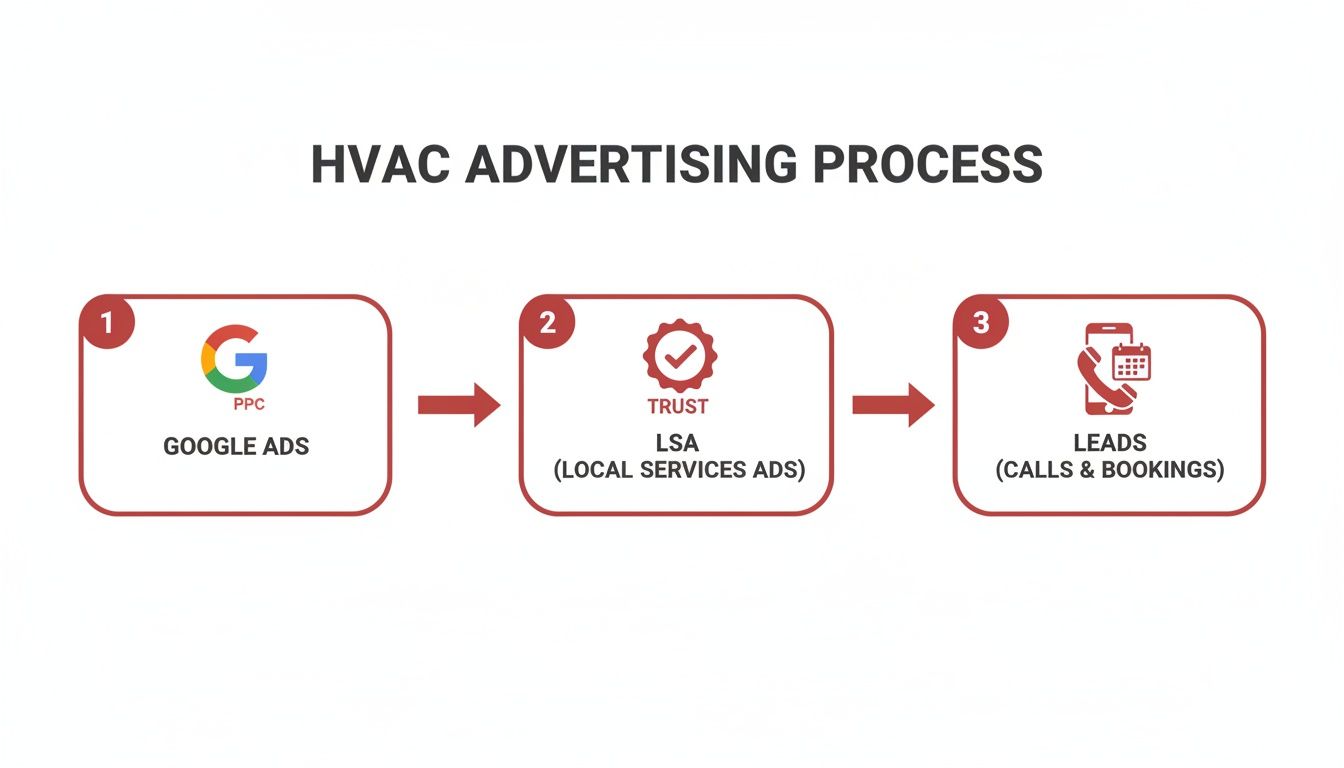
This process shows the handoff. Advertising gets them to your door; your internal system has to take it from there.
Automating the Initial Engagement
The moment a homeowner fills out your online estimate form, the clock starts ticking. Loudly. Your first automated message needs to hit their phone within five minutes. This isn't a hard sell; it's a confirmation and a promise.
Example SMS:
"Hi [Name], this is [Your Name] from [Company Name]. We received your request for an estimate and are reviewing the details now. I'll follow up personally within the next 20 minutes to discuss it with you. Thanks!"
This simple text does two critical things:
- It tells them their submission worked, giving them instant gratification.
- It sets a clear expectation for what’s next, proving you’re responsive and professional.
That one immediate touchpoint stops them from hitting the back button and filling out three more forms on your competitors' sites. For an even bigger impact, an AI chatbot for small business can handle this 24/7, answering basic questions and scheduling consultations even after you’ve closed for the night.
Nurturing Leads Who Aren't Ready Yet
Let's be real: not every lead is ready to buy today. Plenty of homeowners get a quote and then get cold feet. An automated email nurture sequence is designed to re-engage these folks without any manual work from your team. This is all about building trust and providing value over time.
A simple email sequence could look like this:
- Day 2 (Email): Send them a helpful guide, like "5 Things to Ask Before Replacing Your AC." This positions you as the expert, not just another salesperson.
- Day 5 (Email): Share a case study or a few testimonials from happy customers in their neighborhood. Social proof is incredibly persuasive.
- Day 10 (SMS): Send a simple, low-pressure check-in. "Hi [Name], just following up on the estimate we sent last week. Any questions I can help with?"
This follow-up system ensures no lead goes cold. It automates the gentle, persistent reminders needed to turn a 'maybe later' into a 'yes now,' freeing up your team to focus on the hottest prospects.
The HVAC industry is booming, with U.S. contractor revenue projected to hit $156.2 billion in 2025 across nearly 118,000 businesses. With new construction and smart system installs driving that growth, an automated system to manage lead flow isn't a luxury—it's essential for survival.
Driving Recurring Revenue with Automation
Automation isn’t just for landing new installation leads. It’s a powerhouse for generating recurring revenue from the customers you already have. You can set up simple email reminders to prompt customers to buy or renew their annual maintenance plans.
For example, you can trigger an email 11 months after a new system install:
Subject: Is Your New System Ready for Its First Tune-Up?
"Hi [Name], it's been almost a year since we installed your new HVAC system. To keep it running at peak efficiency and protect your warranty, now is the perfect time to schedule its first annual maintenance. Click here to book your tune-up online in just 60 seconds."
This kind of proactive, automated outreach captures high-margin service revenue you’d otherwise miss, building loyalty and squeezing more lifetime value out of every single job you win.
Track Your Marketing ROI to Fuel Growth
If you can't measure it, you can't improve it. Pouring money into HVAC SEO or Google Ads without tracking the results is like driving blind—you're moving, but you have no idea if you're headed toward profitability or off a cliff. The final, critical piece of a successful lead generation system is knowing exactly what’s working and what isn't.
This means getting past vanity metrics like clicks and impressions. What really matters is tying every dollar you spend on marketing back to the actual revenue it generates. This is where call tracking and revenue attribution stop being optional and become your most important tools for growth.
Without a solid tracking system, you’re just guessing. You might feel like your paid ads are working, but which campaign is actually bringing in the high-ticket installation jobs versus the low-margin repair calls? Tracking takes all the guesswork out of the equation.
Connecting Marketing Spend to Real Revenue
This all starts with a simple but powerful technique: assigning unique, trackable phone numbers to each of your marketing channels. You'll have one number on your Google Business Profile, another on your website’s homepage, and a third dedicated just to your "AC Installation" Google Ads campaign.
When a call comes in, your system instantly logs where it came from. Suddenly, you’re not just looking at a list of incoming calls; you’re seeing a crystal-clear breakdown of where your best hvac sales leads are coming from. This data is pure gold.
The Big Picture: When a CSR books a job from a tracked call and you close a $10,000 system replacement, you can trace that revenue all the way back to the specific keyword or ad that started the conversation. This is how you make data-driven decisions instead of gut-feeling guesses.
This level of insight lets you double down on what works and kill what doesn't. You can confidently ramp up ad spend on the campaigns proven to deliver profitable jobs, making every marketing dollar an investment, not an expense.
The KPIs Every HVAC Owner Must Watch
To really know if your lead generation is working, you have to track the right numbers. Focusing on the right essential Lead Generation KPIs gives you a real-time dashboard on the health of your business.
Here are the core KPIs you should be looking at weekly:
- Cost Per Lead (CPL): Total marketing spend for a channel divided by the number of leads it produced. It tells you how efficiently you’re buying opportunities.
- Customer Acquisition Cost (CAC): This takes it a step further. It's your total sales and marketing cost divided by the number of new customers you signed. This is the true cost of winning a job.
- Lead-to-Install Conversion Rate: Of all the leads that came in, what percentage actually turned into a system install? This metric shows you the quality of your leads and how good your sales process is.
A low CPL might look great on the surface, but if those leads never turn into profitable jobs, you're just spinning your wheels. The real goal is to find the marketing channels that deliver a low CAC on high-value installation jobs.
The market for system replacements is a goldmine. Up to 3 million heating and cooling systems are replaced every year in the U.S. as old equipment fails and new efficiency standards roll out. With the U.S. HVAC systems market projected to jump from $31.71 billion in 2025 to $54.02 billion by 2033, a precise tracking system is the only way to capture your share of those high-value installation leads. You can find more of these industry growth statistics on servicetitan.com. By putting a solid tracking system in place, you can stop guessing and start building a more predictable, profitable business fueled by smart data.
Common Questions About HVAC Lead Generation
Running an HVAC business means you're constantly thinking about where the next profitable job is coming from. When it comes to digital marketing, a lot of questions pop up. We've heard them all.
Here are the answers to the most common ones we get from HVAC owners who are serious about building a real growth engine, not just getting a few more clicks. The key is almost never about doing more things, but about doing the right things.
How Long Until I See Results from My Digital Marketing?
This is the big one, and the honest answer is: it depends entirely on the channel you're using. Different marketing strategies have different timelines.
- Paid Advertising: If you need leads now, this is your answer. Channels like Google Local Services Ads are designed for speed. You can have qualified, inbound phone calls hitting your line within a few days of getting your campaigns approved and running.
- Search Engine Optimization (SEO): Think of this as a long-term asset. SEO is about building your brand's authority so Google trusts you. You'll likely see the first trickles of organic leads and ranking improvements in 3-6 months, with a really significant, consistent flow building up over 6-12 months.
The smartest play is to use both. Run paid ads for the immediate wins to keep your team busy today, while your SEO work builds a foundation for a future where high-quality leads come in for free.
What Is the Biggest Mistake HVAC Companies Make?
Hands down, the single biggest digital marketing mistake is chasing the quantity of leads over the quality. So many owners get obsessed with a low Cost Per Lead, which almost always comes from running broad, unfocused ad campaigns.
Sure, your phone might ring more, but it’s with low-margin service calls and price shoppers looking for the absolute rock-bottom deal. Real, sustainable profit comes from strategically targeting high-value installation and replacement jobs. You have to build a system—from your website to your ads—that qualifies leads before your team ever wastes time on them.
The goal isn't just to make the phone ring. It's to make it ring with homeowners who need a new system, not just a cheap fix for their old one.
Is Email Marketing Really Effective for HVAC Contractors?
Absolutely. In fact, we see email automation as one of the most powerful—and most underutilized—tools an HVAC business has. It’s a master at nurturing leads and keeping past customers in your orbit with almost zero manual work.
Think about it. Automated email sequences can:
- Warm up new leads who just used your online estimator, keeping your name top-of-mind.
- Re-engage old customers when their system is hitting that 10-15 year mark, perfectly positioning you for the replacement sale.
- Sell high-profit maintenance plans to your existing customer base, locking in recurring revenue.
This isn’t about spamming people. It’s about building automated relationships that deliver value at the right time, making sure you’re the first and only call they make when it's time for a major investment.
How Much Does a Modern Website Actually Matter?
It matters more than almost anything else. Your website is your digital storefront, your 24/7 salesperson, and the engine that powers your entire marketing system. An outdated, slow, or clunky site isn't just a brochure—it's actively losing you money by sending good leads straight to your competitors.
A modern website with clear calls-to-action, trust signals like customer reviews, and powerful conversion tools (like an instant online estimator) is what turns your ad spend and SEO efforts into actual, profitable jobs. It's the hub where all your hard work pays off. Without it, you're just burning cash.
Ready to stop guessing and start growing with a system built to deliver high-quality installation leads? At HVAC Growth Machine, we provide a done-for-you website and lead generation engine designed to attract profitable jobs, not just clicks. See how we can fill your calendar by visiting https://hvacgrowthmachine.com.





Founder of HVAC Growth Machine