

Relying on referrals and slow-burn SEO to grow your HVAC business is a recipe for a feast-or-famine cycle. You can't control when the phone rings.
HVAC paid ads change the game entirely. Think of it as a faucet for high-ticket installation jobs you can turn on whenever you need to fill the schedule—especially when a heatwave hits and a homeowner’s AC just died. It's a direct, controllable investment that puts your business in front of people with an urgent, expensive problem to solve right now.
Paid Ads Are Your Growth Engine
Let's be real: organic marketing is great, but it's slow. HVAC SEO can take months to rank, and while referrals are gold, you can't build a predictable business on them. When you need jobs booked this week, you need a more aggressive approach.
This is where a smart paid ad strategy becomes non-negotiable.
The magic of paid ads is the immediacy. You can launch a campaign today and instantly show up at the very top of Google for a homeowner frantically searching for a solution to their broken furnace in the middle of a blizzard. Their buying intent is through the roof, and your ad is the first thing they see.
Tapping into Red-Hot Demand
Unlike scrolling through social media, nobody is casually browsing Google for "new ac unit cost" or "emergency furnace repair near me" for fun. They have a serious problem and are actively looking to hire a pro.
By targeting these exact keyword searches, your company can:
- Intercept Motivated Buyers: You get in front of customers at the precise moment they're ready to pull out their credit card.
- Target High-Margin Jobs: You can focus your entire budget on keywords related to system replacements and installations—the services that actually make you money.
- Dominate Your Service Area: Ensure your business is the most visible option in the specific zip codes and neighborhoods you want to own.
The real power here is shifting your marketing from a passive expense into an active, revenue-generating machine. You stop waiting for the phone to ring and start making it ring with profitable leads.
Gaining a Competitive Edge
Here's the hard truth: your competitors are already running HVAC paid ads. If you’re not in the game, you're invisible to a huge chunk of homeowners actively looking for your services.
A proactive paid strategy lets you go head-to-head for the most valuable leads in your market. It ensures you don't lose out on a $15,000 system install just because a competitor's ad showed up first.
Building Your Campaign Structure for Profitability
A profitable paid ads strategy isn’t just one big campaign—it’s a finely tuned system built to drive revenue, not just clicks. So many HVAC owners make the mistake of dumping all their keywords, from "AC repair" to "new furnace cost," into a single campaign. That's a surefire way to burn cash with mediocre results.
Think about it. A homeowner frantically searching for "emergency AC repair" is in a completely different headspace than someone researching the "best high-efficiency furnace." One needs a fast fix for a low-ticket job; the other is making a high-value, long-term investment. If you show them both the same ad, your message will be wrong for at least half your audience.
This is where paid ads become a rocket ship, accelerating your growth from the slow-and-steady pace of referrals to landing big-ticket jobs consistently.
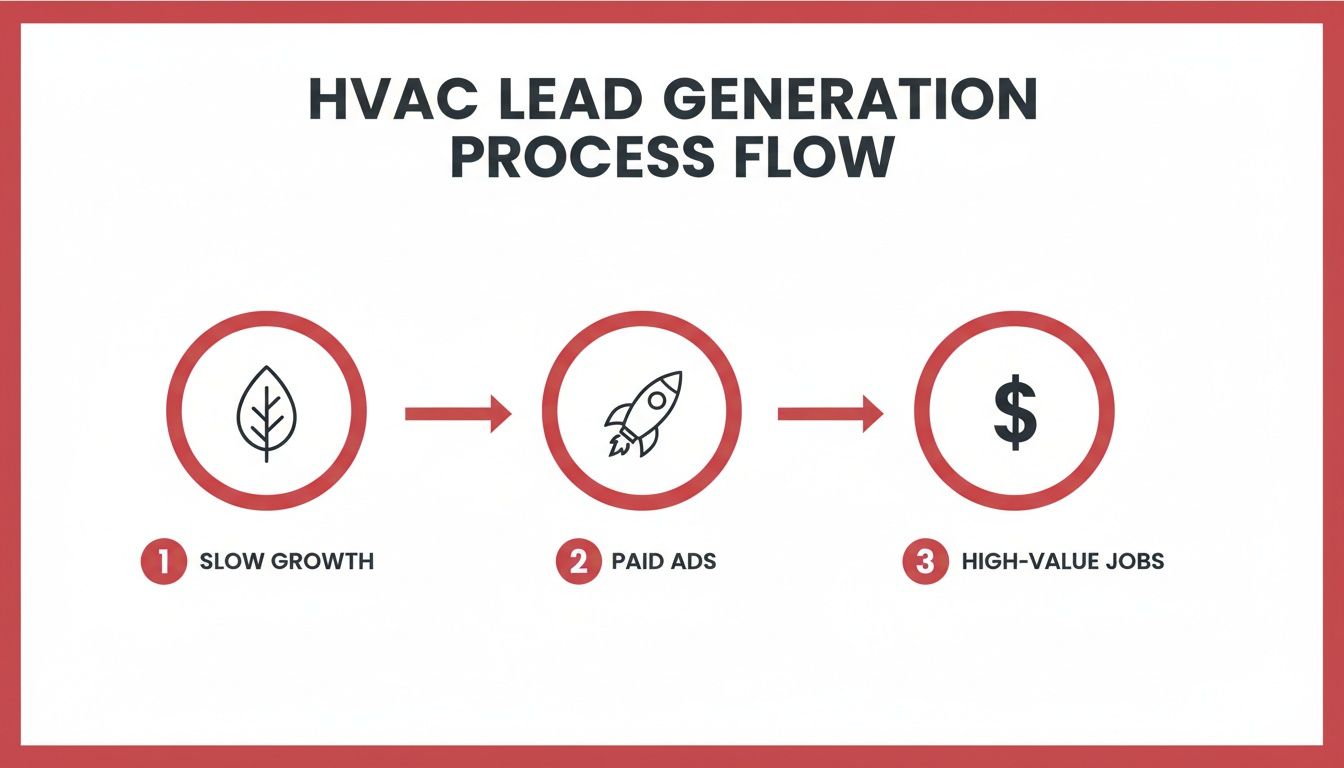
As you can see, paid ads act as a direct pipeline to the most profitable installation and replacement work that really moves the needle for your business.
Segmenting Campaigns by Service Type
The secret to a high-performing account is simple: separate your services into distinct campaigns. This gives you total control over your budgets, ad copy, and landing pages, making sure the right message hits the right person every time.
Here’s a structure we use that just flat-out works:
- Installations & Replacements: This is where the money is. It targets keywords like "new AC unit installation," "furnace replacement cost," and "heat pump install." Give this campaign the lion's share of your budget. It's your top priority.
- Repairs & Emergency Service: This one is all about urgency. It catches searches like "air conditioner not cooling" or "24-hour furnace repair." Your ads need to scream speed, reliability, and immediate availability.
- Maintenance & Tune-Ups: Perfect for filling the schedule during slower months and upselling new systems. You'll target keywords like "AC tune-up" or "furnace maintenance plan."
This segmentation has a direct impact on your bottom line. By funneling more of your budget into the "Installations" campaign, you're putting your money where the highest-revenue jobs are.
A well-structured account allows you to be aggressive on high-value keywords while being more conservative with lower-margin service calls. It gives you the control to invest, not just spend.
Aligning Ad Groups with Your Website
Now, let's drill down a level. Inside each campaign, your ad groups should be a mirror image of the service pages on your HVAC website. If you have a specific page for "Air Conditioning Installation" and another for "Furnace Installation," you absolutely need corresponding ad groups.
This tight alignment is critical.
For example, your "AC Installation" ad group should only contain keywords like "central air installation" and "new air conditioner cost." The ads themselves will talk specifically about cooling systems, and when someone clicks, they land directly on your AC installation page—not your homepage.
This is exactly what Google rewards. This razor-sharp relevance gives you a higher Quality Score, which is Google's way of grading your ads. A better Quality Score directly translates to a lower cost-per-click (CPC).
In plain English? You get more qualified leads for less money. This granular structure turns your website into a conversion machine for your paid ads, making sure every single click has the best possible chance of becoming a profitable job.
Choosing the Right Channels and Crafting Your Message

Not all ad platforms are created equal, especially for HVAC contractors. Where you spend your money is just as critical as how much you spend. The real secret is matching the platform to the customer's immediate need—are they frantically searching for an emergency fix, or do you need to get on their radar before their system fails?
The three undisputed heavyweights for HVAC paid ads are Google Search, Google Local Services Ads (LSAs), and Meta (Facebook & Instagram). Each one plays a totally different, but equally important, role in your HVAC digital marketing strategy.
To make it simple, here's a quick breakdown of where each channel shines.
HVAC Ad Channel Comparison
| Channel | Best For | Audience Intent | Cost Model |
|---|---|---|---|
| Google Search | High-ticket installation jobs and urgent repairs. | High: "My AC is broken, I need a new one now." | Pay-Per-Click (PPC) |
| Local Services Ads | Generating immediate service calls and building trust. | High: "I need a Google-vetted pro to fix my furnace." | Pay-Per-Lead (PPL) |
| Meta (FB/IG) | Building your brand and creating future demand with offers. | Low: Casually scrolling, not actively looking for HVAC. | Pay-Per-Impression (CPM) |
Each one has its place, but you need to know when and how to use them to avoid burning through your budget with nothing to show for it.
Capture High-Intent Leads with Google Search
When a homeowner's AC unit dies in the middle of a July heatwave, they aren't scrolling through Facebook. They're grabbing their phone and heading straight to Google. This is where Google Search ads put you directly in front of motivated customers who are ready to hire someone right now.
You get to target the exact, high-value keywords that signal a big job, like “new ac unit cost” or “furnace installation near me.” Your ad shows up at the precise moment they need you. This is how you hunt for profitable installs instead of waiting for them to find you.
Build Instant Trust with Local Services Ads
Google Local Services Ads (LSAs) are a massive shortcut to the top of the search results. They appear above the traditional paid ads and feature the coveted “Google Guaranteed” badge.
That little green checkmark is an instant trust-builder. It tells homeowners that Google backs your business, which melts away a lot of their hesitation. Best of all, you pay per qualified lead—meaning a direct phone call—not just for a click. LSAs are fantastic for generating a steady flow of repair and service calls.
Keep in mind, LSA performance is directly tied to the health of your Google Business Profile. Make sure you check out our guide on how to optimize your Google Business Profile to get the most out of it.
LSAs are your trust-building tool for immediate service needs. The Google Guarantee removes hesitation for homeowners, making it easier for them to pick up the phone and call you first.
Create Demand with Meta Ads
People scrolling through Facebook and Instagram aren't thinking about their HVAC system. That’s why your goal here is completely different: you’re creating future demand, not capturing an existing need.
Meta ads are perfect for running brand awareness campaigns and promoting seasonal maintenance specials or attractive financing offers. You can get super specific, targeting homeowners in certain zip codes, new movers, or people who have shown an interest in home improvement. For a local business, mastering geotargeting and hyperlocal advertising strategies is the key to making sure your ads are seen by actual potential customers, not just random people miles away.
Crafting Messages That Convert Installs
Generic ad copy like "Call for a Free Estimate" is invisible. It gets completely lost in the noise. Your message needs to cut straight to the homeowner's biggest concerns and offer a real solution, especially for a high-ticket installation.
- Highlight Financing: A new system is a huge investment. Ad copy like, "0% Financing Available for New AC Installs" immediately tackles the biggest barrier to purchase.
- Promote Rebates & Savings: Homeowners are always looking for a deal. Use headlines that grab attention, like "Save up to $1,500 with Energy-Efficiency Rebates."
- Emphasize Speed & Availability: When a system is down, speed is everything. A message like "Get a New Furnace Installed as Soon as Tomorrow!" can be the deciding factor.
When you tailor your message to the right platform and the customer's mindset, your ads stop being simple listings and start becoming powerful lead-generation machines that attract the exact kind of profitable install jobs you want.
Designing Landing Pages That Convert Clicks Into Calls
Getting the click on your ad is only half the battle. The real work starts the moment a homeowner lands on your page.
If you’re sending someone who searched for “new furnace cost” to your generic homepage, you might as well light your ad budget on fire. It’s like dropping them in the middle of a warehouse and expecting them to find the right aisle. They won’t. They’ll just leave.
The post-click experience is everything. You absolutely need a dedicated landing page built for one thing and one thing only: getting that person to call you or fill out a form.
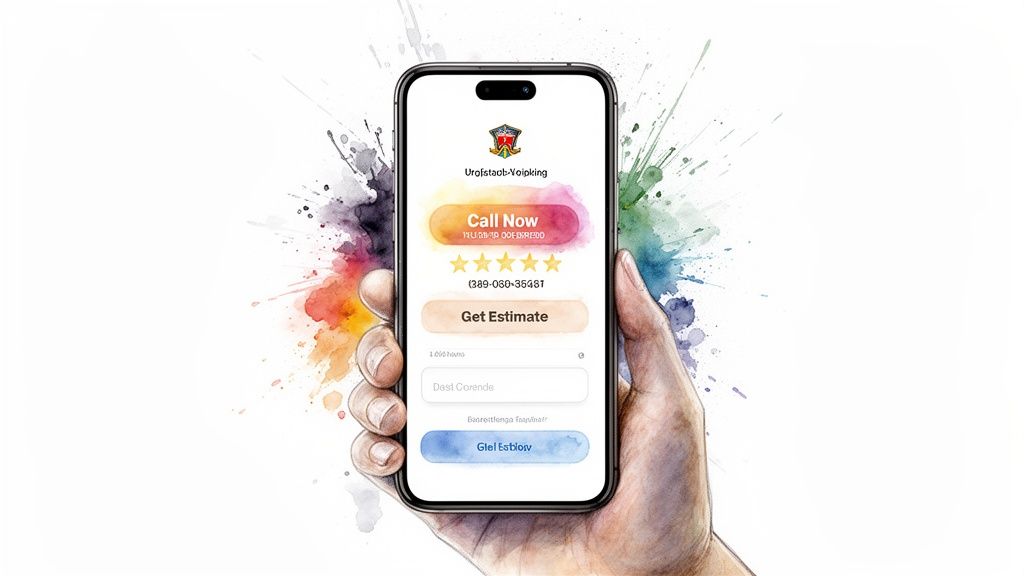
This page has to be a seamless continuation of your ad. If your ad copy promised 0% financing for 24 months on a new AC install, that offer needs to be the first thing they see on the landing page. No exceptions.
Must-Have Elements of a High-Converting Page
A killer landing page isn't about flashy graphics; it's about eliminating friction and building trust in seconds. Every single element should nudge the visitor toward contacting you.
Here’s what you can’t skip:
- A Clickable Phone Number: It has to be big, bold, and right at the top of the page. On a phone, this must be a "tap-to-call" button they can't possibly miss.
- A Dead-Simple Contact Form: Ask for the bare minimum—name, phone, email. That's it. Every extra field you add is another reason for them to give up and click away.
- Trust Badges: Slap those logos on there. BBB, Google Guarantee, financing partners like GreenSky, or any local certifications. These are visual shortcuts that instantly tell a homeowner, "This company is legit."
- Social Proof: Hand-pick a few of your best 5-star reviews. Nothing is more powerful than a real testimonial from another local homeowner who was in their exact situation.
We've seen these fundamentals work time and time again. For a deeper dive, check out our guide to effective HVAC web design, as the core principles apply here, too.
Your landing page has one job: make it incredibly easy for a stressed-out homeowner to take the next step. If they have to hunt for your phone number, you’ve already lost them.
Integrating Advanced Conversion Tools
Want to really pull ahead of the competition? Give visitors interactive tools.
An instant online estimate calculator is an absolute game-changer. It immediately engages the visitor, gives them the answer to their #1 question (cost), and captures their contact info without any high-pressure sales tactics.
Just like that, a passive browser becomes a qualified lead who has already told you what they need and what their home looks like. For more ideas on improving that post-click experience, see this guide to optimize landing pages for higher conversions.
Tracking Every Lead to Its Source
Finally, you can't improve what you don't measure. This is non-negotiable. If you're spending money on ads, you have to know exactly what that money is producing.
That means setting up:
- Call Tracking: Use dynamic phone numbers that connect every single inbound call back to the exact campaign, ad group, and keyword that generated it.
- Form Tracking: Make sure every form submission is fired as a conversion event in Google Ads and Meta, so the platforms know what's working.
Without this data, you're just guessing. With it, you can prove the ROI of your ad spend, kill the campaigns that are wasting your money, and pour fuel on the fire for the ones booking profitable installation jobs.
Managing Your Ad Spend for Sustainable Growth
Let's get one thing straight: HVAC paid ads aren't just about getting clicks. They're about deploying capital to generate predictable, profitable jobs. This means you have to kill the old "set-it-and-forget-it" budget mentality.
Your ad spend shouldn't be a rigid number you set once a month. It needs to be a fluid investment that expands when things are working and contracts when they aren't, all based on real-world performance and seasonal demand.
The whole game is to stop spending on ads and start investing in customer acquisition. You need to know your numbers. For instance, if you know a new system install brings in $10,000 in revenue, and you're willing to pay up to $500 to get that job, your entire bidding strategy just got a lot simpler. That $500 target—your Cost Per Acquisition (CPA)—becomes the North Star for every financial decision you make.
Data-Driven Bidding Strategies
Once you have that target CPA locked in, you can start making smarter bidding decisions. This is where digging into your campaign data becomes non-negotiable. You’ll see pretty quickly that not all keywords are created equal. Some will be gold mines, consistently bringing in high-value installation leads. Others will just be cash furnaces, burning through your budget with low-margin repair calls.
This is where you get surgical with your money:
- Go All-In on Your Winners: See a keyword like "new AC unit cost [your city]" consistently leading to profitable installs? Don't be shy. Crank up your bids. Paying a premium for a click that has a high chance of turning into a $15,000 job isn't a cost; it's a smart investment.
- Cut Your Losses, Fast: If another keyword is getting tons of clicks but zero calls—or only calls for small-time jobs—pause it. Stop feeding it. There's no reason to keep funding something that isn't producing a return.
The core principle is dead simple: feed your winners and starve your losers. Your daily performance data should tell you exactly where to put your next dollar.
Squeezing More Juice from Your Budget with Bid Adjustments
Beyond just bidding on keywords, you can make your budget work a lot harder by using bid adjustments. Think of these as multipliers that let you bid more (or less) aggressively based on who is searching, where they are, and when they're searching. It’s all about showing up at the perfect moment.
Here are a few adjustments you should be using:
- Location: Bid higher in those affluent zip codes where you know homeowners are more likely to spring for a new high-efficiency system.
- Time of Day: Jack up your bids during business hours when your CSRs are actually there to answer the phone and book the appointment.
- Device: Seeing that most of your high-value leads come from people searching on their phones? Increase your bids for mobile searches.
At first, paid ads can feel expensive. But when you look at the unit economics and factor in the customer lifetime value (CLV), the picture changes completely. Industry data puts the average HVAC customer acquisition cost (CAC) around $296–$350, while the average CLV can be as high as $15,340.
That means a $300 acquisition cost is just 2% of that customer's potential lifetime revenue. It's why so many contractors who actually track their numbers find that certain campaigns are quietly kicking out 10x or even 15x returns.
Managing your ad spend isn't a one-time task; it's a constant process of analysis and adjustment. By staying focused on your target CPA and letting the data guide your decisions, you turn your budget into a powerful engine for real, profitable growth. For more hands-on advice, check out our guide on how to reduce customer acquisition cost in your marketing.
Got Questions About HVAC Paid Ads? We've Got Answers.
Jumping into paid ads can feel like a big step, and you probably have a lot of questions. That’s smart. Before you put a single dollar into a campaign, you need straight answers. Here are some of the most common questions we get from HVAC owners just like you.
How Much Should an HVAC Company Really Spend on Ads?
There's no magic number, but a healthy starting budget for an HVAC company that’s serious about growth is usually in the $2,000-$5,000 per month range.
But honestly, the budget itself isn't the most important part. The metric that really matters is your return on ad spend (ROAS).
A great benchmark to shoot for is a 5:1 ROAS. For every dollar you put in, you should be getting five dollars back in actual revenue. Instead of locking yourself into a fixed budget, think about it as profitable customer acquisition. Start with an amount you can track meticulously, prove it's making you money, and then pour gas on the fire. Your results should always dictate your spend.
Are Google Local Services Ads Better Than Search Ads?
This is a classic. The truth is, they're built for different jobs, and they work best when you use them together.
- Local Services Ads (LSAs): These are your workhorse for generating a steady stream of high-trust phone leads, mostly for repair and service calls. That "Google Guaranteed" badge does wonders for building instant credibility, and you only pay per qualified lead—not just a click.
- Google Search Ads: This is where you get surgical. Search ads give you the control to go after high-value, long-tail keywords like "new furnace installation cost." They are the absolute best tool for hunting down those big-ticket system replacement jobs.
The best strategy? Use HVAC Local Services Ads for a consistent flow of service calls and then deploy highly-targeted Search campaigns to bring in the most profitable installs.
What Are the Biggest Mistakes HVAC Companies Make with Ads?
So many HVAC companies make the same handful of costly mistakes right out of the gate. Just knowing what they are puts you way ahead of the curve.
By far, the biggest mistake is failing to properly track phone calls as conversions. The vast majority of serious HVAC leads come from a phone call. If you're not tracking them, you have absolutely no idea if your ads are making you money or just burning a hole in your pocket.
A few other critical blunders we see all the time:
- Sending Ad Traffic to the Homepage: Never, ever do this. Always send clicks to a dedicated landing page built specifically for the service you advertised. Shoving people onto your generic homepage is a surefire way to kill your conversion rates.
- Forgetting About Negative Keywords: If you don't build out an extensive list of negative keywords (like "training," "jobs," "diy," or "parts"), you're guaranteed to waste money on clicks from people who have zero intention of hiring you.
Avoiding just these three mistakes will immediately put you ahead of most of your competitors and ensure your ad budget is actually working for you.
Tired of guessing which marketing efforts are actually booking jobs? The HVAC Growth Machine is a complete, done-for-you system that combines a high-converting website with bulletproof call tracking and revenue attribution. We help you stop wasting ad spend and focus only on the strategies that generate profitable installs. See how it works here.




Founder of HVAC Growth Machine