

Before you can even think about reducing your customer acquisition cost, you have to do one simple thing: figure out what you’re actually spending to land each new HVAC job. This means tracking every single dollar that goes into marketing and sales, then dividing it by the number of new customers you brought in.
Only when you have that number staring you in the face can you start plugging the leaks and cutting out the waste.
Establishing Your Baseline HVAC Customer Acquisition Cost
To slash your spending and boost your bottom line, you first need a brutally honest, crystal-clear picture of where you stand right now. A lot of HVAC contractors get hung up on cost-per-lead, but that metric is only half the story. To really get a grip on your marketing's efficiency, you have to calculate your customer acquisition cost (CAC).
This is the number that matters. It goes beyond just getting a lead; it tells you exactly how much you invested to get a real, paying customer on the books. Think of it as the ultimate health check for your marketing and sales engine.
The Simple Formula for Calculating Your CAC
You don't need fancy software to figure this out. The formula is refreshingly simple:
(Total Marketing & Sales Costs ÷ Number of New Customers Acquired) = Customer Acquisition Cost
The key is to do this for a specific time frame—like last month or the last quarter—to make the number meaningful. For example, if you spent $10,000 on marketing and sales last quarter and signed up 50 new customers, your CAC is $200. Easy enough.
But what exactly goes into "Total Marketing & Sales Costs"? It's way more than just your Google Ads budget. To get a true number, you have to add up everything:
- Ad Spend: The total cash you're putting into Google Ads, Local Services Ads, Facebook campaigns, you name it.
- Agency Fees: What you pay your digital marketing partner every month.
- Software Subscriptions: The cost for your CRM, call tracking software like CallRail, and any email marketing tools.
- Sales Commissions: Any bonuses or commissions you paid your team for closing the deal.
- Content Creation: Any money spent on writing blog posts, shooting videos, or creating social media content.
For a deeper dive into trimming the fat from your budget, check out these proven strategies to reduce customer acquisition cost that apply across the board.
How Does Your CAC Compare to Industry Benchmarks?
Okay, so you've got your number. The next question is obvious: "Is that good?" This is where industry benchmarks come in handy.
Recent data shows that most HVAC businesses are paying somewhere between $75 and $250 to acquire a new customer. The average cost per lead (CPL) is floating around $153. These aren't just random numbers; they give you a baseline to see if your marketing is profitable or if you're overspending to get jobs.
The infographic below breaks down these key benchmarks, including the all-important Customer Lifetime Value (CLV).
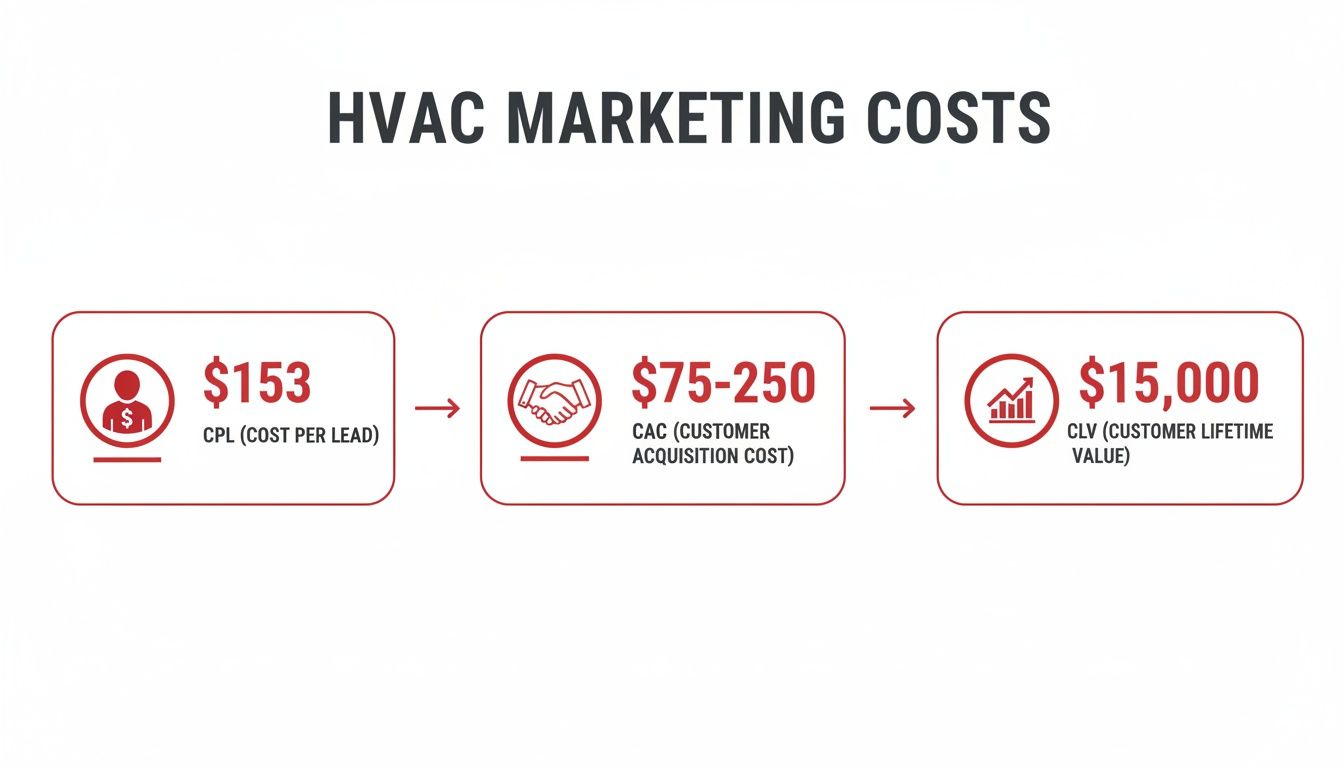
Seeing that high CLV number really puts things into perspective. It shows why it might make sense to spend a bit more upfront to acquire a customer who could be worth thousands over the years—as long as the numbers work for your business. Knowing your CAC is the first real step toward making smarter decisions about where every single marketing dollar goes.
Turning Your Website Into a Lead Generation Machine
Think of your website as your hardest-working salesperson. It never sleeps, never takes a day off, and should be constantly turning visitors into booked jobs. But here's the hard truth: most HVAC sites are unintentionally full of dead ends, leaking potential revenue and pushing your customer acquisition costs sky-high.
If you want to lower your CAC without pouring more money into ads, transforming your digital storefront is the single most effective move you can make.
It all starts with seeing your website through your customer's eyes. Picture this: a homeowner’s AC dies on a sweltering afternoon. They grab their phone, find your site, and land on your homepage. They're stressed, hot, and need help now. If they have to pinch, zoom, and hunt for a phone number, they’re gone. A clunky mobile experience isn't just an annoyance; it's a lead killer.
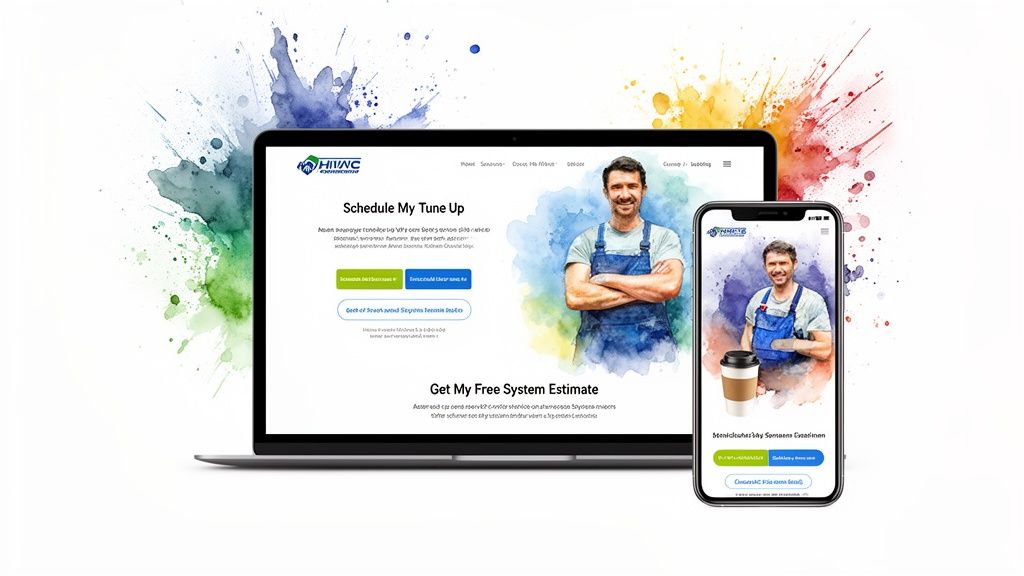
This is why every single pixel on your site needs to be designed with one goal: making it ridiculously easy for a visitor to take the next step. Every page, every image, every word should guide them toward becoming a paying customer.
Make Booking a Job Effortless
In the world of online leads, the path of least resistance always wins. Simply listing a phone number isn't enough. You have to give visitors multiple, obvious ways to connect with you. The best HVAC websites put these options right "above the fold"—the very first thing a user sees.
- Click-to-Call Buttons: For mobile users, this is non-negotiable. One tap and they’re calling your office. No fumbling with copy-and-paste.
- Simple Contact Forms: Keep it short. All you need is a name, phone number, email, and a quick note about their problem. Anything more is a barrier.
- Online Scheduling Widgets: Give customers the power to book their own tune-up or service call directly on your calendar. It’s the ultimate convenience.
These small tweaks remove friction. They meet customers where they are and let them choose how they want to communicate, which dramatically boosts the number of visitors who actually turn into leads.
Deploy an Instant Online Quoting Tool
One of the biggest questions on any potential customer's mind is, "How much is this going to cost me?" Many homeowners avoid calling for an estimate because they’re afraid of a high-pressure sales pitch. An instant online quoting tool completely sidesteps this fear.
By letting visitors get a ballpark estimate for a new system right on your site, you capture high-intent leads that your competitors will never even talk to. These aren't just tire-kickers; they are actively researching a major purchase.
The tool works by asking a few simple questions about their home—square footage, number of rooms, current system—and then provides an automated estimate. To get the quote, they give you their contact info. Just like that, your sales team has a warm, qualified lead to follow up with. This single feature can be a game-changer for your website's conversion rate on high-ticket installs.
For a deeper dive, check out our guide on HVAC website lead generation secrets to really transform your online presence.
Craft Compelling Calls to Action
Generic buttons like "Contact Us" or "Learn More" are passionless and weak. They don’t inspire action. To get someone to click, your calls-to-action (CTAs) need to be specific, urgent, and focused on the benefit to the customer. They have to speak directly to the problem at hand.
Think about the psychology of the search. A homeowner looking for an AC repair isn't "learning more"—they're sweating and desperate for a fix. Someone considering a new furnace wants to know their family will be warm this winter. Your CTAs need to reflect that reality.
CTA Examples That Actually Convert
| Weak CTA | Stronger, Action-Oriented CTA | Why It Works |
|---|---|---|
| Contact Us | Schedule My Emergency Repair Now | Creates urgency and speaks directly to a user in distress. |
| Our Services | Get My Free System Estimate | Highlights a clear value (a free estimate) and uses personal language. |
| Submit | Book My $79 Tune-Up | It's specific, anchored to a price, and makes the action feel easy. |
When you optimize these critical elements—your mobile experience, booking options, quoting tools, and CTAs—you start converting more of the traffic you already have. This directly lowers your customer acquisition cost because every single dollar you spend on marketing suddenly starts working a whole lot harder.
Dominating Local Search to Attract Ready-to-Buy Homeowners
For any HVAC company, the most profitable leads aren't just floating around the internet; they're right in your backyard. Winning the local search game is where you find homeowners with urgent problems—a broken AC in July, a dead furnace in January—who are actively looking to book a service now.
Lowering your customer acquisition cost starts with being the first and most trusted name they see.
This is where your Google Business Profile (GBP) becomes your single most powerful free marketing tool. It’s no longer just a digital business card. It’s the engine that powers your visibility in the coveted Google "map pack"—that trio of local businesses shown at the top of search results for queries like "ac repair near me."
A well-optimized profile can generate a steady stream of high-intent calls without costing you a dime in ad spend.
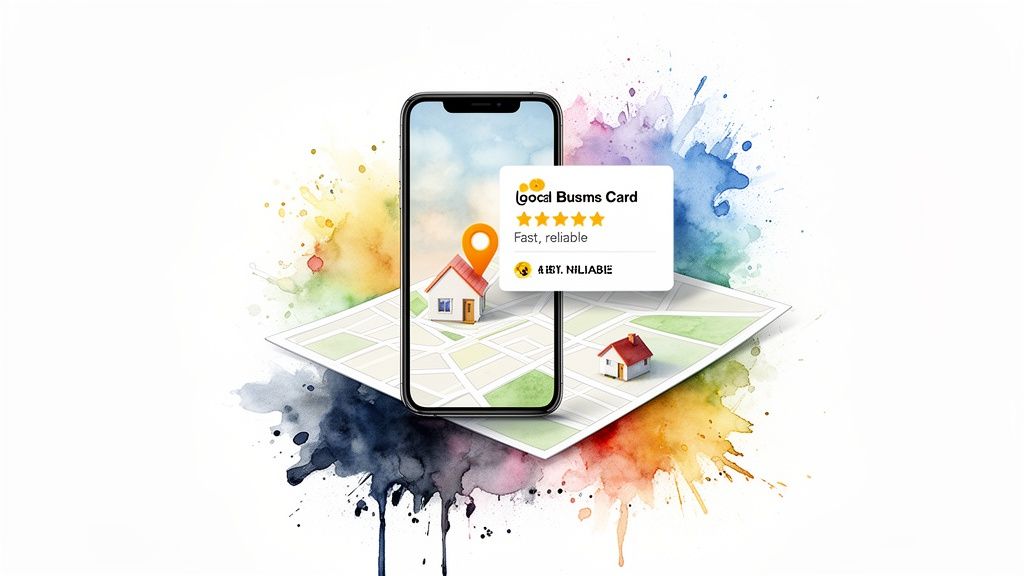
Master Your Google Business Profile
An optimized GBP is a non-negotiable for reducing CAC. It’s the foundation of your entire local presence and directly influences whether a potential customer clicks on your listing or a competitor's. To stand out, you need to go beyond just listing your name and number.
Start by treating your profile like a dynamic mini-website. This means regularly uploading real photos of your team and trucks, which builds trust and shows you're an active, legitimate business.
More importantly, use Google Posts to showcase seasonal offers, like a "$79 Fall Furnace Tune-Up" or "10% Off New AC Installs." These posts act as free, hyper-local ads that appear directly in the search results.
Another often-overlooked feature is the Q&A section. Proactively populate this with common questions you get from homeowners, such as "Do you offer financing?" or "What brands do you service?" By providing the answers yourself, you address potential concerns upfront, making it that much easier for a customer to choose you.
Build an Unbeatable Reputation with Reviews
In local search, reviews are everything. They are the single most powerful social proof you have.
A steady stream of recent, positive reviews tells both Google and potential customers that you are a trustworthy and reliable choice. This directly impacts your map pack ranking and your conversion rate.
The goal isn't just to get reviews; it's to build a system for consistently generating them. After every successful service call, your process should automatically trigger a request for feedback. This can be as simple as an automated text message or email with a direct link to your Google review page.
Making it effortless is key. A customer is far more likely to leave a 5-star review if they can do it in two clicks from their phone rather than having to search for your profile themselves. This consistent flow of positive feedback is a massive signal to Google's algorithm that your business deserves top placement.
To learn more about building this local authority, explore our complete guide on local SEO for HVAC contractors.
Earn Immediate Trust with the Google Guarantee
While a stellar GBP can dominate organic results, Google Local Services Ads (LSAs) offer a fast track to the very top of the page. These pay-per-lead ads appear above traditional paid ads and the map pack, but their real power comes from the Google Guarantee badge.
This little green checkmark is a massive trust signal.
It tells homeowners that Google has vetted your business and backs your work with up to a $2,000 guarantee. For a customer anxious about hiring the right contractor, this badge can be the ultimate tiebreaker. It instantly sets you apart from competitors and attracts buyers who are ready to book, not just browse.
By combining an expertly managed GBP with the trust-building power of the Google Guarantee, you create a local search presence that captures high-quality leads at a much lower cost. You stop paying to reach broad audiences and start attracting ready-to-buy homeowners in your immediate service area.
Refining Your Paid Ad Campaigns for Maximum ROI
Running paid ads on platforms like Google and Facebook can feel like feeding cash into a furnace. It burns fast, and if you’re not careful, you get very little heat in return. An untamed paid ad strategy is one of the quickest ways to inflate your customer acquisition cost.
The fix isn't just about spending more money. It's about spending it smarter by dialing in your campaigns for the highest possible return. A scattergun approach—targeting broad areas and generic keywords—is a surefire way to waste your ad budget on clicks from people who were never going to become customers anyway. The solution is to get laser-focused, making sure every dollar is aimed directly at your ideal, ready-to-buy homeowner.
Eliminate Waste with Hyper-Targeting and Negative Keywords
Think about where your most profitable customers live. They’re in specific neighborhoods and zip codes, right? So instead of targeting an entire county, your ad campaigns should be geographically locked to the precise service areas that actually make you money. This one adjustment immediately stops your ads from showing up for homeowners who are too far away, cutting out a huge source of irrelevant clicks.
Just as important is telling Google what not to show your ads for. This is where negative keywords become your absolute best friend in lowering your CAC. Think about all the searches that include "HVAC" but have zero commercial intent.
Common sources of wasted ad spend include clicks from users searching for:
- DIY repair guides: People Googling "how to fix ac unit myself" aren't looking to hire you.
- HVAC schools or training: Clicks from aspiring technicians searching "hvac certification" drain your budget fast.
- Appliance parts: Someone looking for a "furnace ignitor replacement part" is a DIYer, not a lead for a service call.
- Job seekers: Searches like "hvac technician jobs" should always be excluded from your customer-facing campaigns.
When you build a robust negative keyword list, you’re basically creating a filter that stops your ads from appearing for these money-wasting searches. It forces your budget to work harder on attracting actual customers.
Structure Campaigns Around Your Most Profitable Services
Let’s be honest, not all HVAC jobs are created equal. An emergency AC repair call is great, but a full system installation is where the real profit is. Your Google Ads campaigns should reflect that reality.
Don't just lump all your services into one generic campaign. Instead, structure them around profitability.
Create separate, dedicated campaigns for your highest-margin services like "AC Installation," "Furnace Replacement," and "Emergency HVAC Service." This lets you put more budget behind the keywords that bring in the big-ticket jobs and write super-specific ad copy that speaks directly to that customer's immediate need.
For example, an ad in an installation campaign can highlight financing options and free estimates. Meanwhile, an ad for emergency repairs should scream 24/7 availability and fast response times. This level of specificity dramatically improves your click-through and conversion rates, which directly lowers your acquisition costs. If you're weighing different lead generation models, it's also worth looking into how HVAC pay-per-lead services can fit into your overall paid ad strategy.
Recapture Lost Opportunities with Retargeting
Here’s a startling fact: 97% of people who visit your website for the first time leave without doing anything. That’s a massive pool of missed opportunities just floating away. Retargeting is how you bring those people back.
It’s simpler than it sounds. By placing a small piece of code on your website (called a pixel), you can show follow-up ads to users who visited specific pages—like your AC installation page—but didn't fill out your form. These ads can then follow them around on platforms like Facebook and other websites they visit.
This strategy is incredibly cost-effective because you're marketing to a warm audience—people who have already checked you out. A well-crafted retargeting ad offering a special discount or a simple reminder about your free estimate can be the final nudge they need to book a job. For those using social media heavily, digging into a modern guide to Facebook ad optimization can unlock even more savings. By turning these near-misses into paying customers, you recover potentially lost revenue and make your initial ad spend far more efficient.
Boosting Customer Lifetime Value Through Smart Automation
The cheapest customer you'll ever get is the one you already have.
It’s easy to get tunnel-vision on finding new leads, but a massive opportunity to lower your effective customer acquisition cost lies in getting more revenue from your existing customer base. This is where Customer Lifetime Value (CLV) becomes your secret weapon.
When you increase the total amount a customer spends with you over the years, that initial investment to acquire them becomes way more profitable. It’s the difference between a one-off repair job and a long-term, loyal relationship that generates predictable income year after year. The key to unlocking this value is smart, targeted automation that works for you 24/7.
Sell Maintenance Plans on Autopilot
One of the most powerful ways to boost CLV is by selling preventative maintenance plans. These agreements create recurring revenue, smooth out the seasonal slumps, and keep your techs busy. But most HVAC companies make it way too hard for customers to sign up, relying entirely on technicians to remember to upsell in the field.
A much better approach is to make buying a maintenance plan as easy as ordering from Amazon. By adding simple eCommerce functionality to your website, you can create dedicated pages for your service agreements. Customers can see the benefits, check the pricing, and sign up directly with a credit card—no phone call or high-pressure pitch needed.
This strategy turns your website into a passive sales channel. Homeowners who are already happy with your service can easily enroll in a plan at their convenience, locking in future revenue and dramatically increasing their lifetime value without you spending an extra dime on ads.
Nurture Relationships with Automated Email Marketing
Email automation is one of the highest-ROI tools you can have in your arsenal. It lets you stay in touch with your entire customer list, build relationships, and generate repeat business without manually sending a single message. A few well-crafted automated sequences can work wonders for your bottom line.
Think about the different stages of the customer journey and where a timely email could make a difference. These aren't just random newsletters; they are strategic messages triggered by specific actions or dates, designed to get a response.
Here are a few essential automated campaigns every HVAC company should be running:
- New Lead Nurture: Someone requests an estimate but doesn't book. What happens next? An automated series of emails can keep your company top-of-mind with helpful tips, financing info, and testimonials.
- Post-Service Follow-Up: A day after a job is completed, an email should automatically go out thanking the customer and asking for a Google review. This simple step is huge for building your local SEO presence.
- Seasonal Tune-Up Reminders: These are probably the two most important emails you'll ever send. An email in early spring reminding customers to schedule their AC tune-up and another in the fall for their furnace check can fill your calendar with profitable, low-effort jobs.
This automated follow-up system ensures no customer ever falls through the cracks. It's a simple, set-it-and-forget-it strategy that drives a ton of repeat business. It turns one-time customers into lifelong clients, making every dollar you spent to acquire them work that much harder for you.
Setting up the right automated emails can feel overwhelming, but focusing on a few key sequences makes a huge difference. These campaigns are designed to nurture leads, improve the customer experience, and drive repeat business without you lifting a finger after the initial setup.
Here's a breakdown of the most effective automated sequences for an HVAC business, what they're for, and what triggers them.
Automated Email Sequences for HVAC Businesses
| Sequence Type | Primary Goal | Example Trigger | Key Content |
|---|---|---|---|
| New Lead Nurture | Build trust and convert a lead who requested a quote but hasn't booked service. | User submits an online quote request form. | Welcome email, company story, technician bios, customer testimonials, financing options, "Why Choose Us" differentiators. |
| Post-Service Follow-Up | Secure a 5-star review and offer a maintenance plan. | A job is marked as "complete" in your CRM or scheduling software. | Thank you message, direct link to leave a Google review, introduction to maintenance plan benefits. |
| Seasonal Tune-Up Reminders | Book preventative maintenance appointments ahead of the busy season. | Date-based trigger (e.g., March 1st for AC, September 1st for Furnace). | "Time to schedule your tune-up!" message, benefits of maintenance (lower bills, fewer breakdowns), direct scheduling link. |
| Customer Reactivation | Win back past customers who haven't booked service in a while. | Customer has not had a service in the last 18 months. | "We miss you!" offer, special discount for returning customers, reminder of past services performed. |
| Maintenance Plan Onboarding | Welcome new members and reinforce the value of their purchase. | Customer signs up for a maintenance plan online or in person. | Welcome message, detailed explanation of plan benefits, instructions on how to schedule their first tune-up. |
These automated touchpoints are your digital sales reps, working around the clock to ensure every lead and customer gets the right message at the right time. By implementing even a couple of these sequences, you can significantly increase customer retention and lifetime value.
Answering Your Top Questions
Navigating the world of HVAC digital marketing brings up a lot of questions, especially when you're focused on making every single dollar count. I get it. Lowering your customer acquisition cost is a constant process of testing, tracking, and tweaking your game plan.
To give you a head start, I've put together answers to some of the most common questions I hear from HVAC owners.
What’s a Good Customer Acquisition Cost for an HVAC Company?
This is the million-dollar question, isn't it? While a typical CAC for an HVAC company falls somewhere between $75 and $250, that number doesn't tell the whole story. It's not a one-size-fits-all benchmark.
The "right" cost for your business really depends on your market, the services you're pushing, and where you're finding your customers. A cheap repair lead from a Facebook ad will have a different CAC than a full system install from a Google search.
The metric that truly matters isn't CAC in a vacuum; it’s the relationship between CAC and your Customer Lifetime Value (CLV).
The magic number we're always chasing is a CLV:CAC ratio of 3:1 or higher. For every dollar you spend to get a customer, you should be making at least three dollars back over the long haul.
Instead of obsessing over a single CAC number, focus on improving that ratio. You can do this by targeting more profitable jobs—think full system replacements—and locking in future revenue with maintenance plans.
How Can I Track Which Marketing Channels Are Actually Bringing in Profitable Jobs?
Guesswork is the fastest way to burn through your marketing budget. You need to connect your marketing efforts directly to booked, paying jobs. Relying on "how did you hear about us?" alone won't cut it.
Getting a clear picture of what's really working requires a smart mix of tech and good old-fashioned process.
- Use Unique, Trackable Phone Numbers: This is non-negotiable. Assign a different phone number to every single marketing channel. One for your Google Business Profile, another for your website, a third for your Google Ads campaign, and so on. A tool like CallRail makes this a piece of cake.
- Plug It Into Your CRM: Your call tracking software needs to talk to your Customer Relationship Management (CRM) system. This is the crucial step that links an incoming call to a specific customer record, letting you see which ad or click ultimately led to a signed invoice.
- Train Your Team: The final piece is your people. Coach your CSRs and techs to always ask new callers, "And just so we know for our marketing, how did you find us today?" This human intelligence fills in the gaps that technology can sometimes miss.
Combining this digital data with direct customer feedback removes all the ambiguity. You'll know with confidence which channels are driving profitable installs and which ones are just generating noise.
Is It Better to Focus on Lowering Cost Per Lead or Increasing Conversion Rate?
While both are important, I always tell owners to focus on increasing your conversion rate first. It almost always delivers a bigger and more immediate impact on your overall CAC.
Think about it: a cheap lead that never turns into a paying customer is completely worthless. It just clogs up your pipeline and wastes your team's time chasing ghosts.
Improving your conversion rate makes every dollar you're already spending on marketing work harder. By optimizing your website, building high-intent landing pages, and tightening up your lead qualification process, you turn more of your existing traffic into actual booked jobs.
Once your conversion funnel is a well-oiled machine, then you can shift your focus to lowering your Cost Per Lead (CPL). With a high conversion rate already in place, you can be confident that a much higher percentage of the leads you generate will become profitable customers.
How Long Does It Take to See a Reduction in CAC from Improving SEO?
SEO is a marathon, not a sprint. Unlike paid ads that can get your phone ringing tomorrow, SEO is about building a sustainable asset that pays you back for years to come.
Generally, you can expect to see the first signs of life—better rankings, more organic traffic—within 3 to 6 months of consistent, focused effort.
However, seeing a significant drop in your customer acquisition cost from SEO might take closer to 6 to 12 months. That’s the point where your website starts building real authority with Google, allowing you to rank for the big-money keywords like "AC replacement in [your city]."
It definitely requires patience, but once it's established, a solid SEO strategy often delivers one of the lowest and most stable customer acquisition costs you can get.
Ready to stop guessing and start growing? The HVAC Growth Machine is a complete, done-for-you system designed to lower your customer acquisition costs and fill your calendar with profitable install jobs. From a high-converting website with an instant estimate tool to automated email sequences that nurture leads 24/7, we provide everything you need to dominate your local market. Secure your exclusive service area and see how we can transform your lead flow at https://hvacgrowthmachine.com.





Founder of HVAC Growth Machine