

Your website isn't just a digital brochure; it's your #1 sales tool and the foundation of all your digital marketing. Every ad, social media post, and local listing you create will eventually point back to it. If that foundation is cracked—slow, confusing, or untrustworthy—you're just throwing marketing dollars away.
Building Your Digital Foundation for Conversions
Before you spend a single dollar on Google Ads, you need a high-performance HVAC website. Think about it from the customer's perspective. When someone's AC goes out in the middle of July, they're stressed, probably searching on their phone, and have zero patience for a bad user experience.
The reality is that over 60% of HVAC-related searches happen on a mobile device. That number skyrockets for emergency repair calls. Your website has literally seconds to make a great first impression and convince them to call you instead of your competitor.
Prioritize Mobile Speed and User Experience
A mobile-first design isn't a "nice-to-have" anymore; it's non-negotiable for effective HVAC lead generation. Your website absolutely must load in under two seconds on a phone. A slow-loading site is the fastest way to lose a lead. They’ll just hit the "back" button and call the next company on the list.
Keep the layout clean and uncluttered. The last thing a frustrated homeowner wants to do is pinch and zoom just to find your phone number.
- Click-to-Call Buttons: Your phone number should be right at the top of every single page. On mobile, make it a clickable button that immediately opens their phone's dialer.
- Simple Navigation: Keep your menu dead simple. Use clear labels people actually search for, like "AC Repair," "Furnace Installation," and "Contact Us."
- Optimized Images: High-quality photos build trust, but massive image files kill load times. Make sure all your images are compressed for the web.
Capture Leads with an Instant Estimate Tool
Let's be honest, a lot of homeowners are just kicking the tires. They want a ballpark price for a new system but aren't ready for a full-blown sales consultation. This is where an instant online estimate tool becomes your secret weapon for HVAC leads generation.
By answering a few simple questions about their home, a visitor can get an automated estimate sent straight to their email. This does two brilliant things at once: it gives them the instant gratification they want, and it captures their contact info for your sales team to follow up. You can learn more about how to build HVAC lead generation websites that turn casual browsers into booked jobs.
This simple tool positions you as the helpful, transparent expert before you've even picked up the phone. It's a low-friction way to start a conversation with someone who's already raising their hand, showing a clear interest in a high-ticket install.
Craft Service Pages That Convert
Your service pages need to do more than just list what you do. They have to connect with the customer’s immediate problem and scream, "We are the solution!" A homeowner with a broken furnace in January doesn't care about your company's founding story; they want to know if you can get their heat back on tonight.
Each service page—like "Emergency AC Repair" or "New Furnace Installation"—needs to address specific pain points head-on.
- Problem-Focused Headlines: Ditch the generic titles. Use headlines that speak directly to their emergency, like "Fast & Reliable AC Repair When You Need It Most."
- Clear Calls-to-Action: Don't make people guess what to do next. Big, bold buttons like "Schedule Service Now" or "Get a Free Quote" should be impossible to miss.
- Showcase Social Proof: Trust is everything. Plaster your site with social proof. Feature your Google star rating, recent customer testimonials, and industry certifications like the NATE logo. This immediately reassures visitors they're dealing with a pro.
Dominating Local Search with Google's Ecosystem
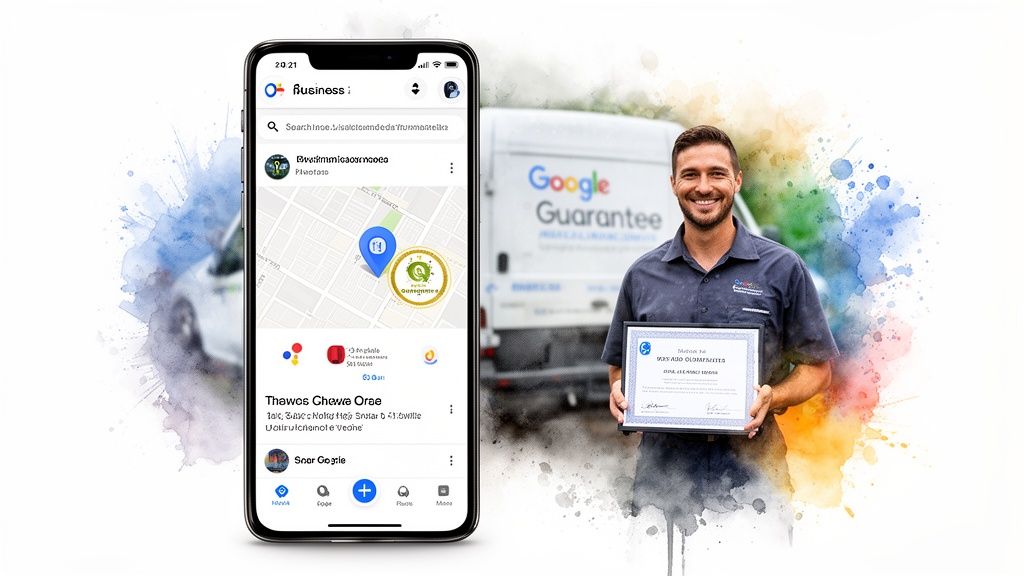
Sure, a great website is your digital home base, but let's be real—most of your customers will find you on Google first. For an HVAC contractor, mastering Google's local search isn't just a good idea; it's the main event. It's where you win or lose high-intent leads who need your help right now.
Think about it. A furnace dies in the middle of winter. The homeowner isn't browsing websites for fun. They're grabbing their phone and searching "emergency heating repair near me." Your job is to be the first, most trustworthy name they see. That's where a dialed-in Google Business Profile (GBP) and Google's trust signals come in.
Getting Your Google Business Profile Dialed In
Your Google Business Profile is way more than just a pin on a map. It's a lead-generating machine if you treat it right. A neglected profile is like leaving the front door of your shop closed—you’re just missing out on easy business. A fully optimized listing, on the other hand, can skyrocket your visibility in the local map pack and search results.
Start with the absolute basics: make sure your Name, Address, and Phone number (NAP) are identical everywhere online. Even a tiny difference can throw Google off and ding your rankings. Once that’s handled, it's time to dig into the details that homeowners actually care about.
- Get Hyper-Specific with Service Categories: Don't just settle for "HVAC Contractor." Go deep. Add "Furnace Repair Service," "Air Conditioning Installation," and "Air Duct Cleaning Service." This helps you appear for those specific, high-intent searches.
- Show, Don't Just Tell, with Photos: You need to be uploading real photos on a regular basis. Pictures of your branded vans, your techs in uniform, and finished installs do more than just look nice—they build instant trust and show you’re a real, professional operation.
- Live and Breathe Your Reviews: Reviews are a massive factor in how Google ranks you. You have to actively ask happy customers for them. More importantly, you need to respond to every single review—good or bad—ideally within 24 hours. Potential customers are always watching to see how you handle feedback.
Think of your Google Business Profile as your digital storefront for local search. It's how you prove to Google—and your future customers—that you're a legitimate, active, and trusted expert in their neighborhood.
Earning Instant Trust with the Google Guarantee
The single most powerful trust signal you can have in local search is that little green Google Guarantee checkmark. This badge comes from running Google's Local Services Ads (LSAs), and it puts you right at the top of the search results—above the regular ads and organic listings.
When a homeowner sees that badge, it tells them you've been vetted by Google and your work is backed by their satisfaction guarantee. That immediately sets you apart from every other company on the page. Suddenly, your phone number is the first one they want to call.
The best part? LSAs are pay-per-lead. You only pay when a qualified customer actually calls you through the ad, making it an incredibly efficient way to generate exclusive, high-intent phone calls.
Building Local Authority with Smart HVAC SEO
Beyond your GBP, you need to be sending clear signals to Google that you own your service area. This is where targeted local SEO for HVAC comes into play. To really dominate your market, you need a solid strategy, and this proven guide to Local SEO for home services is a great place to start.
A killer tactic is creating dedicated service pages for each city or major neighborhood you cover. Don’t just make a generic "AC Repair" page. Build out pages like "AC Repair in Austin" and "Furnace Installation in Round Rock." These pages need to be filled with local context and details that signal your relevance to Google for that specific area.
Finally, you need to build local citations. These are simply mentions of your business's NAP on other trusted online directories like Yelp, the Better Business Bureau, and trade-specific sites. Having consistent citations all over the web reinforces your location and solidifies your reputation as a legitimate local business, which helps boost your authority and bring in more organic traffic.
While building a strong local SEO presence is your long-term engine for growth, sometimes you just need the phone to ring right now. When a surprise heatwave hits or a cold snap is in the forecast, you need a way to jump to the front of the line and grab all that sudden demand.
This is where paid advertising becomes your best friend. It’s the fastest way to generate immediate HVAC leads.
Paid ads on platforms like Google and Facebook let you put your business in front of homeowners at the exact moment they need you. You get to bypass the slower ramp-up of organic strategies. The goal isn’t just to get clicks, though. It’s to engineer campaigns that drive profitable, high-intent phone calls and quote requests straight to your business.
Targeting High-Intent Keywords on Google Ads
The single biggest mistake HVAC companies make with Google Ads is bidding on broad, expensive keywords like "hvac company." A search like that is usually from someone just kicking tires. Instead, you have to focus your budget on high-intent keywords—the ones that signal someone has a real, urgent problem.
These are the exact phrases a homeowner types when their system is dead and they need a hero, not a brochure.
- Emergency Repair Keywords: Get inside your customer's head. They’re frantically searching for "emergency ac repair," "furnace not working," or "24 hour heating service."
- Replacement Keywords: You can also target users who already know it's time for an upgrade. Think "new furnace cost," "ac unit replacement quote," and "heat pump installation near me."
- Negative Keywords: Just as important is telling Google what not to show your ads for. You need to add negative keywords like "free," "jobs," and "training" to filter out the irrelevant searches that chew through your budget.
When you focus on these specific, problem-focused keywords, you make sure your ad spend is going directly toward people who are actively looking to hire a contractor. Today.
A well-structured Google Ads campaign should always separate repair leads from installation leads. This lets you allocate your budget with precision—you can be much more aggressive on high-value install keywords while keeping a steady, profitable flow of repair calls coming in.
Here’s the good news: lead generation costs in the HVAC industry are surprisingly competitive. The average cost per lead (CPL) is just $92 when you blend both paid and organic channels. According to these lead generation statistics at EmailToolTester.com, this makes it one of the most cost-effective industries for getting new customers.
Even if you only look at paid ads, HVAC leads average a reasonable $115. When you factor in organic efforts, that cost plummets to just $69.
Reaching Untapped Audiences with Facebook Ads
While Google is great for capturing people who are actively searching, Facebook lets you generate demand by reaching your ideal customers before their system even breaks. Its powerful targeting tools let you get your brand in front of very specific homeowner profiles, building awareness and generating leads often at a lower cost per click.
This is where you can get really creative and proactive with your marketing.
| Audience Target | Why It Works for HVAC |
|---|---|
| New Homeowners | People who recently moved are often clueless about their HVAC system's age or condition. They are prime candidates for inspections, tune-ups, and service plans. |
| Homeowners by Home Age | You can target ads to people living in homes built 15+ years ago. These homeowners are way more likely to be facing an imminent system replacement and are open to upgrade offers. |
| Website Visitor Retargeting | Show ads to people who visited your "AC Installation" page but didn't fill out the form. This keeps your company top-of-mind and pulls interested prospects back to your site. |
For example, you could run a Facebook ad campaign in the spring that targets homeowners in older neighborhoods. The offer? A compelling "AC Tune-Up Special." The ad could show a friendly technician and highlight the benefit of avoiding a mid-summer breakdown.
This proactive approach to hvac leads generation plants a seed, making you the first and only company they think of when they eventually need service or a full replacement.
Automating Your Lead Nurturing and Follow Up
Getting a new lead is a great feeling, but it’s just the starting line. The real work is turning that initial interest into a paying customer, and that's where most HVAC companies drop the ball. Perfectly good leads go cold simply because the follow-up is slow, inconsistent, or non-existent.
This is where a solid, automated nurturing process becomes your 24/7 digital sales rep. It ensures every single lead gets the right attention at the right time, without you having to manually chase everyone down. This isn't about sending one generic email; it's about creating a series of smart, strategic touchpoints that build trust and guide a homeowner from "just looking" to "let's do this."
Creating Your First Automated Email Sequences
The whole point of email automation is to deliver the right message when it matters most. For an HVAC business, this means setting up email sequences that trigger based on what a prospect does or who they are. These sequences work for you in the background, keeping your company top-of-mind.
Here are a few must-have sequences every HVAC company should have running:
- The "New Quote Request" Welcome Series: The moment someone requests an estimate, an email should hit their inbox. This first message confirms you got their request, links to your stellar Google reviews for instant social proof, and tells them exactly when to expect a call. A day later, another email can go out with a helpful guide, like "How to Choose the Right AC Unit," positioning you as the expert.
- The "Unconverted Estimate" Follow-Up: Let's be real—most homeowners won't sign off on a $10,000 system replacement on the spot. An automated sequence can gently follow up a few days after you send the quote. This is your chance to remind them of the benefits, tackle common objections head-on, and showcase financing options that make the decision a whole lot easier.
- Seasonal Maintenance Reminders: Don't wait for customers to remember their spring AC tune-up. Set up an automated email to go out in early March, reminding past customers why preventive maintenance is so important and maybe even including a small early-bird discount to get them on the schedule.
Think of these automated sequences as a conversation. You're not just blasting out offers; you're providing value and guidance at each step, making your company the obvious choice when they're finally ready to buy.
Using Segmentation for Highly Relevant Offers
Sending the same email to every single person on your list is a fast track to the spam folder. The real magic in HVAC email marketing comes from segmentation—breaking your audience into smaller, targeted groups based on their history with your company. This lets you send messages that actually resonate. For a deeper dive, explore these lead nurturing best practices designed for HVAC contractors.
A dead-simple way to start is by segmenting your customer list by their equipment age and what services they've had.
| Customer Segment | Automated Nurturing Tactic | Goal |
|---|---|---|
| New Installs (0-3 Years) | Send annual maintenance reminders and tips for maximizing energy efficiency. | Turn a one-time install into a long-term maintenance plan subscriber. |
| Aging Systems (10+ Years) | Share content about the benefits of new, high-efficiency systems and information on current rebates or financing. | Nurture a future replacement lead before their old system fails. |
| Repair-Only Customers | Follow up after a repair with an offer to join a maintenance plan, highlighting how it could prevent future breakdowns. | Convert a one-off service call into a recurring revenue stream. |
Of course, none of this works if you're missing calls in the first place. To make sure no after-hours emergency or weekend inquiry gets lost, using a reliable HVAC Answering Service is critical. When you combine a bulletproof front line with a powerful automated backend, you create a seamless system that squeezes every last drop of value out of the leads your marketing generates.
Measuring What Matters With Call Tracking And ROI
You can have the slickest ads and the sharpest website, but if you don't know which marketing dollars are actually making your phone ring, you're just lighting money on fire. Guesswork is expensive. The only way to confidently scale your HVAC business is to stop obsessing over vanity metrics like clicks and impressions and start measuring what really moves the needle: revenue.
This is where a solid tracking system becomes your most valuable tool. It's the difference between hoping your marketing works and knowing it does. Without it, you're just as likely to cut your best lead source as you are to double down on a money pit.
Demystifying Call Tracking For HVAC
At its core, call tracking is pretty simple. It assigns a unique, trackable phone number to each of your marketing channels. One number goes on your Google Business Profile, another on your Google Ads, and a third on that direct mail flyer you sent out.
When a customer dials one of these numbers, the call forwards seamlessly to your main business line. The magic happens behind the scenes: the software logs exactly which ad or listing generated that call. Suddenly, you have concrete proof of what’s working.
- Pinpoint Your Winners: You can see with 100% certainty that your investment in Local Services Ads generated 15 install calls last month.
- Identify Losers Quickly: You might discover that a specific Facebook ad campaign is getting tons of clicks but zero phone calls, telling you it's time to pull the plug.
- Understand True Performance: It allows you to tie a specific booked job—and its revenue—directly back to the marketing campaign that produced it.
By attributing every single incoming phone call back to its exact source, you take all the guesswork out of your HVAC leads generation strategy. You can finally make budget decisions based on hard data, not gut feelings.
Focusing On The KPIs That Drive Profit
Once you have accurate tracking in place, you can blow past the surface-level numbers and focus on the key performance indicators (KPIs) that actually reflect the health of your business. These are the metrics that tell the real story of your marketing's profitability.
For instance, you can see how a simple, automated follow-up sequence can nurture a lead from an initial quote request into a booked job.
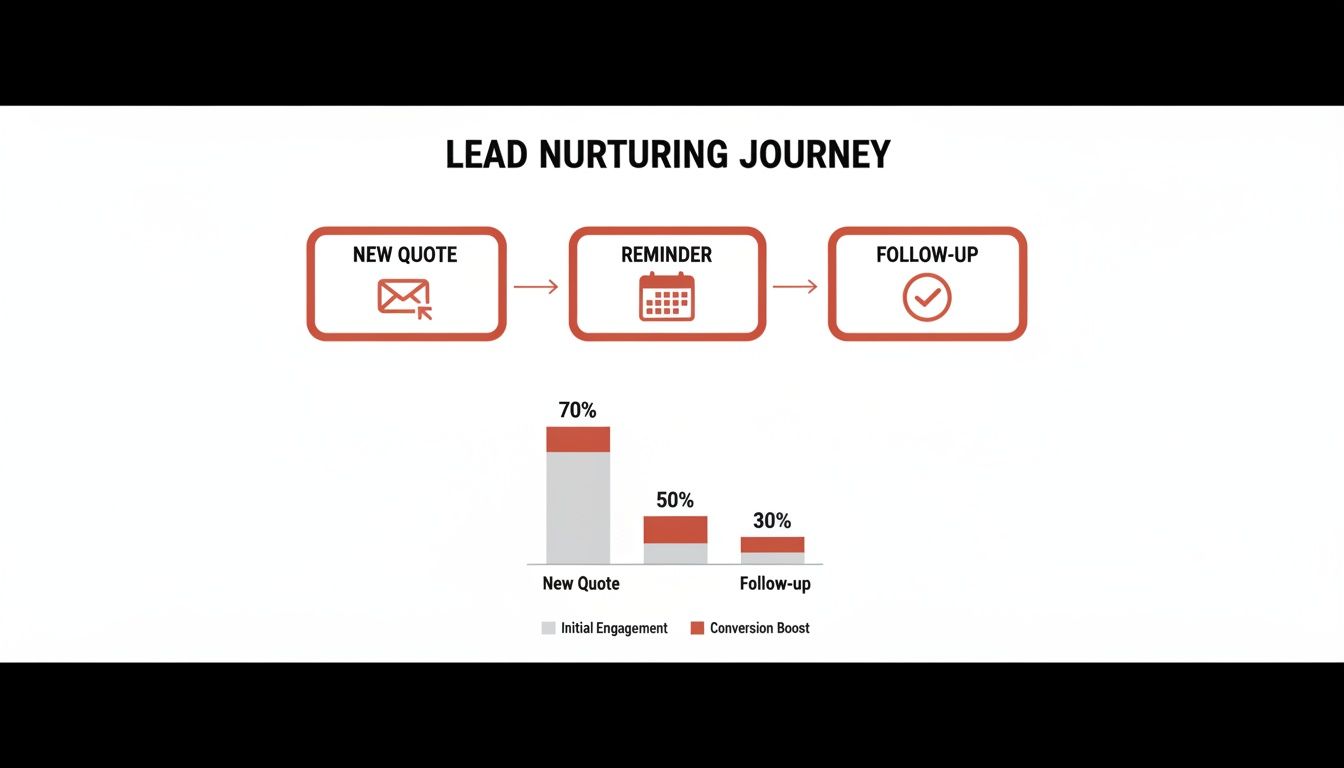
This visual shows how consistent, automated touchpoints guide a prospect through their decision, dramatically increasing the odds they choose you.
Cost Per Lead (CPL)
This is your starting point. It’s a simple calculation: total marketing spend on a channel divided by the number of leads it generated. Knowing your CPL for SEO, Google Ads, and Facebook is the first step to comparing their efficiency.
Cost Per Acquisition (CPA)
Now things get interesting. A lead is great, but a paying customer is what keeps the lights on. CPA measures how much it costs to acquire an actual booked job. You might find that one channel sends you cheap leads that rarely convert, while another delivers more expensive leads that turn into profitable jobs almost every time. That's a critical distinction.
Return on Investment (ROI)
This is the ultimate report card for your marketing. ROI tells you exactly how much revenue you're generating for every dollar you spend. For example, if you spent $1,000 on Google Ads and it produced $8,000 in profitable installation jobs, your ROI is a fantastic 8:1.
To help you decide where to put your first marketing dollars, here’s a quick breakdown of what you can typically expect from different channels.
HVAC Marketing Channel ROI Comparison
| Channel | Typical Monthly Investment | Primary Lead Type | Average Time to ROI |
|---|---|---|---|
| Google Local Services Ads | $500 – $3,000+ | High-intent phone calls | 1-2 weeks |
| Google Search Ads (PPC) | $1,000 – $5,000+ | Installs & high-value repairs | 1-3 months |
| Local SEO & Google Business Profile | $750 – $2,500+ | Service calls & installs | 4-6 months |
| Facebook Ads | $500 – $2,000+ | Tune-ups, maintenance plans | 2-4 months |
| Email Marketing | $100 – $500 | Repeat business, upsells | Ongoing |
This table gives you a ballpark idea, but your actual results will depend on your market, competition, and how well your campaigns are managed.
When you have clear ROI data for every channel, the path forward becomes obvious. You can confidently shift your budget away from the duds and pour more fuel on the fire of what's already proven to be profitable, creating a predictable engine for growth.
Turn Data into Dollars: How to Scale and Secure Your Future
A solid lead generation system does more than just keep your techs busy. It hands you the exact data you need to stop guessing and start scaling your business with confidence. When you know precisely where your best install and service jobs are coming from, you can finally get ahead of the curve instead of just reacting to the phone ringing. This is how you turn marketing from a random expense into a predictable money-maker.
By digging into the data from your call tracking and CRM, you can actually start to see the future. You’ll spot the seasonal trends—that summer AC rush or the first big winter freeze—and be ready for them. That means you can adjust your marketing spend and prepare your team before the rush hits, maximizing your profits without having techs sitting around during the slow season.
From a Full Calendar to a Growing Company
The real goal isn't just to be busy; it's to strategically grow your slice of the market. And the key to that growth is already sitting in your customer database. It’s a goldmine of opportunities to sell more to the people who already trust you.
Think about it. You can set up simple, automated email campaigns that work for you 24/7, targeting specific customers like:
- Maintenance Plan Upsells: Go after customers who've had a one-off repair. Send them an offer for an annual service agreement, showing them exactly how much they’ll save and the headaches they’ll avoid.
- Smart Thermostat Promotions: Got a list of clients with systems over five years old? Perfect. Send them a quick email educating them on the real energy savings a smart thermostat can deliver.
- System Replacement Nurturing: Don't wait for a 15-year-old unit to die on the hottest day of the year. Proactively reach out to homeowners with systems over 12 years old and offer a free, no-pressure replacement consultation.
This kind of systematic approach to hvac leads generation and customer follow-up isn't just a "nice-to-have" anymore. It's quickly becoming the dividing line between the companies that thrive and those that get left behind.
Building a Business That’s Built to Last
In today's market, having a proven, repeatable system for getting customers is your single most valuable asset. The HVAC industry is consolidating fast, with private equity and larger players looking to buy up companies that have their act together. They aren’t just buying a truck and a customer list; they’re buying a machine that generates predictable revenue.
In fact, industry insiders are predicting a massive wave of acquisitions by 2026, specifically targeting shops with strong technology and proven customer acquisition systems. You can read more about what's coming for the future of the HVAC industry on achrnews.com.
When you build a business with a strong lead pipeline and organized processes, you're not just making more money month-to-month. You’re building an attractive asset that’s either ready to sell for top dollar or strong enough to compete with anyone. This is how you build a business that will thrive for years to come.
A Few Common Questions We Hear
Even the best-laid plans bring up questions. When you're diving into a new digital marketing approach, it's natural to have a few things you want to clarify. Here are some of the most common questions we get from HVAC owners, along with our straightforward answers.
How Much Should I Actually Spend on Marketing?
There’s no magic number here, but a solid rule of thumb is to put 5-10% of your total revenue toward your marketing budget. If you're really looking to scale and dominate your service area, pushing that to 12-15% is a more realistic figure.
The key is to start smart, not necessarily big. Pick one channel you can control, like Google Local Services Ads, and start with a modest budget. You have to track your return on investment like a hawk. Once you see which ads bring in the most profitable jobs, you take those profits and reinvest them right back into what's working.
Stop getting hung up on a specific dollar amount. The metric that really matters is your Cost Per Acquisition (CPA). As long as you're profitably landing new install and repair jobs, your budget isn't an expense—it's an investment that feeds the business.
What’s the Real Difference Between SEO and Paid Ads?
I like to explain it as owning versus renting your spot on Google. It’s that simple.
- HVAC SEO (Search Engine Optimization): This is the long game. You're "owning" your ranking by building up your website's authority with great content and technical optimization. It absolutely takes time—you're typically looking at 4-6 months before you see significant results. But the payoff is huge: a steady stream of free, high-intent organic leads for years to come.
- HVAC Paid Ads (PPC/LSAs): This is "renting" the prime real estate at the top of Google. You pay for immediate visibility, and it works fast. We see clients getting calls within days, which makes it perfect for filling the schedule quickly or jumping on a sudden heatwave when demand spikes.
A truly healthy hvac leads generation strategy uses both. You run paid ads to get the phone ringing and bring in cash flow right now, while your long-term SEO investment builds the foundation for sustainable, free leads down the road.
Ready to stop guessing and start growing with a predictable system? HVAC Growth Machine builds you a high-converting website, automates your follow-up, and provides the tracking you need to see exactly what's working. Secure your service area and start generating profitable install jobs, not just clicks. Learn more about the HVAC Growth Machine system.




Founder of HVAC Growth Machine