

Forget about buying shared leads that pit you against five other contractors in a race to the bottom on price. For sustainable growth, your HVAC business must own its digital presence. This guide focuses on the digital marketing strategies that work, from building your online foundation to automating your follow-up for maximum conversion.
This all starts with a solid foundation built on two key pillars: an HVAC website engineered to turn visitors into booked appointments, and a Google Business Profile that dominates local search.
This isn't just about looking good online. It's about creating digital assets that act like your best salespeople, working 24/7 to bring in and qualify real leads. A properly built HVAC website doesn't just list your services—it grabs potential customers and makes it ridiculously easy for them to take the next step.
Building Your High-Trust Digital Foundation
Your Website: The Digital Sales Engine
Think of your HVAC website as the central hub for all your marketing. Every ad, every social post, every search result—they all point back here. That's why it can't just be an online brochure. It has to be a conversion machine specifically designed for the HVAC industry.
Here's what an HVAC website that actually generates leads looks like:
- Crystal-Clear Calls-to-Action (CTAs): Big, obvious buttons like "Request a Free Estimate" or "Schedule Service Now" need to be everywhere. This is especially true on mobile, where over 60% of HVAC searches happen. Don't make people hunt for a way to contact you.
- Trust Signals: You need to show off your licenses, certifications (like NATE), and any affiliations like the Better Business Bureau right away. This stuff immediately tells a homeowner that you're a legitimate, professional operation.
- Social Proof: Nothing sells like seeing other people have a great experience. Feature real customer testimonials and photos of your team and branded vans. This is powerful, real-world proof that you do quality work.
- Mobile-First Design: Your site absolutely must be fast and easy to use on a smartphone. A homeowner with a broken AC in the middle of July isn't going to wait around for a slow-loading page. They’ll just leave and call your competitor.
For a deeper dive into building an online presence that works, check out this excellent guide to Digital Marketing for Small Business. The insights there pair perfectly with the HVAC-specific strategies we're covering.
Conquering Local Search with Google Business Profile
Your Google Business Profile (or GBP) is hands-down your most powerful tool for generating free HVAC leads through local SEO. Period.
When a homeowner searches for "AC repair near me," the first thing they see is the Google Map Pack. A fully optimized profile is what gets you to the top of that list.
A complete and active Google Business Profile is often the deciding factor for customers choosing between you and a competitor. It’s your digital handshake and first impression rolled into one.
To own the map pack, you have to nail these key areas:
- Complete and Accurate Information: Make sure your business name, address, and phone number (NAP) are exactly the same everywhere online. Any little inconsistency can tank your local rankings.
- Strategic Service Categories: Don't just list "HVAC Contractor." Get specific. Add services like "Furnace Repair Service," "Air Conditioning Installation," and "Duct and Vent Cleaning" to match the exact phrases customers are typing into Google.
- Consistent Photo Uploads: Get in the habit of regularly adding high-quality photos. Snap pictures of your team, your branded service vans, and your completed projects. It shows you're an active, real business.
- Review Management: You need to actively ask for reviews and respond to every single one. A quick reply to both good and bad reviews shows potential customers that you're engaged and that you actually care about service quality.
To learn more about integrating these trust signals into your site, our guide on how to design an effective HVAC website offers practical steps for weaving social proof and credibility into your https://hvacgrowthmachine.com/hvac-websites/hvac-web-design/.
This whole process is about creating a powerful one-two punch. Your HVAC website and your Google Business Profile work together to attract and convert local customers who are ready to buy.
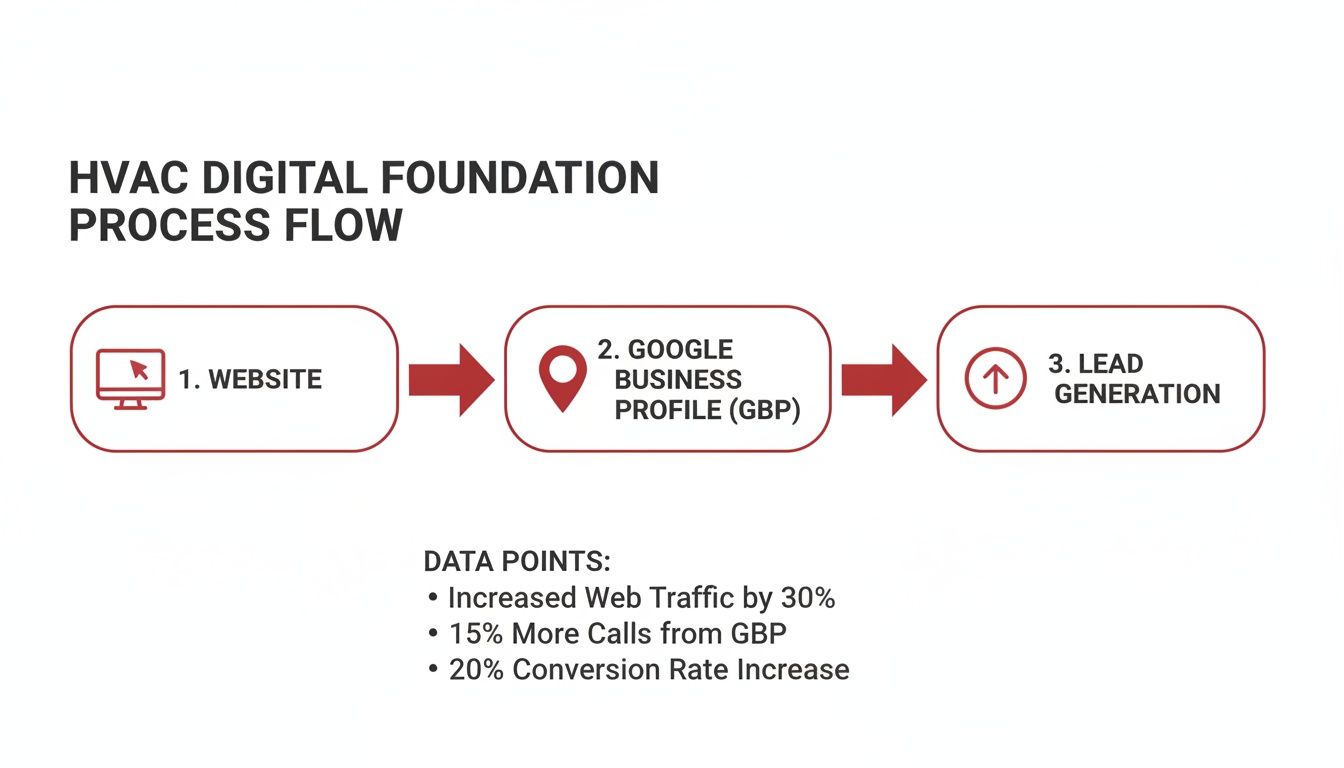
As you can see, they aren't separate channels. They're interconnected assets, and when they're both firing on all cylinders, you've built a foundation that will generate high-quality leads for years to come.
Dominating Local Search and Paid Advertising
Okay, with your HVAC website and Google Business Profile dialed in, it's time to get in front of homeowners with urgent problems. This is where you master local search and paid ads to create a steady stream of high-intent calls.
When someone's AC unit dies in the middle of a July heatwave, they aren't casually browsing. They're grabbing their phone and searching for an immediate fix. Your goal is to be the first, most trusted name they see.
To do that, you need a two-pronged attack: dominate the free, organic search results with smart HVAC SEO and strategically use paid ads to capture anyone who needs help right now.
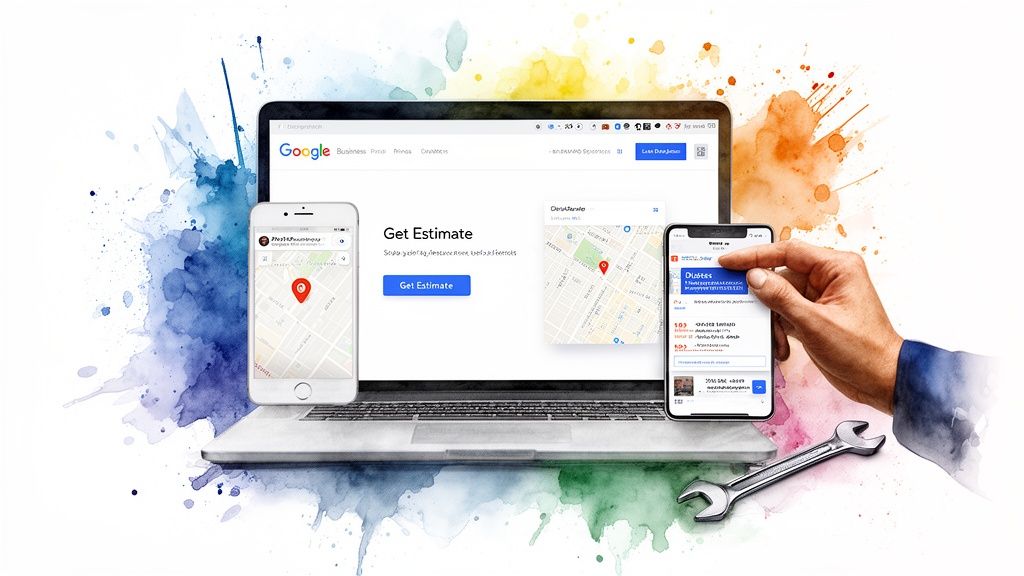
Unlocking Free Leads with HVAC SEO
HVAC Search Engine Optimization (SEO) is all about getting your website to show up in Google for the right searches. When you do it correctly, it's the single best way to get your phone to ring without paying for every single click.
The trick is to stop thinking about generic terms and focus on the exact phrases a panicked homeowner would type into Google. These are the money phrases that lead directly to booked jobs.
- Emergency Keywords: Think "24/7 AC repair [your city]" or "emergency furnace service near me."
- Replacement Keywords: Homeowners ready to spend big are searching for "new air conditioner cost [your city]" or "furnace installation quotes."
- Service-Specific Keywords: Don't forget the niche stuff like "ductless mini-split repair" or "heat pump maintenance."
By building out dedicated pages on your site for each of these services—and optimizing them for the specific towns and neighborhoods you serve—you're telling Google exactly what you do and where you do it. This local focus is absolutely critical for getting into that coveted map pack. Our guide on how to optimize your Google Business Profile is the perfect companion strategy here.
Navigating Google's Paid Advertising Platforms
SEO is a long-term play, but sometimes you just need to turn on the lead faucet today. That’s where paid advertising comes in, and for HVAC contractors, Google has two platforms that are pure gold.
First up is traditional Google Ads, what most people know as pay-per-click (PPC). You bid on specific keywords, and your text-based ad shows up right at the top of the search results. The beauty is you only pay when someone actually clicks your ad.
This platform gives you incredible control. You can target specific zip codes, set an exact daily budget, and write ad copy that hits a customer’s pain point head-on, like "Broken AC? Fast, Same-Day Repairs Available!"
The second option, and frankly the one we see getting the best results, is Google Local Services Ads (LSAs). These are the ads you see at the very top of Google, featuring your company name, star rating, and that all-important "Google Guaranteed" badge.
With Local Services Ads, you don't pay for clicks—you pay for qualified phone leads. This model is a game-changer because it directly ties your ad spend to actual customer inquiries, making your marketing budget more predictable and effective.
Getting that Google Guaranteed badge requires a background check, but the payoff is huge. It instantly builds trust with homeowners, telling them that Google itself has vetted you for quality and reliability.
Maximizing Your Paid Ad Spend
When you start running paid campaigns, you have to know your numbers or you'll burn cash. Forget about cost-per-click; the metric that really matters is Average Sale Per Lead (ASPL). This number tells you the true return on what you're spending.
For instance, simple repair leads might have a lower ASPL of $150-$300, but a high-value replacement lead can bring in $1,500-$3,000+. This is why 61% of marketers say lead generation is their biggest challenge—they aren't allocating their budget intelligently.
The savviest operators know that an exclusive lead from a platform like LSAs is worth its weight in gold. We have clients in hyper-competitive markets like Atlanta who are locking in $60 leads with a 55% booking rate. Those are the kinds of numbers that build empires, and they're infinitely more valuable than a bucket of cheap, shared leads from a lead-gen service.
Automating Follow-Up To Nurture Every Lead
Generating leads is only half the battle. The real money is made in the follow-up, but this is exactly where most HVAC companies drop the ball. Your team is busy and can't respond to every new web form or call the second it comes in.
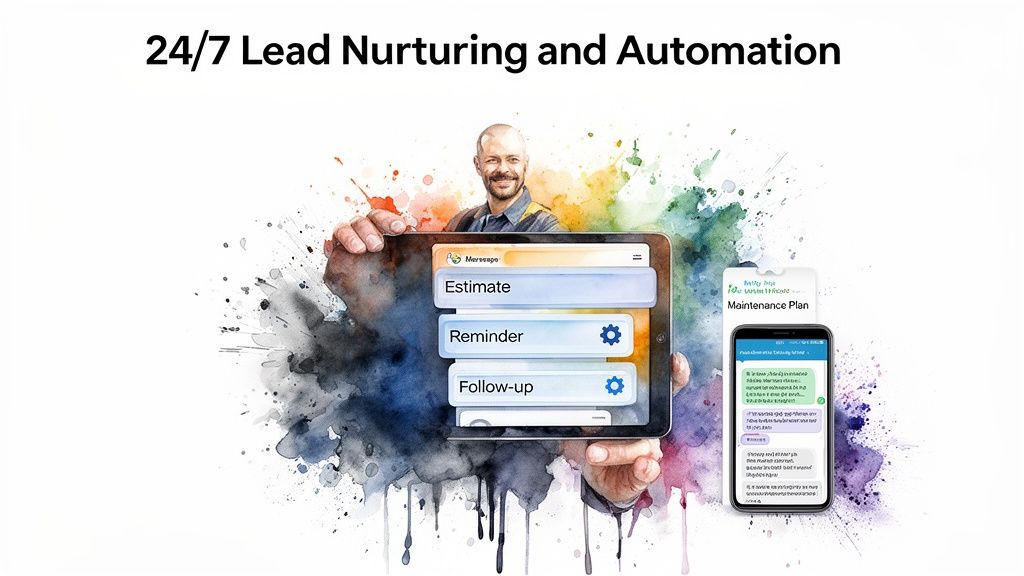
This is where marketing automation becomes your unfair advantage. Think of it as a digital sales assistant that works 24/7, engaging every single lead the moment they reach out so you never miss an opportunity. It ensures no lead ever falls through the cracks, which is key to turning your marketing spend into actual booked jobs.
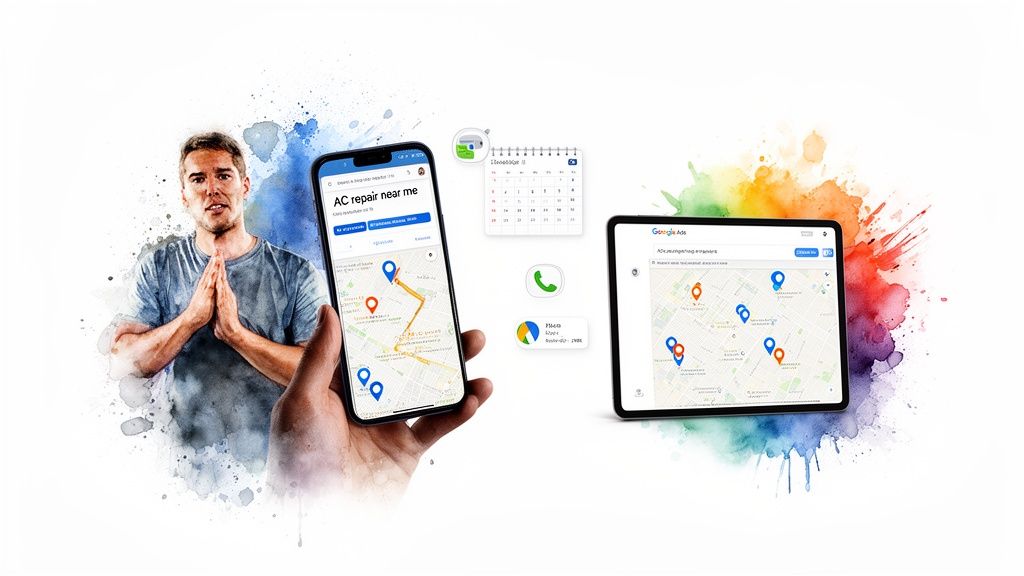
Why Speed Is Everything In HVAC Lead Conversion
In the HVAC world, speed to lead wins. It’s that simple. With 89% of homeowners researching companies online and mobile searches for "HVAC near me" exploding by 400%, your potential customers have endless choices.
Here's the problem: the average response time to a hot lead is a painful four hours. But the companies that respond in under five minutes? They are a staggering 100 times more likely to close the deal.
The takeaway is blunt: if you're not the first one to respond, you've likely already lost the job. Automation is what closes that gap.
A great way to do this is by adding a lead generation chatbot to your site. It can handle common questions, grab contact info, and even schedule appointments around the clock, meaning you're capturing leads even while you sleep.
Building Your Automated Follow-Up Sequences
Effective automation isn't about spamming people. It's about sending the right message at the right time. A homeowner asking for an emergency AC repair needs a totally different conversation than someone who downloaded your guide on furnace efficiency.
Here are a few essential automated campaigns every HVAC business should have running:
- New Lead Welcome Series: The instant someone fills out a form on your website, an automated email and text message should fire off. This immediately confirms you got their request, gives them an emergency number to call, and tells them when to expect a personal call from your team.
- Quote Follow-Up Nurture: After you send a quote for a big install, a series of automated emails can do the selling for you. These can highlight your financing options, share video testimonials from happy customers, and break down the benefits of the specific system you recommended.
- Seasonal Maintenance Reminders: Don’t wait for customers to remember their spring AC tune-up. An automated sequence can start in late winter, reminding them about preventive maintenance and giving them a simple link to book their appointment online.
- "We Miss You" Campaign: Have a list of customers you haven't heard from in over a year? An automated email with a special "welcome back" discount can reactivate those relationships and bring in surprise revenue.
To really see the difference, look at how an automated system stacks up against the typical, manual approach.
Lead Nurturing Automation Impact
| Metric | Manual Follow-Up (Industry Average) | Automated Follow-Up System |
|---|---|---|
| Response Time | 4-24 hours | < 5 minutes |
| Contact Attempts | 1-2 attempts | 5-7 attempts (email, SMS, call) |
| Lead Engagement | Low | High |
| Conversion Rate | 1-3% | 10-20% |
| Consistency | Inconsistent (depends on staff) | 100% consistent |
The numbers don't lie. Automation transforms your follow-up from a chore that sometimes gets done into a reliable system that consistently converts leads into jobs.
Automation changes the game. It turns your follow-up from a manual, inconsistent task into a reliable system. Every single lead gets prompt, professional communication, building trust and making you the company they remember when it's time to buy.
This systematic approach is how you maximize the return on every dollar you spend on marketing. For a deeper dive into setting these up, our guide on HVAC email automations gives you the exact templates and strategies to get started. By putting these systems in place, you build a powerful engine that nurtures relationships and drives sales long after that first click.
Unlocking Growth Through Partnerships and Referrals
While SEO and paid ads are the workhorses of digital marketing, some of your best, most profitable jobs will come from a place many HVAC businesses completely overlook: your own network.
When you build a real system for generating referrals and local partnerships, you create a self-sustaining engine. It feeds you high-trust, high-conversion jobs, often at a tiny fraction of the cost of traditional advertising. These leads aren't just warm; they're practically pre-sold on your quality before they even dial your number.
Forging Mutually Beneficial Local Partnerships
Here's a simple truth: your ideal customers are already doing business with other trusted pros in your area. Building genuine relationships with these non-competing companies lets you tap into a steady pipeline of qualified work.
Your marketing plan can benefit from strategic partnerships with businesses whose customers may need HVAC services.
- Real Estate Agents: New homeowners are a goldmine. They almost always need inspections, tune-ups, or full system replacements right after closing.
- Roofers and Plumbers: These trades often identify HVAC issues while on a job. Building a relationship with them can lead to direct referrals.
- General Contractors and Remodelers: A major kitchen reno or home addition almost always touches the HVAC system. These partnerships can lead to huge install jobs.
- Property Managers: A single property manager can be responsible for dozens or even hundreds of rental units, meaning a constant need for reliable maintenance and emergency repairs.
To make these relationships stick, you need a clear "what's in it for them?" offer. A straightforward referral fee or a reciprocal agreement where you send them business is a perfect start. The goal is to become the only HVAC contractor they think of calling.
A strong local referral network transforms you from a lone wolf hunting for leads into a collaborative community partner. Every connection you make essentially becomes a salesperson for your brand, vouching for your work and building trust on your behalf.
Designing a Referral Program Customers Actually Use
Your happiest customers are your single greatest marketing asset, but they're busy. They won't go out of their way to send you business unless you make it incredibly easy and rewarding for them. A structured referral program removes the guesswork and gives them a real reason to spread the word.
And it's worth it. Research shows a mere 5% increase in customer retention can boost profits by over 25%, and a killer referral program is one of the best retention tools you have.
The Must-Haves for a Successful Program
You don't need some overly complicated system. Just focus on these core pieces:
- Make the Incentive Worth It: A simple "thanks" isn't going to cut it. Offer a real reward that gets people's attention. Think a $50 service credit, a Visa gift card, or a cash bonus for a referral that turns into a full system replacement.
- Reward the New Customer, Too: This is the secret sauce. Make your current customer look like a hero by giving their friend a deal. Something like "$50 off your first repair" makes everyone feel like they won.
- Timing is Everything: The absolute best time to ask is right after a job is completed and the customer is happy. Mentioning the program at this peak moment of satisfaction can significantly increase participation.
- Keep it Stupid Simple: Don't make people jump through hoops. Give them physical referral cards they can hand out or a dead-simple page on your website to submit their friend's info. The less friction, the more referrals you'll get.
Measuring Marketing ROI to Eliminate Wasted Spend
Are your marketing dollars actually turning into profitable jobs? Too many HVAC owners treat their marketing budget like a guessing game, pouring money into ads and hoping for the best without knowing what’s truly working.
It’s time to stop the guesswork. You need a system that connects every dollar you spend directly to the revenue it brings in.
Measuring your Return on Investment (ROI) isn't just about counting clicks or form fills. It’s about getting a crystal-clear, data-driven picture of which channels—from your SEO efforts to your paid ads—are filling your schedule with high-value installation and repair jobs. This is how you confidently double down on what works and cut the campaigns that are just draining your bank account.
The Power of Call Tracking for HVAC
For an HVAC business, the phone is king. When a homeowner's AC quits in the middle of July, they don't patiently fill out a web form; they grab their phone and call the first reputable company they can find. If you aren't tracking where those calls are coming from, you're flying completely blind.
Call tracking software is non-negotiable for any serious HVAC marketing plan. It’s simple: the software assigns unique, trackable phone numbers to each of your marketing channels. You’ll have one number for your Google Business Profile, another for your Google Ads, and a third for your website's homepage.
This simple setup unlocks critical insights you can't get anywhere else:
- You see exactly which ads, keywords, or social media posts are making your phone ring.
- You can listen to recorded calls, which is an invaluable tool for training your CSRs on how to turn hesitant inquiries into firmly booked appointments.
- By connecting this data to your CRM, you can finally see which channels produce the highest-quality leads that actually turn into jobs.
Measuring your marketing isn't an expense; it's an investment in profitability. When you know that every dollar spent on a specific Google Ad campaign brings back seven dollars in revenue, you no longer have a marketing budget—you have a growth engine.
Moving From Lead Tracking to Full Revenue Attribution
Knowing which ad made the phone ring is a great start, but it's not the finish line. The real magic happens when you connect that initial lead all the way through to a closed job and a final invoice. This is called revenue attribution.
Picture this: A potential customer clicks on one of your Google Local Services Ads, calls the tracking number, and books a diagnostic. A week later, they approve a $7,000 system replacement. With proper revenue attribution, your system connects that $7,000 job all the way back to the specific LSA that started the entire conversation.
This level of clarity changes everything. It allows you to move beyond basic vanity metrics like Cost Per Lead (CPL) and focus on what truly matters—your Cost Per Sale (CPS). You might discover that your cheap Facebook leads rarely convert into profitable work, while your more expensive SEO leads consistently turn into high-ticket installations. That insight alone can completely reshape your entire marketing strategy.
Essential KPIs Every HVAC Owner Must Monitor
To get a real handle on your ROI, you need to track a few key performance indicators (KPIs). These numbers are the scorecard for your marketing's health, giving you the power to make smart, data-backed decisions.
- Cost Per Lead (CPL): Total campaign cost divided by the number of leads generated. This tells you how much you're paying just to get someone to raise their hand.
- Cost Per Sale (CPS): Also known as Customer Acquisition Cost (CAC), this is your total campaign cost divided by the number of actual sales. This is the single most important metric for determining profitability.
- Conversion Rate: The percentage of your leads that turn into paying customers. A low conversion rate can point to problems with your sales process, your pricing, or the quality of the leads themselves.
- Average Sale Per Lead (ASPL): This metric shows you the average revenue you generate from each lead source. It’s how you find out which channels are bringing in the big-ticket jobs.
Focusing on these metrics hammers home a critical point: exclusive, high-quality leads will always beat a high volume of cheap, shared leads. While shared leads might seem like a bargain at $15-$200, exclusive leads that cost $45-$300 convert at a much higher rate because you're the only contractor in the conversation.
This is vital in an industry set to hit $367 billion globally by 2030. As competition gets fiercer, the data is clear: one exclusive replacement lead is worth more than ten price-shopping leads from a shared service. If you want to learn more about how lead quality impacts your bottom line, you can get more insights on HVAC lead costs and strategies on wearetg.com. By tracking your marketing performance, you can identify and invest in the channels that deliver these high-value, exclusive opportunities.
Answering Your Top HVAC Lead Generation Questions
Even with the best playbook, real-world questions always pop up when you're in the trenches trying to generate more HVAC leads. We get it. This section cuts through the noise and gives you direct, no-fluff answers to the questions we hear most often from HVAC owners just like you.
What Is a Realistic Marketing Budget to Generate HVAC Leads?
Instead of getting hung up on a magic dollar amount, the smartest way to think about your budget is as a percentage of your revenue goals. A solid starting point for most HVAC companies is to earmark 5-10% of your target revenue for all your marketing efforts.
But the real number you need to obsess over is your Cost Per Sale (CPS). Think about it: if a profitable furnace install is worth $8,000, you’d probably be happy to spend up to $800 to land that job, right?
Start with a test budget on a channel you can measure easily, like Google Local Services Ads. Track your CPS like a hawk, and once you find what's profitable, you can scale up with confidence. An initial budget of $1,500-$3,000 a month is usually plenty to start gathering real data and seeing the calls come in.
Should I Buy HVAC Leads or Generate My Own?
This isn’t an either/or situation—a healthy growth strategy often involves a bit of both, but with a clear priority. Buying leads from aggregators can feel like a quick fix to fill a slow week, but it comes with a massive catch.
Those leads are almost always sold to you and four or five of your competitors simultaneously. This instantly creates a race to the bottom on price, and your close rates will plummet.
Generating your own exclusive leads through channels like HVAC SEO and your own website is how you build a long-term, predictable business. These leads have way higher intent because the customer actively searched for your company.
A lead you generate yourself is an asset you own forever. A lead you buy is just a rental. Prioritize building your own lead engine for sustainable growth, and only use purchased leads as a short-term patch when you absolutely have to.
How Long Does It Take for HVAC SEO to Start Generating Leads?
Let's be clear: HVAC SEO is a marathon, not a sprint. If you're aggressive with optimizing your Google Business Profile, you can definitely see some movement in the local map pack rankings within 60-90 days.
But for the big prize—consistent, page-one rankings for those high-value keywords like "AC replacement [your city]"—you need to be patient. It typically takes a solid 6-12 months of consistent work.
The reward for that patience is huge. The leads that come from strong organic rankings are incredibly qualified, and once you're established, they have no direct ad cost. That upfront investment of time and resources pays for itself over and over again.
What Is the Single Most Important Metric to Track?
So many owners get fixated on Cost Per Lead (CPL), but honestly, it can be a vanity metric. The single most important number for your business is your Cost Per Sale (CPS), sometimes called Customer Acquisition Cost (CAC).
Who cares what your CPL is if those leads never turn into paying customers? Your CPS tells you exactly how much marketing spend it takes to get a signed contract and cash in the bank.
For example, a campaign that brings in $40 leads looks great on the surface. But if it takes 10 of those leads to close one job, your CPS is $400. Another campaign might generate more expensive $150 leads, but if they are so qualified that you close one out of every two, your CPS is only $300. The "more expensive" leads are actually more profitable.
Focusing on CPS ensures every single marketing dollar you spend is directly tied to actual revenue.
Ready to stop guessing and start generating a predictable flow of profitable installation jobs? The HVAC Growth Machine is a complete, done-for-you system that combines a high-converting website, automated lead nurturing, and transparent ROI tracking. We build the digital assets you own, so you can dominate your local market without relying on shared, low-quality leads. Secure your exclusive service area and see how it works at https://hvacgrowthmachine.com.




Founder of HVAC Growth Machine