

Let's be honest, an effective website for your HVAC company is much more than a digital business card. It's a 24/7 sales engine built to attract qualified local homeowners and turn them into profitable installation jobs. It should be your most valuable and tireless salesperson, working around the clock to grow your company.
Why Your Website Should Be Your Best Salesperson
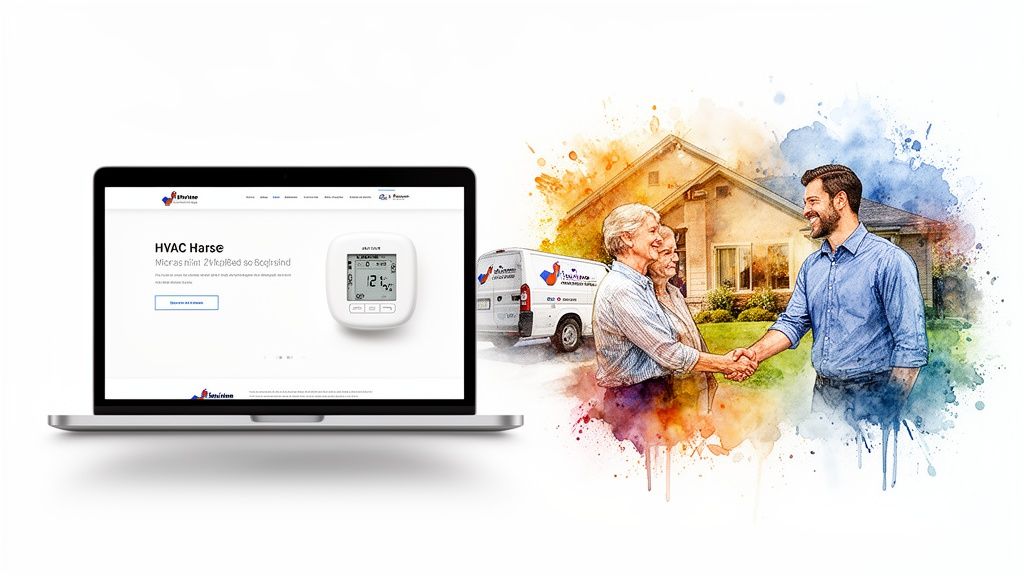
Too many HVAC businesses treat their website like a neglected storefront—it’s there, but it’s not actively pulling in customers. It might look professional enough, but it completely fails at generating a steady stream of high-value installation and replacement leads. This all-too-common mistake turns what should be a growth asset into a frustrating cost center.
Think of it this way: your old website is a passive brochure. A high-performance website, on the other hand, is an automated sales center. It works tirelessly, even while you're out on a job or after hours, to attract homeowners with broken AC units and qualify them before they even speak to your team.
This shift in thinking is what separates the companies that struggle from the ones that scale. A truly effective website is built on three core pillars designed to produce real, measurable results.
The Three Pillars of a High-Performance HVAC Website
A website that drives real business growth isn't about pretty pictures; it's a strategic tool focused on very specific outcomes. To turn your online presence into a profit-generating machine, your site must nail these three things:
- Attracting Qualified Local Leads: Your website has to show up when homeowners search for terms like "AC repair near me." This is all about smart, targeted HVAC SEO and a perfectly optimized Google Business Profile. Without visibility, nothing else matters.
- Converting Visitors into Booked Jobs: Once a potential customer lands on your site, the design must guide them to take action. This is where features like online booking, instant estimate tools, and crystal-clear calls-to-action come in to turn passive browsers into scheduled appointments.
- Proving Marketing ROI: You need to know exactly which marketing efforts are making the phone ring. A great website has call tracking and revenue attribution built-in, showing you which ads and pages are generating profitable jobs versus low-margin service calls.
A purpose-built HVAC website does more than just list your phone number. It’s a complete system designed to capture, nurture, and convert leads, giving you clear proof of its value to your bottom line.
By focusing on these core functions, your website transforms from a static online page into the central hub of all your marketing. It becomes the engine that powers your lead generation, fills your calendar, and gives you the data needed to make smarter business decisions. This is how you ensure your investment delivers a predictable return, turning your site into your company's most reliable asset.
The Old Brochure Website vs The New Growth Engine
The difference between an old-school website and a modern growth engine is night and day. One sits there and collects dust, while the other actively brings in revenue.
| Feature | Outdated 'Brochure' Website | High-Converting 'Growth Engine' Website |
|---|---|---|
| Primary Goal | Look professional, list services | Generate qualified leads & book jobs |
| Lead Capture | Basic "Contact Us" form | Instant quote tools, booking, strategic CTAs |
| Mobile Experience | Clunky, hard to use | Mobile-first, lightning-fast |
| SEO | Generic keywords, if any | Hyper-local SEO, Google Guaranteed ready |
| Tracking | None, or basic traffic data | Full revenue attribution, call tracking |
| eCommerce | Non-existent | Sells maintenance plans 24/7 |
| Follow-up | Manual, if it happens at all | Automated email & text sequences |
| Result | A cost center | A predictable profit center |
Seeing them side-by-side makes it pretty clear. The old way of thinking about a website just doesn't cut it anymore. To win in your local market, you need a site built from the ground up to be a true growth engine for your business.
The Blueprint for a High-Converting HVAC Website
A high-converting HVAC website isn't just a collection of pages. It’s a carefully engineered system designed to turn a stressed-out homeowner with a broken AC into your next booked job. Every single page has a job to do, working together to build trust, answer urgent questions, and guide visitors to the simple solution you provide.
Think of it like a well-organized toolbox. You wouldn't try to fix a complex furnace issue with just a single screwdriver, right? The same goes for your website. Trying to cram everything onto one page is just as inefficient and frustrating for the customer.
The real goal is to create a smooth path that anticipates what a potential customer needs and gives it to them, right when they need it.
Your Homepage: The Digital First Impression
Your homepage is your digital welcome mat. You have literally seconds to convince a visitor they’ve landed in the right place. They need to instantly understand who you are, what you do, and—most importantly—why they should trust you with their home.
This isn't the place for a long, boring company history or a bunch of technical jargon. The homepage's only job is to build immediate confidence with a few critical elements:
- A Clear Headline: Hit their pain point directly. Something like, "Fast & Reliable AC Repair for [Your City] Homeowners."
- Obvious Calls-to-Action (CTAs): Big, bold buttons like "Book Service Now" or "Get a Free Estimate" should be impossible to miss.
- Trust Signals: Your phone number, Google review rating, and any key badges (like the Google Guarantee) need to be "above the fold"—visible the second the page loads, no scrolling required.
This page sets the entire tone. Get it right, and you've earned their attention. Get it wrong, and they're gone.
Dedicated Service Pages That Win the Local Search Game
Posting a generic "Our Services" page is one of the single biggest mistakes we see HVAC companies make. Homeowners don't search for "HVAC services." They search for "AC repair in [City]" or "furnace installation near me." If you want to capture that high-intent traffic from Google, you need a dedicated page for every single service you offer.
Each service page should act like a specialized salesperson, totally focused on solving one specific problem. Your "AC Repair" page, for example, should talk about the exact issues people face—units blowing warm air, making weird noises, or refusing to turn on. This shows customers you get their problem, and it also tells Google exactly what search terms that page should rank for.
Every service you offer—emergency repairs, new system installs, indoor air quality, you name it—needs its own page. This strategy is a powerhouse for your local SEO and makes for a much clearer, more helpful experience for your customers.
For a deeper dive into structuring these pages for maximum SEO impact, check out our comprehensive guide on HVAC website design.
An About Us Page That Builds a Real Connection
Finally, your "About Us" page is where you get to be human. Remember, you’re asking people to invite your team into their homes. They want to know who they're dealing with. This page shouldn’t be a dry, corporate biography; it needs to tell your story.
This is your chance to build a real connection. Use photos of your actual technicians in uniform, not cheesy stock photos. Share a short version of why you started the business and what you stand for. That kind of transparency is a massive trust-builder that separates you from the faceless competition.
To take it a step further, load this page up with social proof. We've seen great results when our clients model their pages after these website testimonial page examples. When a potential customer sees real reviews right next to photos of your real team, their confidence in you skyrockets.
Turning Website Visitors Into Booked Appointments
A good-looking website is nice, but what really matters is whether it books jobs. A high-performance HVAC website is more than just a digital brochure; it’s a conversion machine, built with specific tools designed to turn casual browsers into paying customers. It anticipates what a homeowner needs and gives them an easy way to take the next step.
The difference between a website that just sits there and one that actively generates leads is massive. In the HVAC world, conversion rates tell the real story. Industry benchmarks show the average HVAC website converts at a measly 3.10%. The top performers? They’re hitting 15-30%.
Think about that. Out of every 100 visitors, a typical site gets less than three leads, while a truly optimized site gets 15 to 30. That’s a potential 5-10x multiplier in booked jobs right there.
This flowchart shows the ideal path a homeowner should take through your site, from the first click to the moment they decide to book.
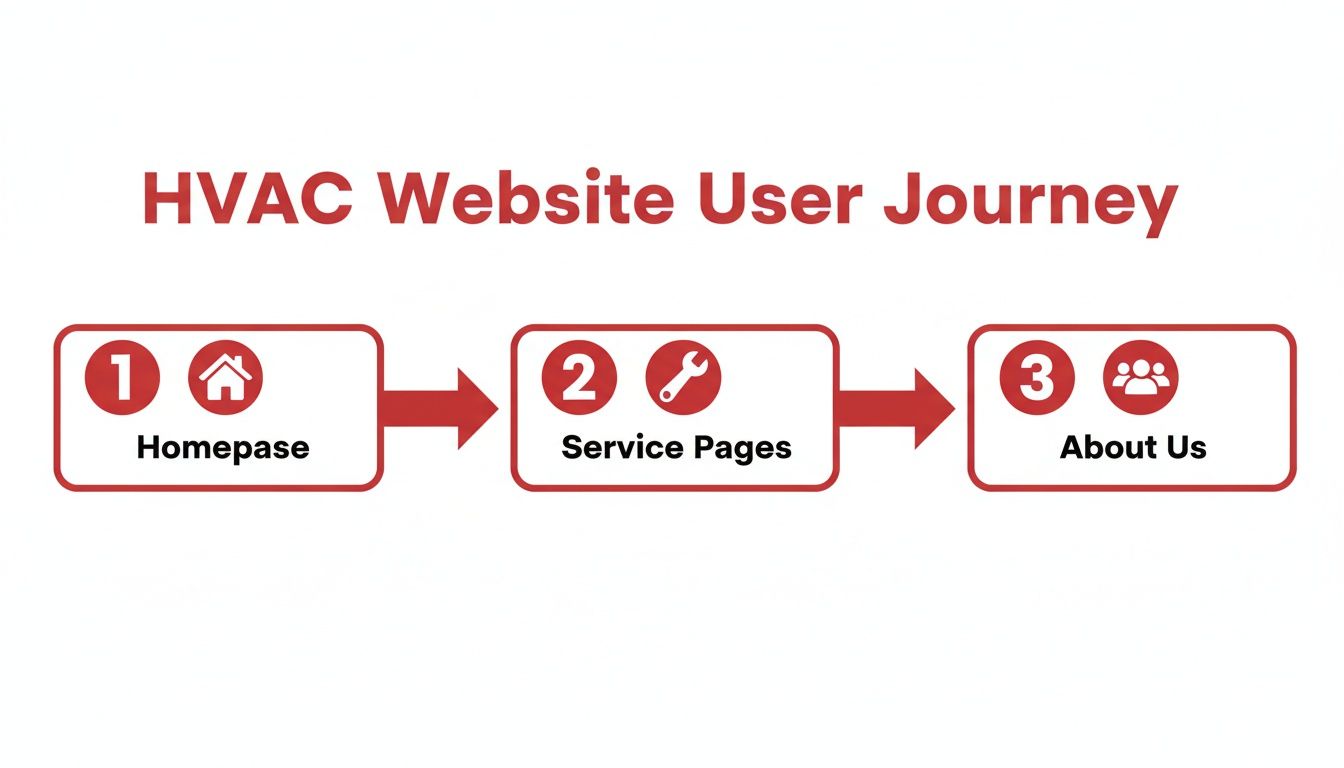
It’s a simple, logical journey from the homepage to the service pages and trust-builders that get them to pick up the phone.
Capture Leads Who Aren't Ready to Call
Plenty of homeowners land on your site just looking for information. They're not ready to call anyone yet. This is where an 'Instant Online Estimate' tool becomes your secret weapon. It offers them something valuable right away in exchange for their contact info.
Instead of letting that visitor click away, you capture their details at the peak of their interest. Now you have a qualified lead who’s shown they have a problem, even if they're still in the research phase. This single feature can dramatically increase your lead count by engaging people who would otherwise disappear.
Make Booking Effortless
For the visitors who are ready to book, the process needs to be dead simple. Every extra click or confusing step is a reason for them to leave and call your competitor. The best sites give customers multiple, obvious ways to get on the schedule.
- Prominent Click-to-Call Buttons: On a phone, your number should be a button that’s always visible at the top of the screen. No scrolling, no searching.
- Simple Booking Forms: Keep your forms short. All you need is a name, phone number, email, and a quick note about their problem. That's it.
- Strategic Chat Widgets: A chat box is a low-pressure way for someone to ask a quick question without having to commit to a full-blown phone call.
- Online Scheduling: To really seal the deal, you can integrate AI-powered scheduling tools like Calendly that let them book an appointment right on the spot.
The goal is to remove all friction. A customer should be able to schedule service in under a minute from any page on your site. When you make it that easy, conversion rates naturally climb.
Sell Maintenance Plans on Autopilot
Recurring revenue is the key to stable cash flow. Your website should be your best salesperson for maintenance plans, working 24/7 through a dedicated eCommerce function. This lets homeowners browse the benefits and sign up online, often right after they’ve had a repair and are thinking about their system’s future.
This turns a one-time repair customer into a long-term client, boosting their lifetime value to your business without any extra work from your team.
Nurture Every Lead with Automation
So, what happens after someone requests an estimate but doesn't book? This is where automated email sequences come in. Once a lead is in your system, a pre-written series of emails can follow up for you.
These emails can share helpful tips, answer common questions, and gently remind the prospect why they reached out in the first place. This nurturing process keeps your company top-of-mind and builds trust over time. When that homeowner is finally ready to pull the trigger, you're the one they'll call. This automated follow-up ensures no opportunity ever falls through the cracks.
How to Dominate Local Search and Google Maps
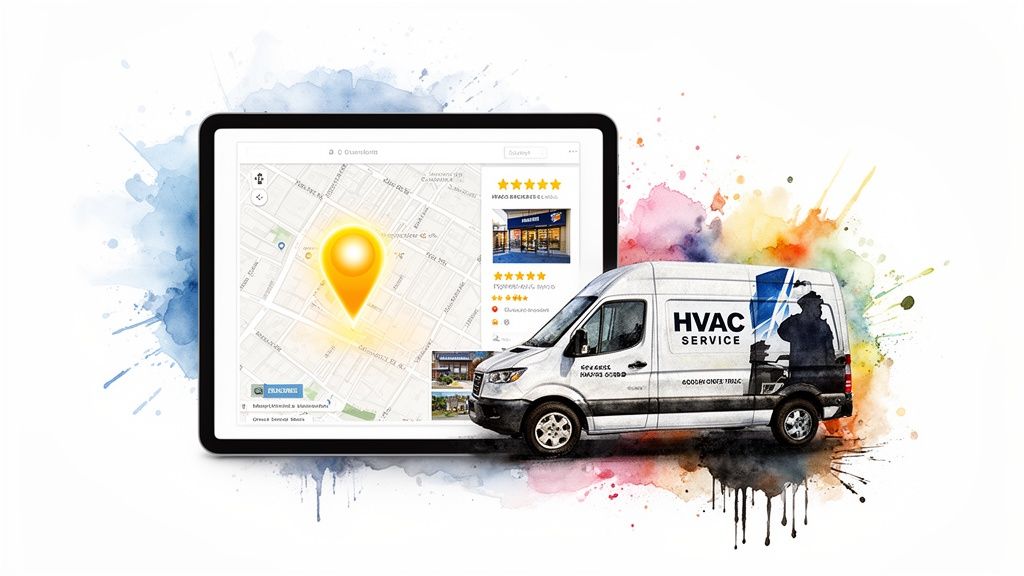
For an HVAC contractor, the game is won or lost at the local level. It's that simple.
When a homeowner's AC gives out on a 95-degree afternoon, they aren't flipping through a national directory. They’re grabbing their phone and frantically searching "emergency AC repair near me." That search almost always ends on Google Maps, which makes getting into that coveted 3-pack at the top of the results completely non-negotiable.
This is where your digital presence slams right into your physical service area. Your website is the engine, but your Google Business Profile (GBP) is the big, flashing billboard on the digital highway that tells customers where to turn. If that billboard is dim, outdated, or just plain missing, you're invisible to almost every customer who's ready to buy right now.
A high-performing website is deeply tied to your local search performance. Google doesn't see your website and your GBP as two separate things anymore. It sees them as one unified signal of your authority, your trustworthiness, and your relevance to a local homeowner in crisis.
Your Google Business Profile: The Digital Storefront
Think of your Google Business Profile listing as the front door to your business online. For most people, it's the very first interaction they'll have with your brand. A neglected profile is like a storefront with a flickering sign and peeling paint—it just doesn't inspire confidence.
To really own local search, you have to treat your GBP with the same seriousness as your top technician. It needs consistent attention and fine-tuning. For a complete deep-dive, check out our guide on how to optimize your Google Business Profile.
The foundation of a strong profile comes down to a few core principles that scream to Google that you are a legitimate, active, and trusted local business. These are the absolute table stakes for even getting a sniff of the map pack.
- Consistent NAP (Name, Address, Phone): This data has to be 100% identical across your website, your GBP, and any other online directory. A tiny variation like "St." versus "Street" can confuse the algorithm and tank your rankings.
- A Flood of Positive Reviews: Google's algorithm loves businesses with a steady stream of recent, positive reviews. This is the single most powerful social proof you have. You need a system to consistently ask for reviews after every single service call.
- Geo-Tagged Photos and Videos: Get in the habit of regularly uploading high-quality photos of your team in action, your branded vans, and your completed installs. When you tag these images with location data, it reinforces your service area and proves you’re a real, active business out in the community.
Earning the Google Guarantee Badge
Beyond just having a solid profile, the Google Guarantee badge is a total game-changer. It's that little green checkmark of trust that tells customers Google has vetted your business and backs your work. This badge shows up on Local Services Ads, which often appear at the very top of the search results—above the map pack and everything else.
Earning the Google Guarantee means passing a background check and showing proof of your license and insurance. It takes a bit of effort, but the instant credibility it gives you makes it one of the most powerful conversion tools an HVAC business can have.
That badge can seriously increase click-through rates because it removes a huge amount of risk for the homeowner. It’s a clear signal that you're a pro.
How Your Website Fuels Your Map Pack Ranking
Your website's performance is directly tied to your ability to rank in Google Maps. Google's algorithm is smart; it crawls your site to verify the info on your GBP and to figure out how much of an authority you are on HVAC topics in your service area.
This is exactly why having a well-built site is so critical. Proximity and review velocity are now huge factors in who wins the map pack, but your website is the foundation that supports it all. Local searches drive a staggering 80% of HVAC conversions, and with queries like "hvac near me" getting 63,000 monthly searches in the U.S. alone, you can't afford to be invisible.
Ultimately, your website and your Google Business Profile have to work together. A fast, mobile-friendly site packed with detailed, location-specific service pages sends powerful signals to Google that you are the authority in your town. That's what pushes you to the top of the map, right where the real customers are looking.
Measuring What Matters to Prove Your Marketing ROI
Your website might be getting thousands of visitors, but if you can't connect those clicks to actual, paying jobs, you're just guessing with your marketing budget. It's time to stop chasing vanity metrics like "impressions" and start measuring what actually hits your bottom line. Any website design for HVAC worth its salt has to include the tools to prove its own value.
This is where analytics and revenue attribution come in. They’re what turn your website from a business expense into a predictable profit center. Suddenly, you get a clear, data-backed picture of what's working and what isn't, finally answering the most important question: "Which of my marketing efforts are actually making the phone ring with high-value jobs?"
Pinpointing Your Best Leads with Call Tracking
A ton of HVAC leads still come through a good old-fashioned phone call. The problem is, most owners have no idea which ad, webpage, or marketing campaign made that person pick up the phone. This is a massive blind spot that leads directly to wasted ad spend.
Detailed call tracking plugs that hole. By assigning unique, trackable phone numbers to each of your marketing channels—your Google Business Profile, your paid ads, your website's service pages—you can see exactly which sources are driving calls.
This technology lets you trace a specific phone call directly back to the customer's journey. You'll know if they called after seeing your "AC Installation" page or after clicking on a specific Google Local Services Ad.
This insight is incredibly powerful. You're no longer in the dark about where your best, most motivated leads are coming from.
Connecting Marketing Efforts to Actual Revenue
Knowing where your calls come from is step one. The real magic happens when you connect those calls to real, tangible revenue in your bank account. This is called revenue attribution, and it’s the key to making smart marketing investments instead of just spending money.
The process tracks a lead from its very first click all the way through to a closed job. For example, you can see that a call from a Google Ad for "furnace replacement" led to a $9,500 installation. At the same time, you might discover that calls from another campaign are only producing $250 service calls.
This level of detail gives you the confidence to make critical decisions. You can double down on the campaigns bringing in profitable installation jobs and slash the budget for the ones that only attract low-margin work.
This data-driven approach completely changes how you see your marketing. It’s no longer about spending money and hoping for the best. Instead, it becomes a clear, predictable system for growth built on a few key principles:
- Identify High-Value Channels: Pinpoint the exact marketing activities that deliver your most profitable customers.
- Eliminate Wasteful Spending: Stop pouring money into ads and campaigns that don’t produce a positive return.
- Optimize for Profitability: Tweak your website and ad copy to attract more of the high-ticket jobs you really want.
When you put these measurement tools in place, your HVAC website becomes the central hub for all your marketing intelligence, proving its ROI and lighting the path to scalable growth.
How to Choose the Right HVAC Website Partner
Picking the right company to build your HVAC website is a massive business decision, not just a tech task you check off a list. You’re not just buying a website; you’re hiring a growth partner. Their job is to make your phone ring and fill your schedule with profitable jobs, not just hand over a pretty design.
You need a team that gets the home services world. A generic web designer might build something that looks nice, but they won't understand the psychology of a panicked homeowner whose furnace just died in the middle of winter. A true partner builds systems that turn that panic into a booked appointment on your calendar.
Key Questions to Ask Any Potential Partner
Before you even think about signing a contract, you need to grill any potential partner on a few critical points. Their answers will tell you everything you need to know about where their priorities lie.
- Do you specialize in home services or HVAC? You want someone who already knows what works for contractors. An industry specialist saves you the time and money of being their guinea pig.
- How do you measure success? If they start talking about traffic, clicks, and impressions, run. The only metrics that matter are qualified leads, booked jobs, and revenue. Their answer should be all about your bottom line.
- What lead-generation features are built-in? Look for them to mention things like online booking, instant estimate tools, and an easy way for customers to buy maintenance plans right from the site. These aren't bells and whistles; they're essentials.
- Do you provide call tracking and revenue attribution? This is non-negotiable. You have to be able to see exactly which marketing dollars are bringing in your best jobs. Without it, you're just guessing.
Red Flags to Watch Out For
Knowing what to avoid is just as important as knowing what to look for. Some common practices are dead giveaways that a vendor cares more about their own cash flow than yours.
- Long-Term Contracts: A partner who is confident in their ability to get you results won't need to lock you into a 12-month contract. Month-to-month agreements mean they have to earn your business every single month.
- A "One-Size-Fits-All" Pitch: If their proposal feels like a template they could send to another HVAC company or even a different trade, walk away. Your business has unique challenges, and their plan should reflect that.
- Obsessed with Flashy Design Over Function: The game has changed. Website design for HVAC is no longer about winning art awards; it's about building a conversion machine. Modern sites are built for speed and performance. Core Web Vitals, for example, are huge conversion multipliers. Sites with 'good' scores see an 8-15% bump in local search visibility, while a slow site can kill your conversion rate by over 3x. Get more details on the future of home service websites.
The right partner doesn’t just build you a website—they deliver an all-in-one system designed for measurable growth. They should feel like an extension of your own team, obsessed with filling your calendar and making you money.
Choosing your website partner is a major investment. By asking these tough questions and keeping an eye out for these red flags, you can find a team that will turn your website into your single most powerful sales tool.
Got Questions? We've Got Answers.
Jumping into a new website project can feel like a lot. How much will it cost? How long will it take? Where should I spend my marketing dollars? It's easy to get bogged down in the details.
We hear these questions all the time from HVAC owners just like you. Here are some straightforward answers to help you make the right call for your business.
How Much Should a High-Performing HVAC Website Cost?
You'll see prices all over the map, from a couple thousand for a generic template to tens of thousands for a completely custom build from a big agency. But honestly, the upfront price is the wrong thing to focus on. The only question that matters is: what's the return on investment?
A true performance-focused website is a system, not just a digital brochure. Look for a model that includes a setup fee and a manageable monthly subscription. This ensures the site is built from the ground up to pay for itself by bringing in profitable installation jobs, not just vanity traffic. You want transparent pricing that bundles in all the critical conversion tools, secure hosting, and real human support, without trapping you in a long-term contract.
How Long Does It Take to Launch a New HVAC Website?
A traditional custom website build can easily drag on for three to six months. That's a huge amount of time—and a ton of lost revenue—especially if your current site is broken or bleeding leads every single day.
The good news? It doesn't have to take that long. A system built on a proven, HVAC-specific framework can be customized with your company's branding and launched in as little as 7-10 business days. Find a partner who has a streamlined process specifically for the trades.
Should I Focus on SEO or Paid Ads for My HVAC Website?
This is the classic marketing question, but it’s not an either/or choice. The real answer is both, and your website is the engine that makes them both work.
Think of it this way: a solid local SEO strategy is like building a valuable asset over time. It generates a steady flow of high-quality, "free" organic leads that will pay dividends for years.
Paid advertising, like Google Local Services Ads, is your immediate lead flow. It’s like turning on a faucet to fill your calendar right now. Your website’s job is to convert visitors from both sources into paying customers. A great site maximizes the return on your time (SEO) and your money (paid ads), making them an unstoppable combination.
Ready to turn your website from a sunk cost into your single best salesperson? HVAC Growth Machine is a complete, done-for-you system engineered to generate profitable install jobs, not just clicks. We’ll replace your underperforming site with a conversion powerhouse that comes standard with an instant estimate tool, online maintenance plan sales, and full revenue attribution.




Founder of HVAC Growth Machine