

When we talk about SEO for HVAC contractors, we're not just talking about getting your website to show up on Google. We're talking about a strategy that puts your company front and center when a homeowner has an urgent, expensive problem—like a busted AC in the middle of July.
It's about making your business the obvious choice for local searches like "ac repair near me" or "new furnace cost." This isn't a technical checklist; it's a direct line to more traffic, more qualified leads, and more profitable installation jobs.
Why SEO Is Your Most Valuable Sales Tool

It’s time to stop thinking of SEO as some IT task and see it for what it really is: your most powerful engine for generating high-value installation jobs.
The days of leaning on traditional advertising are long gone. Today, your ideal customer—whether they're staring at a dead furnace in January or sweating through a heatwave—grabs their phone and searches Google for an immediate fix.
This isn't just a trend; it's a fundamental shift in how people find and hire contractors. Being visible at that exact moment of need is the difference between booking a profitable install and losing it to the competitor who ranks just one spot higher.
From Digital Presence to Profitable Growth
Having a website isn't enough. You need to own the search results that matter in your service area. This means showing up in the Google Maps pack and on the first page for the money-making local searches. The line between that visibility and your bottom line is straight and clear.
When SEO is done right, a potential customer's search ends with them finding you. It’s a combination of key digital marketing pieces working together to build trust and get them to pick up the phone:
- Targeting High-Intent Keywords: You're not just going after any traffic. You're focusing on terms like "new furnace installation [Your City]" that attract homeowners who are ready to make a serious investment.
- Dominating Local Search: A fully-optimized Google Business Profile puts your company on the map—literally. It makes you the go-to choice for all those "near me" searches.
- Building Trust with Reviews: A constant flow of new, positive reviews is the most powerful social proof you have. It tells prospects you're the right contractor for the job before they even click on your site.
The core of SEO for HVAC contractors is simple: Be the first and best answer when a local homeowner has an urgent problem. This strategy transforms your website from a passive online brochure into an active, 24/7 lead-generating machine.
The Real Impact on Booked Installs
The numbers don't lie. Local search is what drives demand in the HVAC world, and roughly half of all "near me" searches result in someone making contact within 24 hours.
While the average industry website might convert organic visitors at a measly 3.1%, we've seen top-performing HVAC sites with optimized landing pages hit conversion rates between 15–30%. Think about that. A properly executed SEO strategy can multiply your booked leads by 5-10x.
For a deeper dive, check out our guide on the benefits of local SEO for HVAC contractors. This isn't about making small tweaks; it's about fundamentally changing how you acquire your most profitable install jobs.
Dominating the Map with Your Google Business Profile
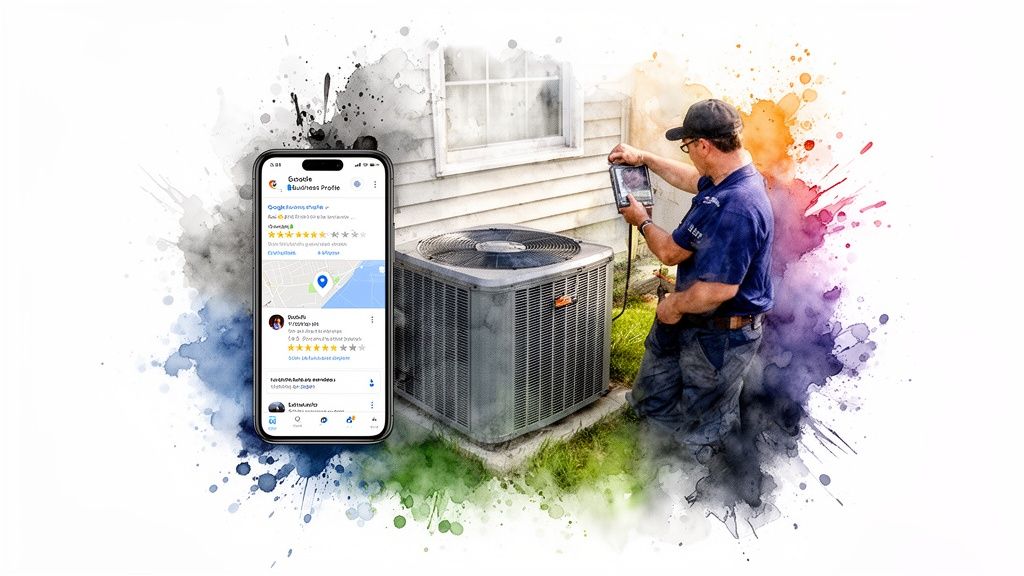
Your Google Business Profile (GBP) is way more than just a listing. Think of it as your digital storefront—it's the first thing a local customer sees. When a homeowner's AC gives out in the middle of July, their frantic search for "emergency AC repair near me" lands them right on the Google Map Pack.
Getting into that top-three block isn't about luck. It's about a smart, deliberate optimization strategy. For any HVAC contractor, a well-managed GBP is the single most powerful tool for local SEO. It's what turns a desperate search into a phone call and a booked install.
Getting the Foundation Right
Nailing the basics is non-negotiable. This isn’t just about filling in your company name and address; it’s about sending Google all the right signals that you're the best solution for a homeowner's problem right now.
Start with your service categories. Your primary category has to be "HVAC contractor." But don't just stop there. Add secondary categories that cover everything you do, like "Air conditioning repair service" and "Heating contractor." This helps Google match you with people searching for those specific services.
Next, write a business description that speaks to both customers and search engines. Forget keyword stuffing. Instead, talk about the problems you solve. Say you provide "reliable furnace installation in [Your City]" or "24/7 emergency air conditioner repair." It speaks directly to a homeowner’s needs while reinforcing your local authority.
A fully optimized Google Business Profile is your #1 local billboard. It’s where you prove your expertise, build instant trust with reviews, and make it dead simple for a customer to call you the second they need help.
Keep It Active to Keep the Leads Coming
A "set it and forget it" mindset is a surefire way to fall behind your competition. Google loves to see activity because it signals that your business is open, engaged, and relevant. Two of the best ways to show this are Google Posts and photos.
Google Posts are like free mini-ads that show up right on your profile. Get in the habit of posting at least once a week.
- Promote seasonal deals like a "Spring AC Tune-Up Special."
- Announce you have 24/7 emergency service during a heatwave.
- Share links to your latest blog posts, like "5 Signs Your Furnace Needs Replacing."
- Showcase a recently completed install.
Likewise, consistently adding new photos keeps your profile from getting stale and builds serious trust. Upload high-quality, geotagged pictures of your team in uniform and your branded vans on a job site. These visuals are proof that you're a real, active local business.
Want to turn your profile into a lead-generating machine? Check out our complete guide on how to optimize your Google Business Profile.
To help you get everything dialed in, here’s a quick-reference checklist covering the most important pieces of a fully optimized profile.
Google Business Profile Optimization Checklist
This table breaks down the key elements you need to focus on to maximize your local visibility and get more calls from homeowners in your area.
| Element | Optimization Tactic | Impact on Ranking |
|---|---|---|
| Primary Category | Set to "HVAC contractor". | Very High |
| Secondary Categories | Add all relevant services (AC repair, Furnace repair, etc.). | High |
| Service Area | Define by specific cities, zip codes, or counties you serve. | High |
| Business Description | Write a customer-focused description with local keywords. | Medium |
| Services | List every single service you offer with detailed descriptions. | Medium |
| Photos & Videos | Add new, geotagged images weekly (team, vans, jobs). | High |
| Google Posts | Publish updates, offers, and events at least once per week. | Medium |
| Customer Reviews | Consistently generate new reviews and respond to every single one. | Very High |
| Q&A Section | Proactively add and answer common customer questions. | Medium |
| Products | Showcase specific systems you install (e.g., "Trane XV20i"). | Low |
| Booking Link | Add a direct link to your online scheduling tool. | Low |
By systematically working through this checklist, you're not just filling out a profile; you're building a powerful asset that directly contributes to getting your phone to ring.
Define Your Turf and Build Unshakeable Trust
It’s crucial to tell Google exactly where you work. Go into your GBP settings and define your service area by listing the specific cities, zip codes, or counties you cover. This is what helps you show up for those valuable "near me" searches, making sure the leads you get are from neighborhoods you actually want to work in.
Finally, you need a rock-solid plan for getting customer reviews. Reviews are a massive ranking factor and the ultimate form of social proof. A steady stream of new, positive reviews tells both Google and potential customers you’re the real deal. Make sure you respond to every single review—good or bad. It shows you care about customer feedback and are committed to doing great work. This makes your business the obvious choice.
Building a High-Converting HVAC Website
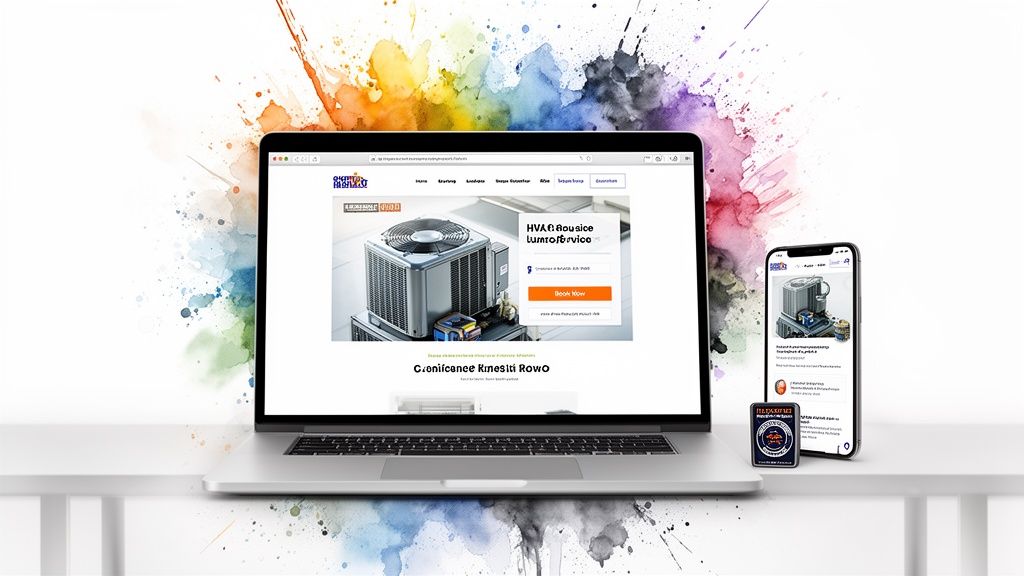
Let's get one thing straight: your website isn't an online business card. It needs to be your hardest-working salesperson, pulling in leads 24/7. A high-converting HVAC website has one job: turning a visitor with a problem into a booked installation job. Every single element, from the layout to the words on the page, has to guide that homeowner toward picking up the phone and calling you.
The whole thing starts with a mobile-first design. That's not just a buzzword. With over 60% of local searches happening on a phone, your site has to be perfect on a small screen. If a homeowner with a busted furnace has to pinch and zoom just to find your number, they’re gone. They’ll just call the next guy on the list.
And it has to be fast. A slow website is a lead killer, plain and simple. Every second a potential customer waits for your page to load, the odds of them clicking the 'back' button go way up. You need to be aiming for load times under three seconds, or you’re just throwing away perfectly good leads.
The Anatomy of a Lead Generation Machine
A website that actually drives SEO for HVAC contractors isn't just a homepage and a contact form. It’s built with a very specific structure in mind—one that creates a clear path for both Google and your potential customers to find exactly what they need.
This means you need dedicated pages for every service you offer and every single town you serve. Generic "services" pages just don't cut it anymore and won't rank for anything meaningful. Instead, you need laser-focused pages like these:
- 'Furnace Repair in [Your City]': This page needs to talk all about your furnace repair services, common problems, and why someone in that city should trust you with the job.
- 'Ductless AC Installation [Your City]': Here, you'll want to focus on the benefits of going ductless, your installation process, and testimonials from local customers.
- 'Emergency HVAC Service [Your City]': This one is all about speed. You need to highlight your 24/7 availability and quick response times, because that’s the only thing someone in a crisis cares about.
These hyper-local service pages are non-negotiable if you want to dominate your service area. They signal to Google that you are the go-to authority for a specific service in a specific location, which is exactly what you need to show up when it counts.
Your website's only job is to make it incredibly easy for a stressed-out homeowner to trust you and book a call. Big, obvious call-to-action buttons, clear service pages, and trust signals like customer reviews are the tools that get it done.
Turning Clicks into Customers with Conversion Boosters
Getting traffic is only half the battle. The real magic happens when you turn those visitors into actual, qualified leads. This is where you move your website from being a passive brochure to an active sales tool.
One of the single most powerful things you can add is an instant online estimate tool. A lot of homeowners hate calling because they're afraid of a high-pressure sales pitch or they just don't know what to expect on price. An online estimator gets rid of that friction. It lets them get a ballpark number on their own terms, which can massively increase your lead volume from visitors who weren't quite ready to make a call.
The difference these kinds of optimizations make is staggering. Your average, run-of-the-mill HVAC site might convert at a dismal 2-5%. But we've seen top-performing sites, optimized with mobile-first design and tools like online estimators, hit conversion rates of 15-30%. That's a potential 5x increase in leads from the exact same amount of traffic.
Automated follow-up emails are another game-changer. When someone uses your estimate tool or fills out a form, a pre-written email sequence can send them helpful info, build more trust, and keep your company top-of-mind until they're ready to pull the trigger. It’s a simple system that makes sure no lead ever falls through the cracks.
For a deeper dive into building a site that actually converts, our guide on effective HVAC web design covers all of these principles in much more detail.
Combining Paid Ads with SEO for Faster Growth
Look, a rock-solid SEO strategy is the foundation for long-term, profitable growth. No question. But it’s not a light switch. Ranking organically takes time, patience, and a whole lot of consistent effort. So what do you do when you need to book high-ticket install jobs right now?
That’s where paid advertising comes in. Think of SEO and paid ads (like Google Ads) as a one-two punch. They aren't competing; they're working together to help you completely dominate your market.
Paid ads get you instant visibility at the very top of the search results, right in front of homeowners actively searching for a contractor. This immediate traffic is the bridge you need while your organic rankings are climbing, making sure your phone keeps ringing and your install calendar stays full.
Capture High-Intent Leads Immediately
The single biggest advantage of paid search is its speed. You can launch a campaign this morning and, by this afternoon, be in front of customers typing in "new AC unit installation cost" or "emergency furnace replacement near me." While SEO is building your brand's authority over months, paid ads put you in the game today.
This is especially powerful for targeting your most profitable services. You can get laser-focused, creating campaigns specifically for system replacements, which have a much higher ticket value than a simple service call.
For HVAC contractors, there are two platforms that matter most:
- Google Ads (PPC): These are the classic text ads you see crowning the search results. You bid on keywords and pay when someone clicks. It gives you incredible control over who you target and what message they see.
- Local Services Ads (LSAs): You've seen these. They're the "Google Guaranteed" ads that appear even above the regular PPC ads. The best part? You pay per lead (a phone call or message), not per click, which often makes it a smarter, more cost-effective way to get qualified homeowners on the phone.
Here’s a simple way to think about it: SEO is like buying a valuable piece of real estate that grows in value over time. Paid ads are like renting a massive billboard on the busiest highway in town—you get instant, massive exposure. You need both to win.
Making the Numbers Work in Your Favor
At first glance, paid advertising can look like a money pit. And if you do it wrong, it absolutely can be.
Paid search CPCs (cost-per-click) for HVAC keywords often average around $29, and the industry cost-per-lead (CPL) can hover near $153. But here's the number that really matters: the customer lifetime value (CLV) for a typical HVAC customer is a whopping $15,340. Suddenly, that CPL doesn't look so scary.
This is where all your hard work on SEO starts to directly fuel your ad profitability.
Those high-converting, service-specific landing pages you built for your SEO strategy? They are the perfect destination to send your ad traffic. A well-built page with clear calls-to-action, trust-building reviews, and an instant estimate tool can skyrocket your ad conversion rates.
Let's look at a real-world scenario. Say you spend $10,000 on ads and send that traffic to a generic homepage that gets a 3.1% conversion rate. That might only get you 11 leads at an insane CPL of $909. You're barely breaking even, if that.
But, if you direct that same exact traffic to a highly-optimized landing page that achieves a 15% conversion rate, you'd generate 52 leads and slash your CPL down to just $192. That's the difference between a failing ad campaign and a high-margin growth engine for your business.
To really dig into the synergy between paid ads and SEO, you can get a deeper analysis on HVAC Services: PPC vs. SEO. The bottom line is that a combined strategy lets you own the search results from top to bottom, capturing leads today with paid ads while you build an unstoppable machine for free, organic leads tomorrow.
Your First 90 Days of HVAC SEO
Having a playbook is one thing, but running the plays is what separates the HVAC contractors who dominate their market from those who are just hoping the phone rings. This 90-day roadmap is designed to get your SEO strategy off the ground with clear, manageable steps. We're going to break it down to prevent overwhelm and build real momentum week by week.
First, let's be clear about what we're building. Paid ads get you leads today. SEO builds an asset that gets you leads for years.
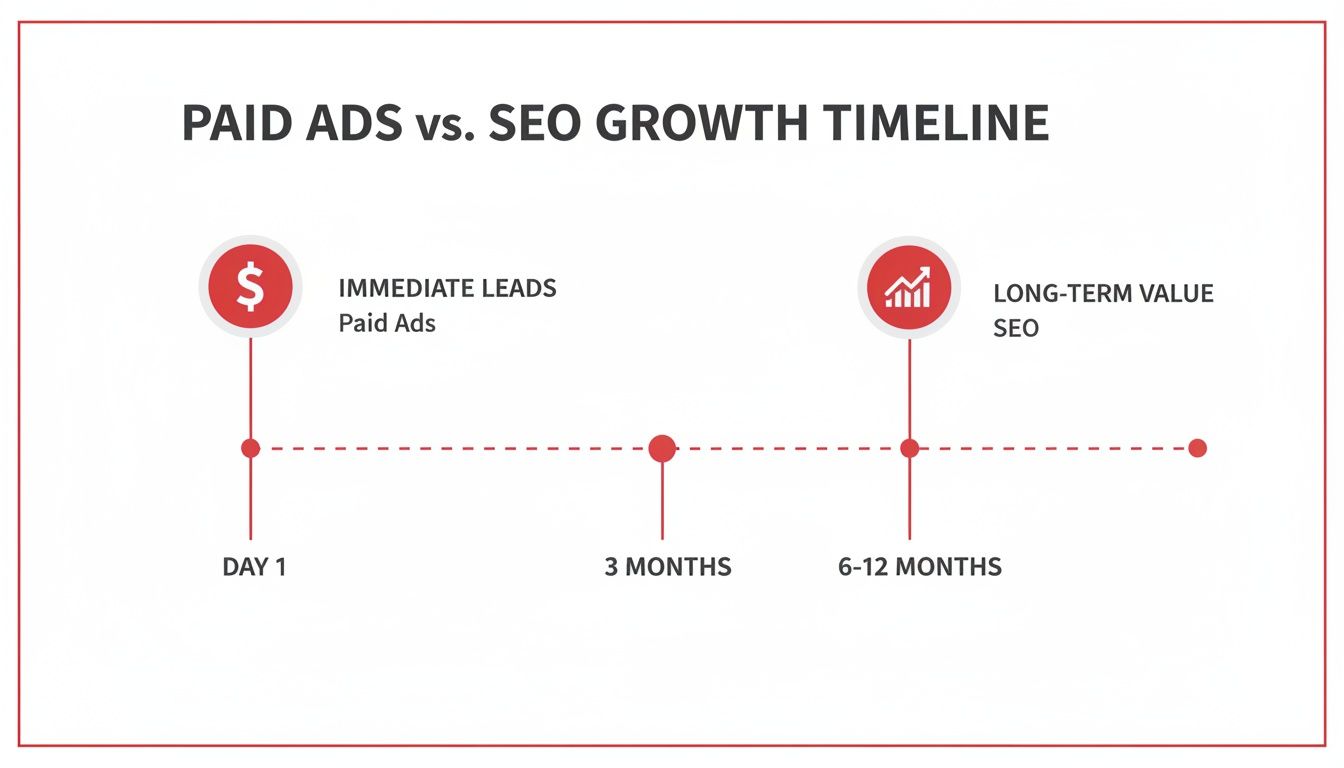
Think of paid ads as renting a billboard—it works as long as you pay. SEO is like buying the billboard. It’s a long-term asset that keeps generating free, high-quality leads long after the initial work is done. You need both, but only one builds lasting value.
Month 1: The Foundation
The first 30 days are all about pouring the concrete. If you build your marketing on a shaky foundation, everything you do later—content, ads, you name it—is going to crumble. The goal here is simple: fix what's broken, claim your digital storefront, and install the tools that tell you what’s actually making you money.
A huge piece of this is knowing who you're up against. Using AI competitor analysis tools can give you a massive shortcut, showing you what your top rivals are doing right so you can do it better. This initial recon work will drive your keyword and content strategy for months.
Here’s your action plan for Month 1:
- Week 1: Site Audit. Get under the hood of your website. Use a tool like Screaming Frog or Ahrefs to run a full technical SEO audit. Your mission is to find and kill critical errors like broken links, missing title tags, and pages that load slower than molasses.
- Week 2: Google Business Profile Overhaul. This is your new storefront. Fill out 100% of your GBP profile. That means every service category, a detailed business description packed with keywords, and at least 10 high-quality, geotagged photos of your team and your trucks.
- Week 3: Get Your Tracking Straight. Install Google Analytics 4 and set up conversion tracking for every lead source—phone calls and form fills. You can't improve what you don't measure. Then, connect your site to Google Search Console to see exactly what keywords people are using to find you.
- Week 4: Initial Keyword Research. Don't boil the ocean. Identify your top 10 "money" keywords. These are the high-intent, location-specific phrases that signal a customer is ready to buy, like "furnace replacement in [Your City]" or "emergency AC repair [Your Town]."
Your first month isn’t about seeing a huge spike in leads. It’s about plugging the leaks in your digital foundation. When the traffic does come, your website needs to be ready to turn it into booked jobs, not dead ends.
Month 2: Content and Credibility
With your technical house in order, Month 2 is all about building the rooms. This is where we create the content that attracts and converts homeowners. We’re talking specific, localized pages that Google loves to rank for high-value searches. At the same time, you’ll start building the social proof that turns a skeptical visitor into a confident buyer.
The goal is to create a digital footprint that screams expertise and trustworthiness. You’ll build out dedicated pages for each core service and start a system for getting real customer reviews on autopilot.
Here’s your to-do list for the second month:
- Weeks 5-6: Service Page Creation. Write and publish dedicated pages for your top five services. Don't lump them together. You need individual pages for "Air Conditioning Installation," "Furnace Repair," and "Ductless Mini-Split Systems." Each page must be laser-focused on a specific local keyword.
- Weeks 7-8: Location Page Rollout. If you serve more than one town, you need a unique page for each one. These aren’t just copy-paste jobs. Each page should have unique content, mentioning local landmarks or neighborhoods and featuring testimonials from customers in that exact area. This tells Google you’re a true local authority.
- Ongoing: Review Generation Machine. Set up a system to consistently ask happy customers for reviews. Use simple email or text automation to send a direct link to your Google Business Profile review page right after a job is completed. Make it easy for them, and they’ll do it.
This isn’t just about filling your site with words. When a homeowner with a broken AC lands on a page that speaks directly to their problem and their town, the odds of them calling you instead of your competitor go through the roof.
Month 3: Amplification and Analysis
In the final month of this initial sprint, we pour some fuel on the fire. With a solid SEO foundation and new content live, it's time to launch a targeted paid ad campaign. This will generate immediate leads while your organic rankings continue to climb.
The focus here is on creating a powerful feedback loop. You'll drive paid traffic to your newly optimized service pages, and the data you get back—what converts, what doesn't—will sharpen your ongoing SEO strategy. It’s about making your paid and organic efforts work together.
Here are your Month 3 tasks:
- Week 9: Launch Local Services Ads (LSAs). Get your Google Guarantee badge and turn on an LSA campaign. This is often the fastest, most cost-effective way to get high-quality phone leads. You pay per lead, not per click. It's a no-brainer.
- Week 10: Pilot a Google Ads Campaign. Create a small, hyper-targeted Google Ads campaign focused on one or two of your most profitable services. The key? Send that traffic directly to the brand-new, high-converting service pages you built in Month 2.
- Weeks 11-12: Analyze and Refine. Pop the hood again. Dive into your Google Analytics and Search Console data. Which pages are getting traffic? Which keywords are actually driving calls? Use these real-world insights to decide what content to build next and where to double down on your ad spend.
By the end of these 90 days, you won't just have a website; you'll have a lead-generating asset. You'll have a system for creating content, a machine for getting reviews, and the data you need to make smart marketing decisions. This isn't the finish line—it's the starting line for sustainable, long-term growth.
A Few Common Questions About HVAC SEO
Jumping into the world of digital marketing can feel overwhelming, especially when your real job is running an HVAC company. Let's tackle some of the most common questions contractors ask about SEO, with real-world answers to help you make smart moves.
How Much Should We Budget for SEO?
There’s no one-size-fits-all answer here. The right investment depends on how tough your local market is, your growth ambitions, and where you're starting from. But here’s the most important thing to remember: SEO isn't a "cost." It's an investment in an asset that generates leads 24/7.
Most reputable HVAC SEO programs run anywhere from $1,500 to over $5,000 a month. Here’s a rough idea of what to expect at different levels:
- The Starting Point ($1,500 – $2,500/mo): This usually covers the essentials—managing your Google Business Profile, building local business listings (citations), and optimizing the pages on your current site. It’s a solid foundation, especially if you’re in a less crowded market.
- The Growth Engine ($2,500 – $4,000/mo): At this level, you get everything from the starting point plus a steady stream of new content, like service and city-specific pages. This is also where strategic link building and deeper technical work come into play to really push you ahead.
- Market Domination ($4,000+/mo): For companies in major metro areas fighting tooth-and-nail for the top spots, this budget fuels a much more aggressive strategy. Think integrated paid ads, advanced content plays, and someone actively managing your online reputation.
The only number that really matters is your return. If you invest $3,000 a month and it brings in just one or two extra install jobs—worth anywhere from $8,000 to $20,000—the system is already paying for itself many times over.
Before we move on, let's put that ROI into perspective. It's not just about leads; it's about the value of those leads. A well-oiled SEO machine is designed to attract homeowners actively searching for high-ticket services like furnace replacements and new AC installs, not just minor repairs.
SEO Investment vs. Expected Return
| Investment Area | Typical Monthly Cost | Potential Monthly Return (Example) | Key Metric Improved |
|---|---|---|---|
| Google Profile & Citations | $500 – $1,000 | 2-3 new repair/tune-up leads ($900+) | Local Map Pack Rankings |
| Content & On-Page SEO | $1,000 – $2,000 | 1-2 new install leads ($8,000+) | Organic Search Traffic |
| Link Building & Authority | $500 – $1,500 | Higher rankings for competitive terms | Domain Authority & Trust |
| Total Combined Effort | $2,000 – $4,500 | $10,000 – $25,000+ in job value | Qualified, inbound leads |
This table is a simplified look, but it highlights a crucial point: a strategic investment in SEO isn't an expense line—it's a direct path to acquiring high-value installation customers who are already looking for you.
How Long Does It Take to See Real Results?
SEO is a marathon, not a 100-yard dash. Be very wary of anyone promising you the #1 spot on Google overnight—it just doesn't work that way. While you can get some quick wins, building a sustainable flow of leads takes patience and consistency.
Here’s a realistic timeline of what to expect:
- Months 1-3 (The Foundation): This is all about getting the groundwork right. We're talking technical site fixes, beefing up your Google Business Profile, and publishing your first round of core content. You might see a little bump in map rankings, but don't expect the phone to start ringing off the hook just yet.
- Months 4-6 (The Momentum): Now you should start seeing some real, tangible progress. Your target keywords will begin climbing the search results, you'll see a noticeable uptick in website visitors from Google, and more importantly, you'll start getting leads you can trace back to your SEO efforts.
- Months 6-12+ (The Payoff): This is where the magic happens. Your rankings for valuable keywords should be solid, delivering a predictable and consistent stream of organic leads. At this point, SEO is no longer a project; it’s a reliable growth engine for your entire business.
Which is More Important: Local SEO or "Traditional" SEO?
For any home service contractor, this isn't even a question. Local SEO is everything.
While the basic principles of SEO apply across the board, your entire strategy has to be laser-focused on dominating your specific service area. A homeowner in Phoenix with a broken AC couldn't care less about the best HVAC company in Chicago. They need someone local, and they need them now.
That’s why all your efforts should be anchored in local signals. We’re talking about:
- Your Google Business Profile: This is your digital storefront and your single most important local SEO asset. Period.
- Local Customer Reviews: A constant stream of fresh, positive reviews is non-negotiable for building trust and ranking higher.
- City & Service Area Pages: You need dedicated pages on your website for every single city you want to rank in.
- NAP Consistency: Making sure your business Name, Address, and Phone number are identical everywhere they appear online is critical.
Think of it like this: Traditional SEO is about being found on the internet. Local SEO is what makes your phone ring with profitable jobs from your own backyard.
Stop letting your website just sit there. The HVAC Growth Machine is a complete, done-for-you system designed to turn your online presence into your best salesperson. With a high-converting website, an instant online estimate tool, and automated follow-ups, we help you book more profitable install jobs, not just collect clicks. Secure your exclusive service area and see how we can fill your calendar.





Founder of HVAC Growth Machine