

When we talk about SEO for an HVAC company, we’re talking about a simple concept: showing up at the top of Google when a homeowner searches for “AC repair near me.” It's not about magic tricks. It's a long-term strategy for building a predictable pipeline of high-value leads, turning your website into a growth engine instead of just a digital brochure.
Building Your Foundation for Predictable HVAC Leads
Stop guessing where your next lead will come from. It's time to build a reliable system that brings in profitable work, day in and day out. For an HVAC company, good SEO isn’t just about ranking #1—it’s about turning those rankings into booked appointments and profitable installations.
It's the difference between a phone that rings randomly and a schedule that’s consistently full.
Paid ads get you a quick burst of visibility, but they work like a faucet. The second you stop paying, the leads dry up completely. Organic search, on the other hand, is an asset you own. A well-built website works for you 24/7, attracting homeowners precisely when they need you most—like when their AC dies in July or their furnace quits in the middle of January.
The Essential Components for Success
To build this lead-generating machine, you need to get the fundamentals right from day one. This isn't about shady tactics; it's about a solid foundation. If you're new to this, it's worth understanding the SEO basics for home service websites.
A successful HVAC SEO strategy really boils down to three core pieces:
- A Mobile-First Website: Let's be real—most homeowners are searching for you on their phones. Your website absolutely must be fast, easy to use on a small screen, and designed to get that visitor to call you.
- Integrated Call Tracking: You can't improve what you don't measure. Call tracking is non-negotiable. It shows you exactly which pages, keywords, and marketing efforts are making your phone ring, giving you a clear picture of your ROI.
- A Conversion-Focused Design: Your site needs obvious calls-to-action, trust signals like customer reviews, and simple ways for people to get in touch. Think instant estimate tools and online booking forms that make it easy for them to say "yes."
This flowchart breaks down how we think about building an SEO foundation that actually drives results.
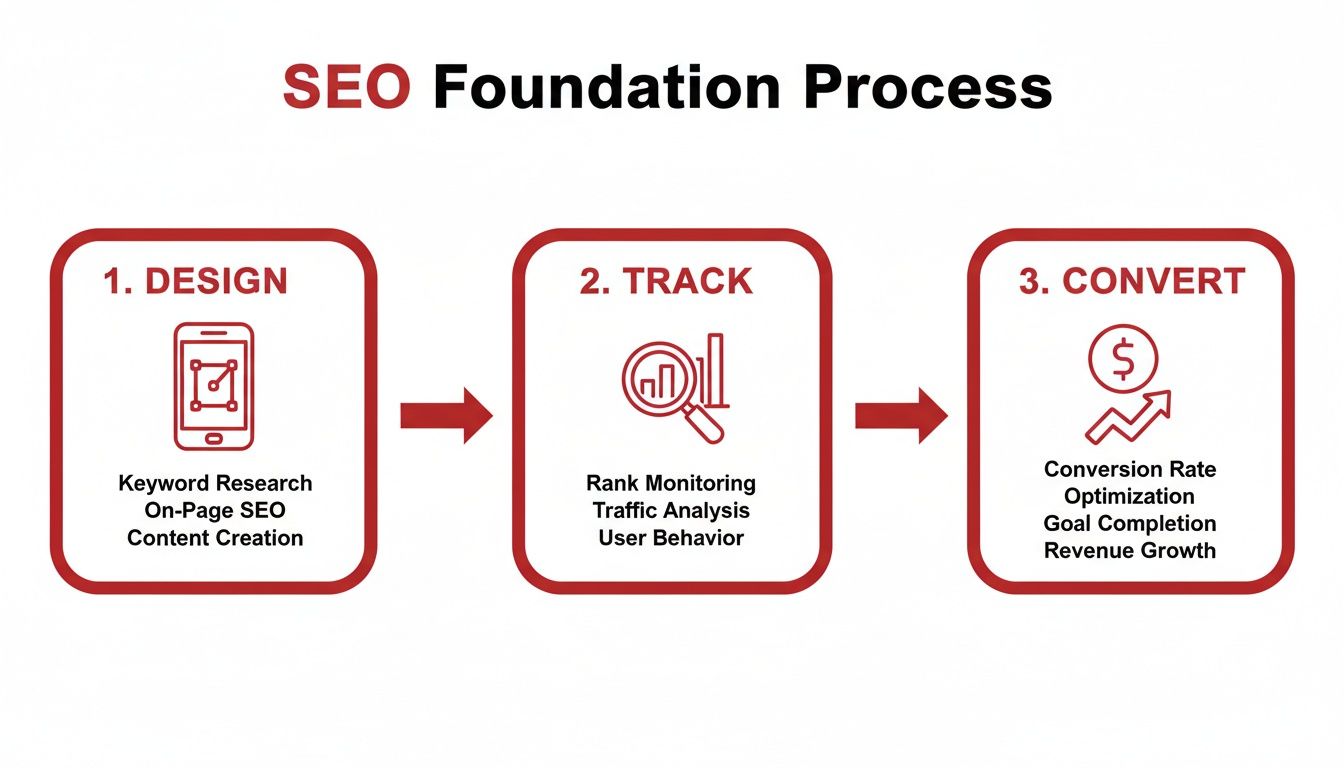
It all starts with a design built to convert, gets refined by tracking what works, and ultimately turns into measurable revenue for your business.
Why Organic Leads Are More Valuable
Think about your own behavior. When you need a contractor, do you click the first ad or scroll down to the businesses Google ranks organically? Most people trust the organic results more. They see those companies as more established and credible.
That trust leads directly to better-quality leads.
An organic lead isn't just a click. It's a potential customer who actively looked for a solution, found your business, and decided you were a credible authority worth calling. These leads almost always convert at a higher rate and lead to more profitable jobs.
This is the real value of SEO for an HVAC company. You're investing in a system that attracts motivated buyers. Instead of just shouting your message with paid ads, you're becoming the trusted answer when a customer has an urgent problem.
This approach doesn’t just fill your schedule today—it builds a brand and reputation that will sustain your business for years. By focusing on this foundation, you can get off the ad-spend rollercoaster and build a practical blueprint for turning your website into your best salesperson.
Winning the Local SEO Game: Your Google Business Profile
When a homeowner's AC gives out on a 95-degree afternoon, they don't open the phone book. They grab their phone and search Google Maps. Your entire local SEO strategy boils down to winning that exact moment.
This isn't just about having a profile. It's about sending every possible signal to Google that you are the most trusted, authoritative HVAC expert in town. That’s how you land in the coveted "map pack"—the top three local listings that get nearly all the attention and, more importantly, the calls.
Your Google Business Profile is the New Front Door
Treat your Google Business Profile (GBP) as your most critical digital asset. For most potential customers, it's the very first impression they'll have of your company. A half-finished, neglected profile signals a lack of attention to detail. A fully built-out profile builds trust instantly.
Start with the basics, but get them perfect. Your business name, address, and phone number (NAP) must be 100% consistent everywhere online. Any variation confuses Google and hurts your ranking.
Once the foundation is solid, it's time to show off your expertise. Don't just settle for the generic "HVAC Contractor" category.
Get Granular With Your Services
This is where most HVAC companies drop the ball. They list "AC Service" when customers are searching for something far more specific. You need to break it down into the exact terms people are typing into their phones.
Think like a customer and list out everything you do:
- Emergency AC Repair
- Central Air Conditioner Installation
- Ductless Mini-Split Services
- Furnace Maintenance and Tune-Up
- Heat Pump Replacement
Every single service you add is another keyword you can rank for. This level of detail is what attracts high-intent customers who are ready to buy now.
Engage Customers Before They Even Visit Your Site
Your GBP has powerful features that let you interact with customers right on the search results page. Using them consistently proves to Google that your business is active and helpful, which is a major ranking signal. Two of the most underutilized tools are GBP Posts and the Q&A section.
Use GBP Posts weekly to share seasonal specials, offer quick tips, or highlight a recent 5-star review. Always add a photo and a clear call-to-action.
The Q&A section is a goldmine for controlling the narrative. You can and should ask and answer common questions yourself. This lets you provide immediate, helpful info on topics like "Do you offer financing?" or "What are your emergency service hours?"
Your goal is to make your Google Business Profile the single most helpful resource for anyone needing HVAC services in your area. When you answer their questions before they even have to ask, you become the obvious choice.
Build Unshakeable Trust and Authority
Beyond just filling out your profile, you need to prove you're a real, active, local business. This is where trust signals come in.
Geo-tagged photos are an easy win. After completing a project, snapping a quick picture on a phone (with location services enabled) can be beneficial. Uploading these "proof of work" photos to your GBP shows Google that you're actively serving the neighborhoods you target.
This gets even more powerful when you earn the Google Guarantee badge. That little green checkmark tells homeowners that Google itself backs your work, offering a money-back guarantee. It’s one of the strongest trust signals you can have and dramatically increases calls from the map pack.
If you want to dive deeper into these strategies, check out our guide on how to rank higher in Google Maps for more advanced tips.
A strong local SEO game is what turns search traffic into profitable jobs. The HVAC industry is uniquely positioned for this, with one of the highest website conversion rates at 3.1%—beating out many other local service sectors. This is a massive advantage, turning that visibility into real installs and measurable ROI.
Designing a High-Converting HVAC Website
Let's be blunt: your website is not an online brochure. It's your digital storefront, and its only job is to turn visitors into booked appointments. We’ve seen countless HVAC companies spend a fortune on a pretty design that does absolutely nothing to fill their calendar.
A high-converting website isn’t just about looking good—it’s an engine built for one thing: lead generation. It needs to speak to both Google and a panicked homeowner whose AC just died in July. This is where a smart site structure becomes your most valuable asset, turning your site into your best salesperson.
Building Your Site Architecture for Local Dominance
Think of your website’s structure like a blueprint. If it’s confusing, people get lost and leave. If it’s logical, they find exactly what they need. For Google, a clear structure is everything. It helps the search engine understand what you do and where you do it, which is the key to ranking in local search.
Your site needs a clean hierarchy built on two non-negotiable page types:
- Service Pages: You need a dedicated page for every single service you offer. Don’t just lump everything under an "AC Services" page. You need individual pages for ‘AC Repair,’ ‘AC Installation,’ ‘Furnace Maintenance,’ and ‘Ductless Mini-Splits.’
- Service Area Pages: You also need a unique page for every city, town, or major neighborhood you want to own. This is how you show up for those money-making searches like "furnace repair in [Your Target Suburb]."
This strategy creates dozens of highly specific landing pages. Each one acts like a targeted net, designed to catch a different type of customer with a different need.
Crafting Compelling Service Area Pages
Just listing the towns you serve on your contact page is a rookie mistake that costs you leads. To win those critical "near me" searches, you have to prove your local authority to Google with dedicated service area pages.
Each of these pages needs to be unique. Don't just copy and paste the same text and swap out the city name—Google sees right through that. You could mention a recent project in that area, a local landmark, or a specific neighborhood. This signals to both homeowners and search engines that you're a real, local pro, not some faceless national directory.
The goal is simple: convince a homeowner in that specific town that you are their best, most convenient option. When you combine local flavor with proof of your expertise, calling you becomes a no-brainer.
Adding testimonials from customers in that specific town creates a powerful engine for local trust and relevance. For more on building a site that actually converts traffic, our guide on HVAC website design dives deeper into these exact principles.
The Non-Negotiables of a Modern HVAC Website
Beyond the structure, a few key elements are absolutely mandatory. If your site is missing any of these, you are actively losing money every single day.
First, your site has to be blazing-fast. People expect a page to load in less than three seconds. Any longer, especially on a phone, and they'll hit the back button and call your competitor. It’s that simple.
Second, you need unmissable calls-to-action (CTAs). Buttons like “Get a Free Estimate” or “Book Service Now” need to be front and center on every single page. A desperate homeowner shouldn't have to hunt for your phone number. One of the easiest wins here is to make phone numbers clickable in WordPress so mobile visitors can call you with a single tap.
Finally, build trust the second someone lands on your page with strong trust signals. This means plastering your site with customer testimonials, industry certifications (like NATE or EPA), and powerful badges like the Google Guarantee. These small elements instantly reassure visitors that you're a legitimate, trustworthy professional they can count on.
Creating Content That Attracts High-Value Customers
Let's be clear: content is what separates the HVAC companies that just get by from the ones that dominate their local market. A slick website and a claimed Google profile are just the ticket to the game. Winning the game—and landing the high-margin install jobs—comes down to your content strategy.
Forget the generic, 500-word blog posts about common HVAC issues. We're talking about building a library of resources that answers real questions for homeowners, solves their immediate problems, and positions you as the only expert they need to call. When they trust you before they even need you, you've already won.
Target Keywords That Signal Real Intent
The difference between a tire-kicker and a ready-to-buy customer often comes down to the words they type into Google. Your content needs to capture them at every stage, from panic to planning.
Here's how we see it:
- Emergency Keywords: These are your "money" keywords. Searches like "AC not blowing cold air" or "furnace making a loud banging noise" mean someone needs help, now. Content for these terms should be direct, diagnostic, and drive them straight to a "Call Now" button.
- Research & Install Keywords: This is where you find the big-ticket jobs. Homeowners searching for "cost to replace HVAC system in [Your City]" or "best high-efficiency AC units" are planning a major investment. Your content needs to give them the detailed information they're looking for to make a decision.
- Top-of-Funnel Keywords: Think of these as brand-builders. Searches like "how often to service an air conditioner" don't lead to an immediate job, but they build trust. When that homeowner does have an emergency, your name will be the first one they remember.
By creating content that addresses all three types of customer intent, you build a digital safety net that catches leads from every possible angle. This is a non-negotiable part of any serious seo for hvac company plan.
Now, let's talk about how to organize this content strategy. It's helpful to think of it as a funnel, guiding a potential customer from a vague problem to signing on the dotted line for a new system.
A simple content funnel helps you map your articles, guides, and videos to what a customer is actually thinking. This ensures you're not just creating content for the sake of it, but are strategically building assets that guide visitors toward a sale.
| Funnel Stage | Customer Intent | Content Type Examples |
|---|---|---|
| Top of Funnel (Awareness) | "My energy bill is high." "Is my furnace safe?" | Blog posts on energy-saving tips, furnace maintenance checklists, videos explaining common system issues. |
| Middle of Funnel (Consideration) | "How much does a new AC cost?" "Lennox vs. Trane." | In-depth buying guides, brand comparison articles, case studies of local installs, online cost calculators. |
| Bottom of Funnel (Decision) | "Emergency AC repair near me." "Get a quote for furnace installation." | Service pages, location pages, financing information, testimonials, clear calls to action for scheduling. |
Thinking this way turns a random collection of blog posts into a cohesive system designed to generate qualified leads.
Go Way Beyond the Standard Blog Post
A blog is the foundation, but relying only on text is leaving money on the table. To truly stand out and build the kind of trust that closes sales, you need to show, not just tell.
We've seen these formats work wonders for our clients:
- Project Case Studies: These are absolute gold. Take before-and-after photos of a tricky install. Write a short story: "The Johnsons' 25-year-old system was costing them a fortune. Here’s the high-efficiency unit we installed and how it cut their energy bills by 40%."
- Video Testimonials: One authentic video of a happy customer is worth more than a dozen written reviews. It's raw, it's human, and it instantly overcomes the skepticism most homeowners feel.
- The Ultimate Guides: Create one massive, go-to resource on a topic like "The Homeowner's Guide to Choosing a New Air Conditioner in [Your State]." This becomes a lead-generating asset that works for you for years, attracting high-value customers looking for a full system replacement.
This isn't about just adding variety; it's about demonstrating your professionalism and expertise in a way your competitors aren't.
Turn Your Content into Booked Jobs
Great content that doesn't convert is just a hobby. Every article, guide, and video must have one goal: to get a potential customer to take the next step.
When you integrate a smart content plan with the right tracking and technology, the results are powerful and predictable. For example, some single-market HVAC clients can see a 30% increase in lead conversion rates in their first year. This isn't a fluke; it's the direct result of combining a killer SEO and content strategy with advanced AdTech.
This proves that organic traffic from great content delivers a far better long-term ROI. You can read more about it and see exactly how it can be done by learning more about the power of data-driven HVAC marketing. This is what happens when you stop guessing and start building a system that turns clicks into customers.
Tracking Your SEO ROI and Attributing Real Revenue
Marketing is just an expense if you can’t prove it’s making you money. For years, HVAC owners treated SEO as a fuzzy, hard-to-measure cost. That’s not the world we live in anymore. With the right tools, you can draw a straight line from your SEO efforts directly to booked jobs and actual revenue.
This is how you stop guessing and start making decisions based on data. You'll move from, "I think our SEO is working," to, "I know our SEO investment brought in $150,000 in new installs last quarter." This kind of clarity isn't just possible; it's the key to predictable growth.
Setting Up Dynamic Call Tracking
Your phone is the lifeblood of your business. If you don't know what's making it ring, you’re flying blind. Dynamic Number Insertion (DNI), or call tracking, is the single most important tool you have for measuring what’s working.
Here’s how it works: A small snippet of code on your website shows a unique phone number to each visitor depending on where they came from. A homeowner who found you through a Google organic search sees one number, while someone from a Google Ad sees a completely different one.
This simple piece of tech unlocks incredibly powerful insights. You can finally answer the questions that matter:
- Which specific keywords are driving emergency repair calls?
- Is that blog post about the "cost to replace a furnace" actually generating high-value installation leads?
- How many calls came from your Google Business Profile versus your website's service pages?
Without call tracking, every inbound call is a mystery. With it, every ring tells a story, giving you a clear picture of which parts of your seo for hvac company strategy are delivering the best returns.
Your HVAC Analytics Toolkit
Beyond call tracking, a couple of free tools from Google are non-negotiable for monitoring your SEO. Think of them as your primary diagnostic gauges—you shouldn't run a website without checking these platforms.
Google Search Console (GSC) is your direct line to Google. It tells you exactly which keywords your site is ranking for, how many people see your listing (impressions), how many click, and if any technical problems are holding you back.
Google Analytics (GA4) shows you what people do after they get to your site. You can see which pages are the most popular, how long people stick around, and which channels (organic search, paid ads, social media) are sending you the most visitors. By setting up goals, you can track important actions like form fills or clicks on your phone number.
These two tools are a team. Search Console tells you how people find you, and Analytics tells you what they do once they arrive. Mastering both is how you understand the full journey from search to service call.
This data lets you double down on what’s working. If a specific service page gets a lot of traffic but very few calls, you know you need to tweak the call-to-action or add more trust signals.
Implementing a Real Revenue Attribution Model
This is where it all comes together. An attribution model connects the dots from a homeowner’s first click all the way to a paid invoice. It’s how you calculate the true return on your SEO investment.
Here’s a real-world example of how this plays out for an HVAC business:
- Lead Capture: A homeowner searches "AC repair downtown," lands on your website, and calls the tracked phone number. Your system logs this lead as an "Organic SEO Lead."
- Job Booking: Your CSR books the appointment. That lead is now updated to a "Booked Job" with an estimated value.
- Invoice and Payment: The service is completed, and the customer pays. The lead is officially marked as "Closed-Won Revenue" in your system.
By following this process, you can run a report at the end of the month that says: "We spent $3,500 on SEO and generated $42,000 in revenue directly from customers who found us on Google." This is how you justify your marketing spend and confidently make decisions to scale up. It's critical to have a system in place to measure marketing effectiveness from the very beginning.
The data backs this up. A Q4 2026 report on HVAC marketing showed a median ROI of 27.46x for companies that dialed in their SEO. Organic search was responsible for 44% of all paying customers, converting new visitors to revenue at a 50% rate—outperforming paid advertising. With an average monthly SEO spend of just $3,604, this is proof that a well-tracked strategy is an absolute powerhouse. You can see the full breakdown of how SEO drives real results in this HVAC marketing report from searchlightdigital.io.
Your Top HVAC SEO Questions, Answered
If you're focused on running your HVAC business, diving into the world of digital marketing can feel overwhelming. We get it. Here are some straight, no-fluff answers to the most common questions we hear from contractors about SEO for an HVAC company.
How Long Does HVAC SEO Take to Actually Work?
This is always the first question, and the honest answer is: it takes time. Anyone who promises you #1 rankings overnight is selling you snake oil.
You can often see some early movement in your local map rankings within 3-4 months of consistent work. However, seeing that translate into a significant, steady stream of organic leads and booked jobs usually takes 6-12 months.
Think of it like building a great reputation in your community—it doesn't happen with one ad. The good news? The results from SEO compound over time, building a sustainable growth engine that paid ads just can't replicate on their own.
Can I Just Do My Own SEO?
Yes, you can absolutely handle some of the basics. Things like claiming and filling out your Google Business Profile, asking customers for reviews, and making sure your name and phone number are correct online are great first steps.
But a real SEO strategy that drives installs gets complex, fast. It involves technical website optimization, advanced local keyword strategies, creating city and service pages, and building local links. To truly compete and get the best return, most HVAC owners find it’s far more efficient to partner with a specialized agency.
The right partner doesn't just "do SEO"—they build a lead generation system. They understand the goal isn't just to rank on Google; it's to make your phone ring with profitable installation jobs.
SEO vs. Google Ads: Which Is Better for an HVAC Business?
The best strategy isn't choosing one or the other. It’s using both, together, as part of a smart marketing plan. They do different jobs, and they do them well.
- Google Ads are for right now. They deliver immediate visibility and leads, which is critical for filling your schedule quickly, especially during peak season or when you're pushing into a new service area.
- SEO is your long-term asset. It builds authority and creates a sustainable flow of organic leads. Over time, your cost to acquire a customer from SEO will almost always be lower than from paid ads.
Think of it this way: Google Ads gets you the quick wins, while SEO builds the foundation for predictable, long-term growth.
Why Do I Really Need All Those Service and City Pages?
We hear this a lot: "Can't I just list all my services and the towns I work in on one page?" If you actually want to rank for what people are searching for, the answer is a hard no. Search engines are all about relevance.
When you create separate pages for "AC Repair" and "Furnace Installation," and separate pages for "HVAC in [City A]" and "AC Repair in [City B]," you're sending a crystal-clear signal to Google about exactly what you do and where you do it.
This is what allows you to show up for those high-intent searches like "emergency furnace repair in [suburb name]"—the kind of search a generic "Services" page will never, ever rank for.
Ready to stop guessing and start getting predictable, high-quality installation jobs from your website? The team at HVAC Growth Machine builds done-for-you lead generation systems specifically for HVAC contractors. We replace underperforming sites with a conversion-focused platform complete with an instant estimate tool and automated follow-ups to turn more visitors into booked jobs. Secure your service area and see how it works.





Founder of HVAC Growth Machine