

To really understand your Cost Per Acquisition, you just need a simple formula: divide your total marketing and sales costs by the number of new customers you landed in a certain timeframe.
It sounds basic, but this one number tells you exactly how much you’re spending to get each new HVAC customer. If you're serious about growing profitably, mastering this metric isn't optional.
Understanding Your HVAC Cost Per Acquisition
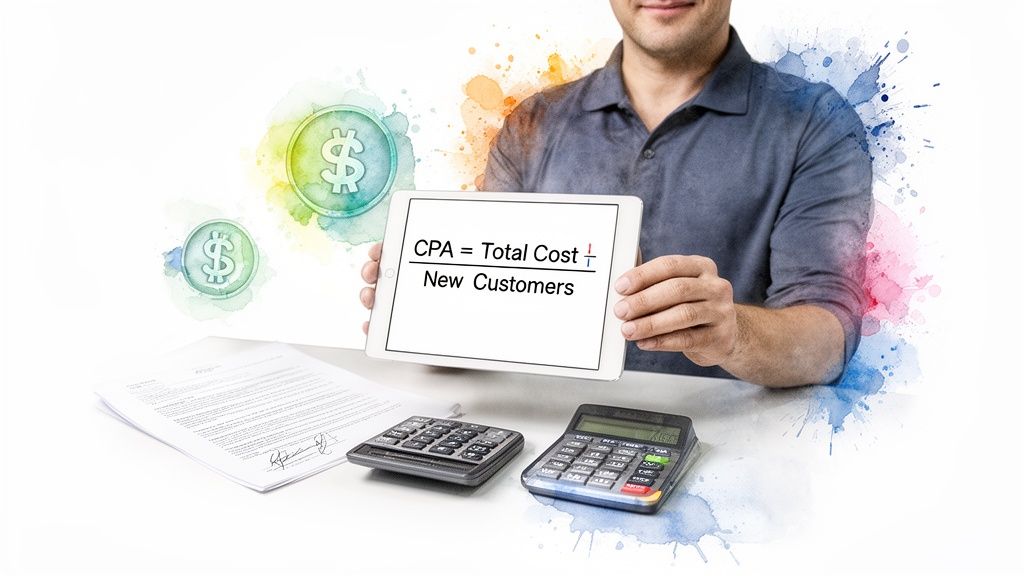
Knowing your Cost Per Acquisition (CPA) is the first real step toward making smarter decisions with your marketing budget. It gets you away from feel-good numbers like website clicks and social media likes and forces you to focus on what actually matters: booking more profitable jobs.
Without a firm grip on your CPA, you're flying blind. You have no real way of knowing if that money you're pouring into Google Ads, HVAC SEO, or HVAC email marketing is actually making you money or just costing you.
This guide is for HVAC owners who want to kill the guesswork and build a predictable system for growth. Calculating your CPA isn't just an accounting chore; it's a powerful strategic tool for your HVAC digital marketing efforts.
Defining Your Terms Correctly
Before we get into the math, we have to get one thing straight: the difference between a "lead" and an "acquisition." This is where I see a lot of owners go wrong, and it completely skews their numbers and leads to some really bad decisions.
Getting this right is the foundation for knowing how to calculate cost per acquisition accurately.
A Lead: This is just an inquiry. It’s a phone call from your Google Business Profile, a form fill on your HVAC website, or an email asking for a quote. A lead is someone kicking the tires—they have potential, but they haven't paid you a dime.
An Acquisition: This is a paying customer. It's the signed contract for a new furnace, the confirmed AC replacement, or the paid invoice for a major repair. An acquisition is what puts money in your bank account.
Your goal isn't just to generate leads; it's to secure acquisitions. Calculating your CPA based on leads instead of actual customers will give you a dangerously misleading and overly optimistic view of your marketing performance.
Gathering the Right Data
To get a true CPA, you need a complete picture of your expenses and your new customer count over a specific period—whether that’s a month, a quarter, or the whole busy season. The formula is only as good as the data you feed it.
Let's break down the essential pieces you need to pull together.
Key Components for Your CPA Calculation
Here's a quick rundown of the critical data points you'll need to gather to get an accurate CPA. Make sure you're not leaving anything out, or your final number won't reflect reality.
| Data Category | What to Include | Example Sources |
|---|---|---|
| Marketing Costs | Every dollar spent directly on attracting potential customers. | Google Ads spend, HVAC SEO agency fees, social media management, HVAC email marketing software subscriptions. |
| Sales Costs | All expenses tied to converting those leads into paying customers. | Salaries and commissions for your sales team or comfort advisors, CRM software costs, proposal software. |
| New Customers | The total number of new, paying customers you acquired during that period. | Signed contracts in your CRM, new customer records in your accounting software like QuickBooks. |
Once you have these three components—your total marketing costs, your total sales costs, and your total new customers for a specific period—you have everything you need to calculate your true CPA.
Tallying Your True Marketing and Sales Costs
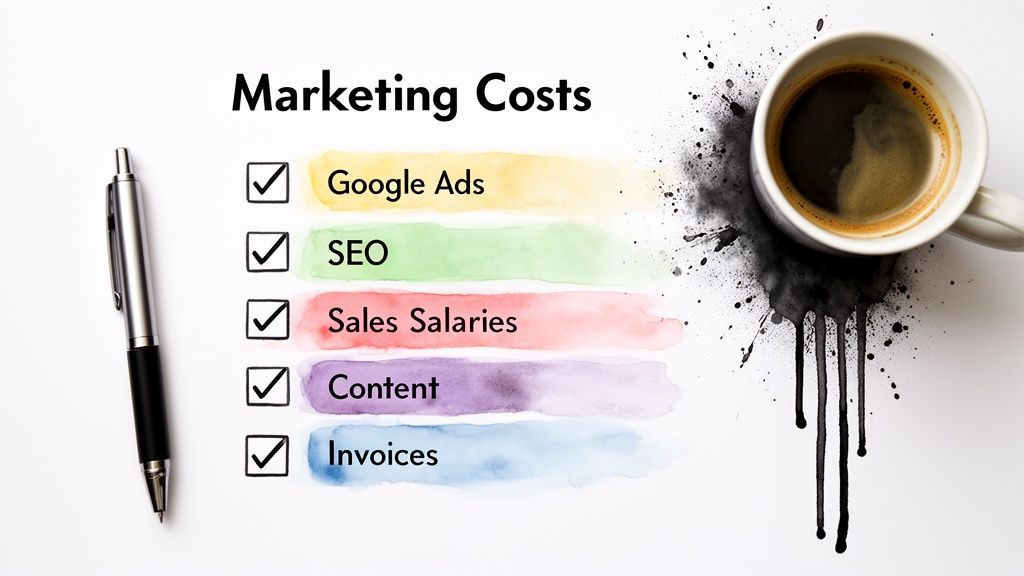
If you really want to know what it costs to land a new customer, you have to look at every single dollar spent to make it happen. So many HVAC owners make the mistake of just looking at their Google Ads invoice and calling it a day.
That approach gives you a dangerously incomplete picture. It's like trying to calculate your truck's operating cost by only looking at the gas receipts—you're missing oil changes, insurance, and tire replacements. Getting your CPA right means doing a full financial audit of your entire growth engine.
Your Complete HVAC Expense Checklist
Let's break down exactly what you need to track. To get a real sense of how to calculate cost per acquisition, you have to look beyond the obvious ad platforms and into every corner of your business that touches marketing and sales.
These costs fall into two buckets: the money you spend directly on advertising and the behind-the-scenes costs that make it all work.
Direct Marketing & Advertising Costs:
- HVAC Paid Ads: This is the big one. It's your total spend on platforms like Google Ads, HVAC Local Services Ads, Facebook ads, or any other pay-per-click channel.
- HVAC SEO Services: If you're working with a marketing agency for search engine optimization, that monthly retainer goes right here.
- Content Creation: Paying someone to write blog posts, shoot videos, or design social media graphics? That's a marketing cost.
- Social Media Management: The fees you pay an agency or freelancer to run your Facebook page and campaigns.
A study from Decision Analyst, commissioned by JB Warranties, found the average cost to acquire a new residential HVAC customer is about $350. The industry as a whole drops a whopping $2.78 billion a year trying to get new business. That tells you just how critical it is to know your numbers.
Uncovering the Hidden Operational Costs
This is where I see most HVAC owners get tripped up. Operational costs are all the software, salaries, and tools that your marketing and sales efforts rely on. They are just as important to your CPA calculation as your ad spend.
Don't leave these out:
- Software Subscriptions: Think about what you pay every month for your CRM, email platform like Mailchimp, call tracking software, or proposal tools. It all adds up.
- HVAC Website Expenses: Your domain renewal, hosting fees, and any premium plugins you pay for are part of the cost of doing business online.
- Sales Team Compensation: This is a big one. You have to factor in the salaries, commissions, and bonuses you pay your comfort advisors. Their entire job is converting leads into customers, making their compensation a direct acquisition cost.
- Marketing Team Salaries: Got a marketing coordinator on staff? Their salary is absolutely part of your total cost.
When you meticulously track both direct and operational costs, you finally get a clear, honest look at what it truly costs to win a new job. This clarity is the foundation for making smart decisions about your marketing budget.
You can also explore this topic further in our guide on how to measure marketing effectiveness.
Add all of these line items together, and you'll have the "Total Marketing and Sales Costs" figure for your CPA formula. This is the only way to get a number you can actually trust to guide your business.
Alright, you've tallied up every last dollar in your marketing and sales budget. Now for the part where most HVAC owners stumble: figuring out who actually counts as a "new customer."
Get this wrong, and your final CPA number is completely useless. It's a critical step.
An acquisition isn't a website click. It's not a form submission asking for a quote, and it’s definitely not just a phone call from a curious homeowner.
For a profitable HVAC business, a true acquisition is a signed contract and a paid invoice. It’s the new furnace installation, the complete AC system replacement, or the major repair job that puts real money in your pocket. Anything less is just a lead—and confusing the two gives you a dangerously false sense of security.
Moving Beyond Guesswork with Solid Tracking
To get an accurate cost per acquisition, you need a system that connects every single paying customer back to the marketing effort that brought them to you. Without this, you're just guessing where your best jobs are really coming from.
This is where having a robust tracking setup becomes non-negotiable. You simply can't win in modern HVAC digital marketing without the right tools to attribute every single sale.
Call Tracking Software: This is the foundation. Services like CallRail assign unique, trackable phone numbers to each of your marketing channels. One number goes on your Google Business Profile, another on your Google Ads, and a third on your direct mail flyers. When a call comes in, the software logs which number was dialed, telling you exactly which campaign made the phone ring.
CRM Integration: Your CRM is the brain of your operation. When you integrate it with your call tracking and website forms, you can finally see the entire customer journey in one place. You can follow a lead from a specific Facebook ad all the way through the sales process until it becomes a closed, paying job.
This level of detail gets rid of all the ambiguity. You can finally say with confidence, "This $12,000 system installation came from our HVAC SEO efforts," or "This $8,000 commercial repair job started with our HVAC email newsletter." That’s the kind of clarity you need.
A bulletproof tracking system is the only way to know which channels are delivering high-margin installation jobs and which are just driving low-value service calls. It separates the revenue-drivers from the budget-wasters.
Tagging Every Lead from Its Source
Once your tools are in place, the next job is to create a process for tagging every single incoming lead. Your whole team—from the dispatcher answering the phone to the comfort advisor running the sales call—needs to be trained to capture this information consistently.
The goal is simple: attach a source to every potential customer the very first time they contact you.
Common Lead Sources to Track:
- Organic Search (Google, Bing)
- Google Business Profile
- Google Ads (by specific campaign)
- HVAC Local Services Ads
- Facebook Ads (by specific campaign)
- HVAC Email Marketing Newsletter
- Referral (from a past customer)
- Yard Sign or Truck Wrap
This process ensures that when you pull your report of new customers for the month, each one has a source tag attached. You’re not just counting how many new customers you got; you’re counting how many came from each specific marketing channel. This is a crucial part of learning how to calculate cost per acquisition on a channel-by-channel basis. For a deeper dive, check out our guide on how to implement an effective HVAC lead management system.
Choosing the Right Time Frame
Finally, you need to decide on the time frame for your calculation. The period you choose should be long enough to capture your typical sales cycle. A customer might inquire about a new system in March but not actually sign the contract until May.
- Monthly: Calculating CPA monthly is great for keeping a close eye on short-term campaign performance, especially for things like HVAC paid ads. It lets you make quick adjustments.
- Quarterly: This is often the sweet spot. A quarterly calculation smooths out the monthly ups and downs and better reflects the longer sales cycle for big-ticket items.
- Annually: An annual CPA gives you that 30,000-foot view of your overall marketing efficiency for the year, which is perfect for bigger strategic planning.
By defining an acquisition correctly, getting a solid tracking system in place, and choosing the right time frame, you build a reliable foundation. You'll finally have the accurate "Number of New Customers" you need to complete your CPA formula and unlock real insight into your marketing ROI.
Calculating and Benchmarking Your HVAC CPA
You’ve tallied up your total costs and you know how many new customers came through the door. Now it's time to connect the dots. The math itself is simple, but the clarity it brings is a game-changer. This is where all that data gets boiled down into a single, powerful number for each of your marketing channels.
Forget about a blended, company-wide average. We're getting into the nitty-gritty of what's really driving growth. By calculating CPA for each channel separately, you can finally see which efforts are making you money and which are just burning through your budget.
Practical CPA Calculation Scenarios
Let's walk through how this looks for a real HVAC business. Knowing how to calculate cost per acquisition isn't some abstract theory; it’s about applying a simple formula to your actual spending to see what's working.
Imagine you spent $5,000 on a Google Ads campaign last quarter. Don’t forget to add related costs, like a portion of your marketing manager's salary for the time they spent managing it. Let's say that adds another $1,000, bringing the total campaign cost to $6,000.
Now, you check your CRM and call tracking software. That campaign brought in 20 signed contracts for new systems.
The math is straightforward:
$6,000 (Total Campaign Cost) / 20 (New Customers) = $300 CPA
Simple as that. You paid $300 for every new customer you landed through Google Ads. Now you have a hard number you can actually use.
Comparing Across Different Marketing Channels
The real magic happens when you stack this number up against your other marketing efforts. Take your ongoing HVAC SEO investment, for example.
- Monthly SEO Cost: You pay an agency $3,000 per month.
- Quarterly SEO Cost: Over three months, that's $9,000.
- New Customers from Organic Search: Your tracking shows you acquired 30 new customers from organic search during that same quarter.
The CPA for your SEO work is:
$9,000 (Total SEO Cost) / 30 (New Customers) = $300 CPA
In this scenario, both your Google Ads and HVAC SEO efforts have the exact same CPA. This is incredibly valuable information. It tells you both channels are equally efficient at bringing in new customers at this spending level. No more guessing.
This visual shows the journey from a prospect becoming a lead, to tracking where they came from, and finally confirming a signed contract—the core of any accurate CPA calculation.
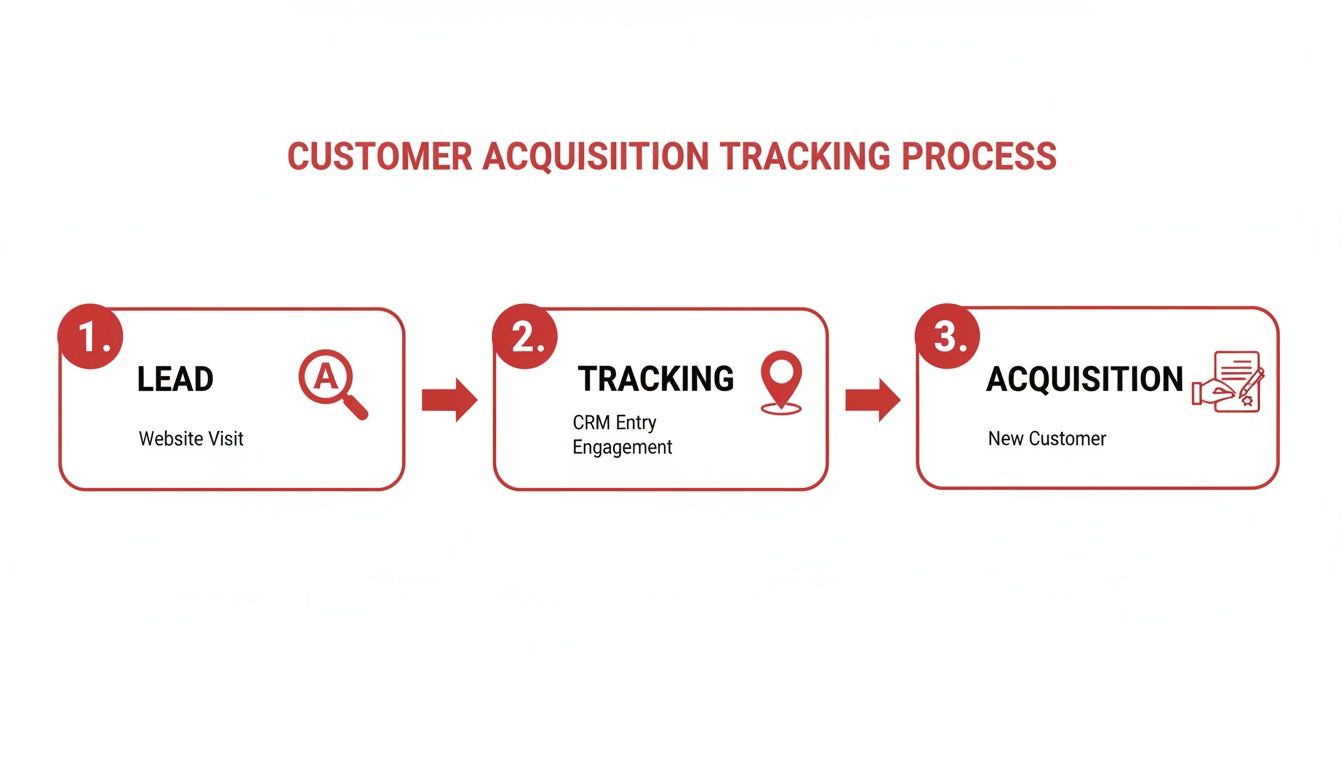
As the flowchart shows, a true acquisition isn't the initial phone call; it's the final, revenue-generating step.
Benchmarking Your CPA Against Industry Averages
Okay, so you have your number. Is a $300 CPA good? Bad? On its own, the number doesn't mean much. You need context. This is where benchmarking comes in, comparing your performance against industry averages and—more importantly—your own business metrics.
Industry data shows the average residential HVAC customer acquisition cost hovers somewhere between $296 to $350. Some local companies, especially those leaning heavily on paid search, might even spend $250 to $350 per customer. This isn't surprising when the cost-per-click on Google Ads can hit $29.03 for competitive keywords. This data tells us a $300 CPA is right in the ballpark of what other successful HVAC businesses are paying. You can dig into more HVAC marketing statistics to see how you stack up.
The real secret to understanding your CPA isn't just comparing it to competitors; it's comparing it to your Customer Lifetime Value (CLV). A single $300 acquisition might lead to a $10,000 system install, followed by years of profitable maintenance plan revenue and a future replacement system.
The Critical Link Between CPA and Customer Lifetime Value
This perspective is what separates the fast-growing HVAC companies from the ones that stay stuck. While the average acquisition cost is around $300, the lifetime value of that same customer can easily climb over $15,000.
When you look at your marketing spend through that lens, a $300 CPA stops looking like an expense. It looks like an incredibly smart investment. You're spending $300 today to potentially generate tens of thousands of dollars in revenue over the next decade.
This is exactly where a system like the HVAC Growth Machine becomes so powerful. With built-in features that let you sell maintenance plans via eCommerce and attribute every lead from sources like your Google Business Profile, you can clearly track both the upfront acquisition cost and the long-term revenue it generates.
Ultimately, your CPA is a tool for strategic, long-term thinking. It’s not just about the cost of one job; it’s about the profitability of a long-term customer relationship. Mastering this is the key to building a sustainable and highly profitable HVAC business.
Strategies to Lower Your CPA and Boost ROI
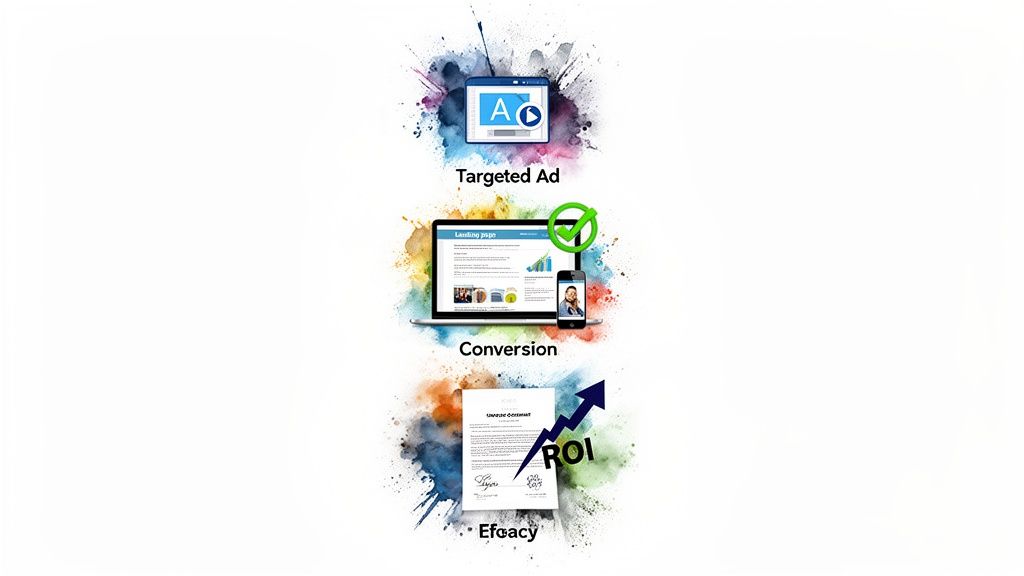
Knowing your CPA is one thing; actively driving it down is where you start to really win. This number shouldn't just be a report you look at once a quarter. It should be a dynamic tool that guides every marketing dollar you spend, turning your budget into a predictable engine for booking high-margin jobs.
The real power in knowing how to calculate cost per acquisition lies in the action you take afterward. It’s about making surgical adjustments to your strategy, not just sweeping cuts. The goal is to spend smarter, not necessarily less, to fill your schedule and maximize your return on investment (ROI).
Optimize Your High-Cost Channels
If you’ve run the numbers and discovered your HVAC paid ads have a sky-high CPA, don't panic or immediately pull the plug. Often, a high CPA is a symptom of a few fixable issues. Before you abandon a channel, dive in and see what's really going on.
Start by looking at your ad copy. Is it generic, or does it speak directly to a local homeowner’s urgent problem? Mentioning specific service areas, emergency availability, or current promotions can significantly increase click-through rates from the right kind of searchers.
Next, analyze your landing pages. This is the most common point of failure I see. A generic homepage is not a landing page. You need dedicated pages for each service (e.g., "AC Repair in [Your City]") that match the ad's promise and have a clear, unmissable call to action. Improving the conversion rate of your landing page is one of the fastest ways to lower your CPA.
Finally, get way more specific with your keywords. Instead of bidding on broad terms like "air conditioning," focus on long-tail keywords like "emergency Trane furnace repair [Your Town]." These searches have much higher intent, meaning the user is closer to making a buying decision, which translates to a more cost-effective acquisition. For more ideas, you can find a number of strategies for how to reduce customer acquisition cost in our detailed guide.
Double Down on What Works Best
Your CPA calculations will almost certainly reveal a star performer—a channel that delivers high-quality customers for a fraction of the cost of others. For many HVAC businesses I've worked with, this channel is HVAC SEO.
If your data shows that customers coming from your Google Business Profile or organic search results have the lowest CPA, it's time to double down. This means investing more of your time and resources into activities that boost your local search dominance.
- Aggressively Pursue Reviews: Make getting new Google reviews a core part of your process for every single job. It's non-negotiable.
- Optimize Your Google Business Profile: Regularly upload new photos of your team and recent installations, publish weekly posts, and answer questions in the Q&A section. Treat it like a second website.
- Create Hyper-Local Content: Write service pages and blog posts for every single town and neighborhood you serve. This is how you show up when people search for "hvac installation near me."
By redirecting budget from an underperforming channel to fuel your most efficient one, you can lower your overall blended CPA without reducing your lead volume.
Leverage Automation to Increase Efficiency
HVAC email automation is a powerful tool for lowering your CPA because it helps you convert more of the leads you already have without increasing your ad spend. It works by pre-qualifying prospects and nurturing them until they are ready to buy, so your team doesn't have to.
Marketing automation can improve business productivity by an average of 20%. By automating repetitive tasks like lead follow-up, your team can focus on closing deals, not just chasing cold leads.
Consider tools like an instant online estimator on your HVAC website. This feature captures the contact information of visitors who are interested but not quite ready to call, giving you a warm lead to nurture instead of letting them click away forever.
From there, automated email sequences can take over. These pre-written emails can educate the prospect on their options, build trust with testimonials, and present timely offers to nudge them toward booking a consultation. Each customer you convert through these automated touchpoints is an acquisition you didn't have to pay for with another ad click.
Once you have your CPA calculated, understanding and Mastering Marketing Automation ROI can significantly contribute to lowering future acquisition costs and improving overall financial returns. This approach turns your website into a 24/7 digital sales rep, efficiently moving prospects through the funnel and boosting your conversion rate, which directly lowers your cost per acquisition.
Common Questions About HVAC Cost Per Acquisition
Even after running through the numbers, some questions always pop up. Getting the math right is just the start—knowing what to do with your Cost Per Acquisition is what really moves the needle.
Let's dig into the questions I hear most often from HVAC owners trying to get a handle on their marketing spend.
How Often Should I Calculate My HVAC CPA?
You don't need to live inside a spreadsheet, but you do need a consistent rhythm. For most HVAC shops, calculating your CPA on a quarterly basis is the perfect sweet spot. It's a long enough window to smooth out any weird monthly blips and, more importantly, it captures the full journey of those bigger installation jobs that can take weeks to go from a first call to a signed deal.
Now, if you're actively pouring money into paid ads on places like Google Ads, a monthly check-in is a must. This lets you react quickly. You can tweak your ad spend or targeting before a campaign with a crazy-high CPA burns a hole in your budget.
Think of it this way: monthly is for tactical adjustments, quarterly is for measuring trends, and an annual calculation gives you that big-picture view for planning next year's budget.
What Is a Good Cost Per Acquisition for an HVAC Company?
This is the million-dollar question, and the honest answer is: it depends. If you're looking for a ballpark number, industry chatter puts the average CPA for residential HVAC somewhere between $250 and $350. If you're in that range, you're probably not way off track.
But here’s the thing—a "good" CPA has less to do with an industry average and everything to do with your business's numbers. The only comparison that truly matters is your CPA versus your Customer Lifetime Value (CLV).
If your CPA is $300 but your average customer sticks with you for a new system, a maintenance plan, and a future replacement—bringing in $15,000 over their lifetime—then that $300 is an incredible investment. You'd make that trade all day long. A healthy rule of thumb is to aim for a CLV that's at least three times your CPA.
How Can I Lower My CPA Without Cutting My Marketing Budget?
Slashing your budget is the easy answer, but it's rarely the right one. Lowering your CPA is about spending smarter, not just spending less. The fastest way to do this is by plugging the leaks in your sales funnel and improving your conversion rate.
Start with your HVAC website and landing pages. Is your site fast? Does it work well on a phone? Is it painfully obvious what a visitor should do next? A clean site with clear calls to action and tools like an instant online estimator can squeeze way more leads out of the exact same traffic you're already getting.
Then, look at what happens after you get the lead. A shocking number of leads die on the vine due to slow follow-up. Using simple automated email and text messages to nurture every new inquiry makes sure nothing gets missed. When you convert more of the leads you already paid for, your CPA naturally drops.
What's the Difference Between CPL and CPA?
This one trips people up all the time, but it's a critical distinction. Getting this wrong means you're measuring the wrong thing.
Cost Per Lead (CPL): This is what it costs you to make the phone ring or get a form filled out. A lead is just an expression of interest—someone kicking the tires.
Cost Per Acquisition (CPA): This is what it costs you to actually land a paying customer. An acquisition is a signed contract, a truck rolling out, and money in the bank.
CPL is a useful pulse-check to see if your ads are getting attention. But CPA is the metric that tells you if you're actually making money. Your business doesn't run on leads; it runs on profitable jobs. Always, always treat CPA as your North Star for marketing success.
Ready to stop guessing and start getting a clear, predictable return on your marketing investment? The HVAC Growth Machine is a complete system designed to lower your CPA by converting more website visitors into profitable installation jobs. With features like an instant online estimator and built-in eCommerce for maintenance plans, we give you the tools to not only track your acquisitions but increase them. Secure your exclusive service area and see how we can fill your calendar by visiting https://hvacgrowthmachine.com.





Founder of HVAC Growth Machine