

So you’ve decided to start your own HVAC company. You’ve got the technical skills down cold, but launching a business is a whole different beast. It’s not just about fixing furnaces; it’s about building a solid foundation with a smart business plan, the right licenses, and a killer marketing strategy from day one.
Getting these first steps right is the difference between a profitable, long-lasting company and one that fizzles out after the first year.
Building Your Business Blueprint
Before you even think about wrapping a van or ordering your first set of gauges, you need a business plan. Seriously. This isn’t some pointless document you create just to get a loan; it’s your personal roadmap. It’s what forces you to think through every single detail, turning that “great idea” into a business that can actually handle the punches.
Without this blueprint, you’re flying blind. You’ll end up reacting to problems instead of building a system for success from the get-go.
Your first real decision is picking your niche. This one choice impacts everything that comes next—your marketing, the tools you buy, and the kind of techs you’ll eventually need to hire. Are you going to jump into the high-volume, quick-turnaround world of residential repair and maintenance? Or are you aiming for the bigger, more complex commercial contracts with local businesses and property managers?
Choosing Your Market Focus
You can’t be everything to everyone, especially when you’re just starting out. Deciding on a target market is how you stand out from the crowd. Take a hard look at the needs in your specific service area.
- Residential Services: This is the bread and butter for many. You’re dealing with a higher number of smaller jobs—emergency repairs, seasonal tune-ups, and full system replacements for homeowners. Success here depends on top-notch customer service and an airtight scheduling process.
- Commercial Services: Going after businesses means bigger, more complicated projects. Think new construction installs, servicing massive rooftop units, or landing multi-year maintenance contracts for office parks. The sales cycle is longer, but the payoff is bigger.
- Specialized Niches: You could also carve out a space by becoming the local expert in something specific, like geothermal systems, smart home HVAC integrations, or high-efficiency heat pumps. This can attract a premium customer who’s looking for specialized knowledge.
Once you know who you want to serve, it’s time to scope out the competition. Who’s already working in that space? What are they great at, and where are they dropping the ball? Do they have a thousand five-star reviews, or are people constantly complaining about their bad communication?
Finding those gaps in the market is your opportunity. It’s how you position your new company as the obvious, better choice.
Key Takeaway: Your business plan needs to spell out exactly how you’ll be different. Maybe you’ll offer true 24/7 emergency service when nobody else does. Maybe you’ll guarantee a two-hour response window or offer transparent, flat-rate pricing that gets rid of the guesswork for customers.
Selecting the Right Legal Structure
Next up: choosing a legal structure. This isn’t the most exciting part, but it’s one of the most critical decisions you’ll make. It determines how you’re taxed and, more importantly, protects your personal assets if things go sideways.
- Sole Proprietorship: This is the easiest to set up, but it comes with a huge risk: there’s no legal separation between you and the business. If the business gets sued, your personal assets—your house, car, and savings—are on the line.
- Limited Liability Company (LLC): This is the go-to for most new HVAC businesses for a reason. An LLC creates a protective wall between your business debts and your personal finances.
- S-Corporation (S-Corp): An S-Corp can offer some smart tax advantages. It lets you pay yourself a “reasonable salary” and take the rest of the profits as distributions, which aren’t hit with self-employment taxes. It’s a bit more complex, but worth looking into with an accountant.
Getting this stuff handled correctly from day one—registering your business name, getting an Employer Identification Number (EIN) from the IRS, and opening a separate business bank account—is non-negotiable. It saves you from the kind of expensive messes that can sink a brand-new company before it even gets its first call.
Mastering Your Startup Finances and Pricing
Let’s talk about the numbers. Getting a handle on your finances isn’t just important—it’s the single biggest factor that determines whether your new HVAC company survives its first year. Solid financial planning and a smart pricing strategy are the engines that will power your business, ensuring you’re not just busy, but actually profitable.
So many startups fail because the owner mismanages the money. It’s absolutely critical to move beyond guesswork and build a clear picture of your real costs and how every single job contributes to your bottom line.
Calculating Your Real Startup Costs
Before you can even think about running your first service call, you’re going to have to make some serious investments. The idea that you can get started with just a few hand tools is a common—and very costly—mistake. The reality is, the initial cash you’ll need to put up can be pretty substantial.
Starting an HVAC business isn’t cheap. The basic equipment and tools alone will likely run you between $2,000 and $12,000, and that’s before you even think about a truck. A reliable used van can set you back up to $40,000, while a new, fully-stocked one can soar to $125,000 or even $150,000.
This financial reality, combined with equipment costs jumping roughly 40% since 2020 and the high cost of acquiring new customers, helps explain a sobering statistic: 70% of new HVAC businesses fail within their first year. Don’t be one of them.
Here’s a closer look at the kind of numbers you should be planning for.
Estimated HVAC Startup Cost Breakdown
This table gives you a detailed look at the potential initial investment required to launch an HVAC business, separating one-time costs from recurring monthly expenses.
| Expense Category | Estimated Cost Range (Low-End) | Estimated Cost Range (High-End) | Notes |
|---|---|---|---|
| One-Time Costs | |||
| Business Registration & Licensing | $500 | $2,000 | Varies widely by state and local jurisdiction. |
| Down Payment on Work Van | $5,000 | $20,000+ | A significant initial expense, even for a used vehicle. |
| Essential Tools & Equipment | $5,000 | $15,000 | Includes diagnostic tools, recovery machines, hand tools, etc. |
| Initial Inventory (Parts & Supplies) | $2,000 | $5,000 | Common parts like capacitors, contactors, and refrigerant. |
| Website & Initial Marketing Setup | $1,500 | $7,500 | Professional website, logo, business cards, Google Business Profile setup. |
| Recurring Monthly Costs | |||
| Vehicle Payment & Insurance | $700 | $2,000 | Loan payment, commercial auto insurance, and fuel. |
| Business Insurance (Liability, etc.) | $200 | $800 | General liability is a must; worker’s comp if you have employees. |
| Software (CRM, Dispatching) | $150 | $600 | Essential for scheduling, invoicing, and customer management. |
| Phone & Internet | $100 | $300 | Dedicated business lines and reliable internet are non-negotiable. |
| Marketing & Advertising | $500 | $3,000+ | Google Ads, SEO, local marketing efforts. |
| Office/Shop Rent (if applicable) | $0 | $2,500 | Many start from home, but a shop adds significant overhead. |
Keep in mind, these are just estimates. Your actual costs will depend heavily on your location, the services you offer, and how quickly you want to scale. The key is to be realistic and plan for more than you think you’ll need.
As part of your financial planning, you’ll also need to decide on a business structure.
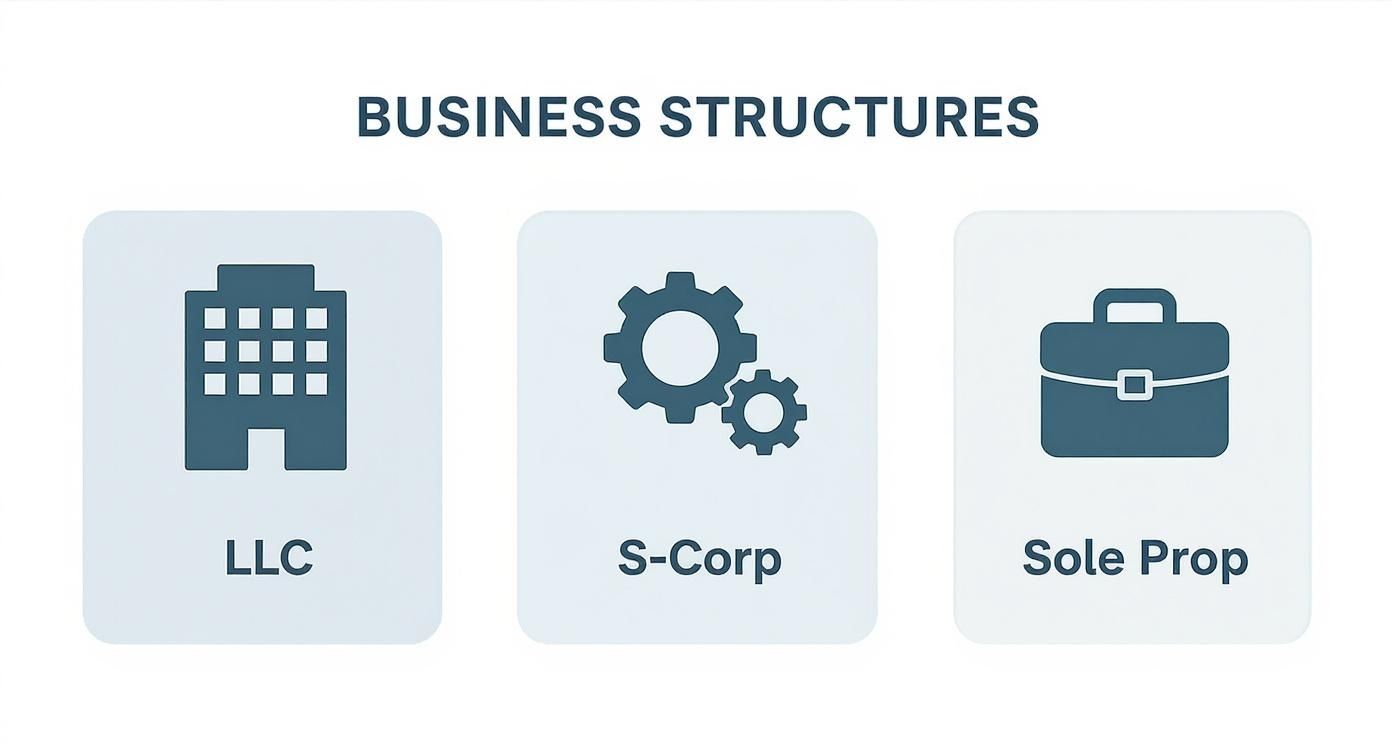
This decision is a big deal. Choosing the right structure, like an LLC or S-Corp over a Sole Proprietorship, can protect your personal assets and have major implications for your taxes down the road. Talk to an accountant about this one.
Developing a Profitable Pricing Strategy
Once you have a firm grip on your costs, you can finally build a pricing strategy that actually makes you money. Pricing your services isn’t about looking at what the cheapest guy in town charges. It’s about covering all your expenses, paying yourself a decent wage, and generating enough profit to grow the business.
The two models you’ll see most often are time-and-materials and flat-rate pricing.
- Time and Materials (T&M): This is where you charge the customer for the actual hours your tech is on-site, plus the cost of any parts used. It’s transparent, sure, but it can make homeowners anxious about a runaway bill and doesn’t reward your most efficient technicians.
- Flat-Rate Pricing: With this, you offer a single, upfront price for a specific job—think a furnace tune-up or a capacitor replacement. Customers absolutely love the predictability, and it lets you price your services based on the value you provide, not just the time it takes.
Pro Tip: Flat-rate pricing is the way to go for residential service, hands down. It gets rid of arguments over the final bill, builds trust instantly, and lets you bake your overhead and desired profit into every single job in a standardized, repeatable way.
No matter which model you choose, the foundation is knowing your true hourly operating cost. This is the magic number—it’s how much it costs your business to simply exist for one billable hour. This includes everything from your truck payment and insurance to your software subscriptions and marketing spend.
For a deeper dive into creating profitable service tiers, check out our guide for creating an HVAC maintenance plan template. This is one of the best ways to build predictable, recurring revenue right from the start.
Calculating your hourly operating cost ensures that every quote you give is built for profit, not just to cover the immediate parts and labor. Forgetting to account for all your overhead is exactly how companies end up working themselves to the bone but still losing money every month. Your price has to reflect the total cost of doing business.
Navigating Licenses, Insurance, and Compliance
Before you ever run your first call, you’ve got to get your house in order. Operating a legitimate HVAC company isn’t just about knowing your way around a furnace; it’s about building a business that customers, employees, and even the government can trust.
Skipping the legal stuff—getting the right licenses, certifications, and insurance—is a rookie mistake that can cost you dearly. We’re talking hefty fines or even getting your business shut down before you’ve barely started. This framework isn’t just red tape; it’s the foundation of a professional, credible business.
Federal, State, and Local Licensing
First things first: the feds. Before you handle any refrigerant, you absolutely must secure your EPA Section 608 Technician Certification. This is non-negotiable. It’s a federal requirement for anyone who maintains, services, repairs, or disposes of equipment that could release refrigerants into the atmosphere. Make sure your certification type covers the specific equipment you plan to work on.
Now for the tricky part: state and local rules. This is where things can get complicated because requirements vary wildly from one place to another. For example, in California, you’ll need a C-20 specialty license for any project valued over $500, and that requires proving four years of journeyman-level experience. Hop over to Texas, and you’re dealing with a whole different set of licensing classes managed by the Texas Department of Licensing and Regulation.
Actionable Tip: Don’t guess. Your first and most important stop should be your state’s contractor licensing board website. They have the official checklists, experience requirements, and exam info you need to operate legally. This is your single source of truth.
The Must-Have Business Insurance Policies
Think of insurance as your financial safety net. It’s what protects your new business from the kind of accident that could otherwise wipe you out. For a new HVAC business, there are three policies you simply can’t go without.
- General Liability Insurance: This is your bread and butter. It covers you if your work causes bodily injury to a third party or damages their property. A technician accidentally causes a water leak that ruins a customer’s hardwood floors? Your general liability policy is what pays for the repairs.
- Commercial Auto Insurance: That personal auto policy on your truck or van? It’s worthless the second you’re using that vehicle for a job. Commercial auto is a must-have to protect you from liability in an at-fault accident and to cover damage to your work vehicles.
- Workers’ Compensation Insurance: If you plan on hiring anyone, this is required in nearly every state. It pays for medical bills and lost wages if an employee gets hurt on the job. It’s a critical policy that protects both your people and you from potentially devastating lawsuits.
How to Find the Right Coverage
Don’t just jump on the first cheap quote you find online. The smartest move is to connect with an independent insurance broker who specializes in the trades. These brokers get the specific risks HVAC contractors face—from high-voltage systems to refrigerant exposure—and they can shop your policy around to multiple carriers to find the best fit.
When you talk to a broker, be ready to detail the kind of work you’ll be doing. Residential only? Commercial projects? New construction? The answers directly shape your policy needs and what you’ll pay in premiums. Getting your insurance dialed in from day one is one of the most important steps to building an HVAC company that lasts.
Equipping Your Operation for Success
Your technical skills are the engine of your new HVAC company, but the tools, vehicle, and suppliers you choose are the fuel that keeps it running. A well-equipped operation isn’t just about having shiny new gear; it’s a real-world advantage that directly impacts your efficiency, professionalism, and ultimately, your profit on every single job.
Investing wisely in these core assets from day one prevents the kind of frustrating delays and on-the-job headaches that can sink a new company’s reputation before it even gets going. It shows customers you’re serious, prepared, and ready to solve their problem.

Stocking Your Toolbox for Day One
When you’re just starting, you don’t need every specialized tool under the sun. What you do need is a rock-solid set of essentials to handle the most common residential service calls without making extra trips back to the shop.
Build your initial toolkit around these core categories:
- Essential Hand Tools: This is your foundation. Don’t cheap out here. Get quality sets of screwdrivers (especially multi-bit drivers), nut drivers, various pliers (linesman, needle-nose), adjustable wrenches, and a solid hammer.
- Diagnostic Equipment: This is where you make your money. A quality multimeter is absolutely non-negotiable for electrical troubleshooting. You’ll also need a digital thermometer, a manifold gauge set, and an electronic refrigerant leak detector to accurately diagnose system issues.
- Specialty HVAC Tools: These are the job-specific items that make your work possible. Think tubing cutters, a flaring tool, a core removal tool, and a coil fin straightener.
- Safety Gear: Never, ever cut corners on safety. Always have safety glasses, durable work gloves, steel-toed boots, and the right respiratory protection ready to go in your van.
Your Van: The Mobile Command Center
Your work van is so much more than just transportation. It’s your mobile workshop, your rolling storage unit, and your most visible piece of marketing. A messy, disorganized van costs you time and money, while a clean, organized, and professionally branded vehicle builds instant confidence with homeowners.
Focus on an efficient layout from the start. Use shelving, bins, and drawers to give every tool and part a designated home. This simple system means you can grab what you need in seconds instead of digging through a pile of junk, saving precious minutes on every call.
Pro Tip: Your van is a mobile billboard. Even a simple, professional wrap with your company name, logo, phone number, and website will generate calls while you’re driving around town. It’s one of the most cost-effective marketing investments you can make.
Building Your Supply Chain
Your relationships with local parts suppliers are among the most critical partnerships you’ll form. Seriously. Having a reliable source for capacitors, contactors, motors, and other common parts is the secret to minimizing customer downtime and getting jobs done in a single visit.
Don’t put all your eggs in one basket. Identify two or three primary suppliers in your area and work on building solid relationships with the people behind the counter. They can be an invaluable source of information and will be much more willing to help you out in a pinch if you’re a loyal, consistent customer.
As you grow, managing parts and inventory gets more complex. This is where you’ll want to look into HVAC service business software. The right platform can help you track inventory on your truck, automate purchase orders, and integrate parts management right into your workflow, saving you from costly mistakes and keeping your operation running smoothly.
Building Your Customer Acquisition Engine

Alright, your business is legal, you’ve got the insurance, and the van is stocked. Now for the most important part: making the phone ring. A reliable stream of high-quality leads isn’t a “nice-to-have”—it’s the fuel that will keep your new company alive and growing. Forget stuffing mailboxes with flyers; your most powerful tool for winning jobs is a smart, focused online presence.
This isn’t about just throwing up a website and a Facebook page and hoping for the best. We’re talking about building an interconnected system—a customer acquisition engine—that consistently finds, attracts, and converts homeowners in your service area into paying customers.
Your Website Is Your 24/7 Salesperson
Think of your website as the foundation for everything else you do. It needs to do more than just list your services and phone number; it has to actively build trust and convince visitors to call you. A clunky, slow, or poorly designed site will send potential customers running to your competition in a heartbeat.
To make sure your website is a lead-generating asset, it absolutely must have these elements:
- Mobile-First Design: The vast majority of homeowners will find you on their smartphone, probably while their AC is out on a hot day. Your site has to be dead simple to use on a small screen.
- Obvious Calls-to-Action (CTAs): Don’t make people hunt for how to contact you. Big, bold “Call Now” buttons and “Request Service” forms should be impossible to miss on every single page.
- Trust-Building Elements: Show them you’re the real deal. Use actual customer testimonials, photos of your team and your wrapped trucks, and proudly display any licenses or guarantees you offer.
Your website is your best salesperson. It works around the clock, never takes a sick day, and should be your hardest-working employee when it comes to answering questions and turning visitors into booked jobs.
Dominate Local Search with Your Google Business Profile
For any local service business, your Google Business Profile (GBP) is arguably more important than your actual website. It’s the key to showing up in the coveted “Map Pack” when a frantic homeowner searches “AC repair near me.” Owning this digital real estate is how you attract customers who are ready to buy right now.
Your GBP acts like a mini-website right on the Google search results page, giving customers everything they need to make a quick decision without ever having to click through to your site.
Optimizing your profile isn’t a set-it-and-forget-it task. It requires ongoing attention:
- Complete and Accurate Info: Your business name, address, phone number, and hours must be perfectly consistent everywhere they appear online. Any variation can confuse Google and hurt your ranking.
- Plenty of High-Quality Photos: Regularly upload pictures of your team on the job, your clean vans, and completed installations. It shows you’re an active, professional operation.
- A System for Getting Reviews: This is huge. You need to actively ask every single happy customer for a review. A steady stream of fresh, positive reviews is the most powerful signal you can send to Google that you’re a top local provider.
Modern Tools That Turn Visitors Into Leads
Getting traffic to your site is only half the battle; you have to convert those visitors into actual leads. Modern tools can drastically increase your conversion rate by giving customers the instant gratification they expect.
Look into adding an instant online estimate tool to your website. This lets homeowners get a ballpark price for a new system without having to wait for a callback, turning a casual browser into a qualified lead. In the same vein, offering eCommerce for maintenance plans allows you to build predictable, recurring revenue by making it incredibly easy for customers to sign up and pay online.
The HVAC industry is a giant, with the U.S. market pulling in $156.2 billion. That revenue is split almost evenly between equipment sales and labor, which shows just how critical it is to build those long-term service relationships.
Track Everything So You Know What Works
Finally, you have to track your results. You can’t afford to pour money into marketing strategies that aren’t bringing in jobs. Use call tracking numbers to see which ads or website pages are actually generating phone calls. Set up conversion tracking to understand exactly where your booked jobs are coming from.
This data is gold. It tells you where to double down on your marketing spend and what to cut, ensuring every dollar you invest is fueling real, measurable growth for your new company. For a deeper dive into specific tactics, we put together a complete guide on how to get HVAC leads for your business.
Got Questions? We’ve Got Answers
You’re not the first person to have a million questions when starting an HVAC company. Let’s tackle some of the most common ones we hear from guys just like you.
How Long Does It Take to Start a Profitable HVAC Company?
Getting the doors open is one thing; getting profitable is another.
Realistically, you should plan for 6 to 12 months just to get the essentials locked down. This means getting licensed and insured, buying a decent van, and stocking it with the tools you need to actually do the work.
But consistent, reliable profit? That usually takes 1 to 3 years. Your first year is all about survival. Every dollar you make should be getting pumped right back into the business—mostly into marketing and anything that makes your operation smoother. You’re building a customer base and a local name for yourself, and that doesn’t happen overnight.
Should I Start Solo or Hire Technicians Immediately?
Go solo. Period.
Nearly every successful HVAC business I’ve seen started with the owner in the van, turning the wrenches. This keeps your overhead almost non-existent while you focus on one thing: building up cash flow and a reputation for doing killer work. Trying to cover a tech’s salary from day one is a massive gamble you can’t afford to lose.
The right time to hire your first tech is when you’re so busy you’re consistently turning away good, profitable jobs. Before you even think about posting a job ad, make sure you have enough cash in the bank to cover their full salary and all the associated costs for at least three months.
What Is the Biggest Mistake New HVAC Owners Make?
This one’s easy. The single biggest, most destructive mistake is underpricing your services. It’s a classic rookie error. You’re scared of not being competitive, so you lowball your prices, and in the process, you dig yourself into a cash-flow hole that’s nearly impossible to climb out of.
New guys almost always calculate their prices based on parts and their time on the job. They completely forget about all the other costs that are bleeding them dry behind the scenes:
- Commercial insurance premiums
- Van payments, gas, and maintenance
- Software subscriptions for dispatching and invoicing
- Marketing and advertising costs
- And, of course, taxes
When you ignore this overhead, you can find yourself working 60-hour weeks and still losing money on every single call. You absolutely must calculate your true cost of doing business to make sure every invoice you send actually builds your business instead of breaking it.
Ready to build a lead generation system that fills your calendar with profitable jobs? At HVAC Growth Machine, we build high-converting websites with instant estimate tools and maintenance plan eCommerce that turn your online presence into your best salesperson.
Learn more and secure your service area at https://hvacgrowthmachine.com.





Founder of HVAC Growth Machine