

Calculating your Return on Ad Spend (ROAS) is surprisingly simple. You just divide the total revenue your ads brought in by the total amount you spent on those ads. That's it. This single number tells you exactly how many dollars you're getting back for every dollar you put into an advertising campaign.
Why ROAS Is the Only Metric That Matters for HVAC Ads
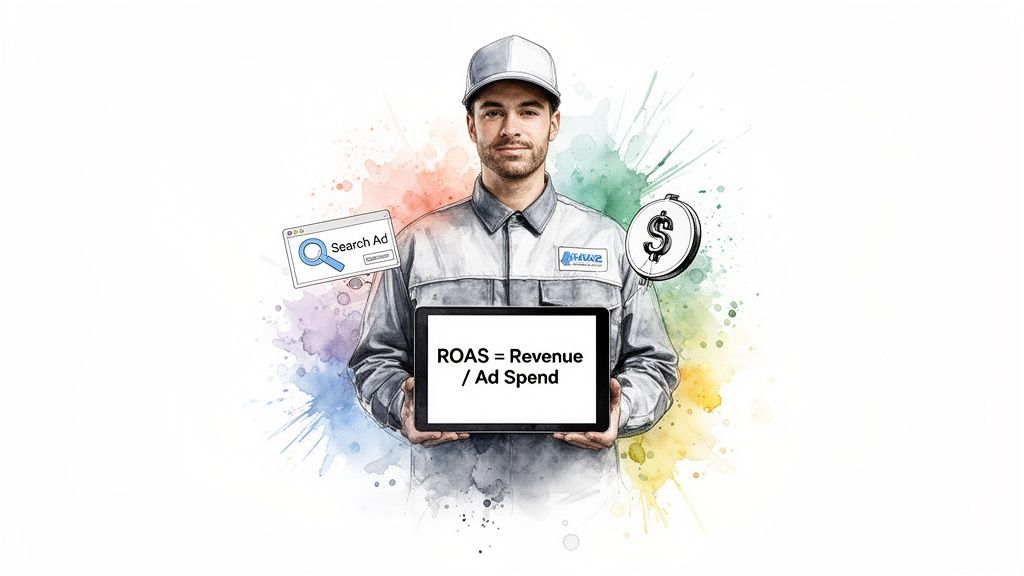
In the HVAC world, getting bogged down in metrics like clicks, impressions, or even cost-per-lead is a dangerous game. They might make your ad campaigns look busy, but they don't pay your technicians or buy new trucks. Booked jobs do. ROAS is the only number that draws a straight line from your ad budget to your bank account.
This isn't just theory; it's a harsh reality in the heating and cooling space. The average Cost Per Click (CPC) for a keyword like 'HVAC repair near me' can easily hit $29.03. It's one of the most brutal battlegrounds on Google Ads.
Now, pair that high cost with a typical Customer Lifetime Value (CLV) of around $15,340 for a loyal residential client. Suddenly, you can see why you need a ROAS of at least 3:1 just to break even after covering all your costs. If you want to dig deeper, you can learn more about how these crucial HVAC marketing statistics directly impact your profitability.
Shifting from Spending to Investing
Getting a handle on your ROAS forces a critical shift in how you think about marketing. You stop seeing it as an "expense" line item and start treating it like what it is: a strategic investment in profitable growth. A high click-through rate means nothing if those clicks aren't turning into high-margin system installations or lucrative service agreements.
The whole point of calculating ROAS is to get undeniable clarity. It tells you which campaigns are filling your schedule with profitable jobs and which ones are just burning cash.
Before we dive into the nuts and bolts of the calculation, here's a quick reference guide to get you oriented. Think of this as your cheat sheet for understanding the core ideas.
ROAS Quick Guide for HVAC Contractors
This table breaks down the essential concepts, benchmarks, and formulas every HVAC owner needs to know before we go deeper.
| Metric | Definition | HVAC Benchmark |
|---|---|---|
| ROAS | Revenue from Ads / Cost of Ads | Target 5:1 or higher for healthy profit margins. |
| Break-Even ROAS | 1 / Your Profit Margin | Typically 2:1 to 3:1, depending on your overhead. |
| Ad Spend | Total cost of your ad campaign. | Varies, but must be tracked accurately. |
| Revenue | The actual dollar amount from jobs booked because of the ads. | Must be tracked back to the source. |
With these fundamentals in mind, you're ready to see how this plays out in the real world. To truly understand why ROAS is king, it helps to look at the broader role of analytics in advertising in building a system where every single dollar is accounted for. This guide will give you the exact tools and frameworks to do just that, ensuring you know precisely which ads are driving your business forward.
The Foundational ROAS Calculation for HVAC Companies
Let's cut through the theory and get down to what actually pays the bills. Knowing how to calculate your Return on Ad Spend is all about connecting your marketing dollars to real, tangible jobs. The formula itself is dead simple.
You just divide the total revenue your ads brought in by how much you spent on them.
ROAS = Total Revenue from Ads / Total Ad Spend
This gives you a straightforward ratio that tells you exactly what you're getting back. A ROAS of 8:1, for instance, means you’re pulling in $8 in revenue for every single $1 you spend on advertising.
A Real-World HVAC Scenario
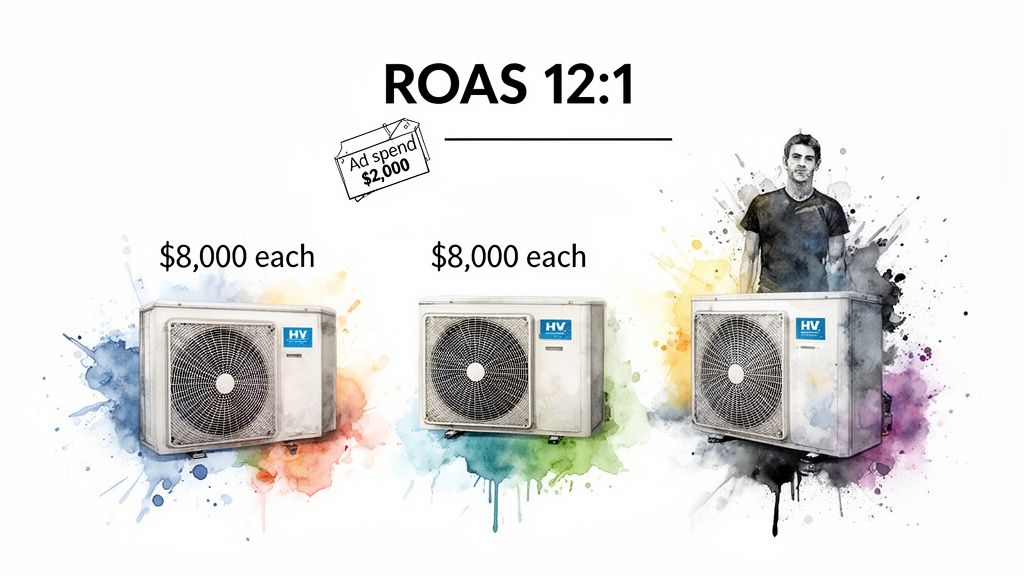
Imagine you're running a Google Ads campaign targeting homeowners with busted air conditioners during a blistering summer heatwave. You decide to put $2,000 into this campaign for the month.
Over that month, your ads bring in a steady flow of calls. After you filter out the tire-kickers and price-shoppers, your team successfully books and completes three full HVAC system installs that came directly from this campaign.
This is the critical link. You absolutely must have a system in place to track which calls and jobs came from which ad. We'll get into that tracking process in a bit, but for now, let's just focus on the math.
Each of those new system installs brings in an average of $8,000 in revenue. Let's break down the campaign's results:
- Total Ad Spend: $2,000
- Jobs Booked: 3 installations
- Average Revenue Per Job: $8,000
- Total Revenue Generated: 3 jobs x $8,000 = $24,000
With these numbers in hand, you have everything you need to calculate ROAS and see just how well your investment paid off.
Putting the Formula into Action
Now, we just plug those numbers back into our simple formula to see how the campaign really performed.
$24,000 (Revenue) / $2,000 (Ad Spend) = 12
That gives you a 12:1 ROAS.
For every single dollar you invested in that Google Ads campaign, you generated $12 in top-line revenue. That's a powerful number that gives you immediate, actionable insight. It confirms your emergency AC repair campaign isn't just an expense—it's a highly profitable growth engine for your business. For a deeper dive, check out this guide on how to calculate ROAS and truly measure ad performance.
Consistent investment is what drives this kind of growth. Research shows that monthly spends of $3,000-$6,000 can lead to over 50% year-over-year growth for HVAC firms in the $1M-$5M revenue range. This foundational calculation is your first step toward making those strategic investments with total confidence.
Tracking What Really Matters Beyond Clicks
The basic ROAS formula is a great start, but it hinges on one massive assumption: that you can actually connect real-world revenue back to your ad spend. This is the single biggest challenge for any HVAC business. A click on a Google Ad doesn't pay the bills. A phone call that leads to a booked install a week later does.
Forget clicks and impressions. Those are vanity metrics. You need a rock-solid system that tracks what truly matters—booked jobs and paid invoices. This means going way beyond the default dashboards in Google or Facebook Ads. The goal is to draw a straight, undeniable line from a specific ad campaign all the way to the final payment from a happy customer.
From Digital Click To Real-World Revenue
The key to solving this puzzle is a technology called dynamic call tracking. It's a simple but brilliant system that assigns a unique, trackable phone number to each of your marketing channels—or even to individual ad campaigns.
Think about it this way: when someone clicks your Google Ad for "emergency AC repair," your website shows them one specific phone number. If another visitor comes from a Facebook ad, they see a completely different number. This means you know with 100% certainty which ad made the phone ring.
All the guesswork is gone. You can finally attribute every single inbound call to its exact source.
Without call tracking, you're essentially flying blind. You might know your phone is ringing more, but you won't know why. You can't calculate an accurate ROAS if you can't prove where the revenue-generating calls came from.
Closing the Loop with Your CRM
Getting the call is only half the battle. To find your true ROAS, you have to connect that first phone call to the final invoice. This is where your call tracking software needs to talk to your Customer Relationship Management (CRM) system.
This integration creates what we call a "closed-loop" reporting system. Here’s how it works in the real world:
- A Lead Calls In: A homeowner finds your Google Local Services Ad and calls the unique number displayed. Your call tracking system instantly logs the source of that lead.
- The Lead Enters Your CRM: The new lead, along with its source data (the ad campaign that drove the call), is automatically pushed into your CRM. No manual data entry needed.
- The Job Is Completed: Your technician knocks it out of the park, completing a $9,500 system installation. The job is marked as "complete" and invoiced inside your CRM.
- Revenue Is Attributed: Because the lead's origin was captured from the very beginning, that $9,500 in revenue is now directly tied back to the specific Local Services Ad that generated it.
This closed-loop system is the ultimate proof of performance. For HVAC contractors, truly understanding how to measure marketing effectiveness is impossible without connecting your ad platform data to your actual sales data. It’s the only way to stop guessing which ads work and start knowing with absolute certainty.
Going Beyond ROAS: The Profitability Metrics That Really Matter
That high Return on Ad Spend (ROAS) number might look great on your marketing report, but let's be honest—it doesn't tell you the whole story. Revenue is one thing; actual profit is another. To really see if a campaign is pulling its weight, you have to dig deeper.
This is especially true for HVAC businesses where the first job is rarely the last.
We need to move past simple ROAS and start thinking about Profit on Ad Spend (POAS). This is where you factor in your real-world costs. Instead of just looking at the $8,000 in revenue from that new furnace install, POAS forces you to account for your actual margins—the cost of the unit, labor, commissions, and all the other overhead that eats into your bottom line.
Simple ROAS vs Profit-Adjusted ROAS
Looking at revenue alone can be dangerously misleading. A campaign might bring in a ton of low-margin repair calls that look great on paper but barely move the needle on your bank account. Here’s a quick comparison to show you why factoring in profit is a non-negotiable.
| Metric | Standard ROAS Calculation | Profit-Adjusted ROAS (POAS) Calculation | Why It Matters |
|---|---|---|---|
| Formula | Revenue / Ad Spend |
(Revenue - Costs) / Ad Spend or Profit / Ad Spend |
Shifts the focus from vanity metrics (revenue) to what actually grows the business. |
| Example Ad Spend | $2,000 | $2,000 | The initial investment is the same for both scenarios. |
| Example Revenue | $8,000 | $8,000 | The top-line revenue number looks identical at first glance. |
| Cost of Goods Sold (COGS) | Not included | $6,000 (unit cost, labor, commission, etc.) | This is the key difference, accounting for the real cost to deliver the service. |
| Calculated ROAS/POAS | 4:1 ROAS ($8,000 / $2,000) |
1:1 POAS (($8,000 - $6,000) / $2,000) |
One looks like a solid win. The other shows you just broke even. |
This table makes it crystal clear: a 4:1 ROAS might actually be a 1:1 POAS, meaning you're just trading dollars. Without knowing your profit, you could be scaling a campaign that isn't actually making you any money.
Beyond the First Sale: Customer Lifetime Value
Here's the most critical shift you can make in understanding your advertising's real impact: Customer Lifetime Value (LTV).
That first job you book from an ad is just the beginning. Your ad didn't just sell a one-off repair; it bought you a new customer relationship that can be worth a small fortune over the next few years.
Think about it. That single customer might:
- Sign up for one of your profitable annual maintenance plans.
- Call you next summer when their AC unit inevitably gives out.
- Buy a complete system replacement from you in five years.
- Tell their neighbors and family all about the great service you provided.
When you start factoring in LTV, a campaign that looked just "okay" with a 4:1 ROAS might actually be a massive long-term winner. That initial $150 repair job could easily lead to over $15,000 in revenue over that customer's lifetime.
This is why tracking is so critical. You have to connect the dots from the first ad click all the way to a closed-won deal in your CRM.
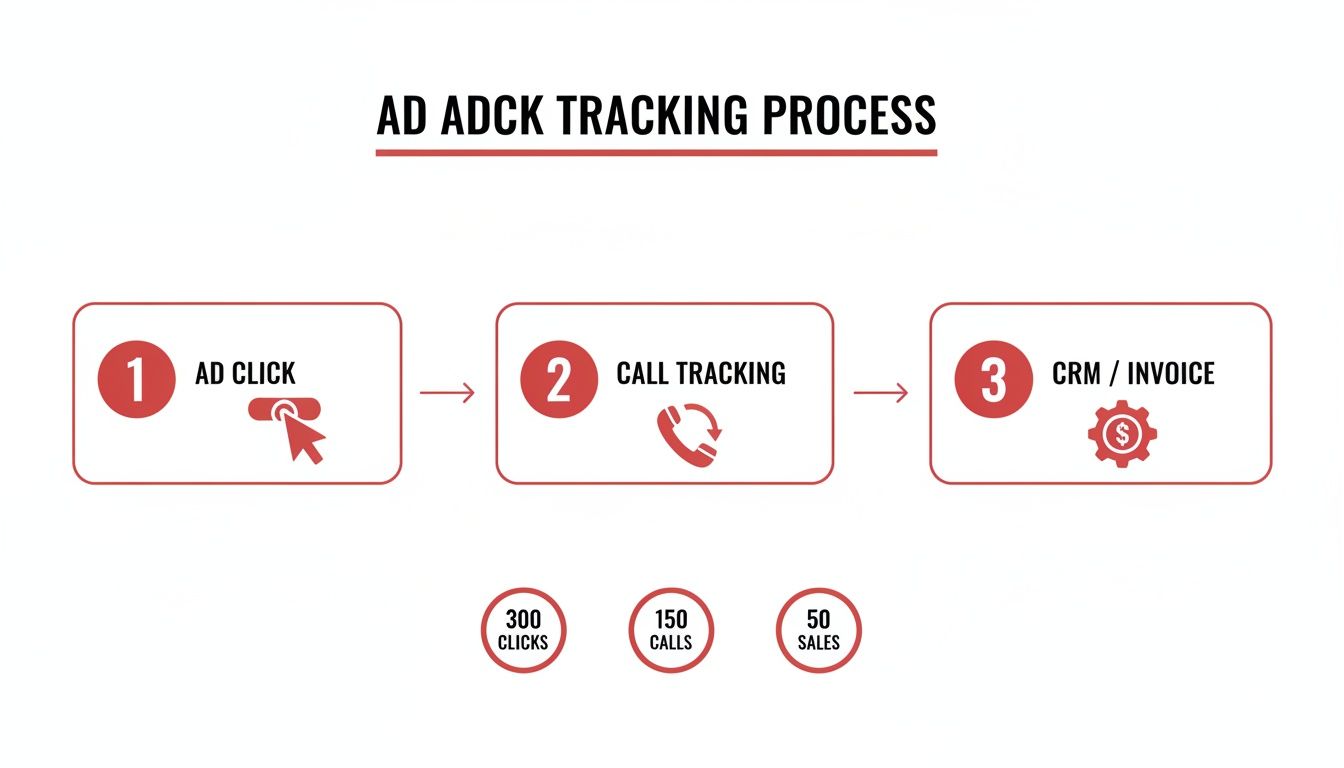
Without this unbroken chain of data, you're just guessing. With it, you can attribute real revenue to the specific marketing efforts that brought in your most valuable customers.
Uncovering the Full Customer Journey
Finally, you can't ignore multi-channel attribution. A customer almost never sees one ad and immediately books a high-ticket job. The journey is more complex.
They might see your Google Local Services Ad, get retargeted with a video on Facebook a few days later, and then finally search for your brand name directly and make a call. A basic ROAS calculation would give 100% of the credit to that final brand search, completely ignoring the other ads that did the heavy lifting to build trust and awareness.
This is where a narrow focus on paid ads falls short. The repeat business in HVAC means there's hidden gold in channels like email and SEO. We've seen that 87% of HVAC companies use email marketing for a reason—it works. Just adding visuals can boost click rates by 300%, feeding directly into that powerful $15,340 average customer lifetime value.
When you adopt this more sophisticated view, you stop obsessing over short-term campaign metrics and start seeing the complete picture of your marketing's long-term financial impact. If you want to get a handle on what it costs to bring these valuable customers in the door, a great next step is to check out our guide on how to calculate cost per acquisition.
Setting Your Target ROAS and Avoiding Common Pitfalls
Knowing your ROAS is a powerful first step, but that number is meaningless without context. The real question isn't just "What is my ROAS?" but rather, "What should my ROAS be to actually grow my business?"
Answering this is what separates HVAC companies that just get by from those that dominate their market.
Lots of marketers will toss around a generic 4:1 ROAS benchmark, suggesting you aim for $4 in revenue for every $1 spent. And while that’s a decent starting point, it's not a universal rule. A truly profitable target ROAS is unique to your business and depends entirely on your profit margins.
Finding Your Break-Even Point
Before you set any goals, you have to know your break-even ROAS. This is the absolute minimum return you need just to cover your costs without losing money on a campaign.
For example, if your company operates on a 30% profit margin, your break-even ROAS is around 3.3:1. Anything below that, and you're literally paying to acquire jobs.
Setting a target without knowing your break-even point is like driving without a map. A 4:1 ROAS might sound great, but if your margins are thin, it might not be enough to generate meaningful profit. Always start with your own numbers.
Once you know where you break even, you can set a realistic target that actually lines up with your growth goals. A target of 5:1 or 6:1 might be the sweet spot that fuels real expansion, letting you invest in more trucks, better tools, and top-tier technicians.
Common Mistakes That Sink HVAC Ad Campaigns
Calculating ROAS is one thing; protecting it from common mistakes is another. Even with the best tracking in place, a few classic pitfalls can completely destroy your returns and make it seem like your ads aren't working.
Here are the most frequent errors we see HVAC owners make:
- Relying on Inaccurate Tracking: Without dynamic call tracking and proper CRM integration, you're just guessing where your best jobs are coming from. Attributing a high-value install to the wrong ad campaign can trick you into cutting spending on what was actually your most profitable channel.
- Ignoring Customer Lifetime Value (LTV): A campaign that generates low-cost repair calls might have a modest initial ROAS. But if a good chunk of those customers sign up for maintenance plans and buy new systems down the road, the long-term ROAS could be massive. You can't just look at the first transaction.
- Pulling the Plug Too Soon: Ad platforms like Google and Facebook need time and data to optimize. Killing a campaign after just a few days of low returns is a classic, costly mistake. You need enough data to see the real patterns and let the platform's algorithm find the right customers for you.
Avoiding these pitfalls is just as important as the initial calculation. For a deeper dive into managing your campaigns effectively, check out our comprehensive guide on HVAC paid ads. It provides actionable strategies to make sure your ad spend translates directly into profitable growth.
Your Top ROAS Questions, Answered
Even with the formula down, putting it into practice in the real world of HVAC always brings up questions. This is where the theory ends and the hard work of tracking real jobs begins. We hear these questions all the time from contractors, so let's tackle them head-on.
What’s a Good ROAS for an HVAC Company, Really?
You’ll see the number 4:1 ($4 back for every $1 spent) thrown around a lot online, but honestly, that’s just a generic starting point. A "good" ROAS depends entirely on your business and, most importantly, your profit margins.
Think about it this way: a company with fat 50% margins on big install jobs could be wildly profitable with a 3:1 ROAS. But another business focused on service calls with tighter 20% margins might need to hit a 6:1 ROAS just to make a decent profit after all costs are paid.
The first thing you must do is figure out your break-even point. Only then can you set a ROAS target that actually helps you hit your growth and profit goals.
How Do I Actually Track Revenue from Ad-Driven Phone Calls?
This is the million-dollar question for any HVAC contractor. If you get this wrong, your ROAS numbers are pure fiction. The single best way to solve this is with dynamic number insertion (DNI) call tracking software.
It sounds techy, but the concept is simple. The software shows a unique phone number on your website to each visitor depending on which ad they clicked. When they call that number, the system automatically tags that call, connecting it back to the specific campaign—and even the exact keyword—that brought them to you.
When you connect your call tracking platform to your CRM, you create a direct, unbreakable line from the first ad click all the way to the final paid invoice. This is the secret to stop guessing and start knowing exactly where your most profitable jobs come from.
My ROAS Is Low. What Should I Check First?
If your ROAS isn't what you hoped for, don't hit the panic button. Before you do anything else, audit these three areas immediately. In our experience, they are almost always the culprits behind poor performance for HVAC ads.
- Your Ad Targeting: Are you actually targeting the right zip codes where your ideal customers live? More importantly, does your ad copy speak their language? An ad for "emergency AC repair" is going to attract a very different person than one for "new AC unit price." Mismatched targeting is the fastest way to burn through your ad budget.
- Your Landing Page: When someone clicks your ad, what do they see? Does that page load instantly on a phone? Is your phone number huge and impossible to miss? Is there a simple "Book Now" button right at the top? We've seen countless high-quality leads give up and leave because of slow, confusing landing pages.
- Your Call Handling: This is the one everyone overlooks. Use your call tracking software to listen to the recordings. Is your team friendly? Are they answering questions confidently and turning callers into booked appointments? A poorly handled phone call can sink a perfect ad campaign. Your team's performance on the phone has a direct and massive impact on your final ROAS.
Ready to stop guessing and start seeing exactly which marketing efforts are booking profitable jobs? The HVAC Growth Machine is a complete system that includes a high-converting website, automated lead follow-up, and the detailed call and revenue tracking you need to calculate your true ROAS with confidence. Secure your exclusive service area and see how it works.





Founder of HVAC Growth Machine