

Let’s be honest, most HVAC websites are little more than a digital business card. They exist, but they don't do anything. An effective website design for HVAC companies is something entirely different. It's your hardest-working sales tool, running 24/7 to turn online searches into booked appointments.
Why Your Website Is Your Most Important Sales Tool
Think of your website as your #1 salesperson. It never sleeps, never calls in sick, and is always ready to guide a potential customer to the right solution. A high-performing site isn't just about looking good; it's a lead generation machine built from the ground up to fill your schedule. This mindset shift turns your website from a line-item expense into a powerful, revenue-generating asset.
Too many contractors treat their website like an afterthought, and that's a massive missed opportunity. When a homeowner's AC gives out in the middle of July, their first move is a Google search. Your website has mere seconds to grab their attention, build trust, and convince them you're the right call. Every single element—from how fast the page loads to how obvious your phone number is—matters in that moment.
The True Purpose of HVAC Website Design
Let's get one thing straight: the goal of your website isn't to win design awards. Its one and only job is to convert traffic into profitable jobs. Period. That means every decision should be focused on what makes a visitor pick up the phone or fill out a form.
A properly designed site acts like a funnel, walking potential customers down a specific path:
- Awareness: They find you through a local search or a well-placed ad.
- Consideration: They land on your site and immediately see your great reviews, professional look, and clearly explained services.
- Decision: They’re guided to a "Book Now" button or a click-to-call number that’s impossible to miss.
Your website’s job is to make it incredibly easy for a homeowner with a broken furnace to see you as the fastest, most trustworthy solution. A confusing or slow website sends them directly to your competitors.
From Clicks to Conversions
There's a huge difference between a site that just gets clicks and one that actually gets you customers. We've seen well-optimized HVAC websites hit conversion rates as high as 15.11%, which blows the industry average out of the water. When you think about the lifetime value of a single HVAC customer, even a tiny bump in your conversion rate can mean thousands in new revenue each month.
The sites that achieve these numbers do it with a relentless focus on the user and a crystal-clear path to scheduling a service. You can learn more about what's working for top performers from the team at Rocket Media.
By treating every page, button, and image as part of a deliberate sales strategy, you can transform your online presence from a passive brochure into an active part of your growth engine. It’s how you make sure your website isn't just costing you money—it's making you money by booking more high-value installation and repair jobs.
The Blueprint For A High-Converting HVAC Website
Think of your website as the digital blueprint for your entire business. A shoddy plan leads to a structure that leaks leads and frustrates visitors. But a great blueprint? That creates a powerful, high-converting machine engineered to turn a potential customer into a scheduled job. The goal isn’t just to look good; it’s to perform flawlessly.
This whole approach is built on understanding one simple thing: user psychology. When a homeowner’s AC dies on a 95-degree day, they aren't casually browsing—they're on a mission. Your website has to meet that urgency with absolute clarity and speed. Every single element, from the layout to the wording, must guide them effortlessly toward a solution.
The Foundation: Mobile-First Design
Your website’s foundation is how it works on a smartphone. Period. The overwhelming majority of homeowners are searching for "emergency AC repair" from their mobile device. If your site is slow, hard to read, or has buttons that are impossible to tap, you've already lost the job.
That's why a mobile-first design isn't just an add-on; it's the non-negotiable starting point for all modern website design for hvac. It means your site is designed for the smallest screen first and then adapted for larger ones. This guarantees that critical info—like your phone number and "Schedule Service" button—is always front and center, no matter the device.
The Structure: Intuitive Navigation and Trust Signals
With a solid mobile foundation, the next step is the structure. This is all about your site's navigation and layout, which needs to be dead simple. A confused visitor is a lost customer, guaranteed. Your menu should be predictable, with clear labels like “AC Repair,” “Furnace Installation,” and “Emergency Services.”
A user should be able to land on your homepage and find the exact service they need within two clicks. If they have to hunt for information, they will just hit the back button and call your competitor.
Beyond easy navigation, your site's structure has to be reinforced with powerful trust signals. These are the little things that tell a visitor your company is legitimate, reliable, and the right choice for the job.
- Prominent Click-to-Call Phone Numbers: Your phone number needs to be impossible to miss in the header of every single page. On mobile, it must be a clickable link.
- Customer Reviews and Testimonials: Don't just link to your Google profile—integrate real reviews directly on your homepage and service pages. Seeing positive feedback from neighbors is incredibly powerful social proof.
- Financing Options: Clearly displaying "Financing Available" can be the deciding factor for a customer staring down a costly system replacement. It removes a massive barrier to making a sale.
- Professional Team Photos: Use high-quality photos of your actual technicians and branded trucks. This humanizes your business and builds far more trust than generic stock photos ever could.
As you put together the blueprint for your HVAC site, it’s critical to understand the core strategies for increasing website conversion rate to make sure every visitor has a clear path to becoming a customer.
Core Features of a High-Performing HVAC Site
Finally, let's talk about the features. A high-converting website is outfitted with tools designed for action. These are the non-negotiable elements that separate a digital brochure from a true lead generation machine. If your current site is missing these, you are leaving money on the table every single day.
You can dive deeper into this topic by checking out our guide on the essentials of an effective HVAC website.
A truly effective website isn't just a collection of pages; it's a system where every feature has a specific job. The table below breaks down the must-have elements and explains why they're so critical for turning website visitors into paying customers.
Core Features of a Lead-Generating HVAC Website
| Website Feature | Primary Purpose | Impact on Conversions |
|---|---|---|
| Simple Lead Capture Forms | To make it easy for visitors to request service without friction. | Reduces user effort, capturing leads from those not ready to call. |
| Clear Calls-to-Action | To explicitly tell visitors what action to take next. | Guides users toward your goals, such as "Schedule Service Now." |
| Dedicated Service Pages | To rank for specific local searches and provide detailed info. | Improves SEO and directly answers a visitor's specific need. |
| Fast Page Load Speed | To prevent visitor frustration and abandonment. | A 1-second delay can reduce conversions by 7%. |
By building your site with this intentional blueprint—a strong mobile foundation, a clear structure built on trust, and features designed for action—you stop having just a website. Instead, you create a digital asset that is engineered to perform and grow your business.
Using Smart Tools To Turn Visitors Into Leads
That generic "Contact Us" form on most HVAC websites? It’s where good leads go to die. Seriously. If you want to capitalize on your hard-earned website traffic, you have to move beyond passive information gathering and start actively engaging homeowners. Smart tools are what bridge that gap, turning your site into a machine that qualifies prospects automatically.
The goal here is simple: provide immediate value. When a homeowner's AC is on the fritz, they want answers now, not hours later when you finally call them back. This is exactly where modern lead capture tools completely change the game.
Think of your website like building a house. You need a solid foundation before you can add the high-tech features that make it a home.
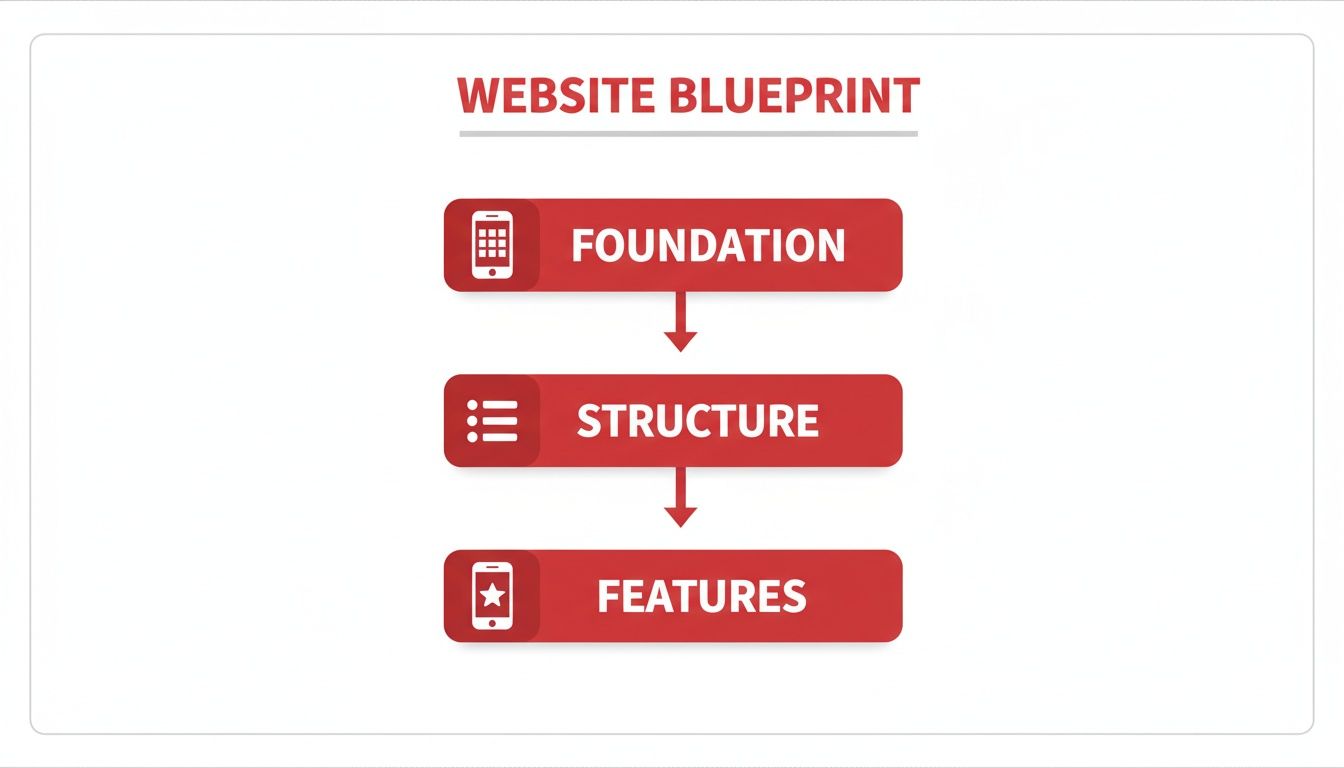
This blueprint shows that without a rock-solid mobile foundation and intuitive navigation, fancy tools like instant estimators won't work nearly as well. You need the whole system working together.
The Power of Instant Online Estimates
One of the single most powerful tools in website design for hvac is an instant online estimate tool. Let's be real—most customers considering a new system are in the research phase. They're trying to figure out a budget but aren't ready to get cornered on a sales call.
An instant estimate tool meets them right where they are. It's a killer lead magnet because it offers something tangible—a ballpark price for their project—in exchange for their contact info. It's a simple, fair trade that lets you capture high-intent leads who would have otherwise bounced from your site and disappeared forever. We dive deep into this strategy in our guide on the power of instant quote tools for HVAC websites.
By providing an instant estimate, you're not just giving a price; you're starting a conversation on the customer's terms. This builds trust and positions you as a helpful expert long before your competitors even know the lead exists.
From Frictionless Booking to Direct Sales
Beyond just estimates, other smart tools can make the entire process dead simple for your customers. An integrated online booking system is a perfect example. It lets a visitor see your real-time availability and schedule a service call right from your website, even if it's 2 AM. No more phone tag. You capture the business at the exact moment they need you.
Making it easy for visitors to take the next step is key. For those who do want to call, having prominent click-to-call functionality ensures they can connect with you instantly from their phone.
You can even add eCommerce features to open up entirely new revenue streams:
- Sell Maintenance Plans Directly: Let customers browse and buy your annual service agreements online. This locks in recurring revenue and customer loyalty without a single sales call.
- Offer Special Promotions: Got a spring tune-up special? Let customers buy it directly from a dedicated page on your site. Easy for them, profitable for you.
These tools aren't just about convenience; they drastically lower your cost to acquire a customer. The average cost per lead in HVAC marketing hovers around a painful $153, and most websites only convert a little over 3% of their traffic. But with smart tools and optimized pages, we've seen that cost plummet to as low as $16 per lead. That’s a massive jump in marketing ROI. By automating the grunt work of lead capture and qualification, you free up your team to focus on what they do best: closing profitable jobs.
How To Dominate The Google Map Pack
For HVAC contractors, the real battle isn’t fought on a national stage—it’s won street by street, neighborhood by neighborhood.
When a homeowner's AC gives out in the middle of a heatwave, they aren't searching for a contractor across the country. They're grabbing their phone and typing in "AC repair near me." This is where the Google Map Pack, that all-important block of three local businesses at the top of the search results, becomes the most valuable real estate online.
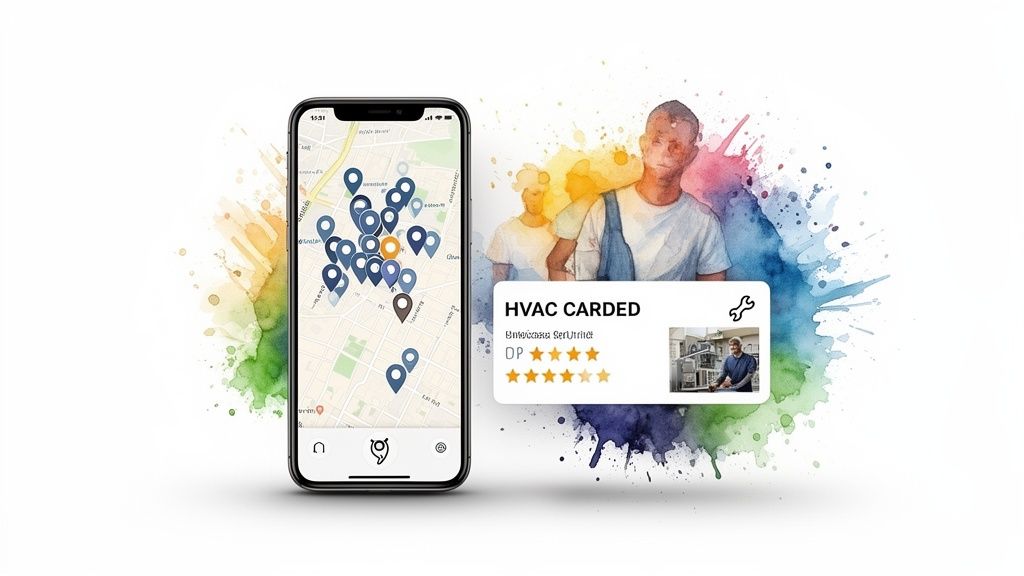
Owning this space requires a smart, two-pronged approach that ties your website directly to your Google Business Profile (GBP). Think of your GBP as the billboard that gets you noticed, and your website as the showroom that actually closes the deal. They have to work together perfectly.
The stakes here are incredibly high. An estimated 80% of local searches for HVAC services end in a conversion—a call, a form submission, a booked job. With a keyword like 'hvac' pulling in around 247,000 searches every month, failing to show up in the Map Pack means you're completely invisible to a massive pool of customers ready to buy right now.
Building Local Authority Through Your Website
Your website is the foundation of your local SEO strategy. Period. Google looks at your site to confirm everything your GBP claims. If your website doesn't scream that you serve specific local areas, your chances of ranking in the Map Pack are next to zero.
The most powerful way to do this is with city-specific service pages. Forget having one generic "AC Repair" page. You need dedicated pages like:
AC Repair in PhoenixFurnace Installation in ScottsdaleEmergency HVAC Service in Tempe
Each of these pages needs to be filled with unique content that’s actually relevant to that location. Mentioning local landmarks, neighborhoods, or specific community needs reinforces your connection. This strategy is a cornerstone of effective website design for hvac because it proves to Google that you are the local expert for that service in that city.
Another key piece of the puzzle is local business schema markup. This is just a fancy term for code added to your website's backend that explicitly tells search engines your business name, address, phone number, and service area. It removes all the guesswork for Google, making your business a much more trusted and authoritative entity in local search.
Optimizing Your Google Business Profile
Your Google Business Profile is your digital storefront, and it needs constant attention. To Google, an active, well-maintained profile signals a reputable and relevant local business. A neglected profile, on the other hand, will quickly get buried.
Your GBP is not a "set it and forget it" tool. Treat it like a social media profile for your business, where consistent activity and customer engagement are rewarded with higher visibility.
Here are the non-negotiable actions you need to be taking:
- Get a steady stream of positive reviews: Reviews are arguably the single most important ranking factor for the Map Pack. You have to actively ask for them from every happy customer.
- Upload geo-tagged photos weekly: Post real photos of your team on the job, your branded trucks, and finished installations. Geo-tagging them with the specific location where the photo was taken adds another powerful local signal for Google.
- Use Google Posts consistently: Share your special offers, company news, and service highlights directly on your profile. This shows Google you're an active, engaged business.
- Answer questions in the Q&A section: Get ahead of the game by proactively answering common customer questions. This lets you control the narrative and provide genuinely helpful information.
Ultimately, the goal is to create a powerful feedback loop. You can learn more about this by checking out our guide on how to optimize your Google Business Profile. Strong local SEO on your website boosts your GBP's authority. In turn, a well-managed GBP drives high-intent local traffic back to your site, where your smart design and clear calls-to-action can finally convert that traffic into scheduled jobs.
Tracking Revenue, Not Just Clicks
Clicks, traffic, impressions—these are vanity metrics. They might look impressive on a report, but they don't pay the bills. The biggest hurdle for most HVAC owners is moving past these surface-level numbers to answer one simple question: are my marketing dollars actually turning into profitable jobs?
This is where true accountability begins. A high-converting HVAC website isn't just about generating leads; it's about generating the right leads and proving which marketing efforts are responsible for your most profitable work. Without a system to track revenue, you’re just guessing where to invest your budget.
From Vague Leads To Specific Revenue
The first step is to pull back the curtain on your analytics by connecting every single lead back to its source. This means knowing, with 100% certainty, whether a booked job came from an organic Google search, a specific Google Ad campaign, or a click from your Google Business Profile.
We make this happen by putting two key technologies to work:
- Dynamic Call Tracking: This clever tool assigns a unique, trackable phone number to each marketing source. When a customer calls, you know exactly which ad, page, or campaign made them pick up the phone.
- Advanced Form Tracking: In the same way, this tracks which marketing channel led a homeowner to fill out a "Request Service" or "Get an Estimate" form on your site.
Putting these tools in place immediately kills the guesswork. You stop wondering what works and start seeing it in black and white.
Connecting The Dots With Your CRM
Now, tracking where the lead came from is only half the battle. A lead for a simple filter change is worlds apart from a lead for a full system installation. To truly measure ROI, you have to connect your website tracking data directly to your Customer Relationship Management (CRM) system.
This integration is the final piece of the revenue attribution puzzle. It lets you see the complete customer journey from start to finish:
- A homeowner clicks on a Google Ad for "new furnace installation."
- They call the unique tracking number shown on your landing page.
- Your CRM logs the call and automatically ties it to that specific ad campaign.
- You close the job for an $8,500 furnace installation.
Now you can confidently say, "My Google Ads campaign for furnace installations spent $500 this month and brought in $17,000 in actual, closed revenue." This is the kind of data that lets you make smart, profitable decisions.
This level of insight transforms your marketing from a frustrating expense into a predictable investment. You can confidently double down on the channels that bring in high-value installation jobs and cut spending on campaigns that only deliver low-profit repair calls.
Ultimately, a data-driven approach is what separates a basic website from a true growth machine. It allows you to stop paying for clicks and start investing in tangible revenue, ensuring every marketing dollar you spend is working hard to grow your bottom line.
Choosing The Right Partner For Your Website
You've got the blueprint for a high-converting website. But knowing what you need and actually getting it are two completely different things. Honestly, deciding who builds your site is one of the most important business decisions you'll make this year. It's a choice that will directly impact your lead flow, how much you get out of your marketing dollars, and whether you grow or stagnate.
It all boils down to a classic trade-off: cost, speed, and real-world expertise. You generally get to pick two. For an HVAC business owner, there are three paths you can go down, and each one has some serious pros and cons.
Comparing Your Website Build Options
Every contractor's situation is a little different, but the ways a bad website choice can bite you are remarkably similar. A cheap DIY site might feel like a win upfront but often ends up costing you a fortune in lost leads down the road. A generic marketing agency might talk a big game and show you a pretty design, but they just don't get what makes an HVAC customer pick up the phone.
Let's break down the usual suspects:
The DIY Route (Website Builders): Platforms like Wix or Squarespace look tempting because they're cheap. The problem is, they are notoriously weak on the technical and local SEO that service businesses live and die by. More importantly, they don't have the specialized lead-capture tools—like instant quote calculators—that turn casual website traffic into actual jobs.
A Generic Marketing Agency: These folks can definitely build a professional-looking site. But they rarely have deep HVAC industry knowledge. They don't understand the urgency of a "no AC on a 95-degree day" call or the subtle differences in selling a $15,000 system install versus a $250 repair. The result is often a site that looks good in a portfolio but doesn't actually convert visitors into paying customers.
An HVAC Industry Specialist: This partner lives and breathes your world. They already know your sales cycle, why the Google Map Pack is everything, and which specific website features generate profitable installation leads. Their entire process is built around a framework that's already been proven to work for contractors just like you.
The Essential HVAC Partner Checklist
When you're looking at a potential partner for your website design for hvac, you're not just buying a product. You're investing in a system designed for growth. Use this checklist to cut through the slick sales pitches and find a provider who can deliver real, measurable results.
A great partner doesn't just ask what you want your website to look like. They ask what you want your business to accomplish and then build the digital tool to make it happen.
Your ideal partner should be able to give you a confident "yes" to every one of these questions:
- Do they specialize in the HVAC industry? They need to get your customers, your services, and the competitive local market without you having to explain it all from scratch.
- Do they offer proprietary lead generation tools? Look for game-changers like instant online estimate calculators or built-in eCommerce for maintenance plans. These are things generic agencies just can't build.
- Is their process focused on revenue attribution? They must have a rock-solid system for tracking calls and forms back to the specific marketing channel that brought them in. This is how you prove which efforts are actually making you money.
- Do they manage technical and local SEO? A true partner doesn't just build the site and walk away. They handle the ongoing work of optimizing your site and Google Business Profile to make sure you're the one showing up in local search.
- Is their solution built for speed and conversions? Ask them point-blank about their launch timeline. A specialist who has this down to a science can often launch a fully optimized, lead-generating site in weeks, not months. That means you get leads faster.
Choosing the right partner means you can stop trying to be a website manager and get back to what you do best: being an HVAC business owner. When you pick a specialist who understands your world, you’re not just buying a website; you’re investing in a predictable system that fills your calendar and grows your company.
Here are the answers to the questions we hear most often from HVAC owners thinking about a new website. These are the real-world numbers and timelines you need to make a smart decision.
How Much Does A Professional HVAC Website Cost?
This is a huge range. You could get a basic template site for a few thousand bucks or pay a generic marketing agency upwards of $25,000 for a custom build.
But honestly, the upfront cost is the wrong thing to focus on. A cheap website that brings in zero leads isn't a bargain; it's just an expense. On the other hand, a high-performance site that consistently books jobs is an investment that pays for itself over and over again.
Instead of asking about cost, ask about the potential ROI. The right solution should have predictable pricing and be engineered from day one to deliver measurable results, not just a big one-time invoice and a prayer that it works.
How Long Does It Take To Build A New HVAC Website?
If you go with a typical marketing agency, get ready to wait. A custom project can easily drag on for three to six months from the first call to launch day. That's an entire season of missed opportunities while they try to figure out the HVAC business from scratch.
A much faster route is working with a provider who specializes in HVAC. When you start with a proven, optimized framework built specifically for this industry, the whole process gets streamlined. We've seen high-performing, fully customized sites go live in just a few weeks because the core system is already built to convert.
Every month you wait for a new website is a month you're losing money. The opportunity cost of a six-month build can easily climb into the tens of thousands in lost revenue. A faster launch means you start getting leads sooner.
Is SEO More Important Than Good Website Design?
That’s a trick question we hear all the time. The real answer is that they are two sides of the same coin—you can't have one without the other.
SEO is what gets people to your digital front door. But great website design for hvac is what convinces them to walk inside and become a customer. You could rank #1 on Google for every keyword in your city, but if your site is slow, confusing, or doesn't make it painfully obvious how to book a call, all that traffic is worthless.
A website that actually grows your business is built with SEO fundamentals baked in from the very beginning and is designed with a single, obsessive focus: turning visitors into leads.
At HVAC Growth Machine, we got tired of seeing owners get stuck with pretty websites that didn't actually make the phone ring. So we built a complete, done-for-you system that solves all these problems. Our platform is designed to generate profitable install jobs, and we can launch your new site in as little as 7-10 business days. See how our system works at https://hvacgrowthmachine.com.





Founder of HVAC Growth Machine