

SEO for HVAC isn’t just another marketing buzzword—it’s the single best way to get in front of homeowners who are actively looking for your services. This isn’t about crossing your fingers and hoping for a lead. It’s about being the first and best answer when a furnace dies mid-winter or an AC unit gives out during a brutal summer heatwave.
Why SEO Is Your Most Valuable Technician
Let’s be real: traditional advertising is a total gamble. You throw money at a billboard or a radio ad and hope the right person sees it at exactly the right moment. SEO for HVAC flips that entire model on its head. Instead of shouting into the void, you strategically position your business to be found by customers who have an urgent problem right now.
Think about two HVAC companies in the same town. One is stuck on the rollercoaster of inconsistent word-of-mouth and seasonal ad buys, leading to chaotic busy weeks followed by dead-slow ones. The other invests in a smart SEO strategy.
When a homeowner’s AC quits on a 95-degree day, they aren’t checking their mailbox for a flyer. They’re grabbing their phone and searching “emergency ac repair near me.” The company with solid SEO is right there in the top results, ready to be the hero. That’s the power of meeting a customer exactly where their need is greatest.
The Core Pillars of HVAC SEO
A winning SEO strategy isn’t some magic trick; it’s a machine built from a few core pillars working in sync. This diagram breaks down how local search optimization, a strong website, and clean technical SEO come together to create a predictable lead-generation engine.
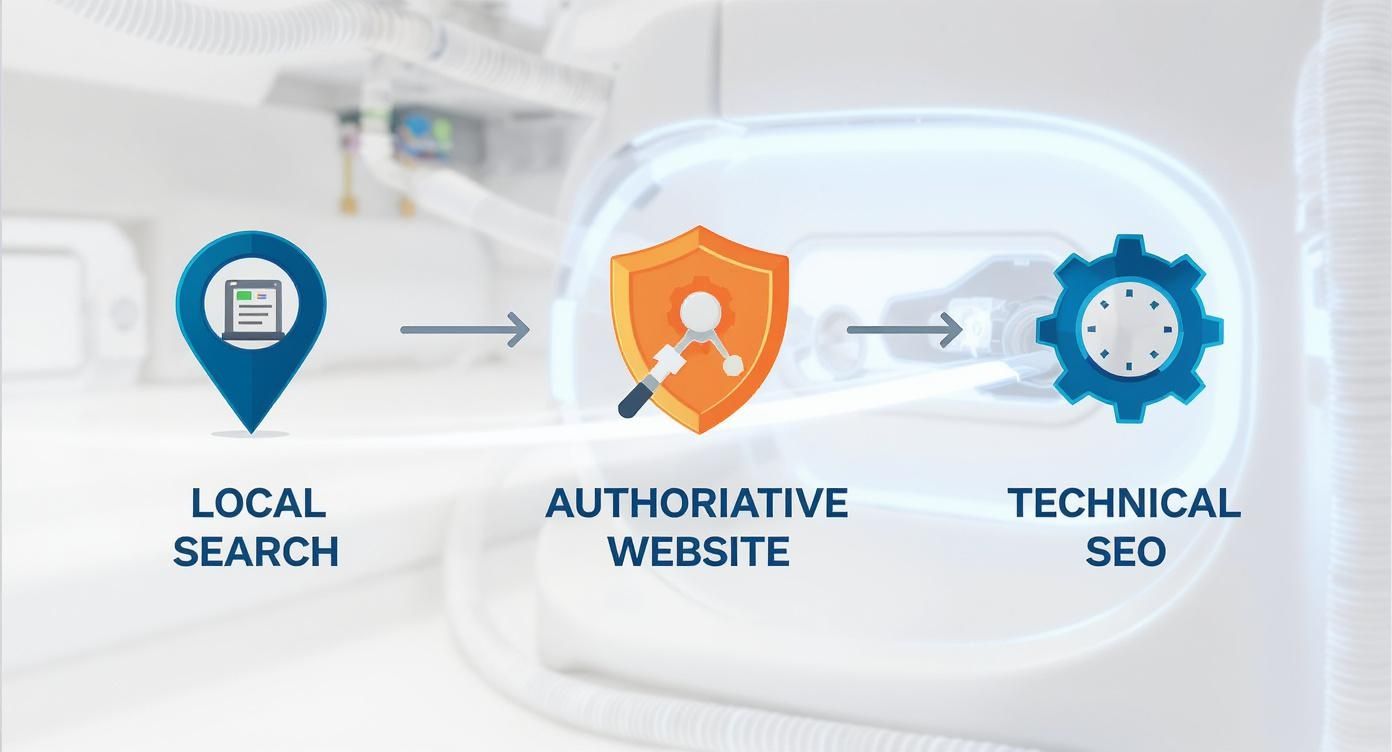
As you can see, it all starts with local visibility. That foundation is then supported by an authoritative website and powered by a technically sound setup. Each piece builds on the last, creating a durable system that consistently attracts the right customers.
The industry data doesn’t lie. Around 60% of HVAC contractors point to SEO as their number one source for high-quality leads, and organic search drives over half of all website traffic in the home services space. You can discover more about how HVAC contractors are generating leads with these insights.
SEO is your most reliable technician because it works 24/7. It doesn’t call in sick or take vacations. It’s constantly on the front lines, capturing high-intent leads from homeowners who need your help right now, turning your website into a predictable source of profitable jobs.
Winning the Local Battle with Google Business Profile
Let’s get one thing straight: Your Google Business Profile (GBP) isn’t just another online listing. It’s the digital front door for 99% of your local customers. When a homeowner’s AC gives out in July, their first move is to grab their phone and search “ac repair near me.” That map pack at the top of the results? That’s your Super Bowl.
Dominating that space is non-negotiable for any HVAC business that’s serious about growth.
Think of your GBP as your most valuable piece of digital real estate. It’s where potential customers get their first impression, scan your reviews, see photos of your team, and decide in a matter of seconds whether to call you or your competitor down the street. A neglected profile is like a dirty, unwelcoming storefront—it’s actively costing you money every single day.
Going Beyond the Basic Setup
Just claiming your profile and tossing in your phone number is table stakes. That was enough five years ago. To win today, you have to treat your GBP like an active, living marketing channel. This means digging into every single feature Google gives you and optimizing it through the eyes of a stressed-out homeowner.
The goal is to answer their questions before they even have to ask. A fully fleshed-out profile sends a powerful signal to both Google and your customers that you’re an active, reputable authority in your local market.
It starts with your categories. Your primary category should be “HVAC contractor,” but don’t you dare stop there. You need to add secondary categories that cover all your bases and tell Google exactly what you do.
- Heating contractor
- Air conditioning contractor
- Air conditioning repair service
- Furnace repair service
These act like powerful keywords for Google, helping you show up for a much wider range of searches. It’s a simple tweak that makes a huge difference.
Crafting a Customer-Focused Profile
Once your categories are locked in, it’s time to fill out the details that actually build trust and make the phone ring. This isn’t about stuffing keywords; it’s about speaking directly to a homeowner’s immediate pain points.
Take your business description. Instead of the generic, “We offer quality HVAC services,” try something that connects with their emergency:
“When your AC dies in the middle of a summer heatwave, you need help—fast. At [Your Company Name], we offer 24/7 emergency repairs to get your home cool and comfortable again. No waiting, just reliable service.”
That small shift changes everything. You’ve gone from a bland statement to an immediate solution for their urgent problem. For a deeper dive into these kinds of advanced strategies, check out our in-depth guide on how to optimize your Google Business Profile for maximum impact.
A killer GBP anticipates what a customer needs to see. It confirms you service their neighborhood, shows real photos of your clean vans and uniformed techs, and backs it all up with a steady stream of recent 5-star reviews. It makes the decision to call you the easy one.
Activating Every Feature for Maximum Visibility
A static profile is an invisible profile. You have to consistently use the interactive features Google provides. This sends constant signals that your business is active, engaged, and a top result for local searches.
Google Business Profile Optimization Checklist
Here’s a quick-reference table to make sure you’ve covered all the critical elements for a high-performing Google Business Profile. Running through this checklist ensures you’re not leaving any opportunities on the table.
| Element | Optimization Action | Why It Matters |
|---|---|---|
| Categories | Select “HVAC Contractor” as primary. Add all relevant secondary categories (Heating, AC Repair, etc.). | Tells Google exactly what services you offer, increasing your visibility for specific searches. |
| Services | List every individual service you offer with descriptions (e.g., “Ductless Mini-Split Install”). | Creates more opportunities to rank for long-tail, high-intent keywords from homeowners. |
| Photos & Videos | Upload 10+ high-quality, geotagged photos of your team, vans, and completed jobs weekly. | Builds instant trust and visual proof. Shows you are a real, active local business. |
| Google Posts | Publish at least 1-2 posts per week with offers, tips, or company news. | Signals to Google that your business is active and engaged, boosting local ranking factors. |
| Q&A Section | Proactively add and answer 5-10 frequently asked questions (financing, service areas, etc.). | Removes friction for potential customers and positions you as a helpful expert upfront. |
| Reviews | Actively request reviews from every customer. Respond to 100% of reviews within 24 hours. | Social proof is the #1 trust factor for local services. Positive velocity & engagement helps ranking. |
Completing these actions turns your GBP from a simple listing into a powerful, automated lead-generation machine that works for you 24/7.
Using GBP’s Interactive Tools
Services: Don’t just list “AC Repair.” Get granular. Add separate line items for “Ductless Mini-Split Installation,” “Smart Thermostat Installation,” and “Commercial Rooftop Unit Repair.” Every single service you list is another chance to show up in a specific search.
Photos and Videos: This is where you show, not just tell. You need a steady stream of high-quality, geotagged photos showing:
- Your uniformed technicians standing next to your clean, branded vans.
- Before-and-after shots of tidy installations.
- Your team actively working on a job site (with the homeowner’s permission, of course).
- Short, 30-second video testimonials from genuinely happy customers.
This kind of visual proof is incredibly powerful and builds far more trust than the stock photos your competitors are using.
Google Posts: This feature is gold, and most of your competition is ignoring it. Use it every single week to promote your “$99 Fall Furnace Tune-Up,” highlight your 24/7 availability during a heatwave, or share a link to a new blog post. These posts show up right in your profile and prove to customers you’re open for business.
Q&A Section: Don’t wait for customers to ask questions—answer them ahead of time. Think about the most common questions you get on the phone and populate this section yourself.
- Question: “Do you offer financing for a new furnace?”
- Answer: “Absolutely! We have several flexible financing options to fit your budget. You can learn more and even get pre-qualified right on our website.”
By answering these questions upfront, you remove roadblocks for potential customers and show them you know what you’re doing. Actively managing these features is what separates the HVAC companies that dominate the map pack from the ones that are invisible.
Crafting Your High-Converting Website
Your Google Business Profile gets the customer to the front door, but your website has to convince them to come inside and book a job. A website isn’t just an online brochure; it’s your best salesperson, working 24/7. It has one primary purpose: turning visitors into paying customers.
Think of it like this: a homeowner with a broken furnace lands on your site. They’re stressed, probably cold, and need a solution now. Your website has seconds to communicate trust, expertise, and that you’re easy to work with. If it’s slow, confusing, or looks like it was built in 2005, they’ll hit the back button and call your competitor. It’s that simple.
A modern, high-converting website does more than just list your services. It guides the visitor on a clear path from problem to solution, making it incredibly easy for them to take the next step.
Structuring Your Site for Maximum Impact
An effective HVAC website is built around its core, high-value services. Forget a single, generic “Services” page. To really move the needle, you need dedicated, individual pages for every single service you want to rank for in Google.
This structure tells Google you’re an authority on each topic and gives customers a hyper-relevant landing page for their specific problem.
Instead of one catch-all page, you should have separate, detailed pages for things like:
- AC Repair
- AC Installation & Replacement
- Furnace Repair
- Furnace Installation & Replacement
- Ductless Mini-Split Systems
- Indoor Air Quality Solutions
Each of these pages should be a complete resource. Answer common questions, explain your process, and show why you’re the best choice for that specific job. This targeted approach is fundamental to a winning SEO for HVAC strategy because it allows you to rank for a much wider range of profitable keywords. If you want a blueprint, check out our guide on HVAC web design that converts visitors into leads for some actionable examples.
Dominating Local Search with Service Area Pages
Beyond your service pages, your secret weapon for local domination is building out hyperlocal service area pages. These are pages specifically dedicated to each city, town, or neighborhood you serve. Think about it—a homeowner in a specific suburb is far more likely to trust a company that explicitly states they serve their community.
A powerful service area page for “HVAC Repair in [Your City]” should include:
- Unique, Local Content: Don’t just swap out the city name. Mention local landmarks, common housing styles (like historic homes with tricky ductwork), or specific weather challenges in that area. This proves you’re a genuine local expert, not a faceless corporation.
- Customer Testimonials: Feature reviews from customers who actually live in that town. This provides powerful, relevant social proof.
- Project Photos: If you can, include geotagged photos of jobs you’ve completed in that neighborhood. Nothing builds trust like seeing your trucks in a familiar part of town.
This strategy sends powerful local relevance signals to Google, helping you show up when someone searches “furnace repair in [suburb name].” It builds a digital footprint that mirrors your physical service area.
Your website must make a visitor feel understood. By creating dedicated pages for their exact problem (AC repair) and their specific location (their town), you instantly build a connection and signal that you are the right person to solve their problem.
Practical Keyword Research for HVAC
Keyword research doesn’t need to be some dark art. Your goal is to find the high-intent phrases that signal an immediate need. We call these the “money” keywords because they lead directly to booked jobs.
Just think like a customer in distress. What would they type into Google?
- “emergency ac repair near me”
- “furnace not blowing hot air”
- “cost to replace air conditioner”
- “best hvac company in [Your City]”
You can use a simple tool like Google’s Keyword Planner or even just pay attention to the autocomplete suggestions in the Google search bar to find variations. Focus on keywords that combine a service with a location and an intent word (like “emergency,” “repair,” “cost,” or “installer”).
Writing Titles and Descriptions That Get Clicked
Once you know your keywords, you have to write page titles and meta descriptions that demand a click from the search results page. This is your one chance to stand out from all the other blue links.
A great page title follows a simple, proven formula:
Primary Keyword | Secondary Benefit | Brand Name
Let’s look at an example for a furnace repair page targeting a specific city:
24/7 Furnace Repair in [Your City] | Fast, Reliable Service | [Your Company Name]
This title immediately addresses the user’s need (“furnace repair”), highlights a key benefit (“fast, reliable”), and includes your brand for recognition. It’s clear, compelling, and perfectly optimized for search.
Your meta description is your short sales pitch. It needs to expand on the title and give the searcher a compelling reason to choose your listing over the others.
Example Meta Description:
“Furnace on the fritz? Our licensed technicians offer fast, 24-hour furnace repair in [Your City]. We fix all makes & models. Call now for a quick diagnosis & upfront pricing!”
This description uses action-oriented language, addresses key concerns like pricing and timing, and ends with a crystal-clear call-to-action. By combining a well-structured site with targeted local pages and compelling search snippets, your website becomes an unstoppable lead-generating machine.
Building a Technically Sound Foundation
If your website is your digital showroom, then technical SEO is the high-efficiency engine running the whole operation. It’s all the behind-the-scenes work that makes your site fast, secure, and dead simple for both customers and Google to understand. Ignore this, and even the slickest website will fail when it matters most.
Imagine a homeowner frantically searching “emergency AC repair” during a summer heatwave. They click your link, but the page just spins… and spins. They’re not waiting around. They’ll hit the back button and call your competitor whose site loaded instantly.
That’s a lost job, right there.
Technical SEO isn’t just a box to check; it’s a massive factor in getting your HVAC website to the top of Google. Search engines are smart—they want to send users to sites that work flawlessly, especially on a phone. With so many homeowners searching while standing right next to their broken furnace, this is a no-brainer.
The data backs this up. One in four visitors will ditch a webpage that takes more than four seconds to load. That delay can kill your lead flow. You can dig into more of these HVAC marketing findings to see just how critical this stuff is.
Prioritizing Speed and Mobile Performance
Website speed isn’t a “nice-to-have.” It’s a core part of the customer experience and a huge ranking signal for Google. A slow site frustrates potential customers and tells Google that you offer a poor experience.
To keep your site running at peak performance, you need to get these things right:
- Image Compression: Those beautiful, high-resolution photos of your latest install are awesome, but they’re also huge files that can bog down your site. Use a tool to compress images before you upload them. You can dramatically cut down file size without sacrificing much quality.
- Quality Web Hosting: Don’t cheap out on hosting. A budget shared plan might save you a few bucks a month, but it can cost you thousands in lost business from slow load times. Invest in a solid hosting provider known for speed.
- Clean Code: A website cluttered with clunky plugins or messy code is like an engine gummed up with sludge. It’s just slow and inefficient. A well-built site, like one from HVAC Growth Machine, is built from the ground up for speed.
Think of your website’s speed like your response time to an emergency call. The faster you show up and solve the problem, the happier the customer is. Your website needs to deliver that same sense of speed and reliability from the very first click.
Translating Your Services for Search Engines
Beyond just being fast, you need to make it incredibly easy for Google to know exactly what you do, where you do it, and when you’re available. This is where a powerful tool called schema markup comes into play.
Schema is basically a special code you add to your site that acts like a translator, telling search engines what your content actually means. It turns your business info into structured data that Google can read and feature directly in the search results.
This screenshot from Google shows how structured data helps search engines understand the content and purpose of a webpage.
By giving Google these explicit clues, you help them feature your business more prominently. This is what powers those “rich results” you see, like star ratings or pricing right in the search listings.
For an HVAC business, this is a total game-changer. By using HVAC-specific schema, you can tell Google things like:
- Your exact service area, down to the zip codes.
- Your 24/7 emergency service hours.
- The specific services you offer (like “FurnaceRepair” or “AirConditioningInstallation”).
- Your customer reviews and average star rating.
Getting this right helps Google show all that great info right on the search page, giving you a massive leg up on competitors who haven’t bothered. It’s the difference between a plain, boring listing and one that’s packed with helpful details that make your business the obvious choice for a homeowner in need.
Earning Trust and Authority Online
Having a technically sound website and a perfectly optimized Google Business Profile is a massive win, but it’s only half the battle. Google is smart. It looks for signals off your website to verify that you’re a legitimate, trusted authority in your community. This is where your off-page SEO strategy comes in—it’s about building your reputation across the entire web, not just on your own turf.
Think of it like digital word-of-mouth. When other reputable websites, directories, and local organizations vouch for you, Google listens. These signals are incredibly powerful for climbing the map pack rankings and proving you’re a real, boots-on-the-ground HVAC business.
Mastering Your Digital Footprint with Citations
The foundation of your off-page presence is built on citations. A citation is simply any online mention of your business’s Name, Address, and Phone number (often called NAP). You’ll find these on sites like Yelp, Angi, the Better Business Bureau, and dozens of other local and industry-specific directories.
Here’s the single most important rule with citations: absolute consistency.
Your NAP information must be identical everywhere. A tiny variation, like “St.” instead of “Street” or “LLC” in one place but not another, can create confusion for Google’s algorithm. These inconsistencies plant a seed of doubt, making it harder for Google to trust your location data, which can directly hurt your local rankings.
A clean, consistent citation profile acts like a verified digital ID for your HVAC business. It tells Google, “Yes, this company is real, this is their physical address, and this is their phone number.” This verification is a non-negotiable step for dominating local search.
Auditing and cleaning up your citations is tedious, I get it. But it’s a critical, foundational piece of any serious SEO for HVAC campaign. Start with the major platforms, then work your way down the list, making sure every single listing is a perfect mirror of your Google Business Profile.
Building Links the Smart Way
Beyond citations, the other major off-page signal is backlinks—links from other websites pointing back to yours. For a local business, quality crushes quantity every single time. A single link from a well-respected local news site or community organization is worth more than a hundred links from spammy, low-quality directories.
Forget about complex, time-sucking outreach campaigns. The best, most powerful links for an HVAC company come from genuine community involvement. You don’t need to be a marketing wizard; you just need to be a good local business.
Here are a few high-impact, realistic ways to build links:
- Sponsor a Local Team: Sponsoring the local little league team or a high school football event almost always gets you a thank you—and a link—from their website. That’s a super powerful, locally relevant link that signals true community involvement.
- Partner with Other Home Services: Build real relationships with a trusted local plumber, electrician, or roofer. You can recommend each other’s services to clients and link to one another from a “Trusted Partners” page on your respective websites.
- Offer a Trade School Scholarship: Create a small, annual scholarship for a student in the HVAC program at a local vocational school. The school will almost always link back to your site from their financial aid or community partners page. Links from educational institutions (.edu domains) are gold.
These aren’t just link-building tactics; they build real-world goodwill and solidify your status as a pillar of the community. This is exactly what Google wants to reward. It’s a clear signal that your authority isn’t just digital—it’s earned through genuine local presence and engagement.
Turning Your Traffic into Paying Customers
Getting your website to the top of Google is a huge win, but traffic doesn’t pay the bills—booked jobs do. All your SEO efforts are only valuable if they connect directly to your bottom line. This is where you shift your focus from just attracting visitors to actively converting them into paying customers.
It’s all about understanding what’s actually driving growth. You need to track the metrics that matter, like inbound phone calls from organic search, form submissions for high-value installs, and keyword rankings for your most profitable services.
Tracking What Actually Matters
Simple tools can give you incredible clarity. Using Google Analytics alongside a call tracking service allows you to see exactly which keywords and pages are making your phone ring. You can finally answer questions like, “Did that blog post about furnace maintenance actually lead to any tune-up calls?”
This data-driven approach removes the guesswork from your marketing. It proves the value of your SEO investment and shows you where to double down.
In fact, 49% of HVAC marketers recognize organic search as their highest ROI channel, beating out paid ads and other methods. When you can connect your SEO work directly to revenue, its power becomes undeniable. You can find out more by reading the full research about HVAC marketing ROI.
Optimizing Your Website for Conversions
Once you have traffic, you need to make it incredibly easy for visitors to take the next step. This is Conversion Rate Optimization (CRO), and it’s about turning your website into an efficient lead-generating machine.
Small changes can make a massive difference. Here are a few practical tips we’ve seen work time and time again:
- Make Your Phone Number Unmissable: It should be proudly displayed in the top right corner of every single page. And on mobile, it absolutely must be “click-to-call.” No excuses.
- Use Clear Calls-to-Action (CTAs): Don’t just say “Contact Us.” Use strong, action-oriented language like “Schedule Service Now” or “Get Your Free Estimate” on highly visible buttons.
- Build Instant Trust: Feature photos of your actual technicians in uniform, not stock photos. Add customer testimonials with real names and cities. Display trust badges like the BBB or local affiliations. People buy from people they trust.
A high-converting website anticipates a visitor’s needs and removes all friction. It answers their immediate questions, builds confidence, and provides an obvious, easy path to scheduling a service call, turning a stressed-out homeowner into a happy customer.
Another powerful conversion tool we swear by is an instant quote calculator. Giving visitors the ability to get a ballpark estimate for a new system can capture leads that might otherwise just leave your site. You can learn more about the power of instant quote tools for HVAC websites in our detailed guide.
By focusing on both attracting and converting traffic, your SEO strategy becomes a predictable engine for business growth.
Common HVAC SEO Questions

Alright, even with a solid game plan, you’ve probably got some real-world questions about putting HVAC SEO into action. Let’s tackle the ones we hear most often from owners who are exactly where you are right now. No fluff, just straight answers.
How Long Does SEO Take to Work?
Let’s get this out of the way: SEO is a long game, not a lottery ticket. You’re building a real asset. With a sharp focus on your Google Business Profile, you can start seeing some movement in local rankings within 60-90 days.
But for the big, competitive keywords—the ones that drive installs—you’re looking at a 6-12 month timeline to consistently own page one. The exact timeframe really depends on how competitive your city is, where you’re starting from, and how consistently you work the plan.
Paid ads are like renting a billboard—the traffic stops the second you stop paying. SEO is like buying the billboard. The authority and rankings you build will keep generating leads for years, adding real, tangible value to your company.
Can I Do HVAC SEO Myself?
Absolutely. You can definitely get your hands dirty with the fundamentals. Things like optimizing your Google Business Profile, consistently asking for reviews, and snapping photos on job sites are high-impact tasks you can manage internally. This guide gives you the blueprint for exactly that.
But once you wade into the deeper end of the pool—technical stuff like site speed, schema markup, or building quality backlinks—it gets complicated, fast. Most owners realize their time is better spent running crews and closing the deals that a dedicated SEO strategy brings in.
A lot of our most successful clients use a hybrid approach that works like a charm:
- You and your team handle: The day-to-day GBP updates, asking every happy customer for a review, and taking those before-and-after project photos.
- An expert handles: The technical SEO weeds, content strategy, citation building, and tracking what’s actually turning into revenue.
This keeps you in the driver’s seat while making sure the complex, time-sucking work gets done right. It’s the fastest path to seeing a real return on your investment and actually growing the business.
Ready to stop guessing and start growing with a proven system? HVAC Growth Machine provides a done-for-you website and lead generation engine that turns your online presence into a predictable source of profitable jobs. See how it works at https://hvacgrowthmachine.com.
Article created using Outrank





Founder of HVAC Growth Machine