

Your HVAC website should be your best salesperson. Period. It ought to be working for you 24/7, booking high-profit jobs while you sleep. But for way too many contractors, their site is more like a silent receptionist who just hands out a digital brochure, costing them leads and revenue every single day.
If your online presence isn't actively turning visitors into paying customers, it's not just an underperforming asset—it's a massive, gushing leak in your sales pipeline.
Why Your Current Website Is a Leaky Sales Pipe
Think about your best salesperson for a minute. They're proactive, they know how to build trust, and they're always closing. They listen to what customers need, answer questions on the spot, and guide people to the right solution, earning their keep by bringing in real money.
Now, take a hard look at your website. Does it do any of that? Or does it just sit there, a static list of services on a digital flyer?
This is the fundamental problem we see over and over. An outdated website doesn't just represent a missed opportunity; it's actively hurting your business. Every single homeowner who lands on your site and clicks away without booking a call is lost income—especially when we're talking about high-ticket system installations.
The True Cost of an Underperforming Site
When a homeowner's AC gives out at 10 PM on a Friday, they aren't going to wait for your office to open on Monday morning. They're grabbing their phone and searching for someone who can help them right now.
An underperforming site completely fails this critical "late-night emergency" test. It has no way to capture that lead after hours, forcing that desperate customer to click over to a competitor who offers instant online booking or a 24/7 chat service.
A website should be a revenue-generating asset, not a line item on your expense report. Its primary job is to fill your calendar with profitable jobs. If it’s failing at that, it’s failing your business.
Beyond just losing out on immediate leads, a poorly built website kills your credibility. In a crowded local market, your site is the first impression a customer gets. If it's slow, looks broken on a phone, or just feels unprofessional, they'll assume the quality of your work is the same. That perception directly impacts whether they'll even bother to call you. You can learn more about these common mistakes by understanding why most HVAC websites fail and how to fix yours.
The first step is to completely reframe how you think about your site. Stop seeing it as just another business expense and start treating it like your most valuable sales tool. This shift in mindset is crucial. It’s the key to understanding why partnering with a specialized HVAC website design agency isn't about getting a prettier design—it's a strategic investment in a system built to finally plug the leaks and turn your website into a powerful growth engine.
The Blueprint For A High-Converting HVAC Website
A great-looking HVAC website is nice, but a website that actually books jobs is a necessity. To turn your online presence from a passive digital brochure into an active lead-generation machine, it needs to be built with a specific blueprint. This isn't about flashy designs; it’s about a strategic combination of features that work together to attract, engage, and convert homeowners.
An experienced HVAC website design agency knows that the foundation of this blueprint is a mobile-first design. Think about it: when an AC unit dies on a sweltering summer night, customers aren't booting up their desktops. They're grabbing their phones, and your site has to be flawless and easy to use on that tiny screen. If they have to pinch and zoom just to find your phone number, they're gone.
The image below paints a clear picture of the financial impact of having an outdated site versus partnering with a professional agency.
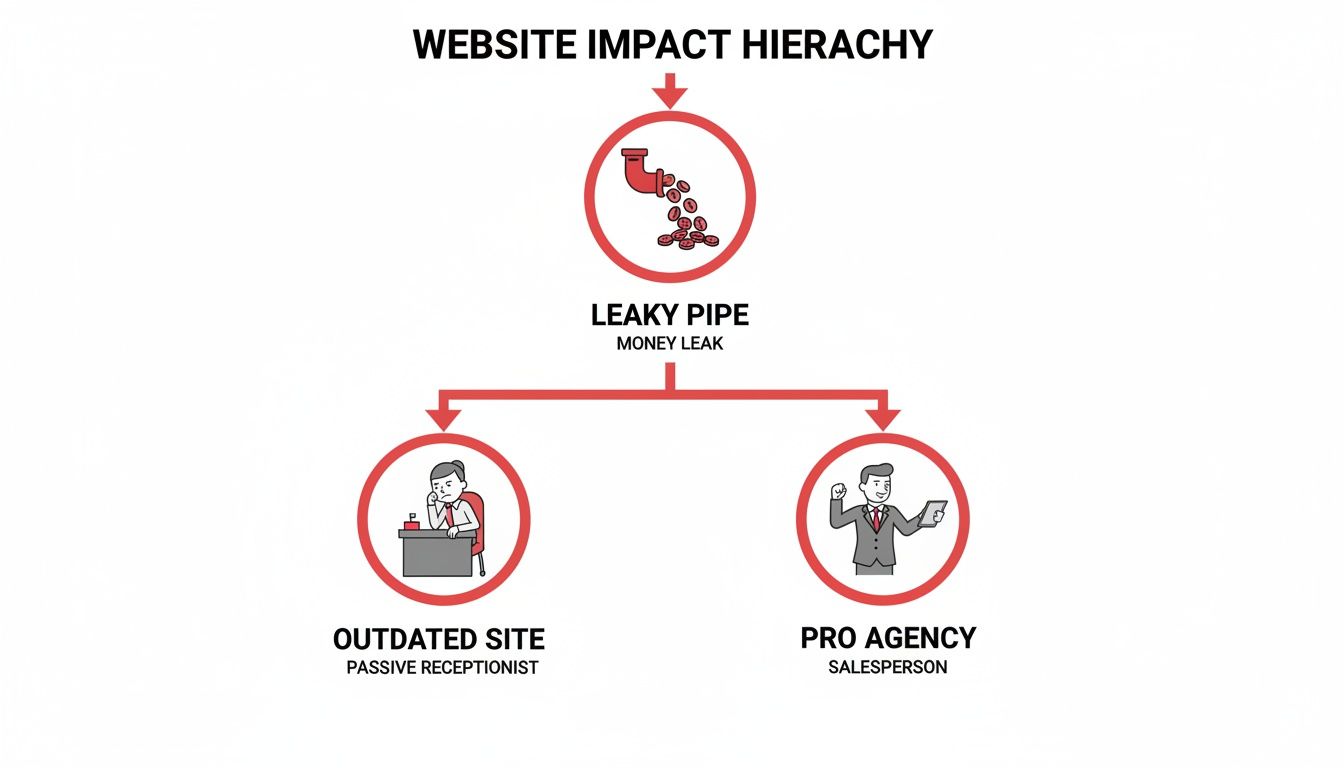
As you can see, an old website is like a leaky pipe—constantly losing you money. A strategically designed site built by specialists, on the other hand, acts like your best salesperson, working 24/7 to drive revenue.
Core Components Of A Lead Generation Engine
Beyond just working on a phone, a high-converting site is packed with tools designed to capture leads, no matter where they are in their buying journey. Not every visitor is ready to pick up the phone and book a service call right away. Your website has to cater to these more cautious prospects, too.
Think of it like having multiple "nets" to catch different types of leads. Some visitors need immediate help, while others are just starting their research for a system replacement.
Here are the features that are absolutely non-negotiable:
- Instant Online Estimators: This tool is a total game-changer. It lets homeowners get a ballpark price for a new system without the pressure of a sales call, turning anonymous visitors into qualified leads with real contact information.
- Maintenance Plan E-Commerce: Why wait for a technician to upsell a service agreement in the home? Let customers review and purchase maintenance plans directly from your website. You'll create a recurring revenue stream without any extra effort.
- Automated Email Follow-ups: Once you capture a lead from an estimator or contact form, an automated email sequence can nurture that prospect with helpful info, building trust and keeping your company top-of-mind until they're ready to buy.
Modern Lead-Gen Features vs Outdated Website Elements
The difference between a website that makes money and one that costs money often comes down to the features it includes. Here’s a quick comparison of what a modern, high-converting site looks like versus the typical outdated websites we see all the time.
| Feature | Modern High-Converting Website | Typical Outdated Website |
|---|---|---|
| Lead Capture | Instant quote tools, dynamic forms, exit-intent popups | A single, basic "Contact Us" form |
| Mobile Experience | Flawless, fast, and built for one-handed use on any device | Clunky, slow, and requires pinching and zooming to navigate |
| Revenue Generation | E-commerce for maintenance plans and service specials | No direct sales capabilities; just an online brochure |
| Follow-Up | Automated email sequences that nurture every lead | No automated follow-up; leads go cold in the inbox |
| Tracking & ROI | Tracks calls and forms back to the ad source and attributes actual revenue | Basic analytics (if any); no idea which marketing efforts work |
| User Engagement | Interactive tools, financing calculators, rebate info | Static pages with blocks of text and a few stock photos |
| Local SEO Integration | Optimized for Google Business Profile, with embedded reviews and maps | No connection to local search signals; invisible on the map |
As the table shows, a modern website is an active tool for business growth, while an outdated one is a passive, and often invisible, digital asset.
Tracking and Optimization For Real Results
Building these features is only half the battle. You absolutely have to be able to prove they are working. This is where robust tracking and attribution come into play, separating the best agencies from the rest.
A modern HVAC website doesn't just generate leads; it provides clear data on which marketing efforts are turning into actual booked jobs. It removes the guesswork and empowers you to invest your marketing dollars wisely.
This means putting comprehensive call tracking in place to see which ads, web pages, or marketing campaigns are making the phone ring. It also means integrating with your CRM to tie revenue back to its original source. This level of detail is critical for calculating your true ROI.
The rise of specialized agencies is a direct response to this need for measurable results. While average contractor sites might convert around 3.1% of their visitors, elite designs can hit 15-30% by embedding these exact lead-gen tools and automation sequences. When you're building out the blueprint for a high-converting website, it's critical to bake in proven strategies like those found in guides on SEO for HVAC companies.
In a market where the average cost per lead is $153 and the customer lifetime value can easily top $15,000, an ROI-focused website isn't a luxury—it's a requirement for survival.
How to Vet an HVAC Website Design Agency
Choosing a partner to build your website is one of the most important decisions you'll make for your business. Let's be blunt: the right hvac website design agency becomes a growth engine, while the wrong one will burn through thousands of your dollars and months of your time. To make the right call, you have to look past the slick sales pitch and ask the tough questions that reveal what they're really capable of.
This isn't about finding the flashiest design portfolio. It's about finding a team that understands how to turn website clicks into booked jobs—and has the numbers to prove it.

Critical Questions to Ask Every Agency
Before you even think about signing a contract, you need to interview potential agencies. Their answers to these questions will tell you everything you need to know about their process, their expertise, and whether they're actually focused on results.
Here are the non-negotiable questions you absolutely have to ask:
"Can you show me case studies from other HVAC clients with specific conversion rate improvements?" Vague promises are worthless. A real pro will have hard data showing how they took a client's site from a 2% conversion rate to 8%, and exactly how that translated into more leads and booked jobs. No data, no deal.
"How do you attribute booked jobs back to specific marketing channels?" This is the ultimate test. If they can’t clearly explain how they track a customer from a Google Ad click all the way to a paid invoice, they aren't focused on your bottom line. They need to prove where your money is making you money.
"What is your strategy for local SEO and optimizing my Google Business Profile?" A beautiful website is useless if local homeowners can't find it. The agency should lay out a clear, actionable plan for getting you into the local map pack and ranking for money-making keywords like "AC repair near me."
"Who owns the website, content, and domain if we decide to part ways?" This one is huge. Some agencies build your site on their proprietary platform, meaning if you leave, you lose everything you paid for. You should always retain 100% ownership of your digital assets. Period.
These questions cut through the fluff and force a conversation about the metrics that actually grow your business. If an agency gets defensive or stumbles on these, that’s a massive red flag.
Major Red Flags to Watch For
Just as important as knowing what to look for is knowing what to run away from. A lot of marketing companies are great at selling you a dream but fall flat when it's time to deliver.
The single biggest red flag is an agency that obsesses over vanity metrics like clicks, traffic, and impressions. Your business runs on booked appointments and revenue, not website visitors. Any agency that doesn't make that their primary goal is not on your team.
Keep an eye out for these other warning signs:
- No HVAC-Specific Portfolio: If their gallery is full of dentists and lawyers but zero HVAC contractors, they don't know your customer. They won't understand your services, your seasonality, or what makes a homeowner pick up the phone.
- Vague or Cookie-Cutter Designs: Ask to see their work. If all their client sites look like slight variations of each other, you're just getting a recycled template. Your site won't be optimized for your unique brand or service area.
- Long-Term Contracts Without Performance Clauses: A confident agency doesn't need to lock you into a 12-month contract from day one. Look for month-to-month agreements or short-term trials that give you an out if they don't deliver results.
- Focusing on "Traffic" Instead of "Leads": Clicks are cheap. Qualified leads are gold. If their entire pitch is about driving more traffic without a concrete strategy for converting that traffic into phone calls and form fills, walk away. Fast.
Finding the right partner takes some homework, but the payoff is a predictable stream of high-quality leads that will fuel your growth for years. For more on selecting the right partner, you might want to check out our guide on what to look for in an hvac digital marketing agency.
When it's time for a new website, you're at a crossroads. The path you choose will dictate your lead flow for years to come. Do you roll up your sleeves with a DIY builder, bring someone in-house, or partner with a specialized hvac website design agency? Each option has massive implications for your budget, your time, and most importantly, your ability to book profitable jobs.
Making the right call means looking past the sticker price and thinking about long-term, measurable growth.
The DIY Builder Route
Platforms like Wix and Squarespace promise a cheap and easy way to get a website online. With drag-and-drop templates and a low monthly fee, it’s a tempting offer for any business owner keeping a close eye on the budget.
But this path is full of trade-offs. You might save a few bucks upfront, but what you end up with is a digital brochure. These sites just don't have the sophisticated SEO framework, conversion tools, or lead tracking needed to go toe-to-toe with serious competitors in a crowded local market. A DIY site might look decent, but it’s not equipped to drive serious marketing results.
The In-House Team Approach
Hiring an in-house web designer or marketing manager gives you total control. You get a dedicated employee who lives and breathes your business, ready to make changes at a moment's notice. This can be a great move if you have the resources to back it up.
The downside? The cost is huge. You’re not just paying a salary. You’re on the hook for benefits, software subscriptions, ongoing training, and new equipment. Plus, finding one person who’s a true expert in web design, development, HVAC-specific SEO, and conversion optimization is like finding a unicorn. This route often locks you into a high fixed cost without the specialized, industry-focused expertise an agency brings to the table.
The Specialized Agency Partner
This is the balanced approach. Partnering with a specialized "Done-For-You" agency combines deep industry knowledge with predictable costs and a relentless focus on results you can actually measure. These agencies aren't just building you a website; they're deploying a proven system designed to generate leads.
An expert HVAC agency gives you a direct line to ROI. They already know your customer, they know what makes them tick, and they have the systems built to prove which marketing dollars are booking high-margin installation jobs.
A specialized partner brings an entire team of experts to your business—designers, SEO strategists, and copywriters who are completely immersed in the HVAC world. They’ve already figured out what works and have the templates, tools like instant estimators, and tracking systems ready to deploy. This cuts your launch time down dramatically and gets you to a positive return on your investment much faster.
In a booming global HVAC market valued at $333 billion, a high-performance website isn't a luxury; it's essential for grabbing your piece of the pie. You can learn more about the industry's massive growth and what it means for your business from the experts at BDR.
Ultimately, the choice comes down to your goals. If you just need an online placeholder, DIY might get you by. If you’ve got a massive budget and want absolute control, an in-house team could be the answer. But if you’re serious about turning your website into your best salesperson, a specialized agency is the most direct and reliable way to make it happen.
Understanding Costs, Timelines, and Measuring True ROI
Investing in a professional website is one of the biggest marketing decisions you'll make for your HVAC business. To get it right, you have to cut through the noise about pricing and timelines. Most importantly, you need to know how to measure what actually matters—your return on investment.
Pricing for a new HVAC website can feel like it's all over the map, but it usually breaks down into a few models. Some agencies charge a one-time project fee, where you pay a lump sum upfront for the entire design and build. Others use a monthly retainer, which often bundles the website with ongoing marketing like SEO or paid ad management.
A third model that’s getting more popular is a subscription. With this, you pay a flat monthly fee that covers the build, hosting, security, and ongoing support. It turns a big one-time expense into a predictable operational cost.
Typical Timelines for Your Project
How long it takes to get your website live depends entirely on who you hire. A generalist agency that doesn't live and breathe the trades could take months. They have to learn your business from scratch—your services, your customers, your seasonality—and that learning curve slows everything down.
On the other hand, a specialized HVAC website design agency usually has a proven system dialed in. They can often launch a high-converting site in just a matter of weeks, sometimes as fast as 7-10 business days. They aren't starting from zero; they already have the industry-specific frameworks and tools ready to go, which means you start getting leads that much faster.
Measuring What Actually Matters
This is the most critical part: measuring your real ROI. This isn't about chasing vanity metrics like website traffic or impressions. True ROI is about tracking the numbers that directly hit your bottom line and prove your website is more than an online brochure—it's a growth engine.
To see the real value an HVAC website design agency delivers, you have to get comfortable with the key performance marketing metrics that show you what's working.
Forget about clicks. The only metrics that matter are the ones that lead to a booked job. Everything else is just noise.
Start by zeroing in on these bottom-line numbers:
- Cost Per Qualified Lead (CPL): How much marketing cash are you spending to get one legitimate homeowner to raise their hand?
- Lead-to-Install Conversion Rate: Of those qualified leads, what percentage does your team actually turn into a paying installation job?
- Total Revenue Attributed to the Website: Using call tracking and form attribution, how much real-world revenue did your website directly generate?
The digital battlefield is no joke. HVAC marketing benchmarks show an average CPL of $153, yet top-tier agencies are helping owners achieve customer lifetime values as high as $15,340 with net profit margins around 8%. This is why you can't afford to settle for the industry's average 3.10% conversion rate—you need a specialist to win.
When you hold your agency accountable for these numbers, you can see the financial impact of your investment clear as day. Our guide on how to measure marketing effectiveness digs deeper into this. This data-first approach takes the guesswork out of your marketing and ensures your website is a powerful, profitable asset for your company.
How to Write a Project Brief That Attracts the Best Agencies
Before you start hunting for the right hvac website design agency, you need to hand them a clear roadmap. A well-written project brief is way more than a simple request—it’s a signal that you’re a serious, organized partner who knows what they want. It cuts through the fluff, ensures you get accurate proposals, and attracts the kind of top-tier agencies that are focused on results, not just pretty designs.
The more specific you are in your brief, the better an agency can understand your goals and solve your real problems. This clarity is what helps them craft a website strategy that truly delivers.
Defining Your Business Goals
Let’s be clear: the most important part of your brief isn't about colors or fonts. It’s about business outcomes. Vague goals like "get more leads" are useless. A good agency will see right through that. You need to tie this project to specific, measurable numbers that matter to your bottom line.
Get granular. What does success actually look like for your company? This shifts the entire conversation from "building a website" to "creating a strategic asset that makes us money."
Your goals need to be sharp and quantifiable:
- "We need to increase high-profit residential installation jobs by 20% in the next 12 months."
- "Our goal is to grow maintenance plan subscriptions by 150 new members through the website's e-commerce feature in the first six months."
- "Let's reduce our cost per qualified lead from paid ads by 30% by building landing pages that actually convert."
Outlining Your Target Audience and Services
Next, paint a crystal-clear picture of who you serve and where you do it. Never assume an agency knows your local market. Define your ideal customers and the specific service areas you want to own. This information is gold—it dictates the site's content, SEO strategy, and the sales message.
Your project brief should empower an agency to see your business through your eyes. The more context you provide about your ideal customer and primary service areas, the more tailored and effective their proposal will be.
Get specific with details like:
- Ideal Customer Profile: Are you chasing homeowners in affluent suburbs with 15-year-old systems? Or are you focused on property managers of commercial buildings who need reliable service contracts?
- Primary Service Areas: List the exact cities, towns, or even the zip codes you prioritize. This is crucial for local SEO.
- Most Profitable Services: Tell them what makes you the most money. Is it geothermal installations? Ductless mini-split systems? Make it clear what you want to sell more of.
Listing Your Must-Have Features
Finally, give them a checklist of the non-negotiable features your new website absolutely must have. If you’ve been following along, you know you’re not asking for a digital brochure—you’re commissioning a lead-generation platform. This list helps agencies understand the technical scope and give you a quote that won't have surprise costs later.
Your feature checklist should include:
- Mobile-First, Responsive Design: Make it clear that the site has to be flawless and fast on a phone. No excuses.
- Instant Online Estimator: You need a tool to grab contact info from people who aren't quite ready to pick up the phone.
- E-commerce for Maintenance Plans: The ability for customers to sign up and pay for service agreements online is a must.
- Robust Lead Attribution: Mention that you need call tracking and form tracking that plugs into your CRM so you know exactly what’s working.
- Google Business Profile Integration: The site needs to be built from the ground up to support and boost your local SEO efforts.
When you provide a brief this detailed, you start the conversation from a position of strength. You’ve set the stage for a real partnership and a website that’s perfectly aligned with your business goals from day one.
Frequently Asked Questions
Hiring a specialized agency for your HVAC website is a big decision, and it’s smart to have a few questions. Getting straight answers is the only way to make a choice you feel good about for the long run.
How Long Until I See Leads From a New Website?
While we can get a professionally built website live in as little as 7-10 business days, a steady stream of organic leads takes a bit more time to build up. Realistically, you should expect to see the first results from local SEO efforts kick in within about 90 days.
That's the typical timeframe for Google to crawl, index, and start trusting your new site. But here's the kicker: if you pair your new site with a targeted campaign like HVAC paid ads or Google's Local Services Ads, you can get the phone ringing almost immediately after you launch.
Do I Own My Website if I Leave the Agency?
This is one of the most important questions you can ask, and the answer should be a simple, unqualified "yes." You must have 100% ownership of your domain name, all the website files, and every piece of content created for you.
Watch out for agencies that build sites on their own private, proprietary platforms. It's a trap. If you decide to leave them, your website vanishes because you can't take it with you. A reputable partner will build your site on a common platform like WordPress and hand over the keys. It's your investment, you should own it.
Key Takeaway: Never, ever sign a contract that doesn't give you complete ownership of your website and digital assets. Your site is a core business asset, and you need to be in full control of it.
Why Can’t I Just Use a General Marketing Agency?
Look, a general marketing agency might build you a pretty website. But they just don't get the HVAC business or what makes a homeowner—often in a state of panic—pick up the phone and call you instead of the other guys.
They don't understand the seasonality, the difference between a repair call and a high-ticket install lead, or why an instant online estimator is a game-changer for converting tire-kickers.
A specialized agency speaks your language from day one. They've already tested what works, they know the keywords that drive profitable install jobs, and they have proven templates for your service pages. That inside knowledge means you get better results, faster.
What Ongoing Support Should I Expect After Launch?
Your website isn't a brochure you print once and forget about. It’s a living, breathing part of your business that needs ongoing care to keep performing.
After your site goes live, you should expect your agency to provide:
- Technical Maintenance: This means keeping all the software updated and patched to prevent security holes and keep things running smoothly.
- Hosting Management: Making sure your site is fast, secure, and stays online without frustrating downtime.
- Performance Reporting: Simple, clear monthly reports showing you the numbers that matter—qualified leads, conversion rates, and the actual revenue tied to your marketing.
- Strategic Guidance: They should be a true partner, offering advice on everything from improving your HVAC SEO to setting up email automations that turn more leads into booked jobs.
This partnership ensures your website doesn't just launch strong but continues to be a lead-generating machine for years to come.
Ready to stop guessing and start growing? HVAC Growth Machine builds high-converting websites that are proven to generate more profitable install jobs, not just clicks. Our done-for-you system includes an instant online estimator, maintenance plan eCommerce, and the lead attribution you need to see a clear return on your investment. https://hvacgrowthmachine.com





Founder of HVAC Growth Machine