

Look, you can throw a ton of money at HVAC marketing and get nowhere. Real success starts with a clear plan, not just a big budget. It's about knowing exactly who you're trying to reach, setting goals that actually grow your bottom line, and figuring out what makes your company the only logical choice in a sea of competitors. Getting this foundation right means every dollar you spend on digital marketing becomes a smart investment in booking more profitable jobs.
Building Your HVAC Marketing Foundation
Before you even think about launching a single ad or optimizing a web page, you have to build a solid foundation. Jumping straight into HVAC paid ads or SEO without a clear strategy is like building a house on sand—it’s expensive, and it's guaranteed to collapse.
The very first step is getting crystal clear on who you want to serve.
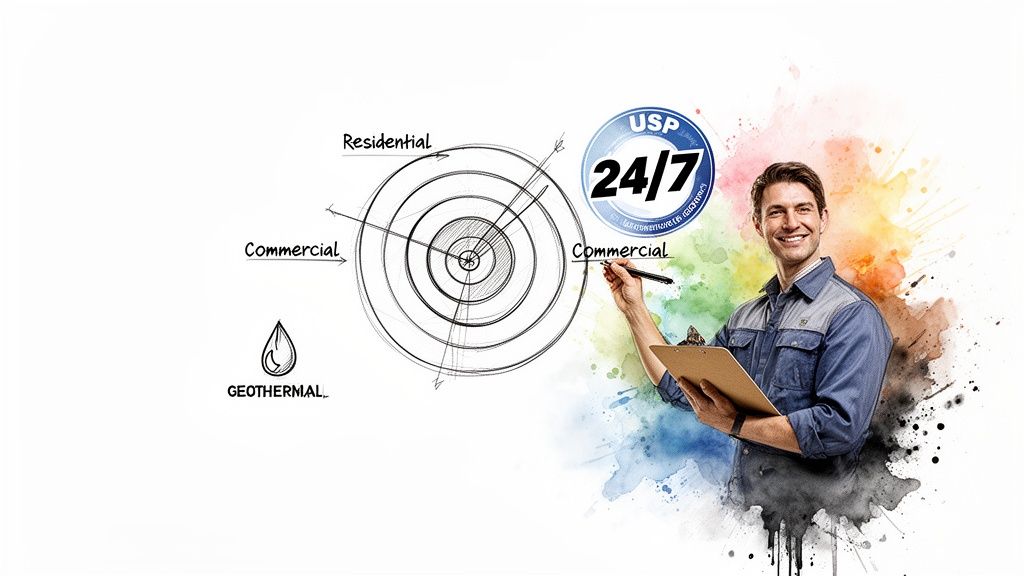
Are you the go-to for emergency residential repairs, or are you chasing those high-value commercial maintenance contracts? The digital marketing for each is completely different. Defining your ideal customer allows you to sharpen your message, your offers, and the channels you use to find the most profitable work.
Define Your Ideal Customer and Niche
Don't just think in terms of simple demographics. Your ideal customer isn't just "a homeowner." It's a homeowner in a specific neighborhood, wrestling with a 15-year-old system, who cares more about reliability than finding the absolute lowest price.
Or maybe it's a property manager juggling multiple commercial buildings who desperately needs a dependable partner for quarterly maintenance. Get specific.
Create a detailed profile:
- Residential Focus: Are you targeting new homeowners who need a full system inspection, or families in established neighborhoods with aging equipment that’s prime for a full replacement?
- Commercial Focus: Do you specialize in small businesses like restaurants and retail shops, or are you equipped for large-scale industrial facilities with complex HVAC needs?
- Specialized Services: Do you have deep expertise in high-efficiency systems like geothermal or ductless mini-splits? Owning a niche like this can be a powerful way to eliminate the competition.
Pinpointing your ideal customer is the most critical step you can take. It transforms your marketing from a shotgun blast into a laser beam, making sure you attract clients who truly value your expertise and are happy to pay for it.
Set KPIs That Actually Matter
Let’s be honest: vanity metrics like website clicks and social media "likes" don't pay the bills. Your HVAC marketing efforts have to be tied directly to Key Performance Indicators (KPIs) that impact your bank account.
It’s time to shift your focus to the numbers that count:
- Cost Per Lead (CPL): Exactly how much are you spending to make the phone ring or get one form submission?
- Cost Per Booked Job: This is the real number—the true cost to actually acquire a paying customer.
- Average Ticket Value by Source: Which marketing channels are bringing in the big-ticket installs versus the minor repairs?
Before you dive into tactics, you need a firm grasp on what lead generation marketing really is and how it fuels your entire sales pipeline. Tracking these core KPIs gives you the clarity to build a profitable growth engine, not just a busy one.
Identify Your Unique Selling Proposition
Finally, you have to know what makes you different. In a market where every single competitor claims "great service" and "fair prices," you need something more. Your Unique Selling Proposition (USP) is the one compelling reason a customer should pick you over anyone else.
Is it your 24/7 emergency service with no overtime fees? Maybe it's your deep specialization in a particular brand or technology. Or perhaps it's your industry-leading installation warranty that gives homeowners total peace of mind.
Whatever it is, your USP needs to be front and center in all your marketing. The opportunity here is massive; the global HVAC market is projected to hit USD 505.73 billion by 2035. A strong, clear USP is what will help you carve out your piece of that pie.
Turning Your Website Into a Lead Generation Machine
Think of your HVAC website as your best salesperson—the one that never sleeps and works 24/7 to turn visitors into booked jobs. But for too many contractors, their site is nothing more than a digital brochure. That’s a massive missed opportunity.
A modern HVAC website isn’t just a place to list your services. It’s an engine. Its only job is to generate qualified leads and make it dead simple for homeowners to do business with you.
The key is to remove all friction. We need to guide every visitor effortlessly from the moment they land on your site to the moment they book a call or request a quote.
Build Instant Trust and Credibility
In a business like HVAC, trust is everything. You're asking homeowners to let your team into their house, often to fix an urgent and expensive problem. Your website is that first handshake, and it has to scream professionalism.
A few things make an immediate difference:
- Showcase Your Real Team: Ditch the cheesy stock photos. Use high-quality pictures of your actual technicians, your branded trucks, and your office staff. People want to see who they’re hiring.
- Flash Your Credentials: Don't bury your license numbers, insurance details, and industry certifications in the footer. Make them prominent. This tells visitors you're a legitimate, professional operation.
- Let Happy Customers Do the Selling: Written reviews are good, but video testimonials are absolute gold. A 30-second clip of a real customer raving about your service builds an instant emotional connection.
You have less than three seconds to make a good first impression online. If a homeowner can't immediately see that you're a trustworthy local business, they're gone. They'll just hit the back button and call your competitor.
Building that initial trust is foundational. For a deeper dive, check out this guide on HVAC web design that converts visitors into leads.
Prioritize Mobile Experience and Speed
Let's be blunt: your customer's journey starts on their phone. Right now, over 63% of all Google searches happen on a mobile device. If your site is clunky, hard to read, or slow to load on a phone, you're literally throwing away the majority of your potential leads.
A mobile-first design isn’t a "nice-to-have" anymore; it's a requirement. This means your HVAC website needs to be built for the small screen first, with big, tappable buttons, simple menus, and a click-to-call phone number you can't miss.
Speed is just as important. A delay of even one or two seconds is enough to make someone give up and leave. A fast-loading site isn't just good for users—it's also a major ranking factor for Google. Slow site = fewer leads.
Implement High-Impact Conversion Tools
To truly turn your website into a lead machine, you need to give people tools that move them closer to a decision. The goal is to make it incredibly easy to do business with you.
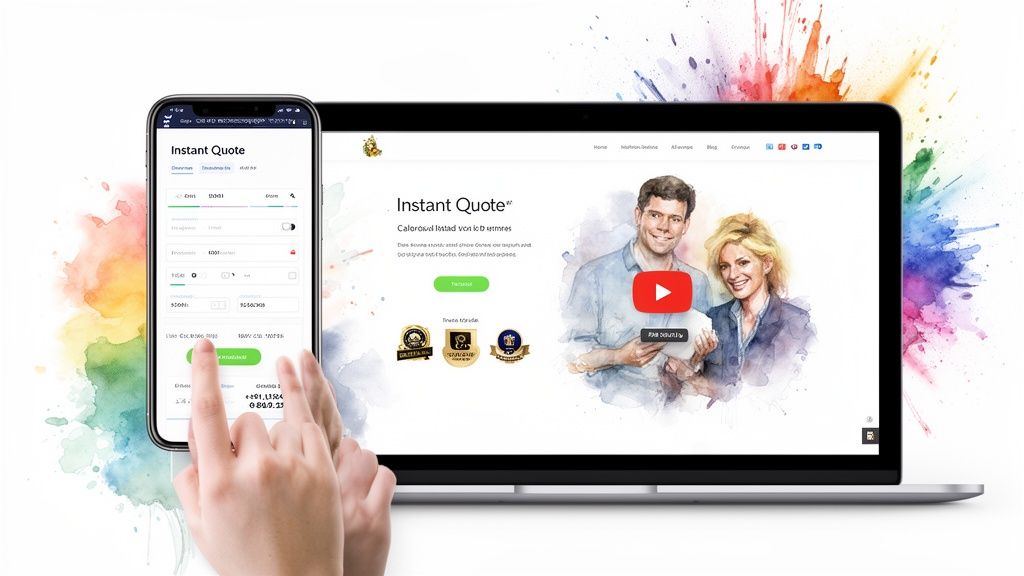
One of the most powerful ways to do this is with an online quote tool.
This kind of feature is a game-changer. It empowers the visitor by giving them the information they crave—a price estimate—and it qualifies them as a serious lead for you.
Here’s a checklist of high-conversion features every HVAC website should consider.
High-Impact HVAC Website Conversion Features
| Website Feature | Standard Implementation (Low Conversion) | Optimized Implementation (High Conversion) |
|---|---|---|
| Phone Number | Small text in the footer or contact page. | Large, click-to-call number in the header on every page. |
| Contact Form | A long form asking for too much info. | A short, multi-step form that feels easy to complete. |
| Social Proof | A "Testimonials" page nobody visits. | Star ratings and customer quotes sprinkled throughout the site. |
| Calls to Action | Vague buttons like "Submit" or "Learn More." | Action-oriented buttons like "Get My Free Quote" or "Book Now." |
| Service Agreements | Mentioned on a service page; "Call for details." | E-commerce functionality to purchase maintenance plans online. |
| Quoting Process | "Contact Us for a Free Estimate" form. | Instant online quote calculator for ballpark pricing. |
| Scheduling | A basic form that sends an email to your office. | Real-time online booking that syncs with your dispatch calendar. |
By upgrading from the "standard" approach to an "optimized" one, you're not just improving your website; you're building a system that captures leads you were previously missing.
Consider adding these powerful features:
- Instant Online Quote Calculator: This is non-negotiable for system replacements. It lets visitors answer a few questions about their home and get a ballpark estimate instantly. You capture contact info from serious buyers who are ready to move forward.
- Direct Maintenance Plan Sales: Add a simple e-commerce function that allows homeowners to buy your annual service agreements right from the website. This automates recurring revenue and locks in customers.
- Online Booking & Scheduling: Integrate a tool like Calendly or Jobber that connects to your dispatch software. It ends the frustrating game of phone tag and lets customers book a slot that works for them, even if it's 10 PM on a Saturday.
How to Dominate Local Search and Google Maps
Let’s be honest. When a homeowner's AC gives out on a 95-degree afternoon, they aren't window shopping. They're grabbing their phone, searching "emergency AC repair near me," and calling the first trustworthy company they see.
Effective HVAC marketing is all about making damn sure you're that company.
Winning at local search isn't some mystical secret. It’s a straightforward process of sending the right signals to Google that you are the most relevant, authoritative, and trusted HVAC contractor in your service area. This is the essence of HVAC SEO.
The Foundation of Local SEO
Before you even touch your Google profile, you have to get your own house—your website—in order. Search engines need crystal-clear signals about where you work and what you do. The absolute best way to do this is with city-specific service pages.
Forget having a single, generic "AC Repair" page. That’s not nearly specific enough. You need to create dedicated pages on your HVAC website for each major city or town in your service area.
- "Emergency AC Repair in Phoenix"
- "Furnace Installation in Scottsdale"
- "HVAC Maintenance in Mesa"
Each page needs to be unique. Talk about local landmarks, mention specific neighborhoods, and—this is key—feature reviews from customers in that exact city. This hyper-local approach tells Google exactly where you're the go-to expert, massively boosting your odds of showing up for those critical "near me" searches.
For a deeper dive into this, check out this guide on Local SEO for HVAC Companies.
Your Secret Weapon: The Google Business Profile
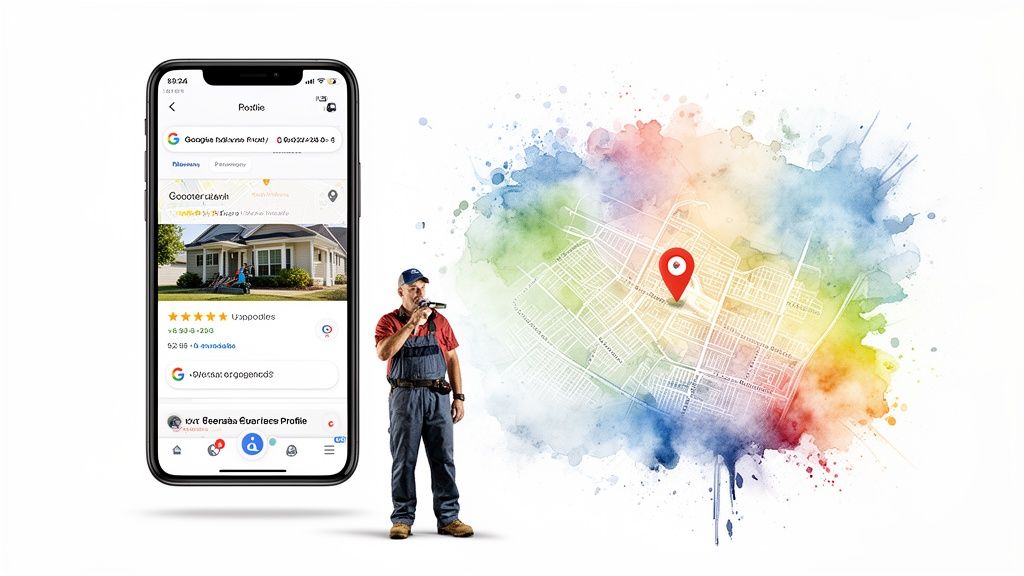
Your Google Business Profile (GBP) is, without a doubt, the single most powerful free marketing tool you have. Period. It's often the very first impression a customer gets of your business, showing them your reviews, hours, and phone number right on the search results page.
An unoptimized profile isn't just a missed opportunity; it's a lead-generation black hole. A fully fleshed-out, active profile, on the other hand, is a magnet for high-intent customers.
Think of your GBP as a mini-website that Google loves to promote. Neglecting it is like not answering your main business phone line. Every single field needs to be filled out, and you have to manage it actively.
If you want the full playbook, our guide details exactly how to optimize your Google Business Profile for maximum calls and clicks.
Optimizing Every Last Detail of Your GBP
To turn your profile into a client-generating machine, you need to give it the same attention you give your website. Consistent activity sends powerful, positive signals to Google’s algorithm, telling it that you're an active, relevant business.
Here's what to focus on:
- Geo-tagged Photos: Regularly add high-quality pictures of your team on the job, your branded vans, and finished installs. Before you upload, use a free online tool to add GPS coordinates (geo-tags) to the images. This gives Google undeniable proof that you're actually working in the areas you claim to serve.
- Active Q&A Section: Proactively add common questions your customers have ("Do you offer financing?" "What brands do you service?") and answer them yourself. This lets you control the narrative and give potential customers the info they need instantly.
- Weekly GBP Posts: Use the "Posts" feature like a mini-blog. Announce special offers, share seasonal maintenance reminders, or link to a new blog post on your site. This shows Google your business is alive and kicking.
- Review Management: Actively ask every happy customer for one. More importantly, respond to every single review—good and bad. A thoughtful reply shows you’re engaged and you care.
Earning the Google Guarantee Badge
The ultimate trust signal in local search is the little green checkmark: the Google Guarantee badge. It shows up next to your business in Google Local Services Ads and tells homeowners that Google itself is backing your work. If a customer isn't satisfied, Google might refund them up to $2,000.
This badge isn't just for looks—it's a call driver. It can dramatically increase the number of calls you get because it removes hesitation. To get it, you have to pass Google's screening process, which includes background checks and verifying your licenses and insurance.
Yes, it requires an investment in HVAC Local Services Ads, but the credibility it provides is priceless. It immediately sets you apart from the competition and gives homeowners the confidence to pick up the phone and call you.
Generating Immediate Leads With Paid Ads
While optimizing your website and dominating local SEO are fantastic long-term plays, they take time to kick in. When you need the phone to start ringing right now, paid advertising is your direct line to homeowners with an urgent problem. It's the engine for immediate, predictable lead flow.
HVAC paid ads put your business right in front of customers the moment they’re desperately searching for a solution. Just think about the mindset of someone whose furnace dies in the middle of January. They aren't casually browsing—they have a serious problem and are ready to hire someone today. Paid advertising makes sure you’re one of the first options they see.
The Best Starting Point: Google Local Services Ads
For most HVAC contractors, Google Local Services Ads (LSAs) are the perfect way to get into paid advertising. These are the ads that pop up at the very top of the search results, usually with a headshot and that coveted green "Google Guaranteed" checkmark.
The real power of LSAs is that they operate on a pay-per-lead model, not pay-per-click. This is a huge difference. You only pay when a real customer contacts you through the ad, which makes it a much lower-risk investment. You’re not burning cash on clicks from competitors or people just kicking tires.
Getting that Google Guarantee badge is a game-changer. It instantly tells potential customers that Google has vetted your business for licenses and insurance, building a level of trust that your competitors might not have right out of the gate.
Building Targeted Google Ads Campaigns
Once you’ve got LSAs running, the next logical step is building traditional Google Ads campaigns, often called pay-per-click or PPC. These are the text-based ads that show up just below the LSA block, and they give you a lot more control over your messaging and who you target. The secret to winning here is focusing laser-tight on high-intent keywords that signal an urgent need.
Your most profitable campaigns will be built around keywords like:
- "emergency ac repair [your city]"
- "same-day furnace service"
- "cost to replace air conditioner"
- "hvac company near me"
These aren't people doing casual research. These are homeowners with a problem that needs a solution, now. This focused approach to your HVAC marketing ensures your ad dollars are spent on the most motivated buyers.
Writing Ad Copy That Actually Converts
Think of your ad as a 3-second elevator pitch. It has to grab attention and immediately answer the question, "Why should I choose you?" Forget generic slogans. Your ad copy needs to speak directly to the customer's pain point and offer a clear, compelling reason to click.
Effective ad copy almost always includes:
- Urgency: Use phrases that scream "fast," like "24/7 Service" or "Fast, Same-Day Repairs."
- Trust Signals: Mention things like "Licensed & Insured" or "5-Star Rated."
- A Clear Offer: Highlight a specific benefit like "Free Estimates" or "No Overtime Fees."
For example, an ad with the headline "Frozen AC Unit? Fast 24/7 Repair in Phoenix" will crush a generic one like "Phoenix HVAC Services." It connects with a specific problem and offers an immediate solution. This targeted approach is critical, especially when you consider the U.S. HVAC services market is projected to hit USD 38.8 billion by 2030, with residential contractors holding the biggest share. You can discover more insights about this growing market and its opportunities.
The Final Piece of the Puzzle: The Landing Page
Sending a potential customer from a highly specific ad to your generic homepage is a classic way to waste money. The user's journey has to be seamless. If your ad promises "emergency AC repair," it absolutely must link to a dedicated landing page that is all about that one service.
This page needs to echo the ad's message, feature glowing customer testimonials about your repair work, and have a simple, impossible-to-miss form or phone number to request service. By cutting out all the distractions and making the next step completely obvious, your landing page will do its job: converting those expensive clicks into profitable, booked jobs.
Automating Your Follow-Up and Customer Retention
Getting a new lead is only half the job. Honestly, it's the easier half.
Every lead you don't follow up with and every customer you forget about is pure profit slipping through your fingers. Real HVAC marketing isn't just about getting that first call; it's about building systems that turn curiosity into cash and one-time customers into clients for life.
This is where HVAC email marketing and automation become your silent, tireless sales team. It works around the clock to nurture leads, build loyalty, and generate predictable revenue—all without you lifting a finger.
Recapturing Unconverted Leads
Let's walk through a common scenario. A homeowner lands on your site, uses your fancy online quote tool to price out a new system… and then their kid spills juice on the carpet. They close the browser and forget all about you.
Without a system, that lead is gone forever. With automation, a new opportunity just opened up.
You can set up a simple email sequence that kicks in the moment they get that quote but don't take the next step. This isn't about being a pest; it's about being genuinely helpful when they're in the middle of a big decision.
- Email 1 (24 hours later): A quick, friendly follow-up. "Hey, just wanted to see if you had any questions about the quote we sent over." You can even pop in a link to a video testimonial from a happy installation customer.
- Email 2 (3 days later): Now, you shift from salesman to expert. Send them a link to a helpful blog post, like "5 Things to Look for in a New HVAC System." You're building trust, not pushing for a sale.
- Email 3 (7 days later): One last check-in. This is where a small, time-sensitive offer can work wonders. Something like a complimentary smart thermostat with their installation creates just enough urgency to get them off the fence.
An automated follow-up system ensures no opportunity goes cold. It systematically nudges hesitant buyers, converting leads that would have otherwise disappeared into thin air.
This kind of strategic, automated follow-up can dramatically bump up your quote-to-job conversion rate. You're turning website traffic into booked jobs without any extra manual work for your team.
Nurturing Existing Customers for Lifetime Value
Your customer list is a goldmine. These people already know you, like you, and trust you. HVAC email automations are the single best tool for keeping that relationship strong and generating predictable, recurring revenue from maintenance and tune-ups.
Stop trying to remember who needs a filter change or a fall furnace check. Automate it.
These reminders do more than just book jobs—they build incredible loyalty. You're proactively helping customers protect their biggest home investment, which just reinforces why they chose you in the first place. This is especially critical on the commercial side. The commercial HVAC sector makes up about 30% of the total market share, and nurturing those high-value service contracts is non-negotiable. You can learn more about these HVAC statistics and see just how big that opportunity is.
By setting up these simple automations for both new leads and past customers, you create a powerful system that works in the background. It maximizes the value of every single contact, making sure your HVAC marketing efforts translate directly into a healthier, more predictable bottom line.
Tracking Your Marketing ROI Down to the Dollar
Guessing which parts of your HVAC marketing plan are working is a recipe for wasted money. If you can't say with certainty which ad campaign or search term led to a high-value installation, you’re flying blind. Real growth comes from connecting every dollar spent to every dollar earned.
It all starts with call tracking. By assigning unique, trackable phone numbers to each of your marketing channels—one for your HVAC website, another for your Google Business Profile, and separate ones for each paid ad campaign—you get instant clarity on what’s actually making the phone ring.
This visual breaks down the direct line from a marketing touchpoint to actual revenue.
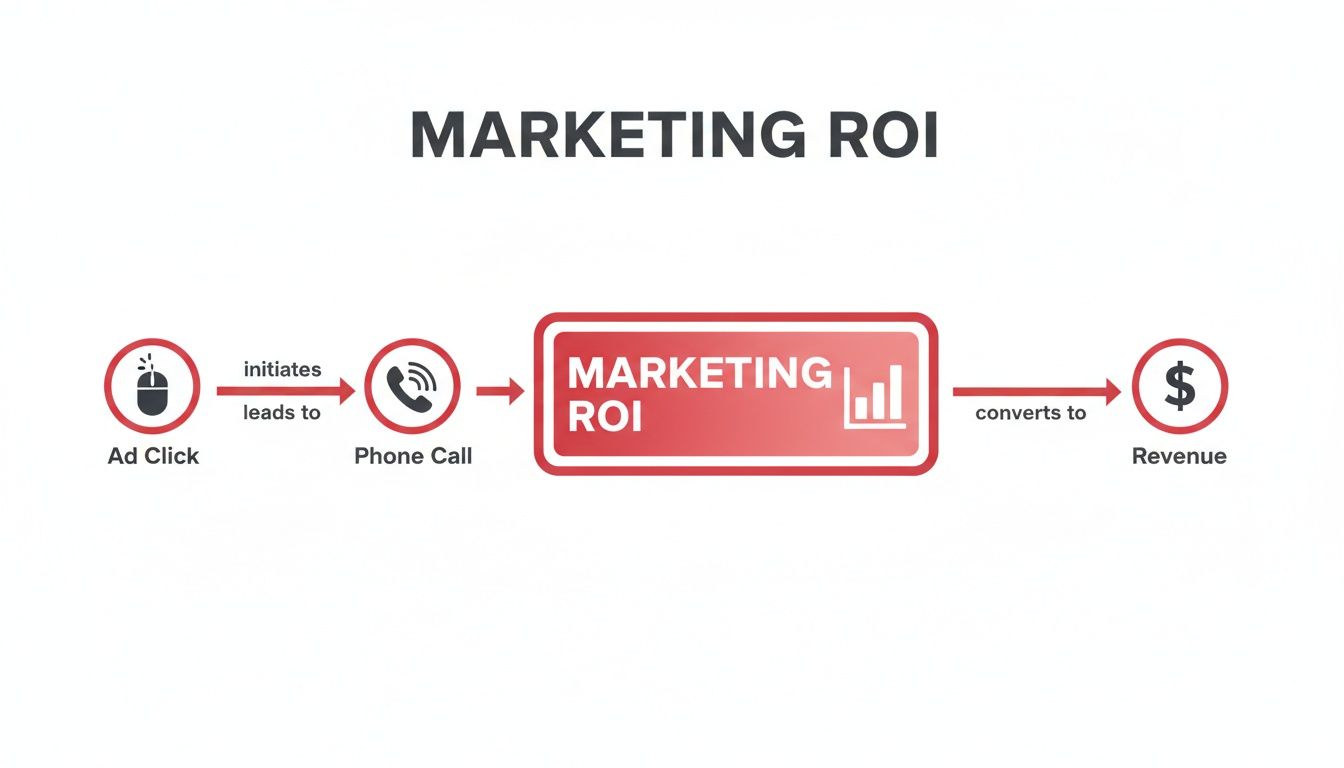
This is the core goal of tracking: proving that a specific action, like an ad click, directly resulted in a profitable job.
Connecting Calls to Closed Jobs
Knowing which channels drive calls is just the first step. The real prize is revenue attribution—linking a paid invoice all the way back to its original source. This requires a system, often integrated within your CRM or field service software like ServiceTitan, that ties call data to customer records and job tickets.
Here's how it works: when a call comes in from your "Google Ads – AC Repair" number, your system should automatically log it. As that lead moves through your sales process—from the initial call to a booked job and then final payment—that original source tag stays attached.
The goal is to get to a point where you can confidently say, "We spent $1,000 on Google Local Services Ads last month and it generated $15,000 in furnace replacement revenue." That’s the kind of data that lets you make smart, decisive investments.
Making Data-Driven Decisions
This level of detail rips all the guesswork out of your marketing strategy. You’re no longer operating on feelings or vanity metrics like clicks and impressions. Instead, you have hard data showing precisely which efforts are profitable and which are just noise.
This allows you to confidently:
- Double Down on Winners: If your HVAC SEO efforts are producing high-ticket commercial jobs, you can increase your investment in content and link-building with a clear expected return.
- Cut Underperforming Channels: Is a specific paid ad campaign generating lots of calls but very few booked jobs? You can kill it and reallocate that budget to a more profitable channel without a second thought.
- Optimize Your Spend: By understanding the true cost per booked job for each channel, you can fine-tune your budget to maximize profitability across your entire marketing mix.
This approach transforms marketing from a necessary expense into a predictable growth engine. You’re no longer just spending money; you’re investing it where you know it will generate the highest return, ensuring every dollar works as hard as possible to grow your bottom line.
Common HVAC Marketing Questions, Answered
Getting your digital marketing right can feel like a moving target, so it’s natural to have questions. Let's tackle some of the most common ones I hear from HVAC owners. My goal is to give you straight answers so you can invest your budget wisely and make the right calls for your company.
How Much Should I Actually Spend on Marketing?
This is the big one. A good rule of thumb for an established HVAC business is to set aside 5-10% of your annual revenue for marketing.
If you're a newer company trying to make a name for yourself and grab market share, you’ll probably need to push that closer to 10% or even a bit higher to get the momentum going. But honestly, the percentage is less important than the return. Once you can prove that every dollar you put into Google Ads brings back five, your budget stops being an expense and becomes a lever you can pull to drive growth.
What's the Single Most Important Marketing Channel to Focus On?
For almost every single HVAC contractor out there, local SEO is the undisputed king. Nothing else comes close.
The highest-leverage activity you can possibly do is to obsessively optimize your Google Business Profile (GBP). This is your digital storefront, and it's how you show up for customers who are frantically searching for your services right now.
Combine a powerful, review-packed GBP with the laser-targeted reach of Google's Local Services Ads (the ones with the Google Guarantee badge), and you’ve built an unstoppable machine for generating both immediate calls and long-term, organic leads.
Should I Hire a Marketing Agency or Just Do It Myself?
This really comes down to a simple trade-off: your time versus your money.
Going the DIY route saves you the agency fees, but it costs you something just as valuable—your time. Learning the ins and outs of Google Ads, SEO, and content creation is a massive commitment, and that’s all time you're not spending running your actual business.
A specialized HVAC marketing agency, on the other hand, brings proven systems and industry-specific experience to the table. They can get you results much faster because they've already made the mistakes and figured out what works.
A hybrid approach can also be a great fit. You might hire an expert to handle the complex, high-stakes channels like HVAC SEO and paid advertising, while you or your office manager handles the in-house stuff like managing your company's social media or sending out HVAC email marketing campaigns.
Ready to stop guessing and start growing? The HVAC Growth Machine is a complete, done-for-you system that combines a high-converting website, an instant online estimate tool, and automated follow-up to fill your calendar with profitable install jobs. Learn more about how it works.




Founder of HVAC Growth Machine